

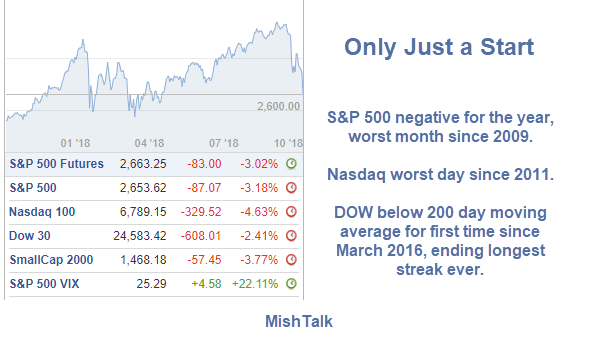
Decline Barely Started
Despite the rout, the S&P is just barely down for the year.
Expect a “Lost Decade”

Why?

The Shiller PE Ratio also known as “CAPE”, the Cyclically Adjusted Price-Earnings Ratio, is in the stratosphere. It’s not a timing mechanism, rather it’s a warning mechanism.
The main idea is that earnings are mean reverting.
On that basis, stocks are more overvalued than any time other than the DotCom era.
But that is misleading. In 2000 there were many sectors that were extremely cheap. Energy was a standout buy then. So were retail and financials.
It’s difficult to find any undervalued sectors now other than gold.
Financial Crisis Coming
At 1:40 AM (this morning), I posted Eight Reasons a Financial Crisis is Coming.
It’s been about 10 years since the last financial crisis. FocusEconomics wants to know if another one is due. The short answer is yes.
Click for details.
Mike “Mish” Shedlock






























Once you hit a half a century on this big stone and seen a few cycles happen its always the same boom and bust cycles. Human psychology. Smart money is selling, all the signs of being at the latter end of the cycle are out there including much of the sentiment in these comments. For those investors here hedge well my friends.
Predict a crash every month for a decade and eventually you’ll be correct.
“At 1:40 AM (this morning), I posted Eight Reasons a Financial Crisis is Coming.”
Two days ago I responded why your 8 reasons are symptoms, and not the cause, to which you won’t respond.
This current hogwash will also be proven wrong because, simply state, simple models like CAPE (with incomplete data) are always wrong. What may prove to be the lost decade is gold, whose religious-like BELIEVERS where sold the snake oil that gold would necessarily rise because of QE. What these believers (not traders) failed to understand is the world is much bigger than just the USA, and just because the banks got more-than-free-money does not mean there were credit-worthy borrowers or US entities that wanted to borrow (other than to buy back stock). Gold will rise again when confidence collapses, but it will likely take at least a decade to eclipse the 2011 high.
I will answer your THEORY about a lost decade for stocks with a simple question that has gone unanswered – where is the over $80 trillion in global investments going to go when the govt bond bubble officially pops?
Bonus questions 1: what asset class is big enough to absorb the flows and has less risk when the govt bond bubble pops (and actually has collateral)?
Bonus question 2: does the CAPE model, or any other model upon which you rely, comprehend the last time there was a sovereign debt crisis?
Wow, too funny. The “$80 trillion in global investments” doesn’t “go” anywhere, other than a large portion of it will go up in smoke. Just like the market capitalizations of Enron, GM and GE didn’t “go” anywhere other than up in smoke. And why is that? Because just under one-half of this $80 trillion of which you speak is nothing but smoke to begin with.
In the end, we’re all dead. Between now and the popping of the big bovt / Socialist bubble, many surprises and conflicts await. When govt bonds are a safe haven, scared capital in equities has a place to hide. When broke and bloated govt’s won’t reform, and can’t afford to roll their debt; plant, property, equipment, and IP becomes a much better safe haven.
Govt’s default all the time, which will be proven in spades over the next few years; and yes, the believers in govt will see their nest egg go up in smoke. On the other hand, companies with real assets provide preservation of capital. After this stock pullback traps as many bond holders as possible, you will get to see where the invisible hand stuffs it’s money.
It was a lost 4 decades for gold stock owners, with the BGMI/XAU index beneath levels of even 1977. It could easily be a lost 4 decades for the Nasdaq bubble.
This post made front page on marketwatch, oh well at least for 1/2 an hour, now it’s gone
Regarding the CAPE, that’s about to drop from 30 to 26 just based on the cycling out the 2008 $18 earnings with 2018 $140+. 26 is solidly within the norm of the post dot com bubble era.
Anyone timing the market based on valuation lost a lot of money on the way up left a lot on the table. Assuming that they got out when the P/E was “too high” as it crossed the historical median years ago.
26 is no gem Its back to where the housing bubble popped
Mish, I’d like to hear your opinion on what shamrock said. I follow a slight variant of the permanent portfolio, so I am heavier than most in gold, and it hasn’t really worked the way goldbugs have thought it should for quite a long time. It would be disheartening to see stocks, bonds, and gold all drop!
What do you think is the catalyst for gold from a timing perspective?
Permanent portfolio makes reasonable sense. It is never the optimum thing which is only known in hindsight.
The optimum thing would have been to buy insanely out of the money interest rate calls in early 2008. For all the talk of the big short, there was a massive amount of money to be made being long Fed Fund Futures calls. Then one could have rolled that into Netflix, Amazon, Fannie Mae. etc calls.
I believe one could have turned $10,000 into $100 million. I do not believe anyone did.
As I pointed out before, gold declined when Mario Draghi announced: “we will do whatever it takes to save the Euro and believe me, it will be enough”. Amusingly he did nothing for years.
If faith in central banks has peaked, gold rates to do well. Look at the US budget deficit, housing, Italy, all eight things I talked about.
Have faith in central banks? If so, dump gold.
My problem with the Shiller CAPE is the fact that it doesn’t include an adjustment for interest rates. If you can get 5% on a 10-year treasury, a 30x valuation from stocks is far too high. But when you only get 2-3% on 10-year treasuries, the equivalent of a 3.3% cash from from the profits of equities (either delivered via dividends, buybacks, or increased valuations) seems like a good place.
I see the issue with stocks not being the high CAPE, but increasing returns on the 10-year bond.
That is the stocks vs bonds issue. It’s a bubble-blowing fallacy which is what happened. Stocks cheap vs bonds or vice versa makes neither cheap. It’s like saying moon rocks are cheap vs gold.
The PE always returns to a normal level in time, because interest rates always return to a normal level. The two go hand in hand. If the PE seems a little high, but interest rates are falling, you are tilting at windmills if you expect PE to fall at that point. With interest rates acting like they will normalize, it is foolish to be long the market, because the time is right for the PE to normalize as well.
We’ve had a cycle of dis-inflation due to increased globalization, and market efficiencies brought about by the internet. I think that cycle is drawing to a close, and that will mean inflation creeping back, and along with it, normal interest rates, and PEs falling back to a normal level. Things don’t shift from bullish to bearish overnight, though, and bull markets tend to run longer than you expect, as do bear markets.
Since the market bottomed in early-2009 alone there have been corrections of -16.0%, -19.4%, -12.4%, -13.3%, and -10.2% in the S&P 500.
But I’m sure you’re right Mish, it is different this time.
Nothing to do with being “different”. At some point lunacy matters. Is it now? I don’t know, but I suspect so.
We’re approaching a lost decade in Gold, which crossed 1200 9 years ago. Gold is not under or over valued because it can’t be valued by any real metric.
“Gold is money. All else is credit.” – JP Morgan
Wait until the next recession, when there are high-profile defaults galore and faith in governments, Central Banks, their bonds and the money they conjure from thin air all go up in smoke. Then we’ll see how well gold does.
Gold has been valued for millennia. Long term, it IS the metric of economic value. An ounce of gold would buy you a nice suit in 1918 — same as in 2018.
9 years ago an ounce of Gold would buy you two nice suits, now it’s only 1.