

China Sanctions Lockheed Martin, Boeing, and Raytheon
Business Insider reports Industrial stocks tank after China sanctions Lockheed Martin, Boeing, and Raytheon over Taiwan sales.
Industrial stocks dragged major indexes lower on Monday after China announced it will sanction US defense firms over planned weapons sales to Taiwan.
The announcement drove a sharp sell-off of the involved companies’ stocks that broadly pulled industrials into a hefty intraday loss. The corresponding S&P 500 sector sat 2.9% lower as of 12:50 p.m. ET, trailing only energy stocks in what’s poised to be the worst day for stocks in a month. Within the industrials sector, aerospace and defense stocks fell more than 3%.
Boeing fell as much as 4.4%. Raytheon and Lockheed Martin fell 4.3% and 3.2% at their respective intraday lows.
China Accuses Trump of Trade Deal Violation
Please consider Foreign Ministry Spokesperson Zhao Lijian’s Regular Press Conference on October 26, 2020
regarding US military sales to Taiwan.
Zhao Lijian: As China pointed out on multiple occasions, the U.S. arms sales to Taiwan severely violate the one-China principle and the three China-U.S. joint communiqués, and seriously undermine China’s sovereignty and security interests. China firmly opposes and strongly condemns it.
To uphold national interests, China decides to take necessary measures to sanction U.S. companies involved in the arms sales to Taiwan including Lockheed Martin, Boeing Defense, Space & Security (BDS) and Raytheon, as well as the U.S. individuals and entities who played an egregious role in the process.
Once again we urge the United States to strictly observe the one-China principle and the three China-U.S. joint communiqués, and stop selling weapons to Taiwan or having any military ties with it. We will continue taking necessary measures to safeguard national sovereignty and security interests.
Three Communiqués
The Three Communiqués or Three Joint Communiqués (Chinese: 三个联合公报) are a collection of three joint statements made by the governments of the United States and the People’s Republic of China (P.R.C.). The communiqués played a crucial role in the establishment of relations between the U.S. and the P.R.C. and continue to be an essential element in dialogue between the two states.
- The first communiqué (February 28, 1972), known as the Shanghai Communiqué, summarizes the landmark dialogue begun by President Richard Nixon and Premier Zhou Enlai during February 1972. Some of the issues addressed in this communiqué include the two sides’ views on Vietnam, the Korean Peninsula, India and Pakistan and the Kashmir region, and perhaps most importantly, the Taiwan (Republic of China) issue (i.e., Taiwan’s political status). Essentially, both sides agreed to respect each other’s national sovereignty and territorial integrity. The United States formally acknowledged that “all Chinese on either side of the Taiwan Strait maintain there is but one China”.
- The second communiqué (January 1, 1979), the Joint Communiqué on the Establishment of Diplomatic Relations, formally announces the commencement of normal relations between the United States and the People’s Republic of China. In so doing, the United States recognized that the government of the People’s Republic of China was the sole legal government of China. In addition, the United States government declared that it would end formal political relations with the Republic of China (“Taiwan”) while preserving economic and cultural ties. Both sides reaffirmed their wish to reduce the risk of international conflict as well as avoidance of hegemony of any nation in the Asia-Pacific region.
- The third and final communiqué (August 17, 1982), also known as August 17th communiqué, reaffirms the desire of both sides to further strengthen economic, cultural, educational, scientific, and technological ties. Both sides also reaffirmed the statements made about the Taiwan issue in the previous communiqué. Although no definitive conclusions were reached on the issue of arms sale to Taiwan, the United States did declare its intent to gradually decrease its sale of arms to Taiwan. Afterwards, the US unilaterally complemented the third communique by adopting the so-called “Six Assurances” to Taiwan.
Six Assurances
Prior to 2016, the Six Assurances were purely informal, but in 2016, their formal content was adopted by the US House of Representatives in a non-binding resolution, upgrading their status to formal but not directly enforceable.
As of September 2018, the Donald Trump administration “has stated that the U.S.-Taiwan relationship is ‘guided’ by the ‘Six Assurances’”.
Trump Pressure on China Backfires Again
The Trump administration tried to pressure China through arms deals with Taiwan.
China claims these are part of the Three Communiqués agreement that Trump unilaterally ended in 2018.
Q: Deal violation or not, how’s that pressure working out?
A: The same as previous trade pressure by Trump on China.
For discussion, please see Trump Promised to Bring Back Manufacturing Jobs: How is He Doing?
Mish






























Trump’s goal is reelection. He feels China is a useful bogeyman. Deep down he doesn’t care about trade. He’s a confidence man and China is his distraction
Mish, you won the trade war. All one needs to do is walk through Home Depot, Walmart, Target, anything on Amazon, any hardware store and any sporting goods store vs any sources pre-1990. The polluted air, water, ground and people in China are none of my concern.
Business Insider thinks defense company stocks are down a smidgen because the said companies cannot sell products to China. Maybe it could cite what business (in billions) do they conduct in China? Or do Chinese defense companies sell their ware in the US?
Trump’s foreign trade ‘policies’ are much closer to those of Bernie Sanders and trade unionists than to traditional Republican free trade sentiment.
My personal opinion, I think the US should do all in it’s power to support free democratic nations. Especially Taiwan who is at a vulnerable state (along side Hong Kong) for fighting for freedom with China. The sanctions really have no bearings since Boing and Lockheed doesn’t have sales to China. It’s basically a publicity stunt… (This is coming from someone who voted for Biden).
The US destroys/overthrows democratic govt and replacing them with pro American corporate often brutal right wing dictatorships.
The US does NOT support democracy.
Quite the dance. It’s interesting that the CCP passed a law that “allows” them to install export controls. Like, they couldn’t have export controls without this new law? Is this law a diplomatic signal, or what?
I always found it ironic Trump looked to long time Hillary Clinton sycophant Peter Navarro to advise him on trade.
Navarro supported Clinton???
I learned market cycles from Peter Navarro….or from his books….way back before he squared off against China….I used to think he was a smart guy…at one time.
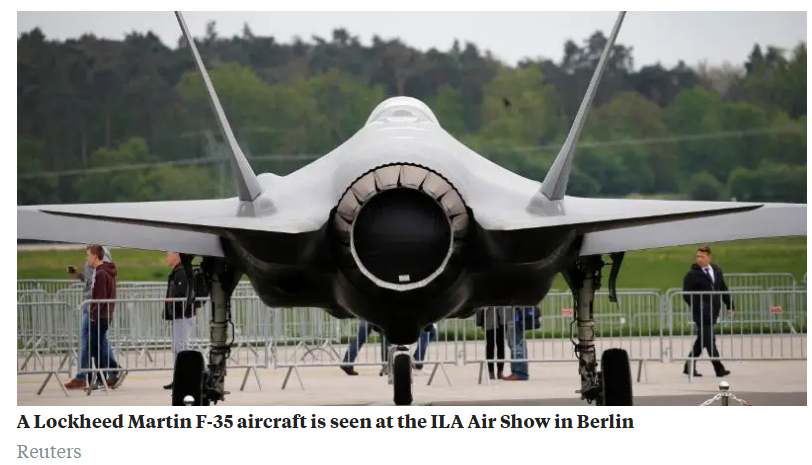
The picture of an F-35 is pure Mish propaganda – nothing about the F-35 should be connected to China. Mish shouldn’t be a propaganda organ.
What business are the Chinese engaged in with Boeing, Lockeed/Martin and Raytheon – besides intellectual property theft?
Little to none is my guess.
I guess you know little about commercial aviation.
Boeing sells planes to PRC carriers. The other two probably sell parts.
Raytheon merged with United Technologies, which designs / manufactures parts for commercial aircraft. Even if China sanctions Raytheon, AirBus uses Raytheon parts on their planes. China’s move could force AirBus to stop doing business with Raytheon in order to sell planes to China.
Since Raytheon provides parts to most major commercial plane manufacturers, China’s sanctions have a similar self-defeating logic structure as Trump’s.
Thanks for that.
I was thinking the same thing but many of these parts have no other producers.
China talks a lot of shit but they generally will do what is good for them. This is a political battle. They will still buy the products.
china buy billions of dollars of planes from Boeing ,at my job bosses are nervous 90 percent of out product goes to Boeing ,and 35 percent of Boeing planes go to china what ,the hell are you talking about stop your bullshit ,and think before you open you big lieing mouth
I’m guessing Trump only skimmed the Three Communiques……
Just kidding. We all know Trump can’t read…..and won’t listen.
But exactly how are Raytheon and Lockheed Martin affected by Chinese sanctions? Were we selling missiles to the PRC?
(That’s in jest, but I still wonder about the impact of sanctions on the biggest US defense contractors…..maybe somebody could elaborate on how that all works.)