

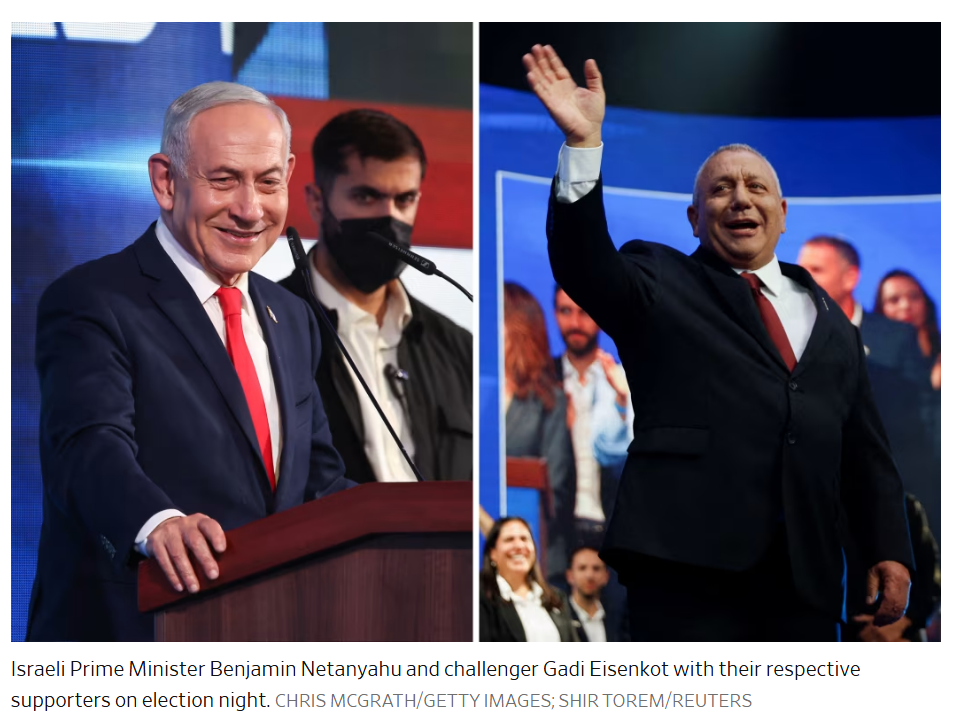
The deadlock I expected now appears likely.
No Clear Winner
The Wall Street Journal reports Early Israeli Exit Polls Show No Clear Winner in Key Election.
Israeli Prime Minister Benjamin Netanyahu received a major rebuke from Israeli voters Tuesday but retained enough support to set up a high-stakes showdown in the coming weeks over whether he will stay in office.
Early results and polls—which could still change significantly—showed Netanyahu’s Likud party winning the most parliamentary seats, though substantially fewer than the 68 seats his majority coalition now holds in the Knesset. Close behind was the party of Netanyahu’s most-powerful challenger, former military chief Gadi Eisenkot, whose overall coalition was either slightly ahead or tied with Netanyahu’s bloc of allies.
If the close margins hold, Netanyahu’s fate would come down to whether Israel’s president gives the prime minister or Eisenkot the first chance to form at least a 61-seat Knesset majority. In either case, a scenario many experts foresee is a hung parliament that ultimately heads to another round of elections, with Netanyahu hanging on as a caretaker premier.
Netanyahu’s right-wing Likud party was projected to finish with up to 25 seats, and Eisenkot’s centrist Yashar was estimated to have around 22 or 23 seats. The overall anti-Netanyanhu bloc was in the lead with 52 or 53 seats, or in a dead heat with the prime minister’s coalition, which was projected to receive 50 seats.
The biggest surprise was the projected showing for Israel’s two major Arab parties, which surged to a combined 18 possible seats from 10 seats now. Arab citizens of Israel make up about 20% of the country’s population.
Netanyahu and his allied political parties have pledged not to work with Arab parties, and Eisenkot’s said it would only do so with major concessions, including the acceptance of Hamas’s designation as a terrorist group.
Many Israelis viewed the election as one of the most consequential in the country’s history, pitting Netanyahu and his ultranationalist and religious allies against a bloc of liberal, centrist and conservative parties united around their opposition to the prime minister and led by Eisenkot.
The huge voter turnout and lack of a clear winner so far underscored the deep splits in Israeli society that worsened after the Hamas-led attack from Gaza plunged the country into three years of war. More than three-quarters of all Israeli voters had cast their ballots before polls closed, one of the highest turnout levels in any Israeli election, according to the country’s Central Election Committee.
With the possibility of a return to active combat with Iran in coming weeks, Israel was facing the possibility that it would again be at war with the election still in flux.
Along with a stalemate in which neither Eisenkot nor Netanyahu can form a government, there are at least two other scenarios.
One is that Eisenkot’s bloc either allies with one or more Arab parties, or seeks a fragile minority government that nonetheless relies on the Arabs vote by vote. Another is a unity government between Eisenkot and Netanyahu, which would also be unstable and would need other parties that have forsworn such an alliance.
In remarks to supporters early Wednesday, Eisenkot recognized that the results wouldn’t immediately drive Netanyahu from office.
“A worthy leader would acknowledge this lack of public confidence and announce his retirement from political life today,” he said. “Given the exceptionally high voter turnout, it would be a mistake to head toward yet another election. It is my duty to carry out the will of the people,” he added.
Election officials said the high turnout meant the final vote tally might not be complete until Friday.
Netanyahu has fought back from scandals, electoral defeats and corruption charges before, but never from a blow that struck so directly at his reputation as the Israeli leader most capable of securing the country.
Projections
What the broader data showsMainstream exit polls (Channels 11, 12, and 13) and independent trackers consistently point to a deadlock:
- Netanyahu bloc: ~50–52 seats
- Opposition bloc: ~49–53 seats
- Arab parties: ~17–19 seats
Arab Celebrations
Vote of No Confidence
We may not have final results for a day, but deadlock remains the expected outcome.
Right So Far
On October 24, I posted Israel Election Final Polls Suggest a Deadlock with Netanyahu Holding On
Political realities are such that no majority coalition in Israel is likely.
But that was the easy part.
With Netanyahu and Trump conspiring to restart the war with Iran after the US Midterm election, no one can easily say what’s next.
US-Israel Joint Plans
- The United States and Israel have drawn up joint military plans for a potential short but intensive bombing campaign against Iran, which are heavily anticipated to take place after the U.S. midterm elections on November 3, 2026.
- Multiple sources confirm that comprehensive strike plans are ready and waiting for final approval.
- Donald Trump has publicly remained ambiguous about whether he will authorize the operation or seek a negotiated agreement, noting, “My question is, do I make a deal with them or do I finish them off?”
The US Israeli Agreement and Political Timing
According to reports from The Wall Street Journal and The New York Times, the delay in executing these strikes is highly correlated with the political calendar:
- Trump’s Condition: Diplomatic sources indicate that Trump’s recent political endorsement of Israeli Prime Minister Benjamin Netanyahu was contingent on Israel holding off on unilateral strikes until after the U.S. midterms.
- Market Stability: A primary U.S. concern is preventing severe disruptions or spikes in the global oil markets during the critical final days of the midterm campaign.
- White House Position: White House Deputy Press Secretary Anna Kelly confirmed that “The United States will not be attacking Iran at any time prior to the midterm elections,” while emphasizing that President Trump keeps all options on the table.
Be Prepared for Anything
Would anyone be surprised by an escalation of war before the midterms coupled with a national emergency?
Hardly anything Trump might do would be shocking, including nothing at all. But the US is geared up, egged on by Netanyahu and the ghost of Lindsey Graham.
If so, Iran may go after the regions’ desalinization plants, oil terminals, and undersea cables. So, be mentally prepared for anything.


Looks like the invasion of Iran is a go!
What kind of country elects a war criminal? Oh wait …
Seems it would be in the interest of the Arab parties to go along with a coalition for the time being without pre-conditions, long enough for Netanyahu to lose his liability shield, be sentenced, and have his role examined for the Oct 7 stand-down and the IDF Hannibal directive, executing hundreds of Israelis.
The Jewish parties will not allow that to happen.