

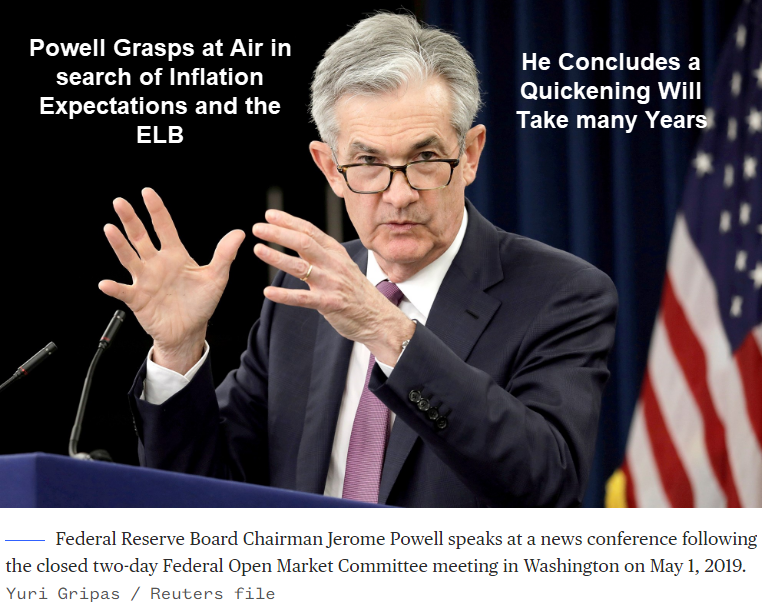
Please consider the Minutes of the Federal Open Market Committee for June 9-10, lead image from Powell Wants to Talk Policy, but all Fed block quotes are from the FOMC Minutes.
Discussion of Forward Guidance, Asset Purchases, and Yield Curve Caps
Participants discussed tools for conducting monetary policy when the federal funds rate is at its effective lower bound (ELB). The discussion addressed two topics: (1) the roles of forward guidance and large-scale asset purchase programs in supporting the attainment of the Committee’s maximum-employment and price-stability goals and (2) in light of the foreign and historical experience with approaches that cap or target interest rates along the yield curve, whether such approaches could be used to support forward guidance and complement asset purchase programs.
Effective Lower Bound
That discussion shows the Fed is concerned that it cannot lower rates further.
The Effective Lower Bound is the point at which lowering rates are counterproductive. That means the Fed cannot or will not set rates negative, a position I have held for years.
Yet, many still clamor for them despite negative results in Europe and Japan.
Simulations
The staff presented results from model simulations that suggested that forward guidance and large-scale asset purchases can help support the labor market recovery and the return of inflation to the Committee’s symmetric 2 percent inflation goal. The simulations suggested that the Committee would have to maintain highly accommodative financial conditions for many years to quicken meaningfully the recovery from the current severe downturn.
Meaningfully Quicken
If you announce to the world you will be accommodative for “many years“, what further good is forward guidance?
Risks
The staff cautioned that businesses and households might not be as forward looking as assumed in the model simulations, which could reduce the effectiveness of policies that are predicated on influencing expectations about the path of policy several years into the future. Alternatively, prompt and forceful policy actions by the Committee might help focus the public’s expectations around better outcomes or reduce perceived risks of worst-case scenarios, which could generate more immediate macroeconomic benefits than those featured in the staff analysis.
Consumers Might Not Follow Models
That isn’t a risk. It’s a certainty.
Yield Curve Caps
The second staff briefing reviewed the yield caps or targets (YCT) policies that the Federal Reserve followed during and after World War II and that the Bank of Japan and the Reserve Bank of Australia are currently employing. The staff noted that these three experiences suggested that credible YCT policies can control government bond yields, pass through to private rates, and, in the absence of exit considerations, may not require large central bank purchases of government debt. But the staff also highlighted the potential for YCT policies to require the central bank to purchase very sizable amounts of government debt under certain circumstances—a potential that was realized in the U.S. experience in the 1940s—and the possibility that, under YCT policies, monetary policy goals might come in conflict with public debt management goals, which could pose risks to the independence of the central bank.
Yield Curve Cap Summation
They may work or they may not. How enlightening.
Meanwhile, please look at Japan and note that it has neary cornered the entire bond market.
What good did caps do?
Credibility
A number of participants spoke favorably of forward guidance tied to inflation outcomes that could possibly entail a modest temporary overshooting of the Committee’s longer-run inflation goal but where inflation fluctuations would be centered on 2 percent over time. They saw this form of forward guidance as helping reinforce the credibility of the Committee’s symmetric 2 percent inflation objective and potentially preventing a premature withdrawal of monetary policy accommodation.
Credibility? There is no credibility.
More importantly, the Fed does not even know inflation is. They have blown bubble after bubble and do not see it.
Inflation Expectations
With regard to inflation, participants reiterated their view that the negative effect from the pandemic on aggregate demand was likely to more than offset any upward pressure from supply constraints so that the overall effect of the outbreak on prices was seen as disinflationary. Consistent with that interpretation, participants observed the recent negative readings on the monthly CPI and noted that they anticipated that the 12-month PCE inflation measure would likely run well below the Committee’s 2 percent objective for some time. Observing that inflation had been running somewhat below the Committee’s 2 percent longer-run objective before the coronavirus outbreak, some participants noted a risk that long-term inflation expectations might deteriorate. Participants noted that a highly accommodative stance of monetary policy would likely be needed for some time to achieve the 2 percent inflation objective over the longer run.
Three Wrong Economic Models
- Deflation Group-Think
- Inflation Expectations
- Phillips Curve
At the top of the list of widely-believed but false central bank economic theories is the notion that falling retail prices are bad for the economy.
Nonsense After Nonsense
The minutes are nothing but complete nonsense after nonsense. Starting with inflation expectations, I have some questions.
Inelastic Item Questions
Q: If consumers think the price of food will drop, will they stop eating? Will they eat twice as fast if they expect prices will rise?
Q: If consumers think the price of gas will drop, will they stop driving?
Q: If consumers think the price of rent will drop, will they hold off renting until that happens? Will they rent two apartments if they expect the price to rise?
Q: Will consumers delay medical services if they think prices will drop? Will they have two operations if they think prices will rise?
Elastic Item Questions
Q. If someone needs a refrigerator, toaster, stove or a toilet because it broke, will they wait two months if they think prices will decline?
Q. Better deals on TVs and computers are always around the corner. Does that stop TV and computer purchases?
Answers to those questions prove inflation expectations are total nonsense.
Asset Price Expectations
- People do buy stocks it they believe prices will rise. They avoid stocks or sell them if they expect prices will drop.
- People will stretch to buy a home if they expect prices to rise. They wait if they expect prices will drop.
But neither houses nor stocks are in the CPI. The Fed does not consider the only places (short of hyperinflation), where expectations matter at all.
For discussion of a CPI basket of goods, please see The Problem is Not Deflation, It’s Attempts to Prevent It
Inane Deflation Fears
The BIS study on Costs of Deflations: A Historical Perspective investigated output growth in numerous deflations over a 140-year period, in 38 economies, The study concluded:
- Deflation may actually boost output.
- Lower prices increase real incomes and wealth.
For a discussion of the BIS study, please see Historical Perspective on CPI Deflations: How Damaging are They?
Lies of the Day
- Fed Lie of the Day: “Low Inflation is One of the Major Challenges of Our Time”
- CPI vs Reality: Medical Care Costs Soar Out of Control
- My Challenge to Keynesians “Prove Rising Prices Provide an Overall Economic Benefit” has gone unanswered.
Hello Jerome Powell, We Have Questions
On March 25, 2019, roughly a year before Covid hit, I penned Hello Jerome Powell, We Have Questions.
My questions remain unanswered and the Fed still has no idea at all what inflation is.
In Search of the Effective Lower Bound
For discussion of the ELB, please see In Search of the Effective Lower Bound
Very Deflationary Outcome Has Begun: Blame the Fed
By foolishly promoting inflation the Fed sponsored credit bubbles of increasing amplitude over time.
It’s asset asset bubble deflation that is damaging, not routine price deflation.
The irony is a Very Deflationary Outcome Has Begun.
When asset bubbles burst, debt deflation results.
Here we go again.
Mish






























Let me get this straight. The world is drowning in debt and facing insolvency due to too much liquidity, so the answer is to inject more liquidity and induce more debt? Is that right? So what you are saying is we can cure debt based insolvency with more debt?
What could possibly go wrong?
The result of the Feds interference in free markets has been to stifle productivity.
That is the real problem and the one no one is looking at. A country cannot prosper while productivity declines.
To reward companies for buying their own stock instead of investing the money in new products and technology, to support zombie companies who are not competitive in the market, to artificially inflate assets so that wealth flows to the unproductive and trading assets rather than working a real jobs, all these things are detrimental to the economy and the well being of the country in the long run.
Wealth is not created by artificially inflating asset value, it is created by allowing capital to flow to the most innovative and efficient.
I believe this is false. The Fed sees it. They are way too smart to be that dumb. They just don’t admit it publicly. The real question then becomes, why won’t they admit it?
They cannot admit it. They have painted themselves into a corner where no matter what they do, it will either cause disaster sooner, or later. They have simply chosen to postpone the disaster until later….. If I were in their shoes, I would allow the reset now, at least they could try to blame it on the pandemic……
Because to admit it would demand a further sequence of questions which would end up damning the Fed no matter what they said.
The Fed took the same approach by denying that its actions exacerbate income/wealth inequality … for somewhat more obvious reasons.
With the great job numbers today, inflation is back in play. Seems like Mish will be wrong again.
Nope.
Deflation on tap.
More fake job numbers this morning.
Behold, The Slackening!
No discussion of the income and wealth inequalities that the Fed’s policies have exacerbated? I think they should be talking about that.
Negative rates? Of course they suggest that they won’t go there. But they will ultimately have no choice, they have boxed themselves into the proverbial corner and there is only one direction he Fed can go, easier and lower. Claiming today that they won’t go there will only dramatically increase the impact once they break the zero bound. Wow, what a surprise, they said they wouldn’t do that!
2% inflation, I think we are well past that. I have noticed a significant increase in my grocery bill. Housing prices are on fire, here where I live. Property taxes, fees and everything else will gravitate higher to fill the giant hole that has been left in state and local budgets.
I can hardly wait many years for such a quickening.
Inflation must be provided at exponential increase for the feudal pigs of wall street.
This can never end.
The survival of the peasants is a small but rather annoying matter.
It would be good to get a good war going where they could be useful fodder.
The biological eugenic plans are still disappointingly ineffective.
The fed needs no more economists but they are always needing more PhD’s in semantics, especially specialists in gobblygook.
If the Fed feels it necessary to intervene, I would rather them flood banks with capital, and banks find credit worthy customers to lend to. Credit agencies are for shit. This way, “credit worthy” businesses are receiving collateralized loans and banks can get a Fed back stop all the while not interrupting the yield curve. Isn’t this how FHA works?
We can’t make banks lend with their Fed money, just like we couldn’t in 2008. Since there is no longer any line between commercial and investment banks, it doesn’t make much sense for them to go through the tedious process of finding worthy customers and making meager gains on the interest. Instead, they can either hoard the cash or use it for speculation. Besides, even if their speculative bets blow up in their faces, they can always get bailed out again.
If we’re dumb enough to keep raining Fed bailout money on them, they are free to use it (or not) as they see fit.
Yea, I get all that crap. Point is, more targeted funds while leaving credit markets to do what they do best, find the natural rates that the Central Banks are chasing anyway.
Nasdaq 50 million.
Rewritten for general consumption…”extraordinary means required for many years in order to have the economy resume growth of a reasonable rate.”
A shorter reading–“a decade or more without growth.”
i think you mean “a decade or more without economic growth”. asset prices on the other hand will explode during that same decade. what matters to you?
Nah, a long, gradual decline over 2 or 3 years which neither bulls or bears will be particularly happy about.
that’s what the doomers have been saying since 2009, except that stonks have gone up 200% since then. there is nothing preventing the nasdaq from being at 30,000 with the economy being exactly where it is today.
“that’s what the doomers have been saying since 2009”
Not me but it’s irrelevant anyway. It’s what happens from here that counts and I think we’re in the early stages of a long bear market. Might be wrong of course.
dear doomers,
how many decades will it take for you to learn the mantra for financial salvation?
here it is: “DNFTF”
get leveraged to the hilt and run out and buy stonks and other assets as quickly as you can with both hands, the same way you buy toilet paper at costco before a pandemic.
affectionately yours,
the fed
The all powerful Fed, like the Wizard of Oz, relies on misplaced trust and confidence. It’s sorta “worked” so far. It will not continue indefinably and the consequences will be dire for those who aren’t prepared.
Tesla sold 367,500 cars in 2019. Toyota sold more Camry’s than that. The biggest car company in the world? What world, Mars? He has the most cars in space, that’s for sure. Ford sold 2,422,698 in 2019. Toyota sold 8,091,277 Ever heard of Baojun Motors? Sold 879,077 in 2018 and only the 25th largest car seller.
In financialized dystopias, “car companies” don’t sell cars. Just as Oil companies don’t sell oil. Noone has sufficient competence to create anything so useful and diffimecult anymore, when everyone’s an idiot who obtained everything he has, solely by way of being handed it by The Fed.
Instead, in such dystopias, the only thing any “company” is capable of making, hence selling, is paper. Which the central bank then buys to hand to its favored leeches. With funds robbed from anyone naive enough to still bother trying to do something useful, by way of debasement. Hey, It’s America! We must all wave a flag and cheer!
100% this… I’ve lost all motivation to work and am trying to figure out how to live out the rest of my days taking advantage of this system. I’ll never be rich because I’m being robbed of my savings and I’m unwilling to buy the bubble and have the rug pulled and lose it that way. I’m choosing what should be the slow inflationary burn. I just need to makre sure I have enough in the end to pay for a painless assisted suicide. I don’t really want to have to end things violently and painfully but may not have a choice. The wriing is on the wall for everyone but the elite.
He probably means by market cap. Tesla is the biggest car company based on market capitalization.
And Stalin was the most loved Dear Leader, based on vote counts.
I am still not seeing this deflation. Meanwhile Elon Musk is on track to become the next Fed President.
Tesla is now the biggest car company in the world.
When all there is, is theft, it’s hardly surprising if the biggest theft beneficiaries get all the top jobs….
Hopefully, the Taliban will beat them to it.