

Airline Industry Turmoil Deepens
Reuters reports Airline Industry Turmoil Deepens as Coronavirus Pain Spreads
Passenger operations have collapsed at an unprecedented rate as the virus spreads around the world, with Delta Air Lines Inc parking more than 600 jets, cutting corporate pay by as much as 50%, and scaling back its flying by more than 70% until demand begins to recover.
Shares in U.S. airlines fell sharply on Wednesday after Washington proposed a rescue package of $50 billion in loans, but no grants as the industry had requested, to help address the financial impact from the deepening coronavirus crisis.
The Trump administration’s lending proposal would require airlines to maintain a certain amount of service and limit increases in executive compensation until the loans are repaid.
American Airlines Group Inc in a memo to staff rebuffed criticism that it had rewarded its shareholders with too many dividends and stock buybacks in better times, leaving it with less cash to manage the crisis.
“Unfortunately, this is no ordinary rainy day,” said Nate Gatten, American’s senior vice president global government affairs. “These are extraordinary circumstances, and additional support is necessary to protect jobs and ensure that the flying public can continue to rely on our industry after the crisis ends.”
No Ordinary Rainy Day
Fair enough, this is no rainy day. But the sad fact is the industry did not save a dime, not enough for even an ordinary rainy day.
Neither did Boeing.
Nor did any company. None of them that I can find.
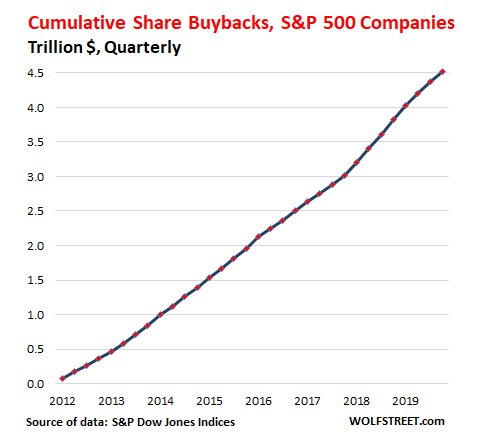
$4.5 Trillion Blown on Share Buybacks
Wolf Richter has an excellent report on the setup.
Please consider After Blowing $4.5 Trillion on Share Buybacks, Airlines, Boeing, Many Other Culprits Want Taxpayer & Fed Bailouts of their Shareholders
The big four US airlines – Delta, United, American, and Southwest – whose stocks are now getting crushed because they may run out of cash in a few months, would be the primary recipients of that $50 billion bailout, well, after they wasted, blew, and incinerated willfully and recklessly together $43.7 billion in cash on share buybacks since 2012 for the sole purpose of enriching the very shareholders that will now be bailed out by the taxpayer.
Share buybacks were considered a form of market manipulation and were illegal under SEC rules until 1982, when the SEC issued Rule 10b-18 which provided corporations a “safe harbor” to buy back their own shares under certain conditions. Once corporations figured out that no one cared about those conditions, and that no one was auditing anything, share buybacks exploded. And they’ve have been hyped endlessly by Wall Street.
The S&P 500 companies, including those that are now asking for huge bailouts from taxpayers and from the Fed, have blown, wasted and incinerated together $4.5 trillion with a T in cash to buy back their own shares just since 2012:
And those $4.5 trillion in cash that was wasted, blown, and incinerated on share buybacks since 2012 for the sole purpose of enriching shareholders is now sorely missing from corporate balance sheets, where these share buybacks were often funded with debt.
And the record amount of corporate debt – “record” by any measure – that has piled up since 2012 has become the Fed’s number one concern as trigger of the next financial crisis. So here we are.
In 2018, even the SEC got briefly nervous about the ravenous share buybacks and what they did to corporate financial and operational health. “On too many occasions, companies doing buybacks have failed to make the long-term investments in innovation or their workforce that our economy so badly needs,” SEC Commissioner Jackson pointed out. And he fretted whether the existing rules “can protect investors, workers, and communities from the torrent of corporate trading dominating today’s markets.”
Reckless Tax Cuts, Rate Cuts, Buybacks and Bailouts
Corporations claimed they would use the Trump tax cuts for investment.
It was a lie upfront. Amd we knew it because President Bush told the same lie with the same result. I was against the tax cuts because it was a big handout to the wealthy, not the middle class.
Those tax cuts boosted the stock market, far more than I thought, to insane levels in fact. Trump bragged about it all the way.
The problem, now obvious, is the tax cuts were not only front-loaded, but squandered as I warned about even though the cut benefitted me personally.
Supposedly 2001 was to be the last bailout. We heard that again from the Fed and Congress in 2009. And now here we go again.
And the Fed recklessly reduced rates even as the unemployment level fel to record lowes. And the Fed kept lowering and lowering rates every time the stock market sneezed.
Now the Fed Funds Rate is at 0% with the Fed totally unprepared for anything except one: Issue more bailouts and cheap money.
We had reckless tax cuts by Trump, reckless rate cuts by the Fed, reckless buybacks by corporations and reckless bailouts by Congress. And here we go again.
To hell with this.
Corporate execs and shareholders ought to be totally wiped out before corporations get a dime.
Mike “Mish” Shedlock






























Mish – you’re right but hedge funds/activist investors are part of the problem too. IF a company didn’t lever up, a hedge fund would come in and force them to or attempt a take over or board turn over or … Same with outsourcing to China even if it made the company more fragile. What do you think of Marc Cuban’s suggestion – any ‘bailed out’ entity can never conduct share buy backs – ever?
It’s to give us hope. They’re all in their seventies.
To be honest, the C-suite’s buyback strategy makes a lot of sense…if you consider the average CEO tenure (less than 5 years), the compensation package (heavily skewed towards outperformance by the stock price), and the time it take to make a capital investment work out (oh and Wall Street love of quarterly reports). Sure airlines are very very guilty of spending all their cash on share buybacks (as did Boeing BTW). The surprise is that everyone is surprised by this outcome…
Analysts (no ones listen to them) have been saying for years that the compensation packages are a problem. Moreover, if one thing has been learned by the powerful since 2008 is that you are better off to be broke when the Sh$t hits the fan that way you get a nice government bailout, no one goes to jail, and if you are a little lucky you still get your bonus.
It would be simpler for shareholders to take all the losses, and bond holders to convert into the new shareholders. The debt is wiped out quickly and a people learn to be more cautious with their investments.
“it was a big handout to the wealthy, not the middle class.” This is a liberal lie, plain and simple.
“It’s well known in finance.”
Sorry for the rant, but your comment about the bean counter gang’s wisdom has triggered yet another rant:
During the same period that Corporate America was running up a tab of $4.5 Trillion buying back stock, a now-formidable competitor for future 5G dominance, Huawei, was spending $ 66 Billion on R&D, $14 Billion of that in 2018 alone.
Yes, I know Huawei steals IP. In fact, they’re almost as bad as the French used to be at it, but that fact won’t save American jobs on the world market in the future.
When a management team decides it has arrived and there are no reasons to hoard cash and search harder for R&D and growth opportunities, they turn to burning cash with buybacks.
When someone steals a march on you in high tech, you can be as much as five years late in discovering it. The lag is typically less in other industries, but effects are the same: lost jobs and lower living standards.
It’s near-impossible to convince the bean counter gang of the above arguments until it’s obvious to the ordinary…like now.
Off track, these presidential briefings….what’s the sense of crowding all of your top people in one small stage, jostling around, sharing the same microphone and air?
Isn’t there an unused meeting room somewhere in DC where they could be spread out by 5 or 6 feet, each with their own microphone?
But, but Mish, surely nobody, nobody could have seen this coming.
ROFL.
“thiiiiingz are aaaaallllwaayyyyys diiiiifereeeeeent thiiiiiiiz tiiiiime” screech the progtessives.
While what “we” need to do, is always the same: Bail them out.
The sad fact is America’s industrial might has been squandered by incompetent management teams looking out for #1. Look at Ford, GM, GE, Boeing … Where are the quality, well built products? Where are the investments and innovations? Instead their main focus seems to be financial shenanigans and outsourcing to China.
I sent an email this morning to Whitehouse.gov on this. Heck no to bailouts for Wall Street. Let capitalism work. Equity takes first hit. Then junior bondholders. Then senior bondholders take haircut if necessary.
Absolutely DISGUSTING that Boeing wants to shake down taxpayers for $60 billion when they have squandered $100 billion on buybacks past 10 years.
New web title:
Why don’t you relabel your site, “Grouse -Talk”?
SHARE BUYBACKS INDIRECTLY BY THE FED
Our so called wonderful economies with a GDP services part above 50 per cent (70 per cent in US) are unable to produce yearly GDP grow without the hot air speculative money (money supply through loans intended to speculate).
Here above we have got the description of the corporate speculative loans and use of cash flows reserves in order to buy back their shares and make billionaires out of their C.E.O. They contributed to the GDP inflationary expansion that way.
A mass of employees ( self-employees or not) draw their yearly revenues from the activity of maintaining the assets bubbles in perfect expansion.
I see no possibility for the GDP to recover unless the bubbles (like in 2008-2009) are quickly re-inflated.
Everybody has noted this time the outstanding speed at which the Fed prepare up to 13 billions of Primary dealers loan facilities accepting in guaranty as collateral every asset now (besides Government papers), including STOCK MARKET SHARES.
Yes the primary dealers will start buying shares and deliver them to the Fed balance sheet!!!. Watch out for their action at important support levels in the markets.
Re stocks as collateral when primary dealers use the discount window. Collateral pledged is subject to a haircut. Even treasuries have a (minor) haircut. I looked at discount window page at FR. Not updated to show haircut for equities. It will be very interesting to know what haircut equities are subjected.
As a general rule I support dividends, and I therefore support stock buybacks, which are mathematically identical to dividends. The stockholders are often forgotten, as management and employees run corporations for their own benefit. Therefore, when some earnings do flow to the owners, I consider it a good thing.
I also consider it a good thing to allow the free market to work the say it’s supposed to work. In this case, that is for the airlines to go through bankruptcy. By going though bankruptcy, airlines and become leaner and more efficient. Yes, the owners (stockholders) take it in the shorts, but that’s only fair. If you allow that to happen, it restores a sanity where corporations avoid excessive leverage, and have plans to deal with problems, and stockholders reduce the value if a company is excessively leveraged.
Kondratiev believed that the great strength of the capitalist system is that every now and then, perhaps once a generation, some tragic event would precipitate a depression, and the depression would in turn purge the excesses out of the capitalist system, rejuvenating it, and preparing it for another long cycle of healthy growth. If we “bail out” everyone, we avoid purging out the excesses, and you allow the problems to fester until the system ultimately collapses.
If you allow the weak businesses to fail, the strong businesses will survive, and they will be poised to grow. It will create an environment where new startups can also thrive. If you protect even the weak, then the strong will also be weak, and the economy will fester.
Don’t put me in the pro-socialist group-think that says that corporations should exist as an extension of government, and that all the profits they earn should go to their employees, and that shareholders should only occasionally get tokens of appreciation. Corporations should pay their employees fairly, and should return excess profits to shareholders, but they should also be accountable for their actions, and need to maintain a “safe” capital structure.
Konfratiev is a 50 year cycle, which is equivalent to the Biblical 50 year Debt Jubilee cycle. Armstrong has a series of six 8.6 year cycles culminating in a 51.6 year major cycle.
It is the same thing repeating over and over again, as the rubber band snaps back again after 50 years.
It takes excesses in order to purge excesses. Everyone loves a boom time. No one wants the 2009-2020 bull market to end. No one wants the 2009 – 2020 economic expansion to end. No one wants to be the one standing without a chair when the music stops.
Used to be that stock buybacks were illegal. After 1980, they were made legal again. Now a new generation is going to see why they were once illegal.
Glass-Steagall was created so that IT couldn’t happen again. It was dismantled so that IT could happen again. All part of the repeating cycle.
i’ve been saying, since at least 2008, all modern economies are a ponzi scam.@ritholtz ) that i don’t know what a ponzi scam is.
i’ve been told (most notably by barry ritholtz
who’s doubting now?
Amen Mish. I was complaining to my wife last fall about her companies buybacks at high stock prices but at least they did not use debt.
let them fail. Greyhound bus for plebs
Hi Mish, if a profitable airline had paid down debt and built up a prudent cash reserve, wouldn’t someone like Icahn have bought their way onto the board and then forced the firm to pare back its pension funding, raise new debt against future cash flow, and divest the surplus to shareholders?
This, (or a hostile LBO), seems to be the fate of any company that has a conservative balance sheet.
Just wait until the Tea Party gets wind of this and marches on Trump’s Washington! /sarc
The tea party was promptly and adroitly distracted with the horrible, latent racism that was gripping the nation under a democratically elected black president! /sarc
“To hell with this.
Corporate execs and shareholders ought to be totally wiped out before corporations get a dime.”
That is something I can agree with and would like to see more writings calling for this! Instead, everyone has their hand out for a bailout. Latest is movie theaters. Why does every business think they are essential and someone has guaranteed them everlasting profits in all business conditions?
This was a good post that gets to the heart of the bailout begging:
The Lesson
By Sven Henrich on March 17, 2020
The lesson of it all? The lesson is that lessons are not being learned.
And here we are. Just four weeks after all time highs in markets America is again turning into bailout nation.
Yes coronavirus is an unforeseen shock. So what?
….
So airlines deserve a break since first of all it’s had to catch Covid-19 on a plane (Google this) and second of all a stock buyback is, technically and mathematically, the exact same as a dividend (Google this).
That said, I’m in principle against corporate pork and welfare. But bailing out airlines might not be a bad idea. You know China, Japan, all the national carriers will get and give support.
Of course bailing out airlines is a bad idea.
If you need their planes to keep flying, as part of a national response to coronavirus or something, take them over and sell them to the highest bidder.
Which may well be the military. Or medical personnel and equipment transport. Or some citywide aerial fogging campaign over Manhattan. But could also be UPS or FedEx, if prolonged quarantines extending even to grocery stores, become the norm.
Then distribute whatever you get to employee backpay, then vendors them bondholders. Wipe the debt and be done. There is less than zero point in keeping planes from becoming cheap enough to be repurposed for uses which are now completely different from what was the case a month ago.
Free markets work by shifting resources to where demand for them is the greatest. As quickly as possible. Even absent moral hazard considerations, all bailing out past due dinosaurs accomplish, is slowing down this re purposing. Increasing the costs for those solving today’s problems, instead of living in the past.
Instead, speed up, and lower the frictional cost, of bankruptcy proceedings. A day for small organizations, 3 days for midsized, up to a week for Aramco and Walmart. Get the debt cleared, and assets repurposed for the demands of the economy now. Who gives a toot about leeches screaming for slowing adjustments down? Solely in order for their unearned so called “wealth” to be artificially pjotected while others are left struggling and dying.
Indeed they should. I have zero interest in bailing out an person or industry. But Trump is running for reelection so let the bailout’s begin.
Do you think it is your money ? It isn’t. It never was. The government creates it out of thin air and it ends up on a balance sheet. It is a purely notional transaction.
My money (which I earned through labor) has to compete with the money conjured from thin air, thus prices rise, essentially diluting the purchasing power of my money. So, yes, the money that is conjured from thin air really is MY money!
It isn’t. It isn’t really money at all. Your earned money is yours. The money created by the Fed and Treasury just ends up on a balance sheet. It isn’t like interest doesn’t have to be paid back. Well maybe until now 🙂
Carelessness https://www.youtube.com/watch?v=n7mvDOBhvnE
“Corporations claimed they would use the Trump tax cuts for investment. … It was a lie upfront.”
Exactly. The old “supply-side” patent-medicine elixir. Real productive investment is a demand-side variable – and depends upon expected demand for the products/service produced by such increased capital investment.
By using that money (and borrowing more at low interest rates) to buy back shares, the management of those corporations were showing us a “tell” – what their informed expectations for the economy were.
[Note: I am not opposed to all share buybacks – only to the lie.]
If there was a sustainability index one could come up with for corporations to abide by then you wouldn’t have these buybacks. They have money for buybacks which goose executive compensation but claim their pensions are underfunded. The public markets are the problem here. Driving up share prices in the short run leads to problems after the run is over. The system is so screwed up. Mark Cuban is right.
As a nation we’ve long subscribed to the idea that “everybody can’t be wrong”. People and companies have figured out that if they all engage in the same fraudulent behavior at the same time, they can all avoid prosecution and blame circumstances beyond their control when things go awry. We all watched bankers get away with this to a spectacular extent in 2008.
As much as I want to castigate Boeing execs for buying back their own shares to trigger their own bonuses, we let them do it in broad daylight as a country. It’s not like they lied about it or covered it up, we just didn’t care until now.
Exactly. It is like in football. If you commit a penalty on every play you will only get called out 10% of the time. The only way to fix it is to make the cost so painful that one never would want to do it again.
That’s why the shareholders should be wiped out if Boeing requires a Chapter 11 reorganization, they’ll care next time. It’s up to the shareholders to police their investment, not the taxpayers to pick up the pieces.
+1000
But hei it’s the USSA.
It’s not that we didn’t care, it’s that we are apathetic about asking crooked politicians to do what is right. Corporations have expensive lobby programs they use to buy our representatives that are supposed to respond to the constituent, so they have to lobby programs going, partly at public expense and we, in actual terms, have virtually no representation.
Companies, like people, need to accept personal responsibility. But of course neither wants to do that if they can get out of it.
In fact if they do get away with such amoral or illegal behaviors, the behavior becomes normalized.
The problem in the airline industry is that if Airline “A” doesn’t run a highly leveraged business, upstart competitors will. And the flying public just wants a cheap ticket — and doesn’t give two sh*ts about the financial position of the airline.
I think the root problem is in the banking regulators that allowed the airlines, and airplane lessors to obtain credit so inexpensively to facilitate highly leveraged business models.
A complete wipe-out of current bank/financial industry shareholders is necessary to fix the problem. Even depositors who fund those sh*t-shows probably need to feel at least some pain in order to realize the necessity of only lending to responsible banks.
“A complete wipe-out of current bank/financial industry shareholders is necessary to fix the problem. Even depositors who fund those sh*t-shows probably need to feel at least some pain in order to realize the necessity of only lending to responsible banks.”
+1000
Ditto 401Ks, financial “asset” backed pensions, “home” equity and local, state and Federal debt. All of it. Wiped out. Completely. None of it was earned by it’s current Fed favored “owners” anyway.
That would make sense if airlines were using leverage to lower prices for consumers. However, the free cash flow was used to buyback shares for the benefit of shareholders and executives, not to lower consumer prices.
I agree with your assessment of the financial industry, and would add that it was the artificially low rates provided by the FED that made these financial games to be so “profitable” until the tide went out and everyone’s pants were down.
Once the initial few years of deflationary shock are done, I suspect that lessors will remember the months, if not years they went without payments. This will drive up airfare costs to more sustainable levels.
Referencing the relative price of airfares in your comment misses the reason the buybacks are problematic now that the airlines are requesting a bailout. One has nothing to do with the other. The point is that even after offering cheap fares the airlines had plenty of cash to save for a rainy day. Instead of conserving that cash, airlines decided to use 96% of it for buybacks. Therefore, airlines favored buybacks over even more competitive pricing or conserving cash for a downturn. Your original comment would be valid if airlines used leverage and the excess cash they earned to drive fares even lower. They didn’t do that though, they repurchased their own shares with it and risked the solvency of their corporations in the process.
Think of share buybacks, intuitively, like refi’ing your house every time there’s some equity earned, and using the proceeds to build additions. Pretty soon you’re left with an unwieldly sized house for which you can’t even afford the operating expenses. At which time, its game over.
Maybe I don’t understand, but I’m trying to. Using the example of refi’ing your house to build an addition, I see how the homeowner is increasing debt to add capacity to their home. Trying to apply that analogy to airlines, buying shares back with free cash flow will drive up the airlines’ P/E ratio and likely the value of their stock, but doesn’t increase the physical capacity of the airlines or lower airfares. Are you saying the airlines then used the inflated stock value that resulted from the artificially high P/E to expand capacity through increased debt financing? You mention the “overly high P/E caused more airlines to receive equity financing…” but my understanding is that equity financing only occurs when a corporation issues shares, which is the opposite of buybacks. Did you mean the airlines received more debt financing as a result of their inflated P/E? Or rather, kept more debt on the books because the free cash flow wasn’t used to extinguish the debt?
If that’s the case, I think I understand. I definitely agree “Way too much debt financing, as equity financing was extinguished through share buybacks, and an increasingly smaller amount of equity was used to backstop an ever-increasing pool of debt capitalization.”
I’ve howled about this for years. For anyone who thinks it isn’t an ongoing outrage: Ask yourself how you’d react, as a shareholder, if the C suite gang rewarded itself with a handsome bonus merely for paying you a one time dividend instead of buying back stock. Right, you’d turn out with pitchforks, but by linking their comp plans to earnings per share, then reducing shares outstanding via buybacks, They’re doing the same thing on a continuous basis!!! Borrowing money to do the buybacks compounds the crime.
And Mish is right, it was rightly held to be a crime to dink with the balance sheet for personal gain before 10B-18 was issued in 1982; it should be again.
An SEC bulletin disallowing any personal compensation flowing from shares outstanding would at least be a fig leaf.
Not a nickel to anyone, anywhere before any and all personal gains from past buybacks are disgorged.
If the BOD and management can’t find a use for “excess” cash, resign and hand it over to people who have the vision to plan for debacles…like this, and drive R&D harder and smarter.
Other than that, good rant.
Wasn’t buybacks illegal at some point in time and why wouldn’t we make them illegal again. I don’t buy Lopez argument, its much more straightforward to give a dividend or to bank the cash for a rainy day. No one is smart enough to time selling shares of a company most people buy and hold
Mish for President
Stock buybacks were allowed to run rampant BECAUSE they were the only thing holding up equities for more than a year now. It was planned to be that way. But look, the top 1% just got caught with their pants down in the midst of a global pandemic and the economic price simply cannot be paid by the bottom 90%. It cannot and it will not. There will have to be massive bailouts and it will have to be those with all that money who pay the bill for it.
Anything less and we all know socialists will end up winning, and at this point I am not even sure I disagree with that.
Money can be created out of thin air. Executives who sold their stock and retired before this crisis really made off like bandits.
Companies like Boeing et al are extorting the govt. They should go completely bankrupt along with the airlines wiping out bondholders and shareholders. The company will then be either bought out or re emerge hopefully more financially prudent and learning from their mistakes. Eg GM etc. This is how the free market works.