

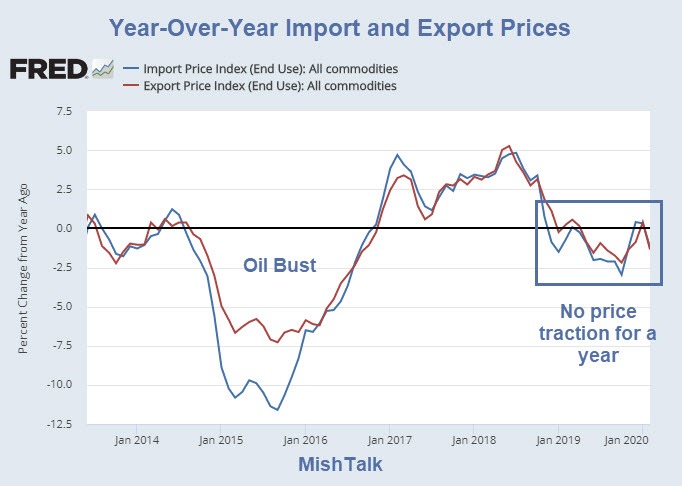
The BLS Import and Export Price report shows more bad news for the Trump administration hoping for a big surge in exports.
Import Prices

Fuel Imports
Import fuel prices decreased 7.7 percent in February, the largest monthly decline since the index dropped 7.8 percent in June 2019. The February decrease was led by lower prices for petroleum, though falling prices for natural gas also contributed to the monthly decline. Petroleum prices fell 7.6 percent in February following no change in January and a 0.5-percent advance in December. The price index for natural gas declined 12.4 percent in February, after decreasing 13.2 percent in January. Import fuel prices fell 5.8 percent over the past 12 months, driven by a 5.5-percent drop in petroleum prices and a 13.9- percent decline in natural gas prices.
All Imports Excluding Fuel
The price index for nonfuel imports increased 0.3 percent in February, following rises of 0.2 percent and 0.1 percent in January and December, respectively. Higher prices for nonfuel industrial supplies and materials; foods, feeds, and beverages; and capital goods all contributed to the February advance. Despite the recent monthly increases, nonfuel import prices fell 0.7 percent over the 12-month period ended in February and have not increased on an over-the-year basis since rising 0.6 percent in December 2018.
Export Prices

Agricultural Exports
The price index for agricultural exports declined 2.7 percent in February following an increase of 2.1 percent in January. Falling prices for vegetables, soybeans, and meat in February more than offset higher fruit prices. Prices for agricultural exports increased over the past 12 months, rising 0.2 percent from February 2019 to February 2020.
All Exports Excluding Agriculture
Nonagricultural export prices decreased 1.0 percent in February, after advancing 0.6 percent the previous month. In February, declining prices for nonagricultural industrial supplies and materials drove the decrease in nonagricultural export prices. The price index for nonagricultural exports declined 1.6 percent for the year ended in February.
Soybean Futures

Soybeans are on a price support level that dates all the way back to 2007.
The current price was first touched in 2004.
Trump will not exactly be happy to say the least. Nor will the farmers who mostly support him.
Mike “Mish” Shedlock






























Weird, just analyzing,. Everytime I moved it changed. During recession, it was above line. 2nd year I lived right near grocery store, 2007-9, Went higher, when I moved East in my town. 6 yrs I lived there 2010-2015. Then dropped when I came here 2016, & still here. Went from a friend house, neighborhood to a family house neighborhood. Hum. FROM city to county. & From corporate to unincorporated. Now, that’s what I call analyzing!😎😎😎
The Fed commits to $5T of money pumping yesterday and precious metals are absolutely flattened today while stocks recover slightly. Any insight on why that is,@Mish ? The commonly offered reason is large diversified investors are liquidating winners to prevent margin calls and forced liquidation on losers, but I wonder if that isn’t wrong. Could it be that if a stock market sell-off vaporizes $10T in asset prices and the Fed adds $5T, then that is still a net loss of $5T in money in the system relative to assets? Could something else be the reason? Any insight?
Yeah it’s called metals are still enemy number 1 and the fed’s least favorite red haired bastard step child. When metals explode is when they have completely lost it.
I have heard that one before. I suppose that is plausible, but that answer is unsatisfying. Do Central Banks really feel the need to smash the gold market 3% lower on a day when they are working to pump the whole system and want to stop general asset price levels from falling? Why waste resources hitting gold relative to the S&P500? According to many, gold is an unproductive pet rock that is not good for anything, so why single it out for a price hit on a day like today? Just to prove to speculators that there is no safe place to hide? Why bother?
Treasury bonds have been in a downward trend for the last 4 days (rising rates), but not enough to break the bigger upward trend and the Fed seems determined to keep rates low. Gold and gold stocks plunged like the top for the bond market is in. Given current circumstances, it seems doubtful the top is in.
I could understand gold prices falling if people think the combination of low oil prices, low interest rates, and easy financing will cause gold mining companies to overproduce and profit on the spread between energy and gold while the profit is good, but major gold mining stocks were pounded especially hard, so that thesis must be wrong. Gold mining stocks are often stocks first and a gold derivative second, and they frequently follow the stock market (although underperform) on a day when gold and stocks diverge, but that did not happen today either.
Then there is the argument that gold mining is mostly a money losing business and gold stocks are fickle and prone to losing money and diluting shareholders. If so, then increasing the supply of gold is difficult and therefore physical gold should at least be a stable asset during highly uncertain financial markets. As the VIX exploded higher, physical gold prices were stable at first and then plunged hard the last few days despite the VIX still being extremely high. Gold prices are as low now as they were at the end of December, 2019; prior to SARS-CoV-2 being recognized as a worldwide problem, and when stocks were near all-time highs, and before it became clear there would be economic casualties from this pandemic.
I have tried to understand the gold market for years and it still puzzles me. It seems like a volatile asset that does not keep up with inflation and certainly does not keep up with productive assets. It does not appear to give a good return even when central banks are having a hard time keeping the wheels from falling off an economy. Also, should there be any gains; the gains are taxes at a higher rate as a collectable and those gains cannot be netted against stock market losses. Ugh. It is obviously not as bad as bitcoin, but it is a difficult investment to love.
I think the down trend will last many years.
I think we’re at the beginning of a highly deflationary period. Deflation is almost always caused by a lack of demand.
“Export prices declined a steep 1.1% in February the most since 2015. Import prices fell 0.5%.”
February.
And March? Hhmm, stock market shock, virus explosion, and Saudi Arabia nuking oil prices with price cut / production increase.
Uhh, I think the down trend will continue a bit further …