

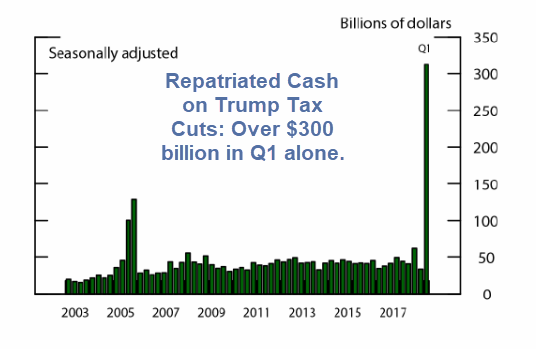
The Tax Cuts and Jobs Act encouraged the repatriation of profits, which had been subject to additional U.S. levies after it was brought home.
In response to the Trump tax cuts, there was a Dramatic Rise in Corporate Cash Brought Home in 2018.
>In the first quarter alone, multinational enterprises brought home about $300 billion of the $1 trillion held abroad, according to a recent Federal Reserve study. A good chunk of that repatriated money went to share repurchases — for the top 15 cash holders, some $55 billion was used on buybacks, more than double the $23 billion in the fourth quarter of 2017.
Tax Cuts and Jobs Act
The repatriated cash is highly unlikely to create many jobs. Most of it will eventually go to buybacks and dividends.
Goldman Sachs expects that the total buybacks from all companies in 2018 could exceed $1 trillion.
There’s Nothing like throwing $1 trillion into an already insanely overvalued market.
Corporations apparently have nothing better to do with the cash. Executive stock options, not shareholder interests, are in play.
Mike “Mish” Shedlock

Buybacks will lead to Stock gains and Fed and State Taxes. So a flow of cash to States and the Fed to hopefully pay off debt.
Mish said: “There’s Nothing like throwing $1 trillion into an already insanely overvalued market…Executive stock options, not shareholder interests, are in play.”
Bingo. Some executives use buybacks to support the stock price while they cash out. From the point of view of those particular executives, throwing $1 trillion into an overvalued market makes sense, especially if the market is near a top. At least one SEC commissioner recently commented “SEC rules do nothing to discourage executives from using buybacks in this way. It’s time for that to change.”:
Executives should be PROHIBITED from selling their own stocks after announcing buybacks and during buybacks and 3 months after ending buybacks.
Buybacks and dividends are the same thing. They both transfer money to investors. Will the money do more for the American economy sitting in foreign banks, or in the hands of Americans? The question is, what will investors do with it? Will they spend it on consumer goods? Will they invest it in other ways in the US? I suspect some of both.
The recent surge in the trade imbalance is pretty clear evidence that some of it is being spent on consumer goods.
Buyback reduces the number of shares and increases share prices. Executives holding stock options benefit when share prices rise. Returning money to shareholders via one-time dividends does not increase share prices. It does nothing to executives’ stock options. Therefore, buyback is a stealth way of enriching executives.
Buybacks and dividends are NOT the same.
Dividend gives money to stock owners and buyback artificially boosts the price of stock during the buyback and only those who sell their stocks during the buybacks benefit from the buybacks.
Buybacks also enable executives to cash out options and reward even mediocre executives since if you can not create actual new shareholder value in the stock by running the company well just announce a buyback and you get rewarded even as a mediocre executive.
Further when buybacks have become pervasive then the buyback does not just lift individual stocks but the many buybacks lift the market as a whole or in part.
Its not sitting in ‘foreign banks’. See my other comment.
Using that repatriated cash for stock buybacks is the height of idiocy.
It is like burning 1 trillion dollars.
The tax laws should have been written so that if the company uses repatriated cash for stock buybacks they pay triple the normal tax.
Likewise using it for extra dividends should have been double the normal tax rate.
The low tax rate should have only been available for those companies that use the repatriated funds inside the company to enlarge or develop their business or improve the financial position of their company or pay down company debt.
There’s a big difference between “held abroad” and “held in the US but titled with offshore subsidiaries”. Most of the alleged “offshore cash” is actually the latter. Apple’s “offshore cash” is actually in Nevada and is managed on behalf of Apple’s foreign subsidiaries by Braeburn Capital, a subsidiary of Apple. If its drained from the US banking system and US dollar where it primarily exists at the moment, that’s a big problem for systemic solvency and for the deposit base of those institutions. How solvent will the US banking system look if its systemically drained of $1T+?
Share buybacks won’t drain deposits. It will simply shift them around.
What do the Eliott Wave guys say about this stage of the Market? It’s been awhile, Mish, since you’ve done a piece on this.
Maybe because eventually most Elliot Wave guys realize that the only correct way to interpret them is in retrospect. A lot of good that does!
It’s the best place for cash, and you criticize them for making the best decision. Why?
It’s the best place for cash – until the next recession hits and their cash flows crater and they can no longer service the debt they issued to buyback the shares at these astronomical valuations. At that point the equity is worth ZERO, or close to it.
But I’m sure everyone will have already sold by then. LOL….
The big corps with real assets are better than govt bonds with no collateral. Govt’s default all the time, but companies with plants, property, equipment, and IP are a safer havens in times like this, and the smart money understands this fact.
Using too much leverage is not the same as using repatriated cash. Again, I will ask, where else would you park cash?
“It’s the best place for cash, and you criticize them for making the best decision.”
It’s the best place for cash as long as one gets out the exit before the rush. Capital flows in two directions- in, then out. Armstrong may be right about his potential 40,000 DOW, but the NIkkei also went to about 40,000 and fell some 80% after that.
The G20 changed the rules for depositors in 2014. Obviously, there is a major financial crisis coming.
True. There is a major reset coming, but many have missed this move because they are US-centric. I’m not saying that trading this market is easy, but it helps to see the bigger picture, which includes understanding that it is a rising dollar that forces the reset, not a falling dollar. The collapse always starts in the periphery and spreads to the core.
You possess bizarre logic. In my day it made sense to buy low, sell high but that now appears to have been turned on its head: the higher stock prices go the more money that gets spent on buybacks — and people you like cheer.
This is nothing more than companies buying $10 stocks for $20 i.e. a loss for shareholders and a win for executive pay. Charles Darwin would be rolling in his grave at the idiocy of it all.
Darwin is resting peacefully knowing the fittest of minds are surviving. This is not your daddy’s market. Fundy’s mean little in a world where the only safe haven is the dollar. Why do you criticize those that recognize the obvious?
Share buybacks are nothing more than a grotesque incentive for accounting control fraud. Corporate executives make out like bandits while the employees and the broader public get screwed.
How are employees and the public screwed? Businesses are not charities. Please do tell me a better place to park cash.
Stock buybacks are an idiotic waste of money and should be BANNED because currently stock buybacks are done when stocks are high so stock buybacks are a WASTE of shareholders money that are only done to give the directors of the company bigger paydays.
Even more idiotic is issuing debt to do stock buybacks because those companies are in deep trouble once the eventual recession comes and demand drops and profit margins drop and refinancing becomes more difficult and financing costs rise so rollover of debt becomes difficult or impossible.
Every CEO doing stock buybacks shows that they are without ideas and should be FIRED after proposing stock buybacks but for some reason ordinary investors have been made to believe that stock buybacks are a good idea.
Stock buybacks increase the profits per share so they make beats easier so even mediocre CEO’s just treading water can FAKE like they know what they are doing but when there are losses and less stocks that also works the other way around and leads to higher losses per share.
If a company has too much money and their CEO does not have any ideas the money should be returned to shareholders through dividends.
All else being equal, that level of buybacks would raise earnings/share by 4%.
The “Last Hurrah” for this bull market.
The last hurrah will come after the soveriegn debt crisis spreads from Europe to Japan, and the dollar and stocks force another G20 emergency reset.