

Reuters reports Canada, Mexico push back on Trump’s ‘fair’ NAFTA deal suggestion.
The two U.S. trading partners have threatened retaliation unless they are exempted from the planned tariffs, which have rattled financial markets. Both Canada and Mexico send more than 75 percent of their goods exports to the United States.
Canadian Finance Minister Bill Morneau, speaking north of Toronto, said Ottawa is now negotiating NAFTA with a partner that has“changed the terms of the discussion,” referring to the United States.
Mexico Must Tackle Drugs
Also Canada Must …
Treat US Farmers Better
US Crop Subsidies
US Crop Subsidies total $20 billion a year with most of the money ending up in the hands of big, rich farmers producing staple commodities such as corn and soybeans in states such as Iowa.
Corn is the top crop for subsidy payments. The Energy Policy Act of 2005 mandates that billions of gallons of ethanol be blended into vehicle fuel each year, guaranteeing demand, but US corn ethanol subsidies are between $5.5 billion and $7.3 billion per year.
New Zealand
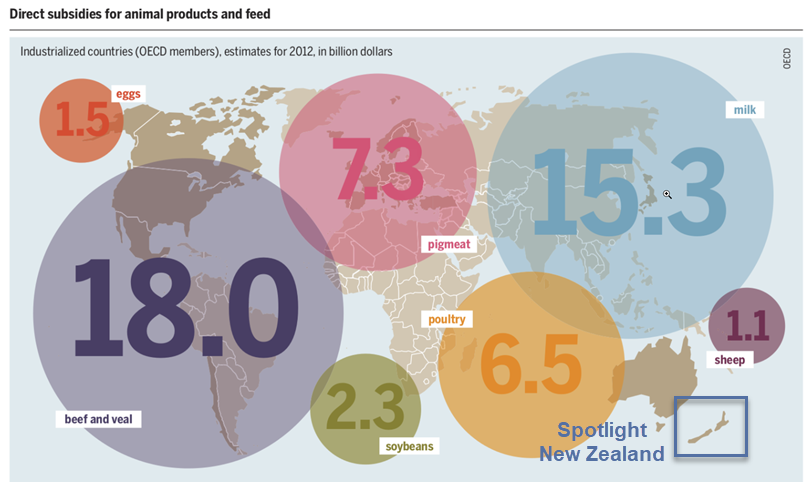
New Zealand is reputed to have the most open agricultural markets in the world after radical reforms started in 1984 by the Fourth Labour Government stopped all subsidies.
In 1984 New Zealand’s Labor government took the dramatic step of ending all farm subsidies, which then consisted of 30 separate production payments and export incentives. This was a truly striking policy action, because New Zealand’s economy is roughly five times more dependent on farming than is the U.S. economy, measured by either output or employment. Subsidies in New Zealand accounted for more than 30 percent of the value of production before reform, somewhat higher than U.S. subsidies today. And New Zealand farming was marred by the same problems caused by U.S. subsidies, including overproduction, environmental degradation and inflated land prices.
I think we should treat New Zealand farmers better by removing our tariffs on all agricultural goods, just as they do.
Mike “Mish” Shedlock






























The fact that China has not been fair in trading with America is a major reason to strengthen ties with those closer to home. A very strong strategic dimension exists for NAFTA and when President Reagan fathered and endorsed the concept decades ago he recognized the need to create a powerful regional trade bloc to compete in a changing global economy. More of why working with Canada and Mexico is smarter than letting China eat our lunch.
http://brucewilds.blogspot.com/2017/11/nafta-let-us-favor-regional-trade-over.html
effect is the same. You raise the price above the natural price, resulting in more production, and less demand, and the result in a surplus. Why would you do this? Is the point to help farmers? Hardly. Overproduction assures that prices never get out of hand, and keeps marginal farmers in business, and keeps the overall profitability of farming down. Farm subsidies are NOT designed to help farmers. Rather, they are designed to assure over-production, which in turn means low food costs and assures that there will always be an ample supply of food. Take away the subsidies, and marginal producers would fail then prices and profitability of the efficient producers would rise, but, in bad years, you might have food shortages. Nothing would cause a group of legislators to lose their positions faster than an angry, hungry group of voters.
Most people never stop to think about what the real point of farm subsidies is. It’s basic economics, and works the same as interference in other markets. Whether you subsidize production, or support prices, the
“Didn’t work then…” It didn’t work for the oligarchs. I agree. For the rest of the population, it created the biggest and the most prosperous middle-class ever seen in the US.
Is that the situation facing the US today? Not really.
New Zealand in the 1980s was primarily an agricultural country, exporting food and importing most everything else. It made great sense for NZ to get the government out of farming by ending subsidies, and to reduce tariffs on imported goods, since NZ could not make those goods themselves.
Now, are tariffs the same thing as subsidies? Not really.
Are government subsidies bad? Absolutely! Bureaucrats and political cronyism interfere with efficient allocation of resources, while enriching the well-connected. See, for example, how subsidies for so-called “renewable energy” have created massive inefficiencies and distortions.
” And subsidies have nothing to do with the market distortions created?” If that is what you want to believe, AWC, go for it. As for me I would say subsidies always cause market distortions.
“”US corn ethanol subsidies”
“Burning food?”
Actually the solid by-product of ethanol production is used for livestock feed.
“Using fossil fuel based fertilizers? Only .gov could come up with something as asinine as that.” Actually the government does not produce fertilizer, and the companies that do, use the most efficient way they can find.