

Goodbye NAFTA, Hello USMCA
In what “seemingly” constitutes a major victory for Trump, Democratic Lawmakers Agree to Support North America Trade Pact.
House Democrats agreed to support the new U.S. trade deal with Mexico and Canada, marking a victory for President Trump who ran for office in 2016 on a pledge to remake or blow up the North American Free Trade Agreement.
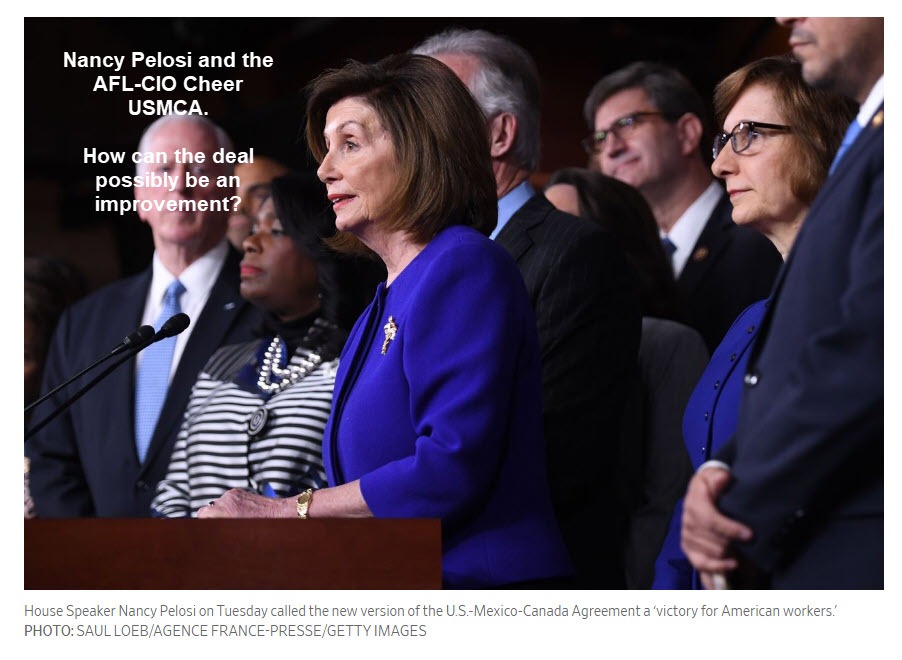
House Speaker Nancy Pelosi called the new version of the U.S.-Mexico-Canada Agreement a “victory for American workers” at a Tuesday morning news conference. The pact will replace Nafta when ratified and contains provisions aimed at creating more manufacturing jobs, for example, by increasing the proportion of vehicles that must originate in North America for the cars and trucks to receive duty-free treatment.
It also includes updated labor rules and beefed-up enforcement provisions to hold firms in Mexico to account on labor, according to people familiar with the emerging deal.
USMCA had long been supported by Republicans and leading business trade groups but opposed by Democrats over concerns such as the legal language enforcing new labor rules. The Democratic approval Monday comes as a rare bipartisan moment of cooperation on economic policy at a time when Capitol Hill is divided over the impeachment inquiry.
USMCA Key Provisions
- Mexican Labor: U.S. labor unions and Democrats have long complained that Mexican workers can’t always form unions freely and demand fair pay, a situation they say puts pressure on U.S. manufacturing jobs. The Trump administration’s USMCA has new additional labor rules, not included in the current Nafta, as well as new enforcement procedures demanded by Democrats.
- Auto Rules: Compared with Nafta, USMCA significantly tightens the rules that the auto industry has to follow in order to trade vehicles duty free in North America. A certain proportion of a car will have to be produced by workers with higher wages, and a greater proportion of components will have to originate in North America.
- Digital Freedom: USMCA, unlike the current Nafta, includes rules mandating the free flow of data among the three countries. This and other novel provisions on exchange rates and other areas aren’t so crucial for Canada and Mexico but could later be applied to pacts with more restrictive countries or even China.
- Agriculture: A deal to pass USMCA means farmers of major crops no longer have to worry about President Trump potentially pulling out of the existing Nafta and leaving them fewer major export markets. USMCA also gives dairy farmers more access to Canada.
- Pharma: Big drugmakers are likely to be disappointed, since Democrats pushed the Trump administration to remove language that would have protected expensive biologic drugs from generic imitators for 10 years. The existing Nafta treaty has no such drug protections.
Point by Point Comments
1: Pelosi wanted more, and settled for less. Five days ago, the Wall Street Journal reported Democrats Want to Invade Mexico. Essentially, the unions demanded that the US be allowed to enforce labor laws in Mexico. However, Mexico would not agree. Canada would not have gone alone either.
2: The devil is in the details. I suspect Mexico will be able to circumvent these rules, if it wants.
3: Digital rules accomplish nothing.
4: Agriculture essentially remains the status quo. Wisconsin dairy farmers do get a minor victory.
5: This is a potential victory for US consumers, but one that Trump did not appear to want. In practice, however, I wonder if it does much.
AFL-CIO President Rich Trumka Tweets

Dramatically Worse
Nearly anything the AFL-CIO supports is, by definition, bad for US consumers.
Thus, if this deal really is a “dramatic improvement”, I propose it is dramatically worse.
The one place Trumka is correct, most likely by accident, is on Big Pharma.
Trump on USMCA
Devil in the Details
What this comes down to is how easily Mexico can get around key provisions 1 and 2.
The more Mexico adheres to those points, the worse the deal Trump negotiated.
Good for Unions, Bad for Consumers
If it’s Good for Unions, It’s Bad for Consumers.
I wrote about that construct a couple days ago in France Should Take a Lesson From Ronald Reagan: Fire the Strikers.
Even FDR understood that public unions and public service were impossibly incompatible.
Click on the link for discussion.
Proud Union Hater
Unions promote on seniority, not talent. Anyone who wants to get ahead based on performance, not seniority, should not be a union supporter.
Moreover, corrupt union leaders get into bed with corrupt politicians. The combination is the biggest vote-buying racket in the world.
This puts the public at the mercy of militant teachers’ unions, police unions, and firefighter unions all demanding and receiving untenable pension promises.
GM and Ford
GM’s bonds, despite a bailout (necessary because giving into union demands bankrupted the company) are just a step above Junk.
So are Ford bond.
The strike is over. Hooray. But GM has a second date with bankruptcy court. Ford will have a first.
Pensions
Meanwhile, please note that Illinois pensions are among the worst funded in the entire nation. Things are even worse in Chicago where Each Chicagoan Owes $140,000 to Bail Out Chicago Pensions.
Chicago Mayor Lori Lightfoot’s only solution is the same as that of predecessor Rahm Emmanuel: Raise Taxes.
Get The Hell Out Now
These facts, and they keep piling up, is what prompted me to write on October 4, Escape Illinois: Get The Hell Out Now, We Are
Also consider Chicago Headed for Insolvency, Get the Hell Out Now.
In 2020 we are moving to Utah. We have had enough.
Trump Irony
Trump is bragging about USMCA. And most Trump supporters will see it that way.
But at best, the deal represents no significant changes.
Importantly, the more the AFL-CIO and Pelosi are right, the worse Trump’s deal is in practice.
Mike “Mish” Shedlock






























Common ground
Why the revised USMCA pleases both Democrats and Donald Trump
On this trade deal, their interests are aligned
Editor’s note (December 11th): This article has been updated.
UNION LEADERS and Democratic lawmakers were cool at first towards the USMCA, a replacement for the 25-year-old North American Free Trade Agreement (NAFTA) which was signed by American, Canadian and Mexican trade negotiators over a year ago. But on December 10th, after months of further talks, they swung behind a reworked version. Richard Trumka, the head of the AFL-CIO, America’s largest trade-union group, proclaimed a “new standard for future trade negotiations”. Nancy Pelosi, the Democratic Speaker of the House of Representatives, called it a “victory for America’s workers”.
The reversal may seem surprising. The AFL-CIO has not endorsed an American trade deal in nearly two decades, and Ms Pelosi is trying to get President Donald Trump, whose deal this is, impeached. According to polling data provided to The Economist by YouGov and published on December 11th, though 79% of Americans say that “trade and globalisation” are important to them, only 37% say the same of replacing NAFTA with the USMCA.
But both the politics and the content of the deal have led to unexpected alliances. Supporting the USMCA lets Democrats claim that they are not obstructing Mr Trump’s agenda for the sake of it. And on trade, Mr Trump has more in common with the left wing of the Democratic Party than with his own Republicans. Many Democrats agree that previous deals made trade too free, with too few of the benefits going to American workers. And several of the changes secured by the Democrats are meaningful. Some are sure to be to Mr Trump’s taste, too.
Among the revisions are an end to intellectual-property protections for biologics, a specific class of drug, and weaker patents for pharmaceuticals in general. Democrats say such protections stifle competition from generics and raise drug prices. Unsurprisingly, those changes went down badly with the Pharmaceutical Research and Manufacturers of America, an industry lobby. Its president said they amounted to an abandonment of protections for American companies.
Enforcement has been beefed up. Improvements to NAFTA’s dispute-settlement system are “probably the most important thing in the whole treaty”, says Jesús Seade, Mexico’s chief negotiator. Under NAFTA, countries could block the appointment of arbiters to hear awkward disputes. This should no longer be possible.
The shared vision of the Trump administration and Democratic lawmakers is clearest when it comes to labour standards. The aim was to make it less attractive to move jobs from America to Mexico than had been the case under NAFTA by supporting Mexican workers’ employment rights. But in the first version of the USMCA, the AFL-CIO complained, the bar for proving a breach of the rules was too high and enforcement mechanisms were too onerous. Critics pointed to the only labour complaint ever to make it as far as a formal dispute as part of an American trade deal: a case against Guatemala in which arbiters agreed that the rules had been broken, but not that any harm to trade or investment had been demonstrated.
The new deal shifts the burden of proof regarding such harm. To avoid penalties, defendants will have to show that it did not happen. Moreover, accusations that manufacturers are breaking Mexican laws covering freedom of association and collective bargaining will be sent for speedy consideration to panels of “independent labour experts”. Rule-breaking will lead to penalties on exports. Overall, the revised labour provisions are good for Mexico, Mr Seade says, and will reinforce its government’s own labour reforms.
The revised USMCA will restrict trade a bit more than NAFTA did. It will probably not live up to the hype. Even if greater use of collective bargaining raises Mexican wages, the USMCA’s official impact assessment suggests that American wages would rise by just 0.27% in response. But for Mr Trump, his Democratic foes and their neighbours in Mexico, it counts as a win.
“Chicago Mayor Lori Lightfoot’s only solution is the same as that of predecessor Rahm Emmanuel:”
Bite off the hand that feeds you.
Electric cars are the future of the auto industry???? Personally I don’t believe it. First of all is the price. The average American is not going to put up $40-50K for a vehicle that can only be used for a shopping spree. Americans want a vehicle that can PULL trailers, snow mobiles, boats, etc. Seen any electric vehicles pulling ANYTHING??? They keep talking about Telsa…In the first quarter, Tesla burned through $1.5 billion of its stockpile of cash and cash equivalents, which shrunk to $2.2 billion. The only ones buying their automobile are super rich. The working class isn’t going to plunk down $100K for a toy car that is limited in driving distance. Remember GM’s salvation??? The Volt. You don’t even hear about the Volt any more. It’s been discontinued for other future GM electric losers. Believe me..the reliable gas driven autos will be available for the rest of (anyone reading this post) your life.
If it’s good for AFL-CIO, then trump wins because he gets the vote for 2020.
It also gives credibility to his claim that us should do bilateral trade deals instead of tpp or other multilateral deals.
It’s the only thing trump’s done that hasn’t burned down, fallen over, and sank into the swamp… so… victory?
Interesting…. So once “organized labor” signed on to the ‘deal,’ the dam broke. What is the political calculus?
The Democrats are impeaching this President. Why not simply say that you need to wait until after the November election? At least let the incoming ‘Democratic’ party president have a ‘bite at the apple’ and negotiate a better deal? That all seems reasonable.
Me thinks that Trump is a good negotiator and that this is a tacit admission that the Democrats agree and believe Trump is unstoppable.
Time will tell….
Inquiring minds want to know………
Around 2008ish I read an article claiming that Toyota would crush Ford going forward. The reason? Pensions.
The argument was that Toyota has workers on a 401K and once a worker is retired they pay the worker nothing. ZERO dollars of a new Toyota sold was going to pay retired workers. Meanwhile, Ford was paying something like $2,000 of every new Ford sold to prop up an insolvent pension….ie…Ford was still paying retired workers.
Therefore, Toyota can dump more and more into research and development than Ford and make better and better products.
Japanese cars are so yesterday. Korea now makes far better quality vehicles and doesn’t have the debt overhang of US, Japanese or European companies. The rise of South Korea is an untold story.
For what it’s worth, this is what former US ambassador to Canada, Bruce Heyman, said about the new deal (after the politically smart move of cheering it as a win-win-win):
““Lo and behold, the president said the TPP was bad and NAFTA was bad…But what did we get? 65% to 70% of the exact language in this new USMCA is TPP. They lifted it right out of TPP. The rest is pretty much the structure of NAFTA with the exception of these auto provisions that were put in.”
As to the auto provisions, I suspect that Mish has a point in that they may lend themselves to being circumvented.
Heyman also said that “[a]lbeit the trade agreement isn’t so significantly different from NAFTA, I think optically it will appear much better.”
So, isn’t the new deal another instance of the Trump administration tearing down some existing treaty or international agreement, creating some artificial crisis or strife in the process, then restoring most of if not all of the original provisions with minor or questionable revisions and declaring victory?
By the way, if you see Pelosi and labor celebrating the deal, you know Trump caved because either the economy is getting really bad or his days in the White House are numbered. Either way this is a huge loss for Trump and a win for the globalists.
Actually, I think it means Pelosi caved – probably because their polling told them that Trump’s constant tweeting about the Democratic Congress “doing nothing for American workers” by failing to pass the trade deal was starting to eat into their support. Mind, I’m strongly opposed to Trump’s trade policies, but it should be obvious that they are fully in line with the well-established protectionist leanings of the Democrats and the unions – which is why you never hear them complain about his trade antics. I found it quite odd that they were taking so long to pass this NAFTA 2.0 accord, since all that did was damage them politically. Then again, they seem hell-bent on committing hara-kiri anyway, as evidenced by the impeachment circus and the party’s shift to the hard-left.
What is most funny about all this is that back in the 19th century, the Democrats were the champions of free trade (incidentally, the civil war was in reality a war over tariffs and trade – the abolition of slavery was a secondary objective that was mainly elevated to prominence for propaganda reasons. After all, Lincoln himself was demonstrably a racist). Workers were actually holding street protests against the protectionist policies of Republican administrations. They rightly accused them of only protecting the profits of big inefficient businesses while raising the prices of goods and services for the common man (political cartoons published at the time attest to the fact that this view was widely shared by the working population). Evidently, the citizenry was economically quite literate back then. This is also confirmed by the intense public debate over the monetary system and sound money at the time. Nothing comparable is even remotely thinkable today.
Neither side got what they wanted but the Dems looked happier about it. Trump looks like he gets marginalized when he cant stand up there with labor the way Reagan did.
A clear victory for Trump. A lump in the throat of Pelosi.
It is actually a lump in the throat of McConnell and other Republicans who always loved every trade deal that was signed even though it was a giant sucking sound of jobs going to Mexico (may Ross Perot RIP). See my post above from the Economist on why this trade deal was a win-win for Trump and Pelosi/Democrats. But Trump comes out looking less Presidential when the deal is celebrated by labor and Pelosi in public. Ronald Reagan worked with labor in the early 80s to grow the US economy and it led to his re-election. Today we have a president who is up for impeachment but Democrats are happy to work with him and Republicans where there is alignment. If he is still in office come next summer, will labor in swing states cross over and vote for him when they now know it was the Democrats that wanted a stronger agreement ? It is possible that this deal will also tip the scales in some house and senate races not in favor of Republicans who wanted a deal that favors corporations. This is a win win for Trump and Democrats because it will allow Trump to campaign for more interventionist Republicans when it comes to trade but in many places those Republicans no longer exist so that helps the Dems too.
As I predicted. There are no enforceable laws in Mexico even by the Mexican government. They have enough problems with cartels and will invite any company to break laws as long as it brings jobs there. The underground economy in Mexico will continue to flourish. There is no trade agreement that can change the forces of globalization.
Ford had a chance to succeed, but chose failure when managers and executives refused to take the advice of the engineers who designed the transmission for the Fiesta and Focus. Warantee work has cost more than $3B. Redesigning or fixing the problems BEFORE hitting the makret certainly would have cost less. Every company or organization that is lead by someone who does not have sufficient knowledge about how to design and build its products are at risk of bankruptcy.
You mean like Boeing?
That’s what they get for pushing crap out the door without testing it and blinded by greed profit number crunching before the junk is even sold. Apparently it’s the norm and the lesson is never learned.