

Wired reports Self-Driving Trucks Now Delivering Refrigerators.
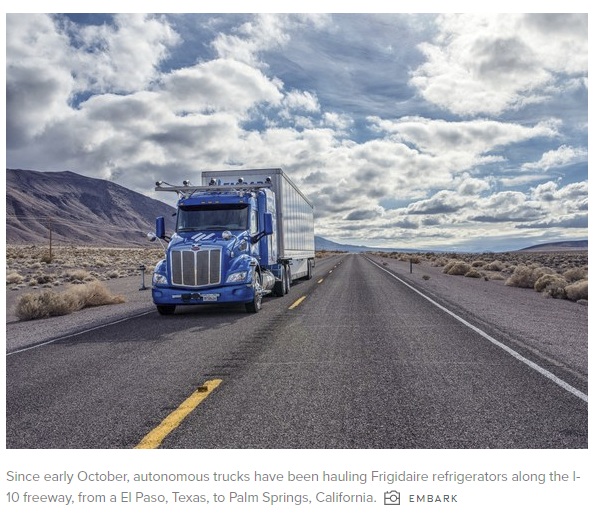
IF YOU LIVE in Southern California and you’ve ordered one of those fancy new smart refrigerators in the past few weeks, it may have hitched a ride to you on a robotruck.Since early October, autonomous trucks built and operated by the startup Embark have been hauling Frigidaire refrigerators 650 miles along the I-10 freeway, from a warehouse in El Paso, Texas, to a distribution center in Palm Springs, California. A human driver rides in the cab to monitor the computer chauffeur for now, but the ultimate goal of this (auto) pilot program is to dump the fleshbag and let the trucks rumble solo down the highway.“This is the first time someone has demonstrated this end-to-end,” Embark CEO Alex Rodrigues says. “It showcases the way that we see self-driving playing into the logistics industry.”They’ve got some good arguments. First off, making a robot that can drive itself on the highway, where trucks spend nearly all their time, is relatively easy. You don’t have to account for pedestrians, cyclists, traffic lights, or other variables. The big rig just has to stay in its lane and keep a safe distance from fellow travelers.In the US, more than 4,000 people die in crashes involving trucks every year, crashes that nearly always result from human error. That’s why the American Trucking Associations has embraced the new tech, recently issuing its first autonomous vehicle policy, calling for uniform federal laws that could help developers and researchers make automated and connected vehicles safer than humans. (The Teamsters are less enthused, and have pushed against the inclusion of commercial vehicles in coming federal legislation.)For now, the Embark milk runs are designed to test logistics as well as the safety of the technology. On each trip, a human driver working for Ryder (a major trucking company and Embark’s partner on this venture) heads over to the Frigidaire lot in El Paso, picks up a load of refrigerators, hauls them to the rest stop right off the highway, and unhitches the trailer. Then, a driver working for Embark hooks that trailer up to the robotruck, cruises onto the interstate, pops it into autonomous mode, and lets it do its thing. The truck mostly sticks to the right lane and always follows the speed limit. Once in Palm Springs, the human pulls off the highway, unhitches the trailer, and passes the load to another Ryder driver, who takes it the last few miles to Frigidaire’s SoCal distribution center.
Hub to Hub Model
Read that last paragraph above closely. It precisely fits my hub-to-hub interstate model that I have talked about for years. Long haul trucking is about to die a sudden death.
The “Under” Line Wins
Reader Mat emailed me earlier today stating “You won the under!”.
To verify, I had to check my calendar. A quick check shows I am not Rip Van Winkle waking up in 2040, 2030, or ever 2025. Rather my calendar reads 2017 and self-driving vehicles are on the roads.
For now, there is a backup driver. I suspect that will last about 18 months, but to be safe I will suggest 2021 before truly driverless is common if not the majority.
Nonetheless, the nay-sayers are now so mind-boggling convinced this will not happen, they will likely insist that it won’t happen even after the majority of tucks on the roads are self-driven.
I will do a follow-up post soon on how many jobs will die.
Mike “Mish” Shedlock






























!function i(n){if(n.ADNXSMediation&&”function”==typeof n.ADNXSMediation.noAd)n.ADNXSMediation.noAd();else{if(window.top===window)return!1;i(window.parent)}}(this); reading the new mishtalk on iPad Pro. Just pressing the enter key, enters the post..
like this:
It will work great until the exceptions start to roll in. Like stack overflow crash boom bang. Would you like a self driving baby sitter for your kids? Thought so..
The industry is so fragmented and such a disaster that this is welcomed. As an entrepreneur, the trucking industry is one of the last great frontiers to make money in if you’re smart and adopt all this technology faster than everyone else. Moreover, as the old timers retire and/or try to fight all this coming technology, a savvy and quick footed entrepreneur will be able to capture this industry. Who’s up for the challenge?
I suspect the great fiction of ceteris paribus is at work here. Cheaper crappier 3rd world truckdrivers driving 3rd world built trucks will delay the adoption of these things longer than people think.
Globalisation – ain’t it great?
@grumblenose, thanks for the laugh, 25 years! OMFG, you are either trolling or completely delirious. which is it?
I’m amazed with the assumption that we’ll have a functioning economy in two years! What if it all goes into the proverbial? That’s worth thinking about. Then all of a sudden we’ll not get the economies of scale everyone is talking of.
And as welcome…
I see even the staunchest Luddites are struggling to summon the will to comment anymore. I certainly have ceased feeling the need to defend self-driving technology. It’s as inevitable and imminent as the sunrise.
Bizbuyer, I don’t think trucking companies are going to reap large rewards (profits). I suspect they’ll all get squeezed by the Amazons/Walmarts into providing lower trucking costs based on the savings of no drivers. The early adapter companies may make short term gains but long term they’ll all end up at the same place (or out of business). Independents will probably be fine. At least those that do short haul (home that day) because that will take longer to automate (mostly city driving) and be less cost effective (because drivers still needed to sign off paperwork on both ends, potentially help load/unload etc.
Bizbuyer,
Also – this should drive a consolidation in the trucking industry – now that you no longer need drivers – all the independents go away as they no longer can compete on cost of capital – all the small truck dealerships also would go away as now you would have purely fleet sales. Truck stops will get hit too, the new trucks will need fuel, but without drivers, there is no need for restaurants, motels, shower facilities, convenience stores, etc.
SoooOOOooo Mish, what is the macro investment play here? Go long trucking companies ($ saved by firing all the drivers, lower operating expenses, etc.? offset by huge capital costs in the beginning) Shorts to offset / hedge? Trucking insurance companies (lower risk = lower premiums?)
I really expect to see some of the railroads buy out a Werner, or Schneider or J.B.Hunt and incorporate autonomous vehicles into their intermodal hub network designs. I also expect to see the same sorts of autonomous technology be adopted rather quickly by the railroads once they get through the hurdle of PTC implementation. In fact it’s the next logical step. Moreover, you can probably start getting a set of semi-autonomous drones (maybe what you replace engineers with are locomotive situated drone pilots who would pilot the train drone fleet) that would monitor train conditions up and down the train (allowing for longer trains) as well as one running out in front (to look for track defects/obstructions/vehicles, etc). Control could then be passed to another set of yard drones and automated yard slugs that could dismantle and reassemble trains in the yards, as well as move intermodal cars to lots for largely automated cranes to load onto the autonomous trucks for mid-range distance distribution.
The insurance companies will end this debate as soon as the first set of empirical data shows that the human in the vehicle is, indeed, non-competitive.
@Stuki None of what you said has anything to do with my post.
@RSM:
The problem is no different than as pertains to any other tool: Humans are ridiculously flexible, and can do pretty much anything. but rarely in an optimized fashion. Machines are the exact opposite: Darned efficient at a narrow set of tasks. A router had at least one autonomous feature once it could spin the bit on its own. Then added more when hooked up to a rail or jig. Then more once CNC controlled. Yet nowhere did it magically go from being non-autonomous to autonomous. The world is a continuum. Attempting to shoehorn it into arbitrary discrete classifications, while sometimes useful for rough communication; becomes nothing but a roadblock, once someone’s arbitrary classification scheme is then treated as a first principle in and of itself. With laws written to conform to the various “classes,” arbitrary privileged clowns tasked with “determining” what “class” something/someone belongs to, so that they can be treated differently etc…. This is the Way of the Progressives. Meaning: Nothing but the lowest and most destructive of human endeavors.
Like routers, cars have had some autonomous features since they were invented. At a minimum, they moved under own power. Faster than a human, or ox, could push or pedal them. Hence were useful. Over time, they have added more autonomous features. From climate control to cruise control to engine diagnostics to rain sensing vipers. Which has made them more useful. And they will continue to do so; adding more and more sensors, making cruise control more and more versatile. Leaving the driver to focus on other stuff, like texting.
There is no magical, arbitrary point at which a car suddenly becomes something different. At least not until no human is required for any task related to the vehicle whatsoever. At which point the car is a living being, capable of reproducing and evolving on its own. Until then, they will just continue to be cars. Tools. With ever more fancy features tacked onto them. A cruise control with enough sensors to stay within a lane and avoid ramming an object in front of it, is a nice feature. Maybe for some uses, this is all that is required to be “autonomous.”
But it’s a long, long way from behaving optimally when involuntarily engaged in a running gun battle through downtown Manhattan. Including making the determination that a) it is in a gun battle and hence needs to drive differently than if under no threat, for example ramming the guy shooting at it; and b) the passenger it is carrying is hit and wounded, and needs to be taken too an emergency room pronto; but two of its tires are shot out, so perhaps it should focus on getting out of immediate danger and call and ambulance… Which, to others, is a requirement for a car to be “autonomous.” Human drivers can do this with at least some reliability, after all. Some Lidar and a microchip strapped to the roof of a Tesla… currently, and for quite some time, not so much.
@KidHorn I think you missed my point. I never said anything about how fast it would happen. My point is that at every step along the way the naysayers will be there to opine that, “Well they may have been able to ______, but they’ll never figure out how to _____.”
Same old song and dance from the very beginning.
@RSM You’re describing a slow process that will take years. I agree with that. It won’t be a sudden drastic switch to an all robot driving force where all vehicle drivers are quickly thrown into unemployment.
@CautiousObserver, totally agree on both points. Expect they will push mandatory automated driving along with electric engines “for our safety”.
These comments are going to get so entertaining over the next few years. Now it’s, “But there is still a human in there.” Next year it’s, “Well yeah it’s automated on the highway, but a human is still drive the last mile.” Then it’s, “Well this automated thing works for trucking, but no way it will work for personal autos.”
@Clintonstain
I have not seen our host publish anything on electric cars or semis lately. Perhaps he has softened his view on that. My own thought is there is no technology available today to make an electric car or semi that outperforms the I.C.E. in the ways that matter most, and that technology may not exist in the foreseeable future.
I think we only get wide deployment of electric cars if lawmakers make I.C.E. vehicles illegal, and if they do then we will all suffer for it.
The human driver has to pull it onto and off of the freeway, how’s that going to work with no human in the cab?
“It precisely fits my hub-to-hub interstate model that I have talked about for years.”
What a fraud. You came around to that position about six months ago because people like me and others with actual industry knowledge drug you there kicking and screaming by asking you pointed, practical questions you couldn’t answer. For YEARS you were predicting total automation in delivery in three/four years and now you’re claiming you’ve been pushing hub-to-hub “for years”. Oh please. Go back and read the comment history from your old blog Mike.
If you remember correctly, you’ve also been saying for years how electric semis are the wave of the future and that Elon Musk was *so* brilliant he was somehow going to overcome the laws of physics and engineering that make it impractical for long haul trucking. Where is that new “Beast” electrical engine he was supposed to show in October? Can he come out with more than 250 units a quarter while simultaneously electrifying house shingles and planning a trip to Mars? Doubtful.
“…but the ultimate goal of this (auto) pilot program is to dump the fleshbag”
I’ve never seen anything that so concisely explains the rise of Donald Trump than this does
Software algorithms tend to advance much more quickly than Moore’s law. Completely autonomous vehicles may not be far off:
https://bits.blogs.nytimes.com/2011/03/07/software-progress-beats-moores-law/
How is this any different than what Tesla offers? Or what google has done? This isn’t anything new. There’s still a driver in the vehicle and the route is very easy. We’re still a long way off from self driving cars becoming the norm.
one last thought, will autonomous trucks (that are at least a decade away according to some) have lug nut spikes?
hmm, probably some fleshbags are more equal than others
just in case anyone’s forgotten, we’re all fleshbags…
wow, no one commented on this?
“dump the fleshbag”
Actually, Mish, your calander should read 2017, but otherwise, point taken. By 2025, there will be no jobs left for anyone. Humans will simply be bred to feed the robots.
That weight limit restriction will not last – was just for the testing phase
https://thenextweb.com/artificial-intelligence/2017/07/31/teamsters-convince-congress-to-block-driverless-trucks/
It does seem like enabling really long runs will require special configurations at truck stops to handle autonomous rigs refueling, but that’s not hard, at least in the wide-open West. Give them a dedicated lane or two, with a human staffer; charge a bit more for the privilege. Done.
This nicely highlights why the “last mile problem” isn’t a problem even in the short term – have humans handle the local legs. Just a form of drayage. As tech improves that’ll be eliminated too.