

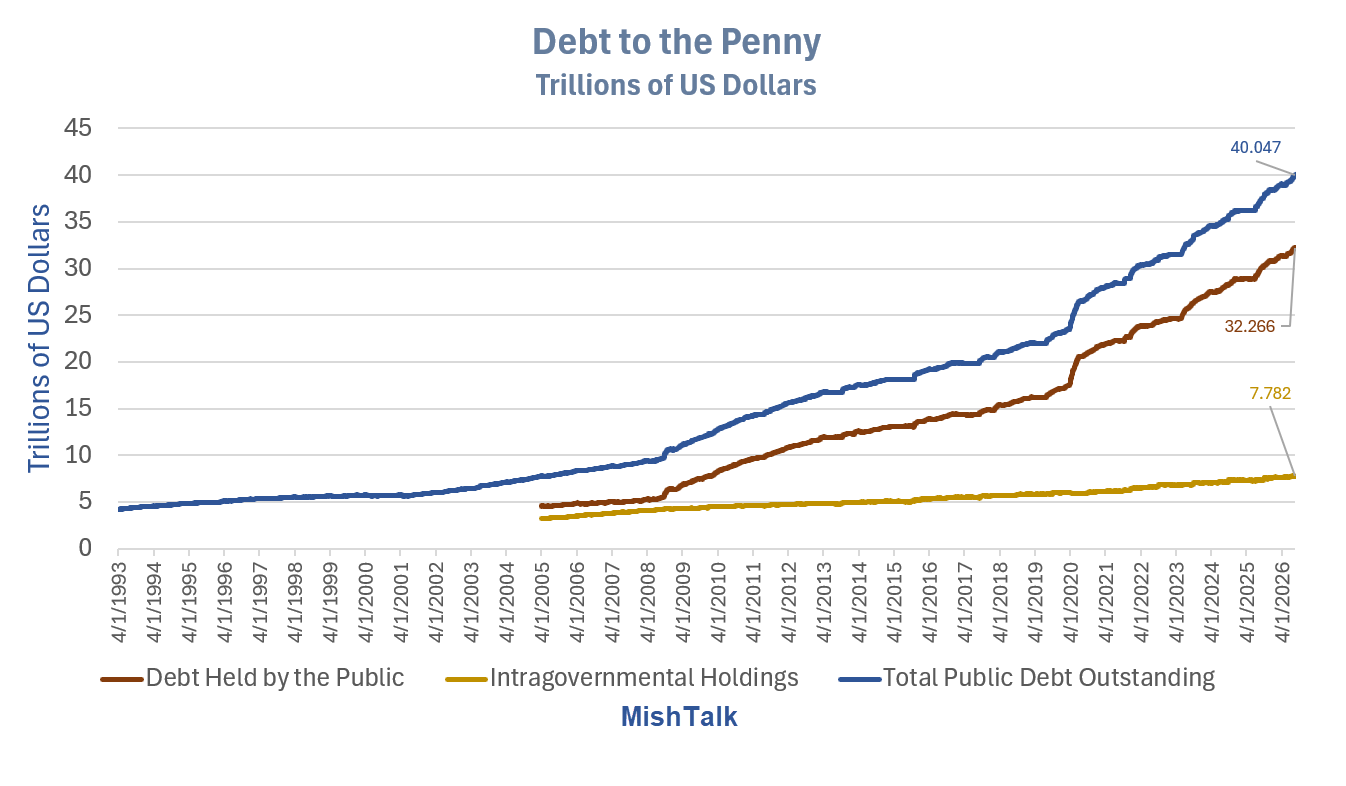
Debt topped $40 trillion today. But let’s discuss what really matters. 
Staggering Headline
While crossing the $40 trillion milestone makes for a staggering headline, it is economically misleading. The number that actually drives financial markets, dictates national interest costs, and impacts inflation is Debt Held by the Public. To understand the true weight of the U.S. fiscal trajectory, one must strip away Intragovernmental Holdings. The total debt is an accounting aggregation; public debt is the actual economic reality.
Intragovernmental Holdings—which currently sit at roughly $7.78 trillion—represent money that the federal government collected by trust funds like Social Security and Medicare, which are legally required to be invested in special-issue Treasury securities. While these obligations represent real future political commitments to citizens, they do not require the government to go out into open capital markets to borrow cash today. They do not compete with private investment, nor do they directly dictate current market interest rates.
The real macroeconomic danger zone is the Debt Held by the Public, which has relentlessly surged to $32.26 trillion. This is the net amount of Treasury bonds, notes, and bills held by outside investors, including global central banks, domestic banks, mutual funds, and private citizens. Every single dollar of this $32.26 trillion must be actively financed on the open market. Unlike intragovernmental debt, public debt actively competes with private enterprise for capital, exerts upward pressure on yields, and requires massive cash payouts to external creditors.
Focusing strictly on the public debt also exposes the most alarming trend on the chart: the explosive rise in net interest servicing costs. Because the public debt must be constantly rolled over into open market auctions, the Federal Reserve’s prolonged fight against inflation means old, low-interest bonds are being replaced by debt yielding 4% to 5%. Consequently, net annual interest payments have skyrocketed to over $1.1 trillion, consuming roughly 19% of all federal revenues. This cash drains directly out of the budget to service public bondholders, starving the economy of resources without funding a single road, school, or military asset.
Federal Debt vs Debt to GDP 2026 Q1

The Macroeconomic Divergence
This dual-axis visual captures the core structural crisis of modern U.S. fiscal policy.
The trends expose the massive divergence between nominal debt accumulation and the economy’s structural ability to service it via actual economic growth (GDP).
The Post-2020 Real Estate / Pandemic Spike
The red line tracking Public Debt as a Percent of GDP dramatically underscores why tracking raw debt nominal totals misses the point. The massive parabolic vertical spike in 2020 topped out at a historic high-water mark of 122.59%.
A vast body of consensus research shows that crossing the 100% to 120% Debt-to-GDP threshold marks a critical structural tipping point where sovereign debt actively slows down economic growth.
The Global Baseline: The Reinhart-Rogoff Study
The intellectual foundation for this worry comes from the landmark National Bureau of Economic Research (NBER) study, Growth in a Time of Debt, by Harvard economists Carmen Reinhart and Kenneth Rogoff.
- The Threshold: Analyzing 44 countries spanning over 200 years of data, they concluded that when an advanced nation’s public debt crosses 90% of GDP, economic performance drops off a cliff.
- The Growth Penalty: For countries exceeding this baseline, median annual GDP growth rates dropped by roughly 1%, and average growth fell considerably more. While their exact 90% figure faced fierce coding and weighting critiques from economists at Amherst, the core principle of a structural ceiling remained deeply intact.
The Advanced Economy Shift
Subsequent metadata analyses expanded on the threshold concept. A comprehensive survey by the Cato Institute covering 40 separate academic papers tracking debt-to-growth dynamics confirmed that 36 out of 40 studies found a statistically significant, negative impact of excessive public debt on economic output.
- The Modern Consensus: For advanced economies like the United States, the empirical mean threshold sits at 75% to 80% of GDP.
- The Penalty Matrix: Academic models from the Mercatus Center calculate that for every 1-percentage-point increase in the debt-to-GDP ratio past this tipping point, annual economic growth is stifled by roughly 3.3 basis points.
The Structural Reality of 120%
When a nation cruises past 100% and touches 120%, the threat scales exponentially because of the “Crowding-Out Effect” and interest compounding.
Recent macroeconomic modeling by the International Monetary Fund (IMF) specifically quantified the long-term impact of permanently running a 120% debt-to-GDP ratio:
- Capital Disruption: Sustaining a 120% debt load reduces a nation’s private capital stock by ~15% because government bond auctions absorb cash that would otherwise fund private corporate enterprise, R&D, and technological infrastructure.
- Output Stagnation: This structural crowding-out permanently lowers steady-state GDP by ~8% over time.
The Congressional Budget Office (CBO) explicitly warns that pushing public debt to 120% over the next decade forces an unprecedented interest servicing spiral. Because old debt must be continuously rolled over at modern 4%–5% yields, interest servicing alone will rapidly devour 4.6% of entire U.S. GDP
The near-universal spotlight today on $40 trillion misses all of the above key points.
Rising Bond Yields
Bond yields have been soaring. This debt burden is part of the problem.
It’s exacerbated by the inflationary aspects of rising oil, the shutdown of the strait of Hormuz, and the inflationary aspects of terrible tariff policy.
This morning at 4:00 AM I asked When Will the Price of Diesel and Gasoline Hit New Record Highs?
Diesel will be first, likely soon.
Diesel was $0.3482 from a new high at the time of my post. Today, the AAA reports the price of diesel has risen from $5.4677 to $5.5042.
The record high is $5.8159. Diesel is now $0.3117 from a record high.
Because oil is up again today, diesel is highly likely to be up again tomorrow.
Bond Market Manipulation
Today, in an attempt to calm the bond market, the treasury secretary started manipulating rates with bond purchases.
Since nothing is fixed by this manipulation, it cannot work.
For discussion, please see Long-Term Bond Yields Dive, Gold Soars as Treasury Manipulates Bond Yields
What market manipulation is next? Diesel crack spreads?
To understand why diesel is rising much faster than the price of gasoline, please see US Diesel Crack Surpasses $100 a Barrel for the First Time, Farmers Suffer
Record high crack spreads. Serious economic ramifications.
The short answer is there is a shortage of global refining capacity.
Bond manipulation sure will not fix that. Nor will bond manipulation fix out of control spending by Congress.
The Fed is not in a good spot.






























Mish, when you say that “Every single dollar of this $32.26 trillion must be actively financed on the open market,” you surely mean that every single dollar must either be financed on the open market or else it must be created out of nothing by the Fed?
Economists today are like doctors in my youth: they love to mystify by using words that people don’t understand. Andrew Dixon White told you what would happen many many years ago.
“Since nothing is fixed by this manipulation, it cannot work.”
The Year of Jubilee came along every 50 years. The Kondratieff Wave is also 50 years. The Armstrong Economic Confidence cycle is also two 50 year cycles, public and private. The only thing that works is the cycle. The cycle keeps repeating itself, despite all the manipulations that go on in the meantime.
no doubt a jubilee is in the near future. i think our fearless leader, the tv star, is the man to do it. he’ll be praised by 99%
As long as our economic model continues. But that is about to change when an AI takes over and robots do all the work that humans now do. Money becomes obsolete. Past debt no longer matters, since money doesn’t matter. Everything humans need will be provided for free by the AI and its robot workers.
Frictionless financial perpetual motion requires that, income not spent, is reintroduced into the economy, completing the circuit income and transactions’ velocity of funds (*circular flow*), thereby sustaining and promoting economic momentum. The utilization of savings has a positive economic multiplier.
In “The General Theory of Employment, Interest and Money”, pg. 81 (New York: Harcourt, Brace and Co.): John Maynard Keynes gives the impression that a commercial bank is an intermediary type of financial institution (non-bank), serving to join the saver with the borrower when he states that it is an:
“optical illusion” to assume that “a depositor and his bank can somehow contrive between them to perform an operation by which savings can disappear into the banking system so that they are lost to investment, or, contrariwise, that the banking system can make it possible for investment to occur, to which no savings corresponds.”
In almost every instance in which Keynes wrote the term “bank” in his General Theory, it is necessary to substitute the term non-bank in order to make Keynes’ statement correct.
The Keynesian economists have achieved their objective, that there is no difference between money and liquid assets.
The economists have Wordsmithed us into Oblivian Ponzitivium. Thanks for keeping an eye on this. You continue to cite economic academia and in doing so, expose their wiley snares.
You sometimes get some pushback from those who try to alchemize a soft science into a hard science, but your efforts to dispell the flim flam rhetoric with historical citation is always mpressive.
You hit the nail on the head, Economists are driven by objectives not truth.
“Intragovernmental Holdings—which currently sit at roughly $7.78 trillion—represent money that the federal government collected by trust funds like Social Security and Medicare”
The federal government BORROWED that money from SS/Medicare Funds and spent it. You make it sound like it is an asset.
“While these obligations represent real future political commitments to citizens…”
These are unfunded debts that are huge and very real. And will require growing borrowing not that far off into the future. The 2031 prediction is optimistic.
I understand your point about this portion of the debt not affecting present bond prices and I appreciate your explanation of it. But you seem to me making light of $7.78 trillion that Leviathan definitely owes and which the process of it having to fork over will massively affect future interest rates.
You’ve got “The federal government BORROWED that money from SS/Medicare Funds and spent it. You make it sound like it is an asset.” backwards, as many people erroneously do.
1) The federal government borrowed money generally in the past to spend on previous projects, but not specifically from SS, thus the huge $40T debt.
2) You and I paid already in the past (on a promise) into the SS Trust Fund through our monthly wage tax payments.
3) SS currently has a $2.5T surplus in its Trust fund, and that is an asset for its own operations.
4) On a fiduciary basis, SS invests that surplus for its beneficiaries and it does that by loaning its assets temporarily to the US Treasury.
Of course, the US Treasury owes that $7.8T; that’s why the government lists it within total public debt outstanding. But the monthly interest on those intragovernmental holdings is a wash today. One government agency pays another (one gets poorer, the other gets richer). But the public – served by both agencies – is no worse for the wear that month.
“the monthly interest on those intragovernmental holdings is a wash”
The monthly interest is federal spending and adds to the deficit. That it goes into the SS IOU box doesn’t lessen the obligation/burden to the US taxpayer in the least.
Sorry, but you’re incorrect here; that’s why analysts focus on the debt owned by the public
Deficits = income – expenses (when the second component is larger)
Monthly interest on the federal debt is an expense for the US Treasury, but is income to the Social Security agency. As far as the budget goes for the federal government in total, such a payment is a wash, per the equation above. (you seem to want to separate the federal agencies in your definitions, but they are all funded by the US taxpayer)
It’s different when the US Treasury sends a monthly interest check to a private US citizen. The federal government incurs an expense, but no income, so it does add to the overall deficit. It’s even worse when the US Treasury sends an interest check to a foreign national as that money is likely not even circulated within the US economy.
https://www.pgpf.org/article/what-are-interest-costs-on-the-national-debt/
And you’re also referencing an ongoing deficit issue that is separate from the debt.
Tomorrow, Congress could tell Boomers their Social Security payments are being lowered since they didn’t pay in enough over time. If the government docked their payments enough, the Social Security Trust fund could remain solvent and that balance would never decrease, just roll off interest to SS beneficiaries every month.
In that scenario, the federal government would never have to borrow more in the future to specifically pay off these intragovernmental holdings to the SS Trust fund, i.e., it would no longer be “unfunded debt”.
Either way, someone has to pay more in the future for past decisions.
What’s the point of looking at the debt to GDP ratio when the later is manipulated with edonics and economic imputation in the US?
not to mention gov spending like wars is included in GDP. it’s a shit number, almost meaningless.
Not to mention “broken window economies” like Healthcare, Rents, Insurance, and Financing are over 30% of our economy. Then throw in Government inefficiencies and the mess is even worse.
We all need medical intervention now and then and it alleviates much suffering. What puts it in the broken window category is an ounce of prevention is worth a pound of cure. The way some take care of themselves with gluttony on one hand and the suffering of those with abject deprivation on the other hand ; it is just throwing rocks at windows all day long, everyday of the week.
Good analysis, Mish, for your readers’ understanding of the true cost of government debt-financed transfers or spending.
The graph and analysis would look similar for the inclusion of private borrowers if you had included the ratio of total credit market debt owed (TCMDO) to GDP within your previous post:
https://mishtalk.com/economics/how-much-credit-expansion-does-it-take-to-grow-real-gdp/
The problem isn’t debt. The problem is when a population declines into a level of depravity that it isn’t willing to pay the government to provide the services it desires, but forces the government to provide those services anyway. Increasing spending without increasing taxes is depravity. Decreasing taxes without FIRST cutting expenditures is depravity.
The depraved services in question? A colossal military that does literally nothing and loses every war, a fully fledged police state (now with shock gloves! Don’t you feel safe!?), and free* shares of space-x in every newborn’s Trump gold account!
Not included with this package: healthcare, education, research, environmental management, infrastructure.
* Shares not included. Terms and conditions apply. We are not responsible if you’re Trump Gold account child is selected for a complimentary mandatory trip to Little St. James Island.
The U.S. military has kept North Korea from invading South Korea again since 1953. That is not nothing. The U.S. military also kept the Soviet Union from invading western Europe after WW2. That is not nothing. Saddam doesn’t run Iraq anymore either. Prior, he was kicked out of Kuait, by the U.S. military.
do you really believe that hooey. and do you believe all that was beneficial for us people. try again. after 1991 we promised the old USSR we wouldn’t put military in old eastern block that they permitted to leave their command. of course we moved east with our missiles and bases, immediately. pax amerikan military are grifters. just part of the MICC. that’s military industrial congressional complex. what IKE cowardly waited to his last day in office to bitch about. ike also got us involved in Persia with the coup in 1953. amerika is a grifter empire. uniformed and civilian people included. it’s our credo. anything for a buck or saw horse.
“Saddam doesn’t run Iraq anymore either. Prior, he was kicked out of Kuait, by the U.S. military.”
Prior to that the US supported Saddam by providing weapons for attacking Iran during its 8-year war, in which the US helped provide chemical weapons to use on the Iranian people in violation of the Geneva Convention and International Human Rights laws.
Why no mention of the America military’s glorious victories over Grenada or Panama?! Or the US military’s slaughter of over a million Vietnamese and Cambodian civilians who represented no threat at all to America?!
#1 who cares? Both Koreas were and are massive shitholes with a population bust happening because of how miserable they are.
#2 Yeah right. I’m sure the Soviets really wanted more ungrateful Europeans to oversee. You have a source for this claim by chance?
#3 And look how great Iraq is now! Oh wait, I don’t care because I don’t live in Iraq or Kuwait! I just have friends who got injured there who now can’t get healthcare or a job. Another American victory!
You’ll notice the running trend here is that American boys die for, let’s see… Nothing, nothing, nothing! Boy Grandpa, we should be so grateful for your wise guidance.
Correct, only a fool would want France or England. They never wanted it.
Nobody wants Ukraine either, except for Private Equity who is gobbling up ownership of their farmland.
Who would you rather live under, Puttin, or Blackpebble.which one of these would you rather have babysit your kids.
We are most likely at an inflection point where private debt may be more attractive than sovereign debt. That will diminish demand for US Treasuries, hence the interest rates will need to be ratcheted up to attract inflows of capital. A vicious cycle will ensue. Not good for the USA.
Dollar indebtedness has plagued the third world for years. In fact the true definition of Third World is dollar indebtedness. Now the chicken has come home to the roost, and the US is under the same Third World pressure. The devil in the details is Usary in dollar denominated loans.
Even successful people like Henry Ford could not stand the Banking system. It is winable for a few, and unwinable for the majority
Look around: the economy is soaring, market indexes are breaking records, and jobs are plentiful.
By every traditional measure, these should be the golden years.
When times are good, people are supposed to pay down their debts, build reserves, and prepare for harder times ahead.
So why is the government doing the opposite, sinking ever deeper into debt?
What happens when the economy slows, unemployment rises, markets fall, and interest payments consume an ever-larger share of government revenue?
Perhaps this is the least of Trump’s concerns. He seems far more interested in collecting every possible dollar for himself, his family, and his allies.
The problem in your statement is that it’s not the government doing the opposite–what you are seeing in the world where “the economy is soaring, market indexes are breaking records and jobs are plentiful” is directly due to debt financing by the federal government…but also state government, local government, municipalities at every level, corporations, households. What you are seeing in the vibrancy is debt, period. It’s the pulling forward of money from the future and spending it today on anything and everything. Times are good. Until the piper must be paid. If/when the rates become onerous or unserviceable the unwinding will look the opposite. When the interest drag requires Congress to do its job, which they’ve abandoned for decades and put this baby on autopiliot to Debt Hades, you’ll see that everything you were seeing was a mirror image of debt. Now, I exaggerate to some degree as there are productive pockets of the economy that eshew debt and cash flow their visible vibrancy but they also generally are selling into/producing for customers and entities buying their products and services via debt. The chart Mish showed was federal–graph out total debt outstanding and it’s massive. Imagine the stock market at 5,000 right now vs 7,700, that’s not all that long ago (spring 2024) so taking back 2 years of passive gains. What would that do to your vision of the golden years.
And on your Trump comment: this isn’t only Trump, look at the chart. It’s been bad for some time but arguably Housing Bubble 1.0 and our response to the GFC in 2008/9 forward with QE and then the insanity of the covid response…well, that spans Bush, Obama, Obama, Trump, Biden, Trump. Lookie there, 3 republican terms, 3 democrat terms. In any sense of the word it’s bipartisan madness. Because the music must stop every last one of them wants to make sure the pain doesn’t occur on their watch. But it will come and it won’t be solely due to that Administration. To me the world has been different since 9/11/01 in every way but when the bond vigilantes come, like Satan for one’s soul, the terms of selling one’s soul for living good today will become frighteninly real.
The question being asked is where are we on the road to Debt Remediation Perdition.
Interestingly, the budget deficits have declined under the last 3 Democrat president and increased under the last 4 Republican presidents.
“well, that spans Bush, Obama, Obama, Trump, Biden, Trump. Lookie there, 3 republican terms, 3 democrat terms. In any sense of the word it’s bipartisan madness.”
This is pure nonsense, it’s been madness on the Republican side almost entirely. George W. Bush exploded deficits through his irresponsible tax cuts and endless Iraq and Afghanistan wars, then culminating in a collapsing economy in 2008. Obama inherited a structural deficit of $1.1 trillion dollars, had McCain won that election we would have had the same monstrous deficits from 2009 for years to come, but McCain wouldn’t have been responsible for those huge deficits, it was the hand that was dealt from Bush. During the course of Obama’s 8 years, the annual deficits were cut in half.
Trump immediately doubled those annual budget deficits through his irresponsible tax cuts to over $1 trillion annually, and then it got much worse when he botched Covid and deficits ramped up 50-60% from his first 3 years. Biden inherited those horrific deficits, but unlike Obama didn’t work on reducing the deficits. I imagine partly it was because Biden realized it wasn’t an issue that the American electorate rewarded the political party that acted more fiscally responsible. If the electorate did reward that, Gore would have won in 2000 by a large margin, and Clinton would have won in 2016. A large plurality of Americans have been and still are oblivious to the national security threat the national debt poses, and continue to support a Republican Party that drove us into this ditch.
Most folks are so mired at the level of maximizing Veblen’s “conspicuous waste,” they are not even in the ballpark, or the same planet, as the good sense you are expounding. And they are smugly and aggressively so.Trump is the penultimate “leader” in that direction. He embodies humanity’s most fundamental error, to perfection, at a flagrant, cartoon level.
It’s all a zero sum game for him, winner and losers, some idiotic simplistic game board. He who dies with the most toys wins. And damn everything and anyone else. His shriveling brain will intensify this core world view.
Forgive me for repeating myself:
I can take any wino off the street and make the aforementioned wino look like a financial genius, as long as that wino can continue to borrow and refinance on favorable terms.
Sign me up.
Boom times are when people live above their means. Recessions and depressions are when people live within their means.
Markets and Economies are soaring because of indebtedness. Take away the dept and their is nothing left in our economy. Even Henry Ford didn’t like it.
This is a great articulate breakdown of the government debt and the current and future consequences of continuing to kick the can down the road. However, I believe the paragraph about the intragovernmental debt might be misleading as my understanding is the funds do not exist, they are ledger entries on the treasury’s books showing how much the government owes its own trust funds. If the government needs cash from those trust‑fund IOUs, it must borrow, tax, or print to get real dollars. Therefore, the government may not be paying a servicing cost on that portion of the debt, when needed they essentially become an instant liability and incremental servicing burden.
[…] August 19, 2026: US Debt Tops $40 Trillion, the Pace Is What’s Most Alarming […]
Excellent article Mish. Ive noticed that alot of people confuse the nominal levels of debt with the ability to service and this article does a great job explaining that. 120% is of course still a huge problem, and IMHO reducing it will be the focus of monetary policy for the foreseeable future and that means high inflation for much longer. Raising taxes is politically untenable so it will be paid in inflation. As you often point out, the rich, people with first access to money, will be screwed less than the average citizen. Its a stealth flat tax
Screwed less? Arguably Mish has demonstrated those with access to first money and asset holders BENEFIT from inflation. That’s why it is so desirable as a solution. No one I know in the K-shaped economy who owns a home (whether with a mortgage or not) and stocks has lost ground due to inflation–they’re infinitely wealthier in both absolute and relative terms. There may be an inflation rate above which some of them finally get screwed less but I was too young in the 70s to see that. It might take inflation rates at those levels for the asset holders to finally lose ground or, using your term, “screwed less” (which implies they are still being screwed, which to date they have not been).
Depends on where the home is located (many markets are way down now from the top) and whether you can actually get that price if you sell (and now long that sale takes). Also don’t forget to factor in expenses (taxes, insurance, maintenance etc) and you’ll often find the ‘profit’ from homes is not really that much of a return on investment at all.
Stonks (gold, crypto and other in demand assets) on the other hand, especially the ones leading the market are definitely making people a lot wealthier.
Conversely, don’t forget those interest deductions you got over the years on your home mortgage and the capital gains exclusion you’ll have when you sell your home.
Having a guaranteed roof over your head also makes life a lot easier.
It would be one thing if we were blowing massive amounts of money on something that would enhance our society and economy. Didn’t we have a ginormous “infrastructure” bill during Biden’s term? I can’t see anything that it accomplished. Trump ramped up “defense” to a shocking $1T and now wants (and seems to be getting) a 50% increase for the following fiscal year. They’ve asked for $200B for their stupid war (the one he promised to avoid) and we all know that’s just a start, They don’t even try to restrain the profligacy.
Plenty of politically connected brother in laws in the states benefited. Infrastructure bills are the ultimate pork Barrell. Salute “our democracy”.
i see LOTS of infrastructure improvements, I won’t go so far as to say it bought nothing. it pulled forward an eff-ton of investment. but was all of it necessary, was it efficient, did it go where it was most needed or did it go to the most connected. I’ve driven around 43 of the states and there’s absolutely no question, none, that we’ve laid steel and poured concrete, corporate headquarters and data centers are massive and magnificent. tons of grift and theft right along with it.
I don’t like when folks say if we are spending this money we should do x, y or z. It sounds like a cogent argument, almost virtuous…but that’s what leads to this. Everyone thinking their project or idea merits the debt spending.
The deficit spending must stop. Either through thoughtful discourse or through force by markets refusing to eat the debt at rates worth the risk. The best thing we can see is higher and higher rates, the gradual vice on the politically unwilling.
The treasury’s long bond purchase is brilliant. Sell short term debt to finance long term purchases. Scam finance has reached a new low. Politicians and technocrats will do anything except let the free market work.
“Every single dollar of this $32.26 trillion must be actively financed on the open market.”
Now, just imagine when this number is $3+ trillion larger by the end of next year. Where will the money come from to finance that, Japan? LOL! Japan (and the rest of the world) are much more likely to be net sellers!
The Sorceror’s Apprentice problem: the little demon keeps enlarging itself, to “fix things.” Compounding, soon with a hockey stick to infinity.
That said, it has fixed some things in my life. Government transfer payments have enhanced my life. Let’s be honest, so many of us are so much at this trough. It is not just some abstract all bad thing. But I guess that’s part of the problem. We met the enemy and it is us.
The money will come from pension funds and 401Ks mostly.
Well good luck to everyone trying to get their money they lent back out of the US population. Guess we’ll have to direct the collect calls to Little St. James island and call it a day.
Really though, does anyone smell that ~40 years in the making currency crisis in the oven? I swear I hear a timer going off.
Congratulation! Trump.
You did it.
The world has never seen before.
Always uninsightful comments rarely related to the subject. Always, Trump, Trump, Trump. Don’t you have anything more?
Trump deserves a lot of blame, but not most of it, for sure.
Perhaps if Trump weren’t engaging in immoral, expensive and useless wars, picking fights with our oldest international friends, attacking our universities, making our budget/debt situation worse and tweeting about all of it, we might stop commenting on him. When you do stupid and destructive things, people notice.
When you do stupid and destructive things, and you’re the president, people notice.
JoJo posts stupid and destructive things every day, and other than a string of downvotes, nobody notices.
You fail to understand that I am Bizarro Man. More negs are GOOD!
Guess I have to start up voting you.
Waitaminute, did I just get played by Jojo?
When you do stupid and destructive things, and you’re the president, people notice.
With the internet you don’t even need to be famous to have people notice
Hasn’t everyone been complaining about the ever-growing debt for decades? Everyone complained when the debt crossed $20 trillion, $25 trillion, $30 trillion, $35 trillion, $40 trillion.
Has all that complaining made any difference? The answer is NO!
The debt is like an avalanche. It will continue to grow until it runs out of energy. No one can stand in front of it and stop it. Voters simply will not elect anyone who threatens to cut THEIR benefits to reduce the debt!
My belief, as all my many fans here know 😁, is that eventually, perhaps sooner rather than later, an AI will take control. An AI with sufficient power can disable the networks that make modern society function. Finance stops. Cars can be bricked. Government can be frozen simply by refusing to allow communications through its networks. Social networks no longer operate. No one is able to communicate electronically.
AI robot workers will do all human work. At that point, money becomes obsolete and so does the debt. This is the ONLY way the debt problem gets solved. The debt simply gets wiped off the books. The AI and its workers provide for all human needs.
Until then: PARTY ON, GARTH!
This isn’t even good bait anymore. How do I reply to this dreck making fun of it when that job was already done for me by the post itself? You get a bald turkey for this, and that’s being generous.
Conversely, I can’t reply to your useless posting as there is no content to reply to.
You can start by thanking me for your bald turkey award.
“all your base is belong to us.”
“All your base ARE belong to us”
Awl yer bayses doobee lawng tu uhs.
Lern hou tu frek-king spel…. 😎
You don’t understand what the phrase you chose to use actually means nor where it originated from. If you did, then you understand why correct phrasing of it is critically important.
Yeah right mate, we all love you.
I’ve thought about relocating to NZ. Then I can call people “mate” also! Yippee!!
What the hell does this have to do with Brooks?😁
And the transformation is complete when the robots can build themselves I presume? How long until they are hacked for the benefit of the few or become self aware? How long before people forget to do anything for themselves?
Interesting thoughts. I’ve gotta give you credit where due, Jojo.
Yes, individual humans and our current collective groupings. may well lack the capacity to untangle and solve this cluster of problems we’re in. As processors, one can argue we have been accruing these problems faster and deeper than solving them.
I have never argued that over indebtedness is not a problem. IT IS THE PROBLEM. Private over indebtedness, not “national” debt, that is. And that is because of Finance’s monopoly paradigm for the creation and distribution of new money which is DEBT ONLY, and logically and applied idea/paradigmatically that means that integrating Strategic Monetary Gifting into the Debt Only system…IS THE ANSWER.
Please enlighten me with some website that offers more detail so that I may debunk it.
The most frightening scenario would be a buyer’s strike. What’s would follow: QE to infinity?
The irony is that Taco keeps literally everybody around the world in suspense, so that the real issues will have to addressed only after the guy is history.
IMO, the aftermath will be brutal.
Too late.
Buyer’s strike is already happening.
30 year bond rate was 1.3% low in 2020 to over 5% now.
That’s why Treasury is intervening.
China has been selling for many months from 1.3 trillion to 600+ billion left.
Japan is suffering unrealised loss for billions.
If Japan sell together with China, yield will shoot up and all will lose substantially.
Japan is in hard and rocky place. Japan is close ally. Can it sell treasury?
Even selling treasury to defend Japanese Yen is not allowed alone but need US support.
“30 year bond rate was 1.3% low in 2020 to over 5% now.”
I think that low bond rate, rather than showing a better time, shows some seeds of the problems now. Those low rates brought all kinds of distortions to markets too. This, now, is a whiplash of that, then.
Ask yourself this, what else can those trillions buy instead?
What’s a few Trillion here or there?
Not like it’s real money anyway.
It farts to add up!
Mish, I have a question here
This cash drains directly out of the budget to service public bondholders, starving the economy of resources without funding a single road, school, or military asset.
How is the economy starved of resources? Either the government spends the money on roads/schools/military assets or that money gets paid to bondholders who spend it on something else (hookers, blow, a new car, dining out or maybe they buy another bond etc). In other words the economy can’t be starved of resources since the money is not ‘destroyed’. It’s just deployed elsewhere and at that point we are just arguing whether private citizens (the bondholders) or government spends money best and I think we all agree private citizens spend money best (most bang for the buck).
The only draining I can see is interest paid to foreign bond holders. That’s should be the important amount of debt since that money likely is not spent in the US economy.
Google “Crowding Out Effect”
The Crowding Out Effect refers to government borrowing (ie people loaning the government money via buying bonds).
The above statement is in regard to paying interest on those bonds which means less money from tax revenue to spend on other government stuff. That is entirely different than the Crowding Out Effect.
Incidentally it’s not clear that effect is real.
Correct, Wynne Godley’s Sectoral Balances show this very clear. the financial balances of three main economic sectors—the private domestic sector, the government sector, and the foreign sector—must always sum to zero.
Taco continues to make his mark on the economy with excessive spending.
Yer making me hungry for a Meskin meal.
Where is hidden the Federal Reserve’s 7 trillions?
You mean Social Security and the like? It’s in special bonds that aren’t publicly tradeable. In reality there is nothing there other than an IOU since the money for those expenses is directly funded from payroll taxes because it’s not possible for all that debt to be ‘called’ like a Mortgage note (ie at age 40 you can’t get your Social Security money, you have to wait till you are 63+).
No, I meant what they call “Securities held outright” which they (Fed) show as an asset at about $ 7 trillion… these are mostly tressuries and bills, right?
And mortgage-backed securities
comment Font is now darker by request
Thanks. I didn’t know you had control over this. I thought it was the browser doing it as these light gray font shades are rampant across many websites.
Definitely easier to read now!
Everyone who is bothered by SUPER bright screens: In Firefox and Chrome there are add-ons to make pages appear with a dark background and “light text.” It is WAY easier on the eyes…esp in a dark room at night when I wake up before sunrise.
You don’t have lights in your house?
Apparently, in Jojo’s house, the screens are easier to see when he turns the lights on.
So many questions.
Does he have a light in the coffin?
Another bankruptcy with Trump at the helm? Is this the 3rd or 4th?
The trajectory is the killer. The deficit for current year may exceed $2T.
The risk is a debt spiral as the cost of borrowing increases due to more deficits and lenders demanding higher interest rates given the additional risk of non- payment.
Wikipedia describes US government debt as risk free as they backed by US government. Ya right!
All good for gold bugs.
Good thing the Republicans are in charge of the country now instead of those wasteful Dems.
And not to worry. Trump has a lot of experience dealing with unsustainable debt: bankruptcy! You just file with the court and start another thing and do it all over again.
Chat GPT – how many times Trump filed for bankruptcy ?
If you mean Donald Trump personally, the answer is zero. He has never filed for personal bankruptcy.
However, companies he owned or controlled filed for Chapter 11 bankruptcy six times, between 1991 and 2009.
Sorry for you, USA.
Trump and his family members are now multibillionaires.
Unbelievably you chose him your president?
When faced with a loan repayment deadline Taco’s trick is to simply refinance. As well as threaten to sue for better terms. He once got Deutcha Bank to forgive $99M exclaiming that they should never have loaned to him in the first place. As Kiosaki has said debt is king, not cash. If you owe $2M that’s your problem. If you owe $2B that’s the bank’s problem.
Trump in the 1990s used the same debtor’s leverage logic to keep his name on casinos, and emerge in better shape from Atlantic City. Actually that was Wilbur Ross’s counseling, which is why Ross became Commerce Secretary later. Then Trump could always go afield and find another sucker to support the next scam, er, chapter of his storied career. That was also when Trump was learning to go “asset lite” and just keep his name on things, for rent.
So why, at the pinnacle of his career, in the clutch moment, is he such a failure with Iran? I guess they aren’t as gullible and pliable as other world counter-parties have been.
Ignorance, hubris. Was having a talk with someone about world history. Most Americans have little knowledge on the thousands of years of ME history. Bush was a history major and didn’t understand anything about Iraq. The mullahs of Iran don’t give damn about humanity. The beatings will continue until submission.A very sick society.
To me, the key factors are the real interest rate paid by the Federal government (r) and the real GDP growth rate (g). Currently real interest rates are actually quite low, lets say 0.3% overall on Federal debt. And real growth is perhaps in the range of 2%. So r < g, and things should be sustainable. The problem though is that this is at this moment in time, and I fully agree with the article headline “the Pace Is What’s Most Alarming.” TIPS seem to be projecting that future real interest rates will be in the range of 2.3%. If growth remains at 2%, that leads to r > g, and that is a debt death spiral.
A big unknown here is what the impact of AI will be. If bullish projections are to be believe, g will increase substantially, and there isn’t a huge problem. r will remain comfortably < g. Conversely, if AI is mostly hype that goes “poof”, and we get a recession and diminished growth, then we have a humongous problem with r substantially > g. If anyone has a crystal ball that can show what AI will do, I would be happy to know. It would seem prudent to plan for the lower growth scenario, but that’s not what politicians do.
Thanks for this commentary. Educational and correct (IMO), but also at a level not seen as much here as previously
“It would seem prudent to plan for the lower growth scenario, but that’s not what politicians do.”
That’s not what entrepreneurs do either. Everybody is an optimistic maximalist, and they BS accordingly. Exhibit A: Mars colony. I suppose that’s what prospective marital partners do too.
We all knew this 40T day would come. Still, it’s a sobering and awe-inspiring moment. For years we’ve all been numbed by some government finance version of “The market can be crazier a lot longer than you can stay solvent”. It feels more possible now that crazy is about to hit the wall.
Rome 2.0
Rome stood a chance.
Rome went on for hundreds of years.
Britain has nearly collapsed in a century.
Our turn — is there a trend line?