

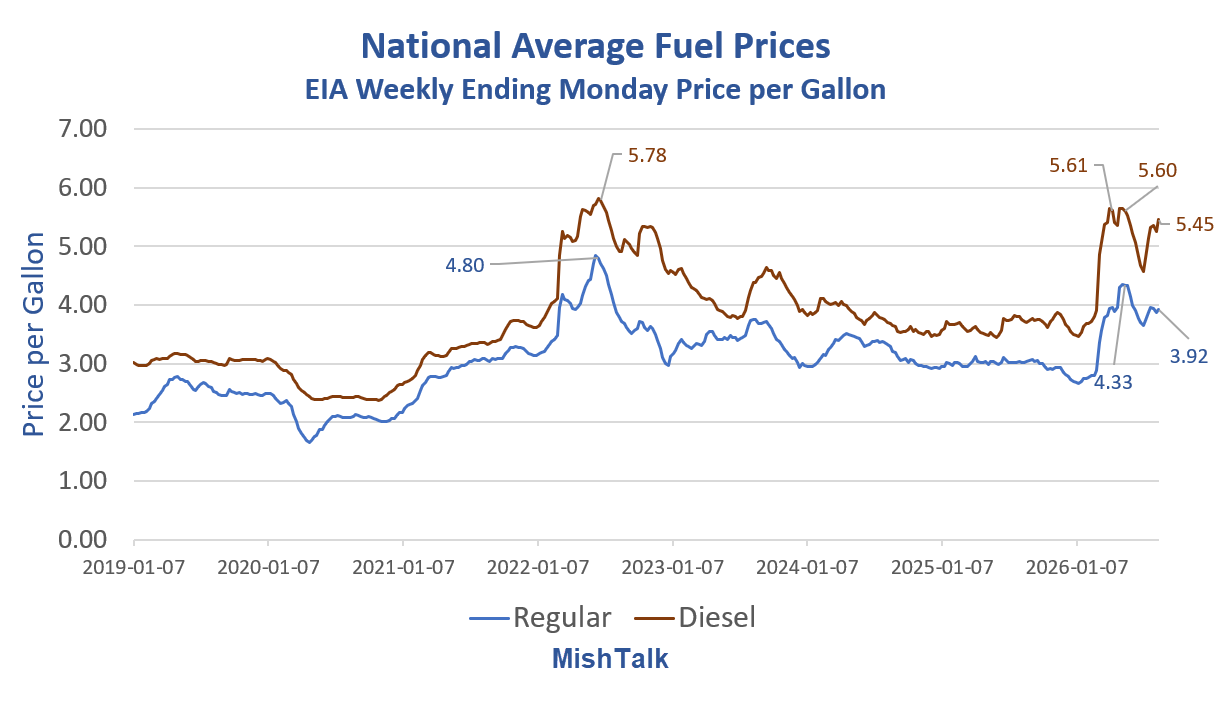
Diesel will be first, likely soon.
National Average Gasoline and Diesel Price, Weekly
- Diesel: $5.45
- Regular Gasoline: $3.92
- Mid-Grade: $4.65
- Premium: $5.02
National Average Gasoline Price, Weekly

Daily AAA Price 2026-08-18
- Diesel: $5.4677
- Regular Gasoline: $4.0654
- Mid-Grade: $4.5740
- Premium: $4.9579
Record AAA Prices
- Diesel: $5.8159 on 6/19/22
- Regular Gasoline: $5.0165 on 6/14/22
Price to New High
- Diesel: $0.3482
- Regular Gasoline: $0.9512
Based off these numbers, diesel diesel crack spreads, and serious refining issues, diesel will hit a new record price much sooner.
Diesel Crack Spread Definition
The diesel crack spread is the pricing difference between a barrel of crude oil and the ultra-low sulfur diesel (ULSD) refined from it.
It represents the profit margin a refinery makes on producing diesel.
The term “crack” comes from cracking, the chemical refining process that uses heat and catalysts to break heavy, complex crude oil molecules into lighter, higher-value middle distillates like diesel and jet fuel.
Because diesel powers global commercial trucking, cargo ships, trains, and agricultural equipment, the diesel crack spread serves as a vital leading indicator for industrial economic activity, supply chain health, and looming transportation inflation.
Path to Record Highs
- Crack Spread Divergence: Ultra-low sulfur diesel (ULSD) crack spreads are pricing in a severe structural premium due to global refining deficits, whereas gasoline cracks typically compress heading into autumn.
- Asymmetrical Path to Records: Diesel needs to climb just 6.37% to break its all-time high ($0.3482), while regular gasoline must surge 23.40% ($0.9511) to breach its 2022 peak.
- Inelastic Industrial Demand: Unlike gasoline, which sees a structural demand drop as the summer driving season ends, diesel demand intensifies through Q3 and Q4 due to agricultural harvesting, holiday freight shipping, and heating oil blending.
- Refining Constraints: Global refining capacity remains highly constrained for distillates, leaving inventory levels with virtually zero buffer for unexpected refinery outages or further geopolitical disruptions.
Economic Hit to Farmers and Truckers
The surging diesel crack spread hits both sectors hard, but it attacks their business models differently.
For truckers, it is an immediate, floating operational cost passed through supply chains.
For farmers, it is a rigid, cyclical gamble that can wipe out an entire year’s profit margin.
Price of Diesel vs Price of Crude

August 4 to August 17 Price Change
- Diesel: +$0.73
- West Texas Intermediate: +$7.69
Yesterday, I noted US Diesel Crack Surpasses $100 a Barrel for the First Time, Farmers Suffer
With diesel inventories sitting at a 12% seasonal deficit right as the agricultural harvest begins, independent truckers and price-taking farmers are left to entirely absorb the blow of a $101.85 crack spread.
The downstream supply chain is broken, and the inflationary consequences are locked in.
US Diesel Exports
According to the U.S. Energy Information Administration (EIA), the United States is exporting an unprecedented 1.884 million barrels per day (b/d) of distillate fuel oil (primarily diesel).
This surge represents an absolute historical record high for U.S. distillate exports.
This aggressive pace of outgoing shipments is a key fundamental driver behind the explosive crack spreads and tightening domestic supplies.
Where Are Diesel Export Going?
The geopolitical landscape has entirely reshaped the destination mapping for U.S. refined barrels. Historically, Mexico and South America have been the primary takers of U.S. diesel. However, under the current market stress:
- The European Shortfall: Following massive drone disruptions to Russian refineries and a strict Russian ban on its own diesel exports, European hubs face severe localized energy deficits.
- The Transatlantic Arbitrage: The price premium in Europe has blown the transatlantic trade arbitrage wide open. This has effectively caused U.S. diesel exports heading to Europe to more than double, drawing heavy commercial volumes right off domestic docks to supply overseas buyers.
Trump Blames the Oil Companies
US Not Immune from Global Constraints
A $5 increase in WTI, or less, could easily result in a new record diesel price depending on global refining capacity constraints.
The US is not immune from global refining constraints despite Trump’s nonsensical claims otherwise.
Hey farmers, how does it feel? Ah, how does it feel.
Not a Small Price
Q: How does it feel?
A: Record low polls for Trump show the answer.
In yet another huge political gaffe, on August 14, Trump proclaimed “I’ll Never Apologize, You’re Just Paying a Tiny Bit More”
Tell that to independent truckers operating on razor-thin spot margins.
Tell that to America’s price-taking farmers locking in massive input costs ahead of a critical harvest.
It isn’t a “tiny little bit more”. It is an inflationary tax that will ripple through every consumer household in the country.
And the bond market is watching too.
For discussion, please see Rising Bond Yields Are a Warning to the US Treasury and the Fed






























Trump has announced a deal with Canada that includes Keystone XL pipeline. I can’t get my head around why he would want the pipeline, he said we have all the oil we need (sarc). Supposedly the 50% tariff goes away.
It’s a strongarm robbery. Keep in mind that the sole priority of the canadian and european governments is The War On Russia. namely, getting Americans to fight for them.
This is why they are so eager to grant concessions which can then ben withdrawn.
It’s an obvious trap, and Trump walks right into it.
“When Will the Price of Diesel and Gasoline Hit New Record Highs?”
I’ve heard China stops buying oil on the open market above $85. They are the big buyer, so they control the price. Since their economy is dragging they obviously have excesse reserves. I don’t think we’ll see a price spike unless China wants it to happen.
Also this AI bubble feeds the top 10% of US consumers, not the bottom 90.
Demand destruction for oil is likely already happening. That being said, I’ve really given up on predicting oil’s big surge.
You misunderstand. The oil price has little to do with the current diesel price. A shortage of global refining capacity is leading to a diesel crack spread of $100 and a diesel price of $185.
“The oil price has little to do with the current diesel price”
Uh,if the price of oil rises then the price of diesel rises. The crack spread is higher in part because of the logistics chaos of shipping oil around to find a refinery. This is ultimately included in the real price of oil, which varies largely on location and type of oil ‘cracked’.
The price of oil is the key variable to diesel pricing.
https://www.cmegroup.com/newsletters/fresh-from-the-trading-room/2026-07-14.html
A spike would happen if spr’s hit bottom and the strait is still closed, China can only do so much. But I expect Trump to fold like a wet noodle when the rubber hits the road.
I just read where China is importing more crude oil to supply its excess refining capacity for export to take advantage of the higher than normal crack spread. That makes more sense to me.
Oil prices are qualitatively tracking the US depleted strategic oil reserves – which have supplemented the Iran war global related shortages. These reserves are currently in the critical zone of ‘structural damage caused by salt-well oil depletion’ and in the 3rd fractal quantitative area of explosive valuation growth. The anger and angst of independent voters (and farmers and other usual non mid term voters, and maybe even MAGA gas paying voters) paying transportation and farming cost of 6-10 dollar a gallon diesel will absolutely ablate and finish the Trump presidency and Mike Johnson’s House of All-Things, Corrupt or Otherwise, Yes … Maybe a 2028 moderate Republican or Democrat will save/resurrect American institutions, laws, and alliance policies for America to have another 50 years of relative peace and prosperity …
Here’s hoping …
“Moderate” = corporate imperialist muppet. Moderates have run this country into the ground, such that fed up voters would even countenance a clown like Trump.
What is needed is a radical. A Huey P. Long.
Well in the long term we will get used to these higher prices. Then went the world economy actual turns up there will be new records set
The part that bothers me is that TRUMPCO and the oil interests (My Dad owned Wells – – and Step Mom stole them from we boys), and he always said: THE OIL INTERESTS DO NOT CARE ABOUT OUR SUPPLY.
All that “we” care about is maximizing profits. So, our export Diesel: ANY COMMENTS, MISH?
Not sure what you want me to comment on.
But yes, diesel is a global market so is oil itself.
That’s why the US is not immune to what goes on in the Mideast and Russia.
Mish, I think that what I was touching upon is that there could be SHORTAGES of Diesel. IS that NOT right? I have an Old Trading pal who is now an oil analyst – – for an Oil Futures Trading Firm – – and he also consults for Banks – – and his contacts are making noise about the Hormuz shortages – which could/will be extreme and not only for the EU. What I am getting at: IS IT INSANE/CRIMINAL for our Oil Interests to be selling ANY OF OUR DIESEL to foreign buyers – – when SUPPLIES COULD BE SHORT due to global demand for Diesel in a Hormuz-caused supply crimp?
I strongly disagree David. It is the legal responsibility of the oil companies to do what is in the best interest of their shareholders and owners. Full stop.
Nothing that is currently happening in the global markets is a result of anything the oil companies have done.
The oil companies did not attack Iran. And they have no say in the price of oil. They are price takers. (Just like farmers.)
Many of the oil companies have interests in the region as well and are being hurt by the war. They certainly don’t want this war.
It is their simple duty to produce oil and sell into the marketplace at the going price. Most of the time they have NO IDEA who the buyer is and where their oil is actually going, other than “into the system”. That system, or marketplace, is global.
It is the government’s responsibility to allow exports or not. Oil exports were banned from 1975 to 2015. They have been allowed since then. Trump even brags and tells the world to come to the US and buy our oil. It will be interesting to see if he changes his mind and brings in export controls again.
NO because we are Supposedly a FREE MARKET and PROTECTIONISM would DESTROY our reputation and later our ENTIRE ECONOMY when no one wants to Trade with our “SKETCHY ASSES” anymore —- this is something WE did to OURSELVES by being RETARDED and ATTACKING RANDOM COUNTRIES FOR NO-REASON.
Thanks, guys. You went with it as I expected.
OF COURSE, Oil prices are TAKER prices and supply and demand to an extent drives our at-the-pump pricing.
————————————————–
We have a price war going on here in Oregon (I drove my 45 Foot RV to a station 7 miles away (In land) and save a dime a gallon (roughly a 200 gallon Tank).
Sure, it seems paltry to drive that far for such a small difference, but my TOW Vehicle tank was empty as well. 27 gallons in it. Full-Sized Diesel Pick-up which weighs a LOT.
Driving 7 miles was also in the direction we are heading now (West to East coast, wedding coming up).
———————————————–
I AM AN OIL TAKER driving a guzzler pulling a TANKER. HA HA. We will be dumping this huge thang some day soon (5 years or less). We are moving overseas for good and leaving America. The America I knew is no where to be found.
———————————————————-
The “Free Market” part is a bit of a tear-jerker as I am also sentimental about the Past.
———————————————————
My Oil analyst pal from Hamburg, Germany (lives near our place in Portugal) has not replied to my email to him about Shortages coming to the EU (soon, we think).
That is causing us to cancel our Trip to Lisboa in 2026-7.
———————————————————–
We are staying “home.” Most likely Fla Keys again for the Wintering crowd connections.
Our Round trip there and back is over 9,000 miles at 8.1mgp. You figure it out. These Buses are flat out consumer guzzlers. We get flipped off a LOT.
Most of our Fla friends are Canadians, by the way and six of them are French Canadians and the COOKING is UNREAL great. One of those couples is considering staying in Quebec. The rest are Maybe gonna winter overseas in Lagos, PT where we live and met them.
Great people, those Canadians (Except for my Step-Dad who was walking prick).
Honestly, I think we’re headed for a great big splat here pretty soon.
If the gov’t would eliminate seasonal mal-adjustments, we would know what’s happening when. There is always ebb and flow.
The downward seasonal effect is in place. Contrary to the pundits, the FED is tight. Reserve balances with Federal Reserve Banks are down – 281,921.00b since July 3rd last year. That would explain why rates are rising and stocks are falling.
The FED just needs to hold the line and the FDIC drop deposit insurance back to 100,000 dollars.
Lending/investing by the Reserve and commercial banks is inflationary (increases the volume and turnover of new money). Whereas lending/investing by the nonbanks is noninflationary (simply activates existing money/savings).
The NBFIs are not in competition with the DFIs. The NBFIs are the DFI’s customers. Savings flowing through the NBFIs do not leave the commercial banking system. There is no change to the size of the payment’s system. But there is an increase in the supply of loan funds, and not the supply of money – which would tend to lower long-term interest rates.
The 1966 Interest Rate Adjustment Act is the template.
Epstein Class
The majority of voters chose The Donald as their American leader and he recently said ” He Will ‘Never Apologize’ for the Iran War causing the Raising Gas Prices: ‘I Did the Right Thing’
“Just remember, you’re doing it so that a very evil country (IRAN) cannot have … nuclear weapons,” the president insisted. Now Trump is going to North Korea –another supposedly evil Country who actually have multiple Nuclear Weapons ..So maybe Global gas prices will go even higher if Trump soon says North Korea also should have no nuclear weapons ? Lucky that America who has a massive Nuclear stockpile is never an Evil Country ? Or is it?
“
That ONE announcement, “QUIT YOUR BELLYACHIN’” (do you remember that one way back), was singularly something I have never forgotten.
I cannot seem to remember who it was but it was when a Republican Member of the UNIPARTY was in Charge.
Trump is essentially saying something quite different: He is SAYING, “The house is not on fire” while the entire living room and kitchen are in flames. He would have us STAND THERE and die of asphyxiation.
It is amazing: THE TONE DEAFNESS now-a-days. I admit I am an old guy who heard that SO MANY time from my Parents – – even a grimace had me slapped across the face by my Mom – – that it hardened me.
But, we must remember now that things are different and people have gotten (MAYBE, I AM NO PRO) hardened a bit like I was when I was a kid. PEOPLE are putting up with a lot of bullshit.
OK, off the stage here and I will shut up now as I get the feeling here that I am not that welcome. I can SEE the misery, though, and it is REALLY AWFUL out here in the real world as you ALL know here!
Thanks for your hard work, Mish.
ULSD futures (HO1) is heading to a target of $5.25 a gallon. I am a professional trader (27 years now, since I stopped working for long hours and dumped my business when all of my hair fell out and I was sick to my stomach). So, I sold out, and learned how to read charts and trade CL futures (WTI) and Cracks, and so on.
Then, I got sicker than hell, almost died in Europe and now I am just waiting to die.
I would insert a Chart with my target shown.
We are in a long (Measured Move), and the entry point was: $3.0013 in June with a chance to get in at $3.2733. I am no longer trading but then price is on its way to a high of $5.2452. That is the -23.6% target using simply measured moves.
I wish you all the best of luck with these crazy days coming. People have made it clear that I am not wanted around here, so I will now SHUT UP FOR GOOD.
If you like posting here, then post.
Who cares about up/down votes and no mentally strong person should be run off by someone else’s posts (which might just be bots anyway).
I would post more but I want to be part of a Group of SOMEWHAT LIKE-MINDED FOLKS – – mainly FACT SEEKERS – but positive thinkers-people who want JUST THE FACTS with less emotions.
Yes, at times: when I REALLY piss off people, I am try to remain positive thinking about what’s going on in this world. I am VERY concerned for America and the world with Wars seemingly brewing…maybe a MAJOR one that affected my Dad, his cousins and brothers in WWII!
Your comments were very KIND and thanks for that.
Hang in there everyone!
“I would post more but I want to be part of a Group of SOMEWHAT LIKE-MINDED FOLKS – – mainly FACT SEEKERS – but positive thinkers-people who want JUST THE FACTS with less emotions.”
Facts are indifferent to positivity or negativity.
stick around. i enjoy your comments and analysis. there is an old jewish joke which goes like this told to me by my hasidic pals in brooklyn long ago. what was Moses secret 11th commandment only given to the chosen people? answer FUCK EM. in other words, keep on commenting. the intertubes are filled with piss and vinegar and comments can be taken out of context. in real life everyone acts much nicer to each other. until they drink too much. good luck old sport. hang in there.
8/10 times it’s Jojo and Jeff using different addresses to give themselves upvotes for their newest shortbus take on Iran
No doubt a farmer is learning what it feels like “to be on your own”
Maybe some of them will have second thoughts about rugged individualism and “leeches” relying on the “welfare state” or will they continue to do as Trump instructs them to do?
You are getting warmer.
For all the talk about pioneers and rugged sons of the soil, agriculture is one of the biggest recipients of government support.
Take North Dakota. The USDA provides financing for everything from rural broadband to water infrastructure to housing, not to mention crop subsidies and a whole bunch more. The DoT is what made the interstate highway system feasible in isolated rural states. The Corps of Engineers and BLR deal with flood control (North Dakota has more flooding than you might expect, and it used to be a lot worse). Even the air force bases provide a steady cash infusion to places like Grand Forks and Minot.
Without federal government intervention and cash, the residents of North Dakota, outside maybe Fargo and Bismarck, would either have to live like something out of “Little House On The Prairie” or give the land back to the Indians.
I suspect the reason that gas prices haven’t hit a record yet is because Trump relaxed the Ethanol content in March. It went from 10% to 15% at a time when most states use far less than 10% (summer driving smog issues).
If I go to my local Wawa here in West Palm, regular is around 3.95. But if I want boat gas (Ethanol free) that gallon costs around 4.60 or more putting it right around the price of premium (often its more than premium).
The extra Ethanol content allowed has artificially lowered prices in consumers minds. It’s also done a couple of other subtle things.
1) If US consumption is 20 million barrels a day and now you use 5% less gas per gallon it means roughly 5% less barrels per day or 1 million barrels a day (yeah not all goes to gas but a vast majority does). This is how the US is helping to deal with the shortage in world wide oil by lowering demand by 1 million barrels a day.
2) It’s harder on engines which means the longer this 15% is allowed the more long term damage will be done to parts (shorter life span) since no manufacturer recommends 15%+ content.
3) It’s lowering gas mileage since Ethanol does not provide the same energy by volume. My neighbor is self employed as a pool guy and drives a regular route. He has to keep track by hand of miles drive + gas bought for business refund purposes. He showed me his numbers since March and his costs are up gas wise even though prices are lower than then which says he’s getting a lot worse mileage in his truck. I’ve also felt something was amiss in my mileage in the last few months too (filling up sooner despite same driving habits). After looking at his numbers now I know it’s true. My guess is depending on miles (city vs highway) and vehicle people are likely getting 3-5 MPG less now. Anyone else noticed similar mileage drops?
This is a real hidden story not covered by media.
Actual blended gasoline has increased from 10% ethanol to 11.3% so far. It made a difference; but only by 1.3% in volume. The percentage will probably increase to 12% by autumn. These things take time. They don’t happen instantly.
Is that everyone since I know many States have vastly different rules for summer blends (Cali especially) that normally call for lower Ethanol than 10%. I looked at my friends numbers for the last few months and my own experience says we are getting way less gas mileage than we were.
Also curious about those no-name stations and what they sell compared to Shell/Exxon stations. We use to call those stations Garbage Gas when I was a kid growing up in Canada.
Blending varies across the nation. It is more prevalent in the midwest states. I can’t speak to individual stations.
Israel
Putin
So if you wanted to hedge for post October 31, what’s the price going to be?
It is fun to imagine how Trump might “October surprise” his way out of this one. Actually, scary. A foreign tangent adventure? Emergency deployment to block voting in blue districts? I don’t think hugging Kim in North Korea will do it.
Diesel prices will remain under upward pressure as long as so many global refineries remain offline. Many refineries in the Persian Gulf have been damaged and will take months to repair and rebuild. And even when back up and running, getting refined product shipped through the strait of Hormuz is still a question mark.
Russian refineries are under continuous bombardment by Ukrainian drones. This has forced Russia to stop diesel exports. Again, it is unknown when this will end. But diesel shortages will persist until this ends.
China has restarted their teapot refineries for now, which provides some relief. But China has shown that it has more control over petroleum prices now than OPEC and their strategy can change quickly.
At this point, the only thing that could reduce US diesel price increases would be an export ban. Though the relief woul be temporary and shortages would soon appear.
Interesting, the global economy always adapts! Any word on the impact of the Houthi attacks on Saudi oil infrastructure and ports, and its closure of Bab El-Mandab?
Good point. Though the Houthi’s are impacting actual Saudi oil supply far more than they are impacting refined exports from Saudi.
The global economy does adapt. But adaptation takes time, and typically happens slowly over years. In the interim, diesel supply problems are going to get worse.
No need to watch Mr Global’s videos with your excellent summaries, but I’ll continue to watch him anyway. Very helpful info for anyone not familiar with all of it!
Thanks
All the pedophile loving farmers and truckers deserve to go bankrupt. These cult members are not much different from the mobs in Iran or the Houthis – all of them religious fanatics willing to die for their senile leader. They eat the shit from his diapers and call it caviar! To hell with all of them!
Wouldn’t you be shooting yourself in the foot sending them all to hell? Who will then grow and deliver your food?
The big corporations can buy up all of the farms at the bankruptcy auctions and run them more efficiently.
Certainly this will have no negative repercussions at all as we watch megacorporations act like feudal rulers of tech. No sir!
I doubt that Trump will be able to refrain from restarting “kinetic” action against Iran, pointless as it will be. When he undertakes the next military non-solution, Iran will destroy much more of the region’s remaining energy infrastructure and refining capacity. The latest date for resumption of American attacks will be right after election, so the new highs in energy prices will probably be at year’s end. Homer Simpson reminds us that it can get worse. https://m.youtube.com/watch?v=bfpPArfDTGw&ra=m
“I doubt that Trump will be able to refrain from restarting “kinetic” action against Iran, pointless as it will be.”
Israel demands it. Israel has The Files.
You mean like this guy who is $hitting his pant$.
https://www.youtube.com/watch?v=FXduazp-GME
Excellent post. 2-star Mishelin award granted.
By the way, Tyson shutdown another meat packing plant yesterday. Boom 3000 people out of work.
There’s a comment thread in that video that says:
>> Diesel in Nova Scotia is $2.35 per litre, that’s around $9.40 per gallon.
>> Here in Southern Europe petrol(gas) 2,02 euro per litre that’s $ 8.90 per gallon today.
So it’s global, and highly damaging. Almost everything that happens now (Hormuz, Ukraine/Russia) is pushing the prices higher.
You’d think the Europeons, being in a hole, would stop digging (assisting the western Ukrainians in attacking Russia – especially its refineries).
They can’t. I lived in Europe for 30 years. And worked, and had a family, and some of my former school friends are now in politics.
The US Constitutional framework is about regulating the government. European frameworks are about regulating (and punishing) the people.
Americans have no idea how good they had it for 250 years, and whom to thank for their swag and attitude. There are comments in this blog that in Germany and the U.K. are punishable with prison. The tragic thing is that America will be like that too after 2028, as I see things going on forward.
They’ll have to destroy the Judiciary branch first. I don’t see the sort of censorship and criminalization of speech as in Europe or the UK making it past any court until such event occurs. Doesn’t mean that they won’t try, though. We already see hints such as Trump trying to deport Palestinian activists for their expression of dissent against the war in Gaza.
The First Amendment will take longer than 2 years to destroy. They haven’t even been able to destroy the 2nd Amendment, thank God.
In the longer run, I have a feeling you are correct, though. All it would take would be a court-packing scheme and Hakeem Jeffries has hinted at such.
That’s what I think too. The “traditional Americans” who were supporting the Constitution are almost all gone, replaced by Grievance Champions and trust-fund kid immigrants who have no idea where they came. Mamdani is part of a colonialist family (that 1% of Hindus controlling Uganda) and they voted for him because of colonialism. Back in 2020 they were “against white billionaires and against the police“, so they voted for an old white billionaire for President, and a prosecutor as Vice President.
You won’t have to wait until 2028. The only question is who will implement a full-blown police state first.
The european political class pay no personal price, so why should they care?
Sure the poors suffer, but the rulers do not, so Let Them Eat Cake. la di da! Can’t be helped!
In the video, the guy says his trucker buddies are still supporting trump. You can’t get any dumber than MAGA morons.
Steven Chu (Obama admin) had said “Somehow, we have to figure out how to boost the price of gasoline to the levels in Europe”.
Why aren’t the dems happier now?
See, that’s the problem when one is a fanboy of a party (either party). So, take your higher prices now and be happy. When they get to $9/gallon, congrats, you will feel like Europeans.
Well, you can pay it in air conditioning (Phoenix 125° norm soon, IMO) and fires.
They say that because they want to save face by not admitting they were dopes in the first place
Humans (Team R and Team D alike) are stupid and easily manipulated herd animals.
That’s Canadian dollars and inflated by Canadian taxes.
Canadians earn less than Americans. And they have to pay those taxes. At the pump I don’t pay “net price”.
Given the European – US Diesel spread. I am betting that President Trump will ban the exports of refined petroleum products from the US.
I think it will happen between now & Memorial weekend.
I already called the last time it went over $5 there was a market decline in economic activity.
I wonder how they will blame this on Biden
Quick flashes of fear, and cartoon bad guys, are more salient to the bran, especially the stupid brain. It is cost-efficient to time this in lurid bursts for the stupid brains heading for the ballot box.
They can’t blame it on Biden. And yes, the US economic prosperity and McMansions (instead of European mini apartments) relies heavily on energy prices. But with the current infrastructure, a change in Trump’s policies will reduce energy prices. But if the DSA is elected, then much higher prices will come in, and they will stay very high by design. That’s what I’m worried about.