

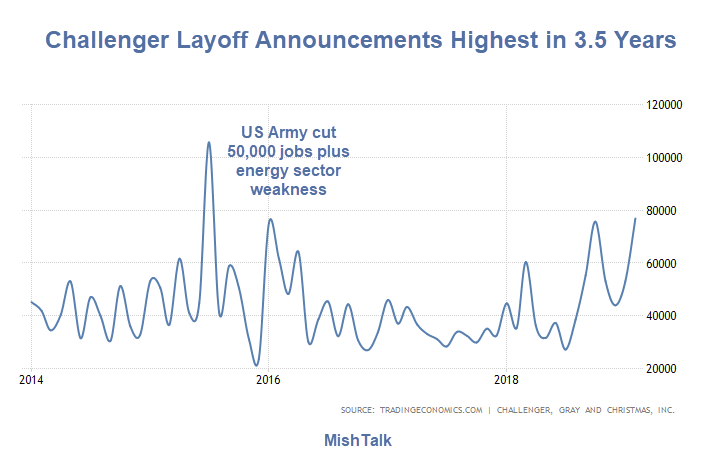
The Challenger Report shows employers announced 76,835 job cuts in February.
The shortest month of the year saw the highest number of job cuts in over three-and-a-half years, as U.S.-based employers announced plans to cut 76,835 positions from their payrolls in February. That is 45 percent higher than the 52,988 cuts announced in January, according to a report released Thursday from global outplacement and executive coaching firm Challenger, Gray & Christmas, Inc.
Last month’s job cuts are 117 percent higher than the 35,369 cuts announced in February 2018. It is the highest monthly total since 105,696 cuts were recorded in July 2015, primarily due to the U.S. Army’s cutting over 50,000 jobs and tanking oil prices, causing thousands of cuts in the Energy sector.
“Job cuts have been trending upward since the last half of 2018. We continue to see companies respond to shifting consumer behavior, new technology, as well as trade and market uncertainty through workforce restructuring,” said Andrew Challenger, Vice President of Challenger, Gray & Christmas, Inc.
“Meanwhile, Retailers are closing or revamping brick-and-mortar locations, leading to job loss or going bankrupt and cutting their entire workforces,” said Challenger.
Retail leads all sectors in job cut announcements with 41,201 this year, 92 percent higher than the 21,484 Retail cuts announced through February last year. It is the highest January-February total since 2009, when Retailers announced 72,727 job cuts in the first two months of the year.
By Sector 2019 vs 2018 – Top 5 Industries

Layoff in retail and industrial production have soared. Health care is one bright spot.
Challenger Cuts By Industry

Job cuts in aerospace, automotive, financial, industrial goods, retail, transportation, and warehousing are all up significantly this year.
There are significant improvements in consumer products, health care, and services.
Layoff Location

The bluest of the blue states got hit the hardest.
Challenger Hiring Plans

There certainly is a lot of month-to-month volatility. September is the crucial month.
Here’s a final set of numbers to ponder:
In 2018, the retail year-to-date hiring plans totaled 66,000. This year, the retail year-to-date total is 0.
These are further significant signs of a huge slowdown.
Mike “Mish” Shedlock






























Mixed bag, but retail is definitely re-inventing itself. Warehousing and automation coming on stronger as wages increase. Not much loss really in dumping jobs that do not pay a living wage.
Where I live, several commercial blocks were torn down to make room for a huge FedEx warehouse.
Seems like online retail purchasing will continue to take a toll on employment in that sector, as well as new store construction.
The red states wont be able to make up for losses in the blue state. Even the plans for 2019 are way lower than the layoffs. Only a matter of weeks before we see a spike in unemployment.
Annotate that graph with Trump tariffs on washing machines and solar panels, Trump tariffs on steel and aluminum, and Trump 25% tariffs on China.
Donald Trump is still marketing his big wins. Here’s Trump’s really big backup plan:
The Federal Reserve announced it would no longer flunk banks based on operational or risk management lapses during its annual health check of the country’s domestic banks.
‘We’re going to win so much, you’re going to be so sick and tired of winning’
Which means that they would flunk otherwise.
So it’s a “good thing”, employment-wise, that this country is full of sick, unhealthy people with declining life expectancies that require more and more “healthcare”.
Broken windows FTW! Actually it would be even better if life expectancy held steady but people were more sickly. I envision a future where the typical 30-something has to take a whole handful of pills daily!
It’s good for the monopoly of collusion we call the health care industry, which is run by pharma and insurance now.
Still massive overcapacity in retail, quick food service, and even casual dining.
It would be interesting to see this data adjusted as a percentage of the jobs in the state. California, New York and Illinois would still look bad, but not quite as bad, and other states like Texas would move from doing OK to doing very well. It would also be interesting, as in SMF’s post, to compare this data to the minimum wage in the state.
In NYC you need to be a minority to get a job in retail especially outside Manhattan. I shop online as much as I can, I hate the bad service and rude service because I am not a minority and I am Jewish but that is the result of a booming economy , record low unemployment and paying a $15 an hour poverty level wage.
You make a good point. A national minimum wage is a ridiculous idea. The cost of living is very different in different places, and the market for labor is very different in different places. $15 an hour may not be enough to live on in some places, but in, say, McAllen, Texas, the city with the lowest cost of living, but where there is a 27% unemployment rate, a $15 minimum wage would be very destructive.
The weakness in home sales, autos, retail, and labor show a clear picture of economic slowdown. Look out below.
I agree, but downturns never hit all areas of the country equally. Understanding the effect local policies can have could be beneficial, not that most politicians are actually concerned with the long term effects. Rather, they only care for the immediate effect, and if that is votes, they are all in.
Of course this has nothing to do with the minimum wage increasing…right?
Amazon has apparently cut back hours after raising to $15 an hour.