

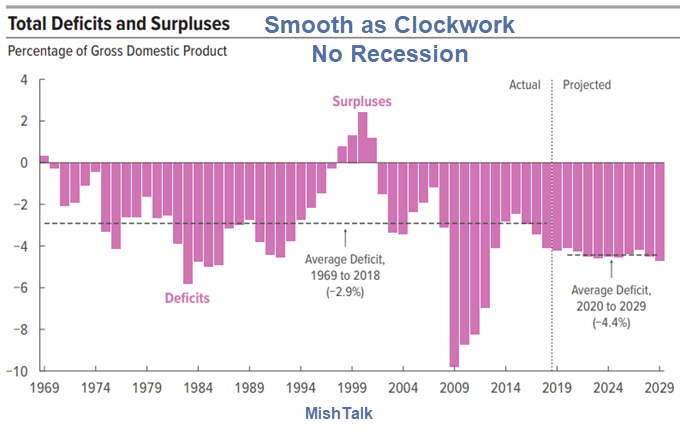
Let’s dive into the 176 page Congressional Budget Budget Office report on the US Economic Outlook: 2019 to 2029 to see what fantasies we can find.
“Over the 2020–2029 period, deficits are projected to average 4.4 percent of GDP, totaling $11.6 trillion. Such deficits would be significantly larger than the 2.9 percent of GDP that deficits averaged over the past 50 years.”
That is a start in the right direction. It implies $1.16 trillion deficits as far as the eye can see.
The problem is debt rises far faster than deficits because deficits ignore unfunded liabilities like Social Security. The CBO uses this sleight-of-hand magic every year.
If they project $1.16 trillion deficits as far as the eye can see, the total will be worse.
Front Loaded Tax Cuts

Despite the fact the CBO expects income tax revenue to jump starting 2025, they expect deficits to be smooth through 2029. What’s up with that?
Smooth as Clockwork
Apparently, there will be no recessions, no inflation, and no deflation in the next decade.
I sympathize somewhat. It is impossible to pencil in recessions when it is impossible to predict the timeline.
But to pass the tax cuts, Congress had to make economic assumptions that are highly questionable at best.
Baseline Projections vs Historical Trends
I seriously question these deficit projections. One hard recession in 10 years will kill the whole shebang.
Also check out that net interest expense projection. The national debt is $22 trillion and rising. The CBO assumes trillion dollar deficits as far as the eye can see. Does 3.0% seem realistic?
Age 65 and Older
Social Security Projections
At some point the percentage of those over 65 will crash as boomers die off. But there are also “Medicare for All” proposals to keep spending escalating.
Even the base assumption seems highly optimistic due to the flatline in the population percentage of those under the age of 64.
Uncertainty
Despite very unfavorable boomer demographics, the CBO projects the deficit to increase a mere 0.5% on average over the next 10 years.
Federal Debt Projections
That chart rings true. We are on a hyperbolic debt path.
That’s as much as I can take. Inquiring minds may wish to slog through all 176 pages for more hidden gems.
Mike “Mish” Shedlock






























“[T]he CBO projects the deficit to increase a mere 0.5% on average over the next 10 years.” Sadly, it was up over 17% in 2018 alone. Unrealistic CBO prediction.
If the CBO had ANY accuracy in its ability to predict the economy, then private finance companies would have scooped up the talent.
I don’t think those are projections. I think those are assumptions. In other words, the CBO starts with the assumption that the economy grows slowly, and that inflation stays at 2%, and then, from that starting point, they make projections about what the deficit will look like.
Most of the resulting projections are logical, but interesting and revealing. As baby boomers age, Social Security expense, and Medicare will explode. As the total debt increases, interest on the debt will increase dramatically. In order to keep the deficit manageable, they project military spending as a percentage of GDP will continue to drop, from 3.1% today to 2.5% in a decade. They project all other discretionary spending will also shrink as well, to 2.4% of GDP.
The first problem I see? Well, listen to the politicians. Do you hear anyone talking about cutting back on spending? Or, do you here politicians who want to dramatically increase spending? Military spending may well continue to fall, and reach 2.5% of GDP, but other discretionary spending has been between 3.2 and 3.6% of GDP for the last 25 years. It’s not going to 2.4%. It might very well go back to 3.6%, or beyond.
The second problem is the interest projections. As the size of the total debt relative to GDP grows, at some point interest rates are going to start reflecting a risk premium. If rates double, suddenly the interest would jump from 3% to 6%, and that pushes you down the austerity path, which leads to major economic decline. The major problem with continuing to run huge deficits is that sooner or later you force the economy into a death spiral. It has happened elsewhere, and sooner or later will happen here. [And of course, in this silly world, people will expect government to “solve” the problem, which in turn will cause government to make it worse.]
“the CBO projects the deficit to increase a mere 0.5% on average over the next 10 years.”
Obviously assuming that AOC’s 70%+ marginal top rate gets enacted, along with Pocahontas’ $50MM+ “Wealth Tax”.
We are living in an economic and financial fantasy land.
NO RECESSIONS…..EVER!!!!!
I notice that the projections do not take into account the possibility of more “progressives” like Bernie and AOC being elected by idiot voters that want that “free stuff”. That will increase the deficit dramatically.
There are an infinite numbers of “possibilities” that would affect the projections. You want a report for the top 100 scenarios?
When the Founders enumerated the appropriate powers of civilized government, “projections” were not included. For good reason.
It’s very clear what we need. We need a wall!