

Perth Investors Fear the Worst
> West Australia property investors are suffer as the mining slump lingers. Nearly One-Third Losing Money on Resale.
> A report from property research firm CoreLogic shows one-third of investors in Perth property lost money on resale in the December quarter.
> The figure of 33.6 per cent was equal with Darwin as the highest proportion of loss-making resales nationally.
> In regional WA, the situation was even worse — 47.5 per cent of resales by investors made a loss in the quarter.
80% of Gladstone Homes Sell at Loss
Five years ago, investors from all over Australia scrambled to snap up a property in Gladstone. Today, you have to pay to get out. More than 80 Percent of Gladstone Homes Sell at a Loss.
> SITTING at the southern tip of the Great Barrier Reef, and famed for being one of the nation’s industrial powerhouses, is the central Queensland city of Gladstone.
> Four decades ago, Gladstone was a tiny port town best known for its fishing industry and boasting easy access to the southern reaches of the reef.
> A decision to build a liquefied natural gas plant was made — encouraging thousands of construction workers to fly into the already prosperous town in an attempt to score a piece of the plant pie. By 2012, the LNG plant was built, the construction workers were getting laid off and the city started to experience a severe downturn. Six years later and things are no better.
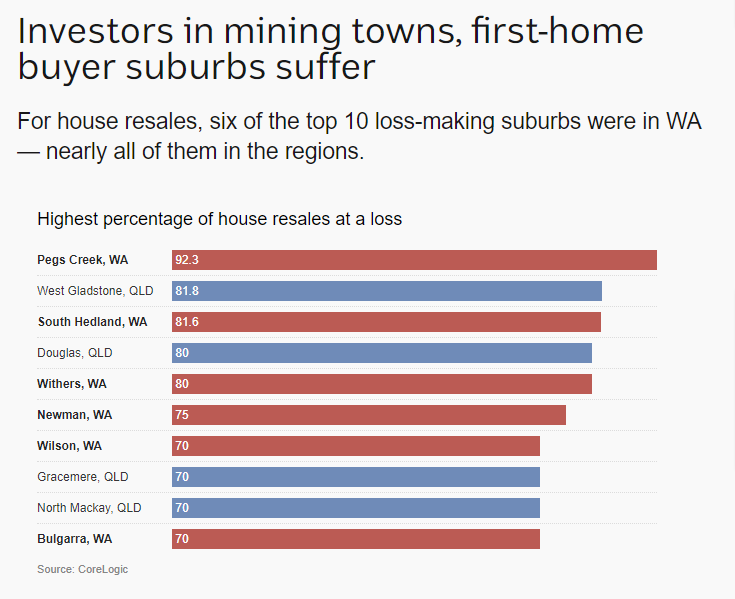
> In the last December quarter, more than 80 per cent of Gladstone homes sold at a loss, according to new data released by CoreLogic. That rate is the highest in Queensland and second highest in Australia, based on the average home price more than halving in the past five years.
> Most of the places in the top 20 are linked to the mining resources sector in Queensland and Western Australia. Pegs Creek in Western Australia is the only suburb to beat West Gladstone, with 92.3 per cent of its properties selling at a loss.
> In 2012, when the city was still on a construction high, Ms. Kerry Connor [Gladstone Real Estate] said working as a real estate agent was exciting. “People came from all over the world to try and buy a Gladstone property. We’d advertise on realestate.com.au and in a few days, the property would be sold. “It was the most amazing time to be a real estate agent and it was mad — everything was happening very, very fast.
> In January 2013, houses in the centre of Gladstone were selling for an average of $595,000 but by January 2017, the average was down to $330,000. Gladstone is also one of the top 10 postcodes in Australia for people behind on their mortgage payments, according to S&P Global Data.
> Ms Connor confirmed this figure, admitting most of Gladstone real estate’s sales are repossessed homes — most of which were bought by investors in the 2011-2012 boom. “A very high percentage of sales in Gladstone are repossessions. It’s quite scary actually,” she said.
Cracks in Sydney

The Sydney Morning Herald reports Sydney house prices fall for the first year since 2012.
> Cracks are showing in the Sydney property market, with prices now falling for the first time over a 12-month period since the boom began.
> The median property value now stands at $880,743, after the first 12-month decline since 2012.
> Over the three months to February, Sydney prices dropped 2.4 per cent. This was the weakest result in the country.
> Melbourne also showed continued signs of a slowing housing market, with prices up a solid 6.9 per cent over the year but down 0.4 per cent for the last three months. Its median dwelling price is now $723,334.
> CoreLogic head of research Tim Lawless said the overall softening in the market was becoming “more evident” with interest rate increases on the horizon.
> “With high levels of household debt and dwelling values now starting to fall as well as tighter credit policies and a prospect of higher mortgage rates down the track, it is reasonable to expect that borrowers will be taking a more cautious approach to taking on debt,” he said.
This is a miniscule down payment on what is ahead.
Any further gains in places like Sydney will just add to the pile of future losses.
Want to know what it’s like selling in the midst of a slump? Look at Gladstone.
Mike “Mish” Shedlock






























Once they strip the asset test for the primary home I would agree with you. Not sure why I should pay taxes to support some old bloke with a multi-million dollar house just so he can pass it on to his kids.
In Australia there are a lot of people who cannot afford a home and the home is explicitly exempted from the asset test when you apply for the pension. Since many people cannot afford a home of their own and for their children at the same time are funding the baby boomer’s lifestyles at the expense of their children and themselves, they realize that the system is not working for them.
Thats a very good answer realist. I get the same feeling that their are miserable people on this site that simply do not know how to make money. My advice to them is get some learning for crying out loud.
Australia has not had a recession in over 20 years. The ride China’s coat tails. If China is still going strong then so will Australia. Their real estate has been almost parabolic. It has to pull back some. I have a friend who lives there , I must check with him.
Philosophically, a lot. Not too long ago, s-holes were small islands in the ocean of stability. But they spread quietly, and now there’re islands of decent life, surrounded by s-holes. That might explains what’s happening in your housing market.
McGrath Real Estate, Australia’s major real Estate brokerage based in Sydney. Share price down 80%. Just about says it all.
*TheLege said: “…i.e. a pyramid scheme. This sucker may not go down today, but it will go down.”*
It will be interesting to see how it unfolds. Apparently Australia does not use non-recourse loans and homeowners will be personally on the hook for the balance of their debts if underlying home values crash:
https://www.moneymorning.com.au/20180120/australia-everything-riding-one-bad-bet.html
If the Australian bubble bursts would anyone but Australians notice?
Better late than never. The more broke and desperate the govt, the more RE is under siege. Fortunately, Australia has natural resources close to China. Although, Venezuela has huge oil reserves. Socialism is the wild card..
https://www.armstrongeconomics.com/international-news/australia-oceania/confidence-in-real-estate-crashes-in-australia/
Realist, you’re a regular here and I don’t know why. You’re either a genuine “glass half full” person or a troll, but either way your world view is not coloured by knowledge or facts. If you’re an optimist then your world view is based on “hope” and nothing else. Before the Australian housing bubble got going the historic median house price-to- income ratio was between 3 and 4. In Sydney, that ratio is now over 12, while in Melbourne it is over 10. This is just insane — an understatement. Even the most egregious city-specific bubbles in the U.S. pre-GFC got nowhere near those levels. The banks in Australia are currently being investigated under a Royal Commission as we speak and the skeletons that have been outed in Phase 1 should cause anyone with a pulse to shudder — widespread mortgage fraud, hyper-loose lending practices. In fact, every grubby scheme known to mankind to ensure extension of more credit to the market has been employed. Hundreds of thousands of people in Australia have multiple investment properties — all courtesy of perpetual rounds of equity withdrawal i.e. a pyramid scheme. This sucker may not go down today, but it will go down.
Is Realist a realtor? The reluctant acknowledgement of the possibility of “modest correction” sounds like something Lawrence Yun would say if he found his way onto an internet forum.
Australia has one of the biggest bubbles in the world. It will crash now or later.
Mish is taking it on the chin with this post. LoL. The more information the better for me and my investment strategies.
Question: any chance that China’s economy and rules influences both markets at the margin?
->”a slowing housing market”
->”softening in the market”
->”a more cautious approach to taking on debt”
The eternal words and phrases of a politician who doesn’t understand, or in any case doesn’t want to draw attention to, the positive feedback loop processes that doom us all.
The price we pay for this hush-hush don’t-feed-the-fear attitude is an ignorant populace that continues to fail to learn who or what lies at the root of the problem.
…still, all the better for those of us who do understand to privately exploit the credit cycles for crazy personal financial gain.
there’s still NEVER been a better time to buy…
It’ll be interesting to see if we see it in Vancouver B.C. as well… https://www.theglobeandmail.com/real-estate/vancouver/vancouver-housing-sales-slump-as-market-braces-for-tax-impact/article38195805/