

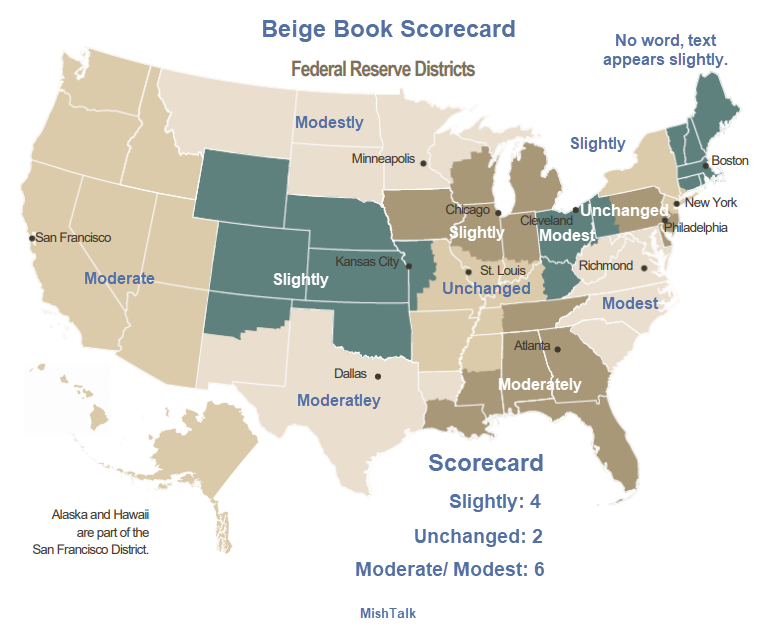
The Federal Reserve “Beige Book” is a compilation of economic activity produced by each of the Fed’s 12 districts.
Despite the impressive-sounding name, there is typically not much in it that has not been reported elsewhere, earlier, either in the regional Fed reports from each district (e.g. Empire State Report, Philly Fed Report, Dallas Fed Report, etc.) or FOMC discussion minutes.
The book does provide an overall compilation and synopsis in one place.
Overall Economic Activity
Economic activity continued to expand in late January and February, with ten Districts reporting slight-to-moderate growth, and Philadelphia and St. Louis reporting flat economic conditions. About half of the Districts noted that the government shutdown had led to slower economic activity in some sectors including retail, auto sales, tourism, real estate, restaurants, manufacturing, and staffing services. Consumer spending activity was mixed across the country, with contacts from several Districts attributing lower retail and auto sales to harsh winter weather and to higher costs of credit. Manufacturing activity strengthened on balance, but numerous manufacturing contacts conveyed concerns about weakening global demand, higher costs due to tariffs, and ongoing trade policy uncertainty. Activity in the nonfinancial services sector increased at a modest-to-moderate pace in most Districts, driven in part by growth in the professional, scientific, and technical services sub-sector. Residential construction activity was steady or slightly higher across most of the U.S., but residential home sales were generally lower. Several real estate contacts noted that inventories had risen slightly but remained historically low, while home prices continued to appreciate but at a slightly slower pace. Agricultural conditions remained weak, and energy activity was mixed across Districts.
Employment and Wages
Employment increased in most Districts, with modest-to-moderate gains in a majority of Districts and steady to slightly higher employment in the rest. Labor markets remained tight for all skill levels, including notable worker shortages for positions relating to information technology, manufacturing, trucking, restaurants, and construction. Contacts reported labor shortages were restricting employment growth in some areas. Contacts in the higher education sector from the St. Louis District indicated falling enrollment as potential students were increasingly choosing to enter the labor market. Wages continued to increase for both low- and high-skilled positions across the nation, and a majority of Districts reported moderately higher wages. In addition, contacts in about half of the Districts noted rising non-wage forms of employee compensation, including bonuses, relocation assistance, vacation time, and flexible work arrangements.
Prices
Prices continued to increase at a modest-to-moderate pace, with several Districts noting faster growth for input prices than selling prices. The ability to pass on higher input costs to consumers varied by region and industry, and a few Districts noted that demand and the level of industry competition played a role in this variance. A few Districts continued to report upward price pressures from tariffs on certain goods and services. However, several Districts noted that the price of steel, which has been impacted by tariffs, had stabilized or fallen recently. In addition, energy costs, including fuel, declined in some areas. Agriculture commodity prices were mixed, though soybeans and dairy prices were notably weak.
Word of the Day Synopsis
The full report is 32 pages of mostly drivel.
A search for the word “tariff” came up 18 times. “Uncertain” came up 17 times.
The word of the day is “shutdown”. It came up 22 times.
Here’s a typical comment: “The partial government shutdown reportedly created uncertainty among client organizations, who were less willing to make hiring decisions near the end of 2018.”
“Weather” was a close runner-up. It came up 21 times. Here’s a typical comment: “Freight contacts reported demand was flat because of extreme weather in the Midwest and Northeast.”
The most pertinent comment regards pricing. Several districts note that manufacturers were unable to pass on input price hikes.
Mike “Mish” Shedlock






























Not a fan of the never ending growth story. And what a story it is.
In the long term, economic growth is just another word for “efficiency improvement.” Left alone, people will always be plugging away at doing what they have to do more efficiently. Hence, you will always, catastrophes aside, have economic growth.
Again, in a free society. In a completely unfree one, where each and every possible improvement from efficiency gains, is simply stolen for the benefit of the Junta and a few well connecteds……
In reality, you’ll still have gains, but the view of what is “long term,” just have to be stretched out some generations. To allow time for the dysfunctional, hence declining, kleptocracy, to be sacked by less dysfunctional “barbarians.” Whether from inside our out.
Economy grows on hope and dies on the lack of it. Trump can’t change the realities, but he can engender HOPE, and a little of that goes a long way. All we need to crash this economy is enough people believing it will. But by all means lets keep predicting “the end” as we have for the last decade, and see what that puts on the dinner plate.
Please, enough with the Phil Gramm “mental recession” idiocy. If you want to believe that we can keep interest rates artifically low, funnel wealth to a parasite banker class, rack up many trillions in debt, and spend insanely in perpetuity without ill effects, be my guest, but not everyone will shrug off such flagrant irresponsibility.
Actions have consequences. If you want to excuse away fraud and malfeasance, you shouldn’t be posting here, you should be somewhere getting paid to do so. Since entire careers are centered on putting a smiley face on graft, it would be foolish to do it for free.
Looks like the people who quipped that Trump was the new orange flavor of “Hope and Change” weren’t kidding.
Well said Tengen. At some point things will diverge and imbalances in the bond market and elsewhere will create a landslide. We are nearing the longest expansion in post WWII era. Many forget that GDP was negative well into 2009 even though the markets started recovering. The longest expansion is still October 1991 to April 2001. This one will be as long in the tooth as that one. The longer this one goes on the more downside risk and instability we will see.
You have no idea what is going on in the economy. Small businesses are booming. Here in Texas yo can’t find an employee with a brain or without. Automation is selling like mad as businesses can’t find people willing to work, meanwhile we are importing millions from the south with zero skills, women and children in tow, that will only ADD to the ultimate costs employers will be forced to pay.
I’m really curious as to the type of people commenting. Are they actively engaged in this economy or are they simply wrapped in gloom and at best betting for its ultimate demise.
Worker drones seemingly trapped in their “jobs” that continue to pay less and less without any introspection as to WHY. Have any actually invested in their OWN productivity or are they waiting and complaining because their employers are not willing to spend thousands to “train” them when they have shown zero motivation to do anything except upgrade their paycheck?
The self employed are moving forward while all those left behind seeking a rich and secure Teat to attach to, are increasingly weaning off to a government entitlement check instead, a reliable progressive voter.
Progressive hate nothing more than anyone suggesting their path to prosperity is actual WORK.
“You have no idea what is going on in the economy. Small businesses are booming.”
As a business guy, it’s your job to look at trees. The ones meaningful for decision making specific to your business.
Economists, OTOH, are tasked with looking at the forest: The economy as a whole.
In the latter, activity is only valuable, if it is productive and constructive. A bunch of twits running around suing each other, selling their houses back and forth for ever higher prices in ever more debased currency; with all of them, plus their mortgage lender and liability insurance peddlers taking a cut; then going out and burning the loot on Jimmy Choos and Starbucks, and paying someone to change their kitchen counter back and forth between black and red every year, while in alternate years decorating their yard with a ditch and filling the ditch back in; does exactly nothing for economic growth. It, no doubt, creates lots of “business opportunities.” Just as running around breaking windows do. So, from the standpoint of some window fixer struggling to find ever greater numbers of “qualified” window fixers, ditch diggers and fillers etc., it may well look like things are hopping.
I realize Texas is a bit of an anomaly, as the Texas-centric fracking industry has brought genuine growth there. But even in Texas, most so called “growth” comes from yahoos with pumped up assets, and those taking a cut from selling them back and forth, lending against them suing each other over them and taxing them. Who then going out “spending” that money, which was never earned in the first place in an economic sense, on ever more frivolous, capital destroying nonsense. It may look like a hopping economy to those stuck watching busybody trees buzzing around to no end; but viewed from above, the forest is decaying, the buzz powered by the trees it contains burning each other down to keep the illusion of activity going.
“Here in Texas yo can’t find an employee with a brain or without.”
Texas is growing big because of fracking (so is North Dakota). Fracking was made possible by technology and financial engineering (very low interest rates and easy credit). I wouldn’t like to depend on the TX economy if there were to be a significant drop in oil prices… (not that I’m saying there will be one)
“Fracking,” has suffered, not benefited, from financial “engineering.” Just like every other productive undertaking has. All “financial engineering” is, is newspeak for robbing the productive, in order to hand uneraned loot to incompetent and idle (at best) well connecteds.
Hence any field, particularly one as capital intensive and speculative as “fracking” (has been)/(is being) deprived of massive amounts of capital, which is instead directed at incompetent idiots in political and “money” centers, who couldn’t “engineer” a ham sandwich if the ingredients fell on their face.
And to add insult to injury, since the idiots can’t engineer, nor produce anything, they are also blissfully unaware of what such exotica as producing something, anything, of value entails. So they spend part of the loot they have been handed in exchange for nothing, running around putting up political roadblocks against the scary “frackers.” “Because those guys look scary with their loud machines and dirty overalls and all.” And, when you’ve been handed unearned loot to the tune of millions your entire life, in exchange for nothing, it’s easy to presume, if you’re not the brightest to begin with, that “everyone” should just sit quietly in a nice suit; filing lawsuits, “investing,” lobbying and writing mindless nonsense about things they don understand, instead…
Explain to us how you have profited from the last ten years of predictions of falling skies. I own businesses. I have NO CHOICE but to retain some optimism. Whatever you might think of “fundamentals”, the economy has been for the bulk of Americans, a reflection of our optimism and pessimism. Businesses are the core of our economy and if they see no future, if the end is near, they will NOT invest in equipment, software or people. This investment is FAR more important to the “economy” than our wonderful “markets” that are purely betting parlors….typically betting with other people’s money on what the rest of us do.
While I follow this “information” closely, I have learned that I must buffer it for it will dominate my mind and having me digging a bunker in my back yard. Instead I have cautiously moved forward balancing the obvious causes of pessimism against the necessary optimism that it takes to get out of bed in the morning and keep plugging along.
Here in Dallas there is plenty of evidence of those who have surrendered and decided to not live to benefit “the man”…living under bridges. I ain’t going there. I have spent my life building and moving forward through shit as fundamentally flawed as they are now.
Our single greatest threat to our economy and society is being witnessed in our government where people enamored with their own ideology are attempting to tear this country apart by unseating an elected president, and replace him with a full blown wealth destroying socialist.
Follow your own path and accept responsibility for it. For me and most that I work with, Trump has been REAL hope for change and have put their money where their mouth is, unlike Obama’s drones who simply wanted to put everyone else’s money where their big ideological brain told them.
Tell us oh enlightened one, what have YOU done to make this a stronger economy? Who have YOU hired, what have YOU invested to make this work for everyone. At 66yrs old, I have a great deal invested and am still trying, even for YOU and YOUR children, to make this all work, rather than making my living screaming of the falling skies and Orange derangement. Basic economic numbers are better than they’ve been in years, but I bet you’re setting back just worried to death that Trump might make a dime off of it, while ignoring that your progressive leaders has vastly enriched themselves from nothing other than their “service” to America…never having had a job, created a job or contributed ANYTHING to this economy except socialist rhetoric.
But dream on, utopia is just around the next “new Green Deal” corner.
“Economy grows on hope and dies on the lack of it”
If that was correct, Africa would be the wealthiest place on earth. Talk about an entire continent living on hope, (an occasional) prayer and nothing else.
An economy grows on capital accumulation and utilization. The more available capital, and the freer actors are to utilize it as they see fit, the faster the economy grows. There are precious few cultures more fundamentally pessimistic than pietistic Lutheran ones. Yet those are the cultures from which industrialization arose.
Permanently skeptical guys with belts, suspenders and ever more elaborately constructed levees, along with ever more sophisticated machinery with which to construct them, around their desert home; just in case some millennial flood may catch them off guard. While conversely, the forever hopeful optimists who insists on building glass houses on beaches in hurricane zones, never end up growing anything.
I know in Dallas, our constant rain is killing home builders. I hear the same in Georgia (tornadoes included). Every Cabinet shop I call on is backed up with orders they can’t deliver, with jobs piled up. Still booming in spite of the weather from my perspective, not that it feeds the impending doom dreams.
Rampant growth isn’t sustainable. Eventually growth goes back to its baseline which in the US is around 2% GDP. The real issue is whether anything can be done in the era of globalization to change this. At some point, people in places where there is slow or no economy will capitulate by moving. If Trump cannot save them no one else stands a chance.
So no growth is bad, and “rampant growth is bad”.
Most of us know that artificially ramped growth is NOT sustainable, but given the whole were were in, growth was an absolute necessity, financially and psychological. There is no doubt that things need correction, but we must get businesses on a sustainable footing. We KNOW China is a problem and there is no other way to “negotiate” with them without pressuring their economy directly, which is what tariffs are doing, but we would never be able to do this if our economy was as weak as it was four years ago.
“We KNOW China is a problem and there is no other way to “negotiate” with them without pressuring their economy directly, ”
No. The problem is Trump directing the biggest world economy. Tariffs decrease world trade and this eventually will cost US jobs. We are going into a world recession created by the orange guy. In the mean time the EU just went all out on “stimulus” which will drop the value of the euro and probably will get Trump a stroke and cause a twitter tsunami