

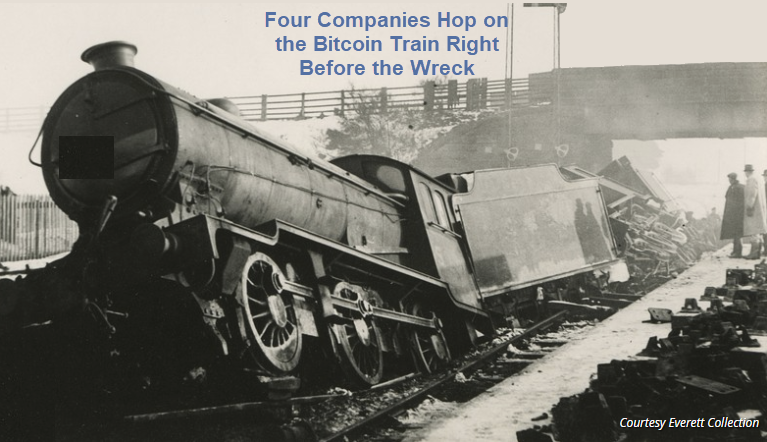
My favorite of the bunch involves the Companies That Jumped on the Bitcoin Train Right Before it Derailed.
Name Change
Long Blockchain may epitomize this craze, as this time last year it traded as Long Island Iced Tea Corp., a microcap beverage company. In late December, just days after what would prove to be bitcoin’s recent peak, it abruptly announced a change in both name and focus, turning instead to ”the exploration of and investment in opportunities that leverage the benefits of blockchain technology.”
Long Island Iced Tea – Now, Long Blockchain

What a Riot
Riot, another new entrant in the sector—it was previously BiOptix Inc., a biotechnology company—saw similar price action. It rallied after announcing its move into the blockchain arena, but the stock saw a peak that coincided nearly perfectly with bitcoin’s, as seen in the following chart.
BiOptix Inc., now Riot

Hive Blockchain

Hive shows the benefit to getting into crazes well before they peak. It’s down 64% in 2018 but it’s up 753% from a kear ago.
Kodak
In January, after the bitcoin record, it announced a “major blockchain initiative” designed to help photographers license their work and get paid for usage.
Kodak, Still Kodak (KODK)

I wrote about the absurdities of Kodak in Peeking Inside an Actual Bitcoin Mine: Care to Buy a Mining Operation?
Kodak is branding a $3,400 bitcoin-mining machine that you would have to be ape-shit nuts to buy.
- The Kodak-branded mining rig called the KashMiner, which was showcased at this year’s CES. It’s created and run by a company called Spotlite, and has licensed the Kodak name.
- Users pay $3,400 to rent the mining machine for two years and give Kodak half of any bitcoins mined.
- Kodak claims the KashMiner will produce about $375 worth of new bitcoins every month, which would lead to estimated revenues roughly $9,000 over those two years.
If these devices actually were profitable to anyone but Kodak, the company would start its own mine rather than selling them.
Let’s move along to more silliness.
$91,000 by 2020
If you are a Bitcoin true believer you will find this absurd story to your liking: If this chart is correct, it puts the price of bitcoin at $91,000 by 2020.
Tom Lee, managing partner at Fundstrat Global Advisors, said the big picture still has bitcoin BTCUSD, the No. 1 digital currency, in a bull phase. That’s even after a 40% decline from the start of 2018, and a 70% fall from its all-time high in December 2017, he said in a note to clients.
Lee compared the 70% decline to that of mid-2013, a retreat that was followed by a 700-plus day rally of more than 55,000%.

I admit that $91,000 is in the realm of possibilities, but so is zero.
At $91,000 how much energy will be sucked out of the grid? And at $1,000,000?
Criminals
Supposedly, Bitcoin is falling out of favor with one key constituency—criminals.
Don’t Fight the FUD
The Bitcoin Vocabulary has some interesting terms.
HODL
The term HODL was accidentally coined in a 2013 Reddit post where an inebriated user (according to the post) was ranting during a bitcoin selloff, trying to explain why he wasn’t selling and instead was holding, or as mistyped: hodling.
The post was headlined “I AM HODLING” and began “I type d that tyitle twice because I knew it was wrong the first time. Still wrong.”
While it began as a joke, the term is now a staple among the bitcoin community, especially the bulls, who are more likely to HODL than sell.
Rekt
This term has been adopted from videogaming where it refers to being wiped out or destroyed. This usually happens when the price of bitcoin plummets and investors lose a significant amount of money.
Noob
If you are new to the above terms you are a “noob” or a newbie who doesn’t have a comprehensive knowledge of the crazy world of cryptocurrencies.
Satoshi
Satoshi Nakamoto is the brain(s) behind bitcoin. This publisher of a bitcoin white paper in 2008 is rumored to be a Japanese male in his mid-40s. But throughout the years, many people have claimed to be, or know, Satoshi. Popular theories include U.S. computer scientist Nick Szabo and Australian businessman Craig Steven Wright.
Additionally, a “Satoshi” is the smallest unit of bitcoin—0.00000001 BTC.
FUD
FUD is not a bitcoin term. It stands for Fear, Uncertainty, Doubt. The term has been around for a decades.
The true believers accuse anyone who writes about Bitcoin in a non-positive manner of spreading FUD.
I was a target the other day. “Please keep spreading the FUD. I would love to pick it up at lower prices.”
Rest assured, nothing I write will change the price of Bitcoin by one penny.
In general, the biggest spreaders of FUD are those who claim to know where the price is headed. I do not claim to know anything, but I do have a strong belief it’s in a bubble.
Companies hopping on the bandwagon and grandmas buying at $19,000 provides strong evidence as to how big the bubble got.
Mike “Mish” Shedlock






























@Stuki
“In either case, as long as people view anonymity, IOW the ability to resist being spied on, as a benefit; the mere fact that anonymity is possible will, given enough time, ensure anonymity will be available. As a corollary, anyone resisting it, is just fighting the inevitable future. At ever greater cost.”
Yeah that’s a pretty succinct summation of the inevitable process. I find that what the government security agencies do to the Darknet markets and their technologies is analogous to what a very powerful and active competition commission would look like if government really believed in free market competition, instead of paying token lip-service to the idea of competitive free markets whilst legislating in corporate oligarchy. It’s also analogous to what the health organizations are doing to viruses and diseases around the world; put selection pressures on them so that they evolve ever quicker too perfect vaccine and antibiotic resistance, as well as an increased ability to remain hidden from medical diagnosis for as long as possible. It comes down to the very simple Nietzschean principle: the more they try to fight these perennial threats, the more they make them stronger and more destructive. It’s sheer Darwinian natural selection; or government-breeding selection if you prefer. Government selecting for that which the government cannot control to any degree whatsoever.
With regards to Monero specifically, I imagine that, because Monero is the preeminent privacy coin, any unique advantages to the other coins would swiftly be transplanted into the Monero code. But the devil is in the details, and all that C++ code on GitHub and cryptographic theory behind it is too heavy for me; I don’t really understand what’s going on at that level.
I didn’t consider bribery specifically; but now that I think on it, it’s surely one of the key threats of the new wave of technology. Thing about the USA though is that bribery is mostly legal anyway in the form of lobbying, and in any case, as mentioned, very little free market competition; but for other nations besides the US, this is could over the long run spell the end for fair competition for private contracting and wider public sector impartiality to private sector affairs.
Taxation is the big one I did have in mind, specifically intellectual services; especially for the subcontractor of the professional, or the freelance sole trader, which is increasing in a big way with the rise of the gig economy. It doesn’t take a high proportion of intellectual service workers who are getting away with not declaring their earnings in cryptocurrency scot-free before everyone else starts to feel a little foolish. Human nature is such that if laws are saliently not enforced, the moral case for following them is thin, and they perceive their peers to already be breaking with the norm; they will break the law the same. You only have to visit a more historical country like Greece to see what a tax evading culture is like, but there’s plenty of that in the US already which we can expect to grow outwards. As of now the phenomena is mostly confined to freelance computer software engineering and graphic design, as well as standard methods of subcontracting out, and hiding wealth, overseas that’s was going on long before the invention of the internet. But there is a residual amount of freelance trade in every intellectual service on the internet, which serves as a proof of concept that this is set to explode. One bout of severe unemployment should do it.
Nevertheless I don’t think this will absolutely cripple government’s ability to tax flow in non-tangible trade until cryptocurrency gains mainstream prominence. Caeteris Paribus, that ain’t happening any time soon. But there are signs that both private banking and government treasury could be losing their social monopoly on the right to define money, should it happen that the finance sector crashes again. I can only specifically argue from the UK perspective, but two authors, both of whom evidently continue to influence UK politics, particularly the left-wing, in a big way: Josh Ryan-Collins and David Graeber. I believe it is thanks to these two writers that the conversation around money and the right to issue it has completely changed in the political arena. Jeremy Corbyn, the leader of the opposition, has said that he would consider nationalizing the Central Bank of England, for the purposes of issuing new currency on the behalf of fiscal expenditure. The consequences of setting a precedent like that aren’t foreseeable, we just don’t know how finance would react if Corbyn actually did this, but what is clear is that it sets precedent for nations such as the US to do the same, such that we are all one very angry left-wing political coup away from radical monetary reform which might force private investors towards currency that transcends government interference. Yes this could mean that we’ll all be saving in swiss francs in 20 years time. But more likely, I imagine, it means we’ll have our money where the government can neither tax it nor inflate it, nor even know of its existence.
We can only hope and dream. Three cheers for newfound liberty, for it looks like we will be returning to the traditional paradigm where a relatively small government taxes only the materially wealthy, for lack of any other choice.
@Rayner-Hilles
I believe you are generally right. Not sure if Monero will prove the once-and-for-all untraceable cryptocoin endpoint, but it may be.
i2p does seem like it provides, or at least can be more reliably built on top of to provide, decreased risk of detection.
In either case, as long as people view anonymity, IOW the ability to resist being spied on, as a benefit; the mere fact that anonymity is possible will, given enough time, ensure anonymity will be available. As a corollary, anyone resisting it, is just fighting the inevitable future. At ever greater cost.
Amongst higher order corollaries; for governments to obtain any funding at all, they need to tax things that fundamentally cannot be anonymized. Which largely resolves to taxing exclusive use of a section of the landmass a given government have control over. Rather than relying on ever more intrusive, expensive, and productivity and freedom destroying, spying into what activities people undertake in the privacy of their own virtual lives.
The above being the easy part. The hard part being; anonymized wealth and communication; allows anyone to bribe any official without risk of being found out. Which is largely the case already for the subset that is wealthy and connected, but most plebs have seemingly been indoctrinated sufficiently that they don’t quite get that one; hence still have enough faith in their tyrants to prefer them to nothing at all. When everyone knows everyone else can easily and obviously be bought; that figment of indoctrination will be a bit harder to pull off.
Also, anonymous wealth and communication means anyone can place public contracts on the heads of anyone else. For any reason. Or no reason. And pay on those contracts. Not really the kind of environment a budding tyrant may want to go out of his way to take consequential actions in…
All in all, a fantastic development for freedom. If less so for naive current status quo institutions charged with maintaining “safety” and stability.
https://s3-us-west-2.amazonaws.com/maven-user-photos/mishtalk/economics/pY98QOHeFE2eAof6gA5bwQ/ViHEVsU13E21DHt0C20fbA
Also, by the way Mish, transitioning to Monero is another key revolution within the criminal underground of the darknet because it means authorities have that much less ability to undermine illegal commerce online. Monero, as it is now, for all intents and purposes, is untraceable. By Design. Period.
A lot of people might find it hard to accept the amount of certainty claimed in a statement like that, but remember that Monero is nothing more than open source software, conventionally adopted. It’s something absolutely mathematical and objective. With artificial constructs such as this, things really can be as black and white as “traceable” and “untraceable.”
The next big transition for the darknet underground, is the transition from private marketplace to the peer to peer marketplace OpenBazaar (which is currently only good for buying weed and a few nick-nacks). This means there will be no centralized server in the real world for the FBI or whomever else to target and take over.
The final transition for the darknet will be OpenBazaar moving from a widely-utilized Tor onion support to a widely utilized i2p support. The key difference between Tor and i2p, is that the authorities can “donate” a large number of servers to Tor onion thus poisoning the network. It is believed most criminals and marketplaces have been caught out by accidentally running sensitive information through these “spy nodes” in the tor network. With i2p, none of this is possible because it is fundamentally a packet switching technology; not circuit switching like Tor (if you follow the tech jargon).
When the illegal underground has finished this third phase of transitioning, such that fully-anonymized Monero is being traded for illegal goods and services over peer-to-peer marketplace OpenBazaar, running on the uncompromisable i2p network, then criminals will have achieved invincible status, and governments around the world will be getting very nervous; uncomfortable about the fact that there will be practically NOTHING they can do to go after these criminals; not even in China. It will be total guerilla-type subversion of the state’s monopoly on force.
The darknet is indeed quite a technical field to get to grips with, and far be it from me to tell you Mish what you should be interested in. But it is a fact that the continued unfolding of the darknet criminal underground will have far reaching socioeconomic and global implications that very few people are yet able consider.
Monero is going to overtake Bitcoin within the Darknet arena in the medium term because it simply provides better anonymization. Seems as Bitcoins long-running and stable usage was itself to permit tax evasion, smuggling and black market trade, it will be interesting to see if this will propel Monero into preeminence over Bitcoin and Bitcoin simply fizzles out.
It’s really hard to say either way. Bitcoin has a brand amongst the wider world that could seriously last, but then again, in the wider world, people don’t think of cryptocurrency as money; they think of it as an investment, and most, if they have any brains at this point, a bad one. It’s the darknet criminals that take cryptocurrency seriously, and it’s what they prefer that gives lasting power through the fashions that come and go.
Then again, the darknet criminals don’t have that much leverage over the exchanges; the darknet and exchanges have to remain separated like church and state. It might very well be that Bitcoin’s most tangle and reliable use going forward is merely to buy Monero. Or any commercial and widely available pseudo-anonymous cryptocurrency that doesn’t provoke extreme suspicion in purchasing it.
In any case, if I were going to buy and hold any cryptocurrency for the long run right now, it would be Monero, no question.
I’m pleased to see that all our high-priced help at the SEC is closely dogging this boondoggle and protecting the little folk.
The Ice Tea and biotech guys mentioned, are no different than every Tom, Dick and Jane automaker falling over themselves babbling about all the electric cars they are supposedly going to build tomorrow.
We live in a financialized dystopia. Whatever money can be made by profitably building products for an increasingly impoverished population to buy; is dwarfed by the amount that can be made by peddling pseudo-futuristic hype to those first in line to receive The Fed’s ever-growing stash of fresh print.
In such dystopias, “maximizing shareholder value” can only be done by maximizing time and effort spent on staying on the hype carousel. At the expense of all else, including making Ice Tea and efficiently building cars that people actually buy.