

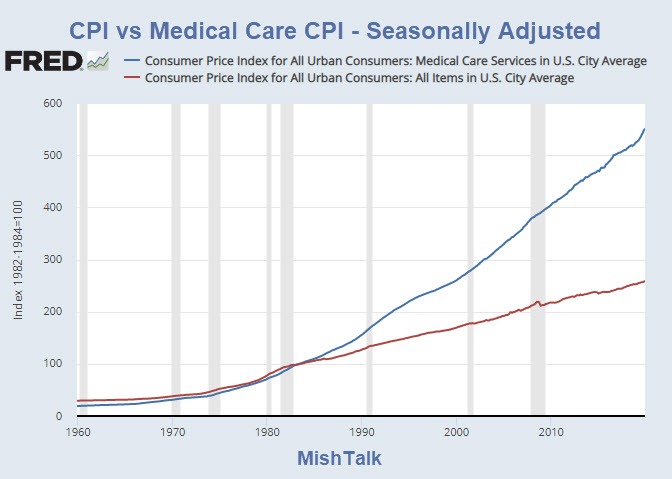
Once again the BLS tells us inflation is under control. Once again, close inspection suggests something else.
Let’s investigate, starting with the BLS Consumer Price Index Report for January 2020.
- According to the BLS, the Consumer Price Index for All Urban Consumers (CPI-U) rose 0.1 percent in January on a seasonally adjusted basis after rising 0.2 percent in December.
- The index for shelter accounted for the largest part of the increase in the seasonally adjusted all items index, with the indexes for food and for medical care services also rising. These increases more than offset a decrease in the gasoline index, which fell 1.6 percent in January.
- The index for all items less food and energy rose 0.2 percent in January after increasing 0.1 percent in December.
- The all items index increased 2.5 percent for the 12 months ending January, the largest 12-month increase since the period ending October 2018. The index for all items less food and energy rose 2.3 percent over the last 12 months, the same 12-month increase as reported in the previous 3 months. The food index rose 1.8 percent over the last 12 months, while the energy index increased 6.2 percent over that period.
CPI Month-Over-Month and Year-Over-Year

Hooray! Inflation Tame
Hooray, inflation as measured by the BLS is only up 2.3% from a year ago, the same as December.
Month-over-month, the CPI rose only 0.1% vs the expected 0.2%.
But does your basket match this?
CPI Percentage Weights
It’s when you dig into details you find disturbing trends, like the lead chart and this.
Medical Care Costs Year-Over-Year
Medical Insurance Quotes
I posted these quotes last month, but it’s worth another look after this gloomy report.
I went to NerdWallet for some quotes. My base case was a husband and wife making a combined $100,000, both aged 60, non-smokers, with no dependents.
Same Couple Making $60,000
Synopsis
- For a couple, aged 60, making $100,000 per year, “affordable” care costs $19,776 right off the top. Then there is a max out of pocket expense of $8,150 per person. Yes, per person.
- For a couple, aged 60, making $60,000 per year, “affordable” care costs $3,804 right off the top. Then there is a max out of pocket expense of $8,150 per person.
The BLS tells us, medical care is only 6.97% of the “average” household expense.
Average includes all those on medicaid and medicare. It also includes those on company plans.
It does not count corporate costs. Why? The BLS is only concerned with “consumer” prices. No other measures of inflation are important.
Averages take into consideration the average person does not go to the hospital.
Heaven help you if you actually need help.
What About Home Prices?
Good question, especially if you want to buy a house.
The BLS Relative Importance Table shows housing is 42.20% of the CPI.
Owners’ Equivalent Rent is the largest component in the CPI, accounting for a whopping 24.05% of the CPI.
The Owners’ Equivalent Rent (OER) Calculation method is absurd.
The expenditure weight in the CPI market basket for Owners’ equivalent rent of primary residence (OER) is based on the following question that the Consumer Expenditure Survey asks of consumers who own their primary residence: “If someone were to rent your home today, how much do you think it would rent for monthly, unfurnished and without utilities?”
Home Prices vs OER vs Earnings
Already have a home?
If not, don’t expect to find an affordable one. Sorry. You simply do not fit the BLS mode where averages rule.
BLS Model vs Reality
If you are in school, looking to buy a home, buying your own health care, or even having insurance but getting sick, then your measure of the CPI will be dramatically different than what the BLS tells you.
If you are 65, on Medicare, and own your own home. Congratulations. You fit the BLS CPI mold perfectly!
Mike “Mish” Shedlock






























But this Can’t be – The Democrats fixed healthcare under Obama. Didn’t we all get $2,500 back like Obama promised?
Another inflation shock on the horizon is the coronavirus. With China shut down, some goods will become scarce, and we can expect prices on them to rise. On the flip side, if coronavirus spreads rapidly here, we could see the reverse effect, if people stop going out, and stop doing things. So, with China shut down, we will see less supply. If the US shuts down, we will see less demand.
“Health Insurance” a sub-component of “Medical Care” has been up more than 20% y/y for several month. BLS calculates the change by subtracting claims paid from premiums collected with a relative importance of 1.17%. Our out of pocket for health insurance (Standard Medicare + supplemental) is over 8% of total expenses.
Mish,
Mine looks much like yours, but we’re all different. There should be a more sustained focus on the key drivers.
I think you should provide a public service by selecting an annual “Most Successful Rent-Seeker of the Year” award, along with stats explaining why, as well as a second and third prize for this prestigious honor.
The perennial winner presently will obviously be health care, but colleges certainly are in the hunt and deserve honorable mention. Their current funding model points kids to the quasi-pse, fed-backed loan scheme, bypassing the traditional loan committees of private banking. Their accum rake of $800 Billion in excess of the CPI, has made a whole generation of kids into indentured servants with student loan debt. All this without a single congressman or Senator taking heat or losing their jobs…Brilliant!
I nominate for third place the grant-and-subsidy-seeking AGW crowd. I just looked at my first 2020 utility bill and I’m being charged $0.266 per kilowatt hour now, almost exactly twice the national average. I’m buying their boondoggle for them: Brilliant!
There are tens of thousands of beltway lobbyists toiling year-round now with scant public recognition or reward beyond their million dollar salaries. You could fix that.
“BLS Reports Tame Inflation as Medical Costs Soar Out of Sight”
…
Yes. Look no further than current US Treasury Monthly Budget Statement. For first 4 months of fiscal year (starting October 1st) fedgov outlays for Centers for Medicare and Medicaid Services:
FY2019 … $499.328 billion
FY2020 … $563.851 billion
My math a bit rusty, but seems more than a couple of percent …
Medical CPI was 5%, that’s $25B. For old people it’s probably significantly higher than 5%. Number of people on Medicare up by 5%. Comes out pretty close.
You need to delve deeper.
Medical services saw an increase of 5.1% year over year, BUT that was driven in large measure by 20.5% (unadjusted) increase in health insurance.
Hospital and related services .. +3.7%
Professional services .. +1.2%
Medical commodities (separate from services. included drugs + equipment) .. +1.7%.
Fedgov outlays on medicare & medicaid strip out health insurance.
“It does not count corporate costs. Why? The BLS is only concerned with “consumer” prices. No other measures of inflation are important.”
Increased corporate health costs will presumably show up in the prices they charge for the end products, so the inflationary aspect will show up there. Why count it twice?
How do you know that increased corporate heath benefit costs do not have the effect of decreasing take home pay instead, reducing reported “wage inflation,” and causing the Fed to under count increases in the real cost of living?
Touche!
Demand for output product, is much more price elastic, than supply of labor is, when the labor pool pretty much rendered entirely captive by complete dependence on their employer for affordable health insurance.
Busting people out of that captivity, is the best argument going, for a single payer system vs. the current one. Since while a single payer system will no doubt suck (government mandated/managed anything does); it will at least suck equally bad, regardless of if you stay or if you go, when faced with a shitty employer. Incentivizing employers to be less shitty, than the current one keeping employees in captivity regardless, does.
I predict that medical costs will accelerate over the next few years. As more and more boomers qualify for Medicare and switch from private pay to medicare it will create a problem. Doctors and hospitals get paid less by Medicare than from private insurance. They can’t increase prices on medicare, so they will have to increase it more on private pay and private insurance.
Meet rural America. That issue is here and guess what no one wants to play so hospitals close and docs are in short supply.
All the more reason we should have been importing health care professionals the past 30 years instead of H1B visa types.
Great! Will help to bring on the robots and AI faster.
Health care costs are a big concern today.
My concern for the future is food shortages and a big increase in food prices. Extreme weather events, disease, loss of agricultural land, population growth, water shortages etc are going to impact agricultural production more and more as time goes by.
Not to worry. Agriculture is going to move inside and be done most via hydroponically. There is much greater production in a much smaller space and the plants grow faster. The only places where food will be a problem is in the 3rd world countries.
I take no pleasure in knowing that people in third world countries will suffer malnutrition and starvation. They will be forced to attempt to migrate to other countries. How many millions will attempt to move to the US?
I’m pretty sure he was stating a fact of economics, not that he endorses the idea of getting deflation by depopulation from viral infection. I can see how that could be interpreted as such, but I don’tthink that was the intention.
Oh. You are probably right. I misunderstood. My apologies. Sorry Bam.
If that situation occurred, we’d be forced to shoot them at the border. They need to learn how to use birth control.
That is one of my fears. The thought of shooting starving women and children at our borders is not a future I want to see.
I agree that the world needs to be better controlling population growth though appropriate birth control methods. Overpopulation is a big problem. But I don’t want to see people suffer and die in order to reduce the population. Sadly, that is already happening now in many places.
Why would improvements in agri efficiency not benefit 3rd worlders?
On the face of it, they are the ones with the most to gain, as they are the ones for whom food comprise the largest share of income. And they are also, the ones most susceptible to droughts and other “unforeseen” disruptions.
I agree Stuki. Providing the basics of life to all the people in the world is very important. If we can grow food indoors here, then it needs to be done in countries where they are losing their agricultural capabilities due to a host of reasons (desertification, drought, flooding, extreme weather, war, etc)
If this pandemic goes global and kills enough people, there will be deflation, not inflation.
You must be a horrible person. Perhaps you would sacrifice your children and grandchildren to reduce the population, just so you can have lower food prices?
An interesting thought-exercise–if an epidemic did occur here–what would the effect be on the health insurance industry? Would they walk away, or declare some sort of uncovered “act-of-god”? Or would they go down in flames valiantly spewing money to the end (Hah!)? Could individuals be liable for their own costs? What would the government be liable for? What about quarantine expenses? Who would draw the line? Are there re-insurers on the hook for these sorts of events? Would this break the insurance industry and move it to a single-payer system?
In the event of an epidemic/pandemic, they would declare “Force Majeure” and you would be on your own. Don’t kid yourself.
Curiously, ours is likely very close
1: I am on Medicare and my wife has company insurance.
2: We own our house free and clear
3: I buy food on sale and have a big freezer. There are only two of us so it is easy to stock up.
4: We have no student debt or education expenses
5: We have no credit card debt
6: We buy cars and keep them for a decade until they wear out
If you fit that bill you are probably close to to the reported CPI
Close to what?
We are close to Medicare age and the only uncontrolled expense is health-insurance. Premiums go up faster than inflation, and out-of-pocket goes up even faster than the premiums.
Excuse me Mish, don t want to bother you, but since yesterday it is impossible to post a comment (there s no box) unless I use the reply mode, like I am doing now …..Thanks .
Not sure I understand that – can you post an image clip?
What Browser and OS?
Thanks
Anyone else having problems?
Those are sick (and not in a good way) prices compared to Medicare! So why are so many fighting to keep their “private health insurance” at these awful costs when current Medicare + a supplement plan is so much less costly? I thought people voted their pocketbook?
As to inflation, I want more! That way, Trump will ensure that everyone on SS gets a really nice increase this year, given that he is going to be struggling mightily to get reelected.
Partly because of people like me that get it thru an employer and have one of the better, low cost plans and dont want people jacking with it and then i’m sure there’s forces that promote “that’s bad” constantly for some fear that it might BK the US which is laughable in itself being we’re already there and digital zeros are easily conjured up. I think this day and age it’s get all you can get and screw everyone else. Not a optimistic vision but seems to be the case.
You are definitely math-challenged. Someone always pays for everything. How do you justify the government taking other people’s money under threat of violence to pay for your sorry butt? If you want to form a beneficial organization to pay for you and can convince others to join VOLUNTARILY, then GREAT. Using the government to be thugs in your extortion schemes NEVER!
Stop being stupid. Do you or will you get Social Security? Same question for Medicare? Because both of those are heavily subsidized by the government. I do hope that you choose to give yours up when the time comes or if you are currently on the roils , to terminate your benefit payments immediately.
What does the deficit have to do with anything? M4A will save money overall by eliminating the middleman, all the insurance dweebs pushing papers from one to another and so on. This will result in lower premium payments for everyone also.
But if the deficit is such a problem to you, then write your Congressman to rescind Trump’s tax cut last year. Or better yet, vote straight Dem this election.
The government will be middleman, which will not save money.
Denninger makes the point that if anti trust law was enforced, that medical costs would drop up to as much as 80%. M4A isn’t needed. Just a free market. Democrats don’t want lower prices, they want government control over you.
Deficits are due to spending, not a lack of taxes. If there was no spending, there would be no tax.
In fact, the federal government can just print all the money it needs to run its normal operation. They choose not to.
“What does the deficit have to do with anything?…if the deficit is such a problem to you, then write your Congressman to rescind Trump’s tax cut”
The deficit has to do with the Federal Government having a spending problem. They always spend more than they collect, no matter how much they collect. Raising taxes does not solve this problem. In your prior comment I responded to, you mentioned programs “heavily subsidized by the government” as though that does not cost taxpayers anything. It costs a lot, and the government is historically very inefficient in its spending.
“eliminating the middleman,”
Fat chance.
All it will do is rebrand her, from insurance dweeb to apparatchik. It’s not as if command economies are some paragons of efficiency and freedom from non productive, leeching middlemen.
“Savings,” if any, will stem from those who can afford to, no longer paying for their own care as directly as before, but instead having their spend being diluted to pay for others as well. Hence being less willing to spend as much for “frivolities” like MRIs for pain in the toenail, and a few million to extend life another hour right at the end.
The only possible actual efficiency improvement, could come by way of it being harder for ambulance chasers to shake down the government, than non government insurers. But I wouldn’t hold my breath for that one. As long as taxpayers have to pay, not the guys who actually comprise “the government”, there is not much more incentive to restrain that leeching racket, either.
Instead, the trend towards an ever increasing share of total end user spend, going to everyone except those competent and useful enough to render actual care, will continue. Funding the lifestyles of those in “the system” is, after all, the one and only purpose of every “system” out there. Whether nominally “public” or “private.”
“M4A will save money overall by eliminating the middleman”
Any money saved won’t transfer to the consumer. Rather, the extra paperwork of M4A will necessitate the staffing up of the bureaucracy, eating up any “savings”.
That’s how government works, bub.
Sure Chief. Have you actually seen the amount of paper (physical and virtual) generated in MD offices alone? Go into any office and you see walls of folders, despite the ACA mandate to switch to electronic records. We pay so much in the USA relative to everyone else because of all the inefficiencies in the private insurance market. This needs ot go and only the government can do that.