

The telegraph reports European Carmakers are Caught in the Crossfire of Trump’s Trade War.
But it’s not just European manufacturers. The US will take a huge hit as well.
China has been the most frequent target of Trump’s ire. At the start of the month he fired another Twitter salvo in the trade war between Washington and Beijing.
From September 1, $300bn (£247bn) of imports from China would be hit with a surprise “small additional 10pc tariff,” Trump threatened. “This does not include the $250bn already tariffed at 25pc,” he added. The news caused the S&P index to fall almost 2pc in just a few minutes.
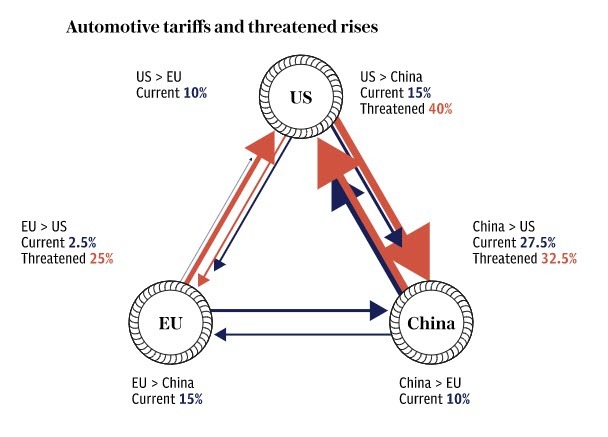
A few weeks later Beijing responded. Retaliatory tariffs of 10pc on US imports would similarly begin at the start of this month. But it also warned that in December the import duty on US-built cars would jump from the current 15pc to 40pc – reimposing a threatened 25pc hike that had been put on hold as tensions cooled last year. The warning put the global car industry squarely in the firing line.
“The car industry is complex with supply chains crossing borders and components moving between countries many times,” Professor David Bailey, a car expert at Birmingham University, says. “That’s before you take into account foreign-owned plants producing cars for export around the world*. Tariffs are a very blunt instrument and using them has unintended consequences*.”
US Impact
- The BMW plant in Spartanburg, South Carolina, opened in 1994 and since then the 11,000 people whose jobs it offers or supports have produced 4m cars.
- The Mercedes site in Tuscaloosa County, Alabama, has 3,800 direct employees and supports 10,000 more jobs, and the plant has churned out 3.2m vehicles since opening in 1997.
- “BMW and Daimler are two of the largest exporters of vehicles from the US to China,” says Ellinghorst. “A 25pc tariff would cause $1.7bn of extra costs for the two of them, split fairly evenly.”
- Volvo may be another victim. The company which is owned by China’s Geely opened its first US plant, in Ridgeville, South Carolina last year. Ian Henry of Auto Analysis added: “There’s also been stories of Volvo supplying some models made in China from its European factories to the US to avoid tariffs, with the shortfall in Europe made up with cars built in China being transported by rail.”
- Evercore says that of the US manufacturers, Ford and Fiat Chrysler, which respectively export 40,000 and 10,000 American-built cars to China annually, face an extra $320m and $80m in costs.
- Tesla, which is expected to sell about 45,000 vehicles in China in the coming year, faces a $620m bill. However, Elon Musk’s electric car company is building a plant in Shanghai which will allow it to dodge tariffs when it opens next year.
Truly Idiotic
BMW, Volvo, Mercedes, and Daimler all produce cars in the US for export to China. That slowdown is in addition to the direct hit on GM and Ford.
Elon Musk will avoid tariff retaliations by building cars in China.
If you think this is truly idiotic, you are not the only one.
The article concludes “For all Trump’s rhetoric about making America great again and protecting the country’s industrial base, his current tactics risk causing huge damage.”
Major Supply Chain Disruptions
Two days ago I commented Major Supply Chain Disruptions Coming: Thank Trump
I stand corrected.
Major supply chain disruptions are already here.
ISM and PMI Reports
The ISM and PMI reports were miserable, not just in the US, but globally.
I commented US Manufacturing Recession Begins: ISM Contracts First Time in 3 Years.
Here are a couple of items that caught my attention.
- Deteriorating demand conditions, especially across the automotive sector, were linked to subdued client demand.
- External demand also weighed on new business growth, as new export orders fell at the quickest pace since August 2009, linked by many firms to trade wars and tariffs.
Deteriorating Automotive Sector
Last Friday, I noted Personal Income Up 0.1%, Spending Up 0.6%, sarcastically commenting “What’s the Problem?”
Here is the contradictory line from the BEA report that caught my eye in advance of the ISM and PMI reports.
“Within goods, recreational goods and vehicles was the leading contributor to the increase.”
I commented “Auto and SUV sales have not been strong. I smell revisions.”
Gross Distortions
The economic reports appear to be grossly distorted, way more than usual.
Little of this ties together.
On July 7, I commented Dealers are Bumper-to-Bumper With SUVs: More Coming as Sales Decline
On August 5, CNBC reported Car dealers struggle to sell 2018 new-car inventory to make room for 2020 cars.
As dealerships look to sell off cars from the 2019 model year to bring in 2020′s shiny new models, they’re running into a problem. They still have cars from 2018 clogging up their lots.
Even if vehicles are a “leading contributor” to increased consumer spending as the BEA says it won’t last.
Auto sales figures are out later today.
Mike “Mish” Shedlock






























Trade war myas….US economy is stage 5 terminal,all the fed is doin is injecting massive QE chemo to make the dying (economy) patient suffering less unbearable……but the Us economy is (dead) defacto…dieing!
I agree. If the US economy was healthy, 40 of 50 states would not be taking more than they give. When the tide goes out, it is going to be ugly in 50/50 states.
Amazing how all the new car manufacturing plants built in America over the last 30 years were built far away from democrat states, closed shop union states, high tax states and gun control states.
I am sure it is just a coincidence…
Amazing how one can just spew random things and relate it to the number of car manufacturing plants built in America (gun control?). You know what, I see it now, those states eat a higher percentage of pork products than “liberal” states, obviously it is the number of pigs that are drawing those car companies in to build new plants, It’s as simple as that right? Just like your dear leader Trump, you may be the partially right, but for the completely wrong reason.
It is also no coincidence that as of 2019, there are only two handfuls of donor states. The states you mention take more than they give despite having “jobs”. Why is it that most of the states in green are in the south and midwest ? Why can’t those states get their act together even under the new tax code ?
What’s not shown is the breakdown in those states. People assume that because a state voted for a particular party, everyone in that state is a member of that party. Far from the truth. In the south, most of the welfare recipients are democrats.
The bottom line is the states are net takers from states like Illinois and New York. Let us keep in mind those states that are takers are primarily controlled by Republican state houses and governors and have been for awhile. It is interesting to note that despite the boom in Texas and increased population and more jobs, Texas went from a giver to a taker. So despite more property taxes, more sales taxes and more other taxes, Texas flipped. And this was before more federal funding for immigration issues.
Mish again: What level of business acumen did you expected from a guy that failed in the casino business where the house always win?
Casino’s go under all the time. It’s the nature of the business.
So he does not have a good business eye? Why would any business genius start a casino business if they fail all the time…?
..Because meaningful “business geniuses” only exist in childish movies and the feeble imaginations of the dumb and uncritical. Like “trade” geniuses, guys who excel at everything from plumbing to tailoring…. Or “sports” geniuses, who are simultaneously great at both being horse jockeys and Sumo wrestlers…
Each business is rather unique. And require a very different set of skills. Some guys may be somewhat more athletically gifted than others, but specialization is what allowed humanity to (at least temporarily it now seems….) escape Nasty, Brutish and Short. Which completely precludes anyone being a general “genius” across a swath as wide as “business” in general. Even the most athletically gifted Sumo wrestler, would be a disaster on the back of a horse at some Derby.
So, you may have businesses built around some who are arguably geniuses in specific, narrow (and ever narrower as s[specialization, hence efficiency and wealth, increases) niches (Brin/Page comes to mind), as well as geniuses in certain sports (Mike Tyson), but noone who are sports, nor business, geniuses in the abstract.
Whenever you hear someone refer to himself, or someone else, as a “business genius”, you can be pretty sure that you are dealing with someone about as far from a genius as possible. Who is, instead, some complete dunce too dumb to even comprehend the stupidity of his own utterings. And, in this day and age, almost as certain that the clown you are dealing with, have been the recipient of a lot of stolen loot, handed to him by The Fed and regulators. Or is someone too dumb to recognize the difference between a genious and a simple Welfare Queen.
There’s a difference between corporate bankruptcy and personal bankruptcy. A lot of people have made money running business that eventually filed for bankruptcy.
“The global repercussions of Trump’s trade wars have a new casualty: US and European car manufacturers.”
US and European car buyers. There fixed it for you Mish.
Because just as with corporate taxes they are not paid by the company but built into the cost of goods (services) sold, and passed on to the end consumers. The fact that it will depress demand is only a very temporary problem for the manufacturers, they will see a small hit to profits for a very short time, then trim costs (layoffs and mothballing facilities) and their profits will be on a smaller base but back to normal in no time.
supply chain disruptions are bigger than you realize
I know they are going to be bigger than people think they will be, but the cost is in dollars and manufacturers are simply going to pass those costs down the economy to end customers.
All companies are used to business cycles, some years are better than others for revenue and profits, and all but startups have been through recessions when they simply scale back for the duration, they will cut costs till they are profitable and this happens very quickly, that is why you suddenly see millions go unemployed in a matter of a few months. So the bonuses get trimmed for all but the corner office people, but the company survives and writes off any losses.
The two (manufacturers and consumers) go hand in hand: No matter how wealthy a few Oligarchs in a nation of slum dwellers may be, their car buying will never support much in the way of a viable car industry.
You are starting to see this in America: The industry is increasingly unable to make cars of any reasonable usefulness. Instead living off of selling the occasional “limited edition” showcase for tacked on drivel, to a few half literates flush with Fed Welfare. Or, when even that fails, simply selling paper, backed by nonsensical empty hype that sometime in the future…., to the same clueless but connected clowns.
“as new export orders fell at the quickest pace since August 2009, linked by many firms to trade wars and tariffs.”
…
That will be the excuse, no doubt. Trade wars just a match to ignite existing problems:
Vehicles too expensive
Too much household debt
Tsunami of off lease vehicles
Aging demographics
Millennials different attitude toward vehicle ownership
Cost of maintaining: repair/taxes/insurance in upward trajectory
Tariffs may hasten day of reckoning … but that day coming, irregardless
“Millennials different attitude toward vehicle ownership”
Is just a function of poor people always having a different attitude to that which they cannot afford.
I know of no “Millennial”, even in hipsteramadomes like San Francisco, who can casually afford a car, a house with parking for it, insurance blah, blah in town (like their parents and grandparents could); who has some weird attitude that they don’t want one. “Milennials” attitude towards car ownership are no different in America than in any other thrid world country: They can’t reasonably afford one, after payments for food, housing, other necessities and idiotic “mandates” are made.
I do know a few boomers and X-ers with such an attitude towards (personally driven at least) vehicle ownership… (which I believe they share with Donald Trump): They all have chauffeurs on staff…..
But it is indeed possible I have overlooked huge pockets of these mysterious “millennials;” who prefer an Iphone to a BMW + a house with parking for it and insurance, even if the price was the same. Just not very likely.
I recently bought a new car for my son. Everyone was slashing prices. I paid more than $8k under the sticker cost. And new cars come with a ton of great safety and convenience features. I think they’re a great deal compared to used cars.
And every college and HS kid with a license has their own car. At least where I live.
My sons have never had the slightest interest in cars, and they are in their early 20’s. Suddenly it has dawned on them that if they have a car, they can get around, and both are getting licenses, and they plan to buy a car. What sort of car? I was surprised – they want an older car, with rear wheel drive and a stick shift… and they want me to teach them to drive a stick.
In my mind, what triggered this metamorphosis was when my prior car was in the shop for transmission work, and I had to rent a car. The only car the rental place had at the moment was a sports car with a stick, and they suddenly realized how much fun it could be to drive a stick. It turns out that maybe that generation isn’t as different as we thought. Maybe they just haven’t realized that cars can be more than a way to get from point A to point B; driving can be fun.