

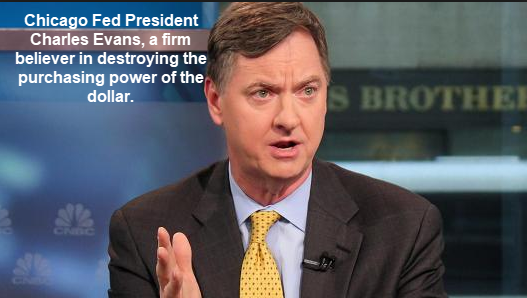
Bloomberg reports Evans Says Fed Must Convince Public It Will Allow More Inflation.
The Federal Reserve should take a more aggressive stance toward boosting inflation and stop talking so much about using interest rates to ensure financial stability, Chicago Fed President Charles Evans said.
Evans expressed concerns Wednesday that the public was losing faith in policy makers’ commitment to bring inflation back up to their 2 percent target.
The central banker has consistently argued for a slower pace of interest-rate increases than many of his colleagues on the policy-setting Federal Open Market Committee.
“In order to dispel any impression that 2 percent is a ceiling, our communications should be much clearer about our willingness to deliver on a symmetric inflation outcome, acknowledging a greater chance of inflation at 2.5 percent in the future than what has been communicated in the past,” he said in remarks prepared for a speech in London.
Two Asinine Economic Theories
- There is a need for inflation
- The Fed can achieve it by talking about it
For proof of number 2, look at Japan.
In regards to point number 1, the BIS agrees that routine price deflation may be beneficial.
BIS Deflation Study
My Challenge to Keynesians “Prove Rising Prices Provide an Overall Economic Benefit” has gone unanswered.
The BIS did a historical study and found routine price deflation was not any problem at all.
**“***Deflation may actually boost output. Lower prices increase real incomes and wealth. And they may also make export goods more competitive*,” stated the study.
For a discussion of the BIS study, please see Historical Perspective on CPI Deflations: How Damaging are They?
CPI deflation is not to be feared. More precisely, CPI deflation is a benefit. Falling prices increase purchasing power by definition and thus raise standards of living.
It’s asset bubble deflation that is damaging. When asset bubbles burst, debt deflation results.
Central banks’ seriously misguided attempts to defeat routine consumer price deflation is what fuels the destructive asset bubbles that eventually collapse.
Average 6th Grader vs Average Central Banker
The average consumer or any age wants money to buy more, not less. Even 6th graders understand the idea.
The average brainwashed economist thinks there is an economic benefit to having money buy less, not more.
The only way to get to be a board member of a central bank is to be a group-think brainwashed economic illiterate.
Hello Charles. Looking for inflation? Look at asset prices and the bubble you helped blow.
Mike “Mish” Shedlock






























Of course the banksters and their deficit-spending customers in CONgress need inflation, just as the establishment needs Trump and any other anti-establishment candidate railroaded out of the club. This is about them, not us. People make the wrong assumption that govt actually cares about them, when the reality it’s all about preserving the perks and power of career politicians. What these short-sited idiots fail to realize is they are shooting themselves in the head, because the fraud and undermining of freedom and the rule of law, causes confidence to decline and capital to get off the grid, which is why you see a painting selling for almost a half a BILLION dollars.
The other obvious problem is the ivory tower economist in govt, CB’s, and talking-your-book analysts on TV view the world from a UC-centric POV and ignore global capital flows / investment that swamps out trade, QE, buybacks, or any other ridiculous rationale to justify why stocks are up, gold is down, and why we will have hyperinflation. These people have little or ZERO real world experience and think (or hope you think) they can manipulate the world economy. After all, if voters realized the truth that politicians are completely impotent against the business cycle, how could they sell their promises (lies) to voters?
It’s confidence and global capital flows that drive everything. A businessman does not care what interest rates are, as long as long as he can make a margin on his product. The primary reason stocks keep breaking record highs is because confidence and the economy are imploding outside the US, and things collapse from the periphery to the core. As the risk rises in foreign banks, interest rates will rise, and when the dollar also rises, then that will be your clue capital is desperate for safety. As the dollar and rates rise, the balance sheets of foreign entities holding too much dollar-based debts will explode, sending an avalanche of capital into stocks. In the new world of sovereign defaults, stocks are the new safe haven for the big money, and the only inflation will be in taxes and govt desperation, as govt’s throw citizens under the bus to preserve their perks and power. This may help – https://www.armstrongeconomics.com/uncategorized/keynesianism-monetarism/.
The Fed has no interest in deflation, nor in the strength of the Dollar, because if inflation decreases or interest rates increase, the Treasury (and thus the Congress and the administration) will have to come up with another $4 or 500 Billion per year in debt service. We are already insolvent, but the politicians need to buy more votes. The Fed will do everything it can to increase inflation and decrease interest rates, because that’s where its rice bowls come from.
Deflation is the natural result of a successful economy. Efficiencies drive the cost of production down and decrease market friction. Deflation is the best measure of whether a society is healthy.
Just as I never have, and never will, see anyone make a logically coherent argument for why “consumer price” deflation is a bad thing; neither have, nor will, I ever hear such an argument for why “asset price”, nor “debt,” deflation is somehow a bad thing. Even more obviously so in an asset pumped, overindebted economy.
Just as I am better off if hamburgers get cheaper, hence I can afford more f them; the same holds equally true of houses. Or shares in a factory. Or fixed future income streams. The cheaper ALL things get, the better off people are. Period. Full stop. No exceptions. All the way up until the limit case of nothing costing anything; hence all scarcity being banished forever.
For my 2 cents, I don’t understand the CB end game of having a policy of 2% inflation which decreases the dollars purchasing power. Eventually your dollar is worth nothing. You may be able to sell it to the general public over a period of 10, 20, 30, but what are the effects over a longer timeframe of say 60 years plus. It seems bizarre to have a policy in which your dollar eventually has no value.
“Consider that 2% inflation cuts purchasing power in half about every 36 years, whereas 2.5% inflation cuts purchasing power in half about every 29 years.” Which is why I should have had a regular purchase plan of gold 30 years ago when I was 20 years old. I remember reading an investment book 30 years ago recommending to hold 10% of your investments in gold but I had difficulty understanding the benefits of doing so. Better late than never I guess to have started a regular gold purchasing plan.
@Ambrose_Bierce:
“We are a long ways from inflation levels where hyperinflation can assert itself.”
My understanding is the terms “inflation” and “hyperinflation” are mostly related in name only, with hyperinflation being tied to economic collapse/default risk outside the purview of a country’s central bank. Higher inflation often precedes hyperinflation, but mainly because governments tend to issue huge debt to support their excessive spending habits as their collapsing economies no longer support them, with the collapsing economic activity and government default risk actually being the result of chronic bad policy making.
I think the only thing a higher inflation target will do at this point is enable bad policies to go on longer than they should. In that sense, it would be a step in the wrong direction I think Evans is unwise to advocate it.
CPI has been a more steady economic indicator than GDP. In light of all the Fed dithering CPI comes in pretty much the same, even during wild swings in energy prices. I think they’re right to focus on CPI, GDP is too volatile. Assuming economic confidence is a important factor, CPI or inflation sentiment should be a more valid working tool. We are a long ways from inflation levels where hyperinflation can assert itself.
Attempting to impose inflation on an obviously deflationary global economy is willful stupidity on a cosmic scale. The Fed and it’s CB buddies look more and more like a flock of roosters crowing at sunset. Applying their 2 percent inflation rate to, for instance, electronic components in a throw-away cell phone would have the market price of a Gig of storage costing $1,000 today instead of pennies.
You really have to dig deep to find such a fine selection of dimwits. Can they teach it, or do you have to be born with it? My theory is; due to societal well being, the Darwinian selection goes backwards and select not those that are most able to survive, but quite the opposite. Democracy is just a tool of reverse Darwinism on a long time scale. Sorry, can’t find any better explanation.
@Carl_R: Yes. Trying to keep it simple.
I think the Federal Reserve may be more disingenuous than clueless.
It has recently dawned on me what the Fed’s problem is. They need to inflate payment streams so that the presently inflated asset prices are justifiable and stable in a higher interest rate environment. They are pushing for CPI inflation because they see that as the wellspring for payments that feed debt service on assets. I do not think they care about the detrimental effect this may have on the average person.
@MtnMan – The difference between 2% and 2.5% inflation is actually substantial. 2.5% inflation is 25% greater than 2%. Consider that 2% inflation cuts purchasing power in half about every 36 years, whereas 2.5% inflation cuts purchasing power in half about every 29 years. In about 58 years, 2.5% inflation takes three-quarters of any dollar denominated debt (or savings) over that time and converts it to dust.
Jon Sellers, you imply that Friedman believed that interest rates and employment were tied together. That is not correct. He believed that the relationship was only temporary, and that longer term the Phillips curve was a vertical line. Thus, he believed that if unemployment was too high, you could lower interest rates, which would temporarily decrease unemployment, but that unemployment would return to its prior level, this time with a higher inflation rate, and thus, using interest rates to try to decrease unemployment would lead to stagflation.
It crazy to think that expectations about 2% versus 2.5% would make any difference at all. I never check with central bankers with regards to inflation expectations before I make a purchase. I actually try and avoid reading anything they spew out of their mouths. They are simply doing what they believe to be correct no matter how delusional.
“Evans expressed concerns Wednesday that the public was losing faith in policy makers’ commitment to bring inflation back up to their 2 percent target.” Just who is this public that Evans is talking about?
Evans says “Low inflation expectations keep inflation down”. Well, that is just silly. People only have X amount of income to spend each week. The FED has spent its money on inflating the stock market, not consumers purchasing power.
The Fed bases it’s policy on the economic philosophy of Milton Friedman: monetarism. Friedman believed that by setting the perfect interest rate, you could balance the economy between the right level of growth, inflation and unemployment. Per Friedman, if interest rates were too high you would get low growth, deflation, and high unemployment. If you set them too low, you would get high growth, high inflation and low unemployment. All this because businesses wouldn’t invest if rates were too high, and would over-invest if rates are too low. The Fed believes business investment is too low, causing low inflation, high unemployment, low wage growth and low inflation. Interest rates have a zero bound and taking them to zero didn’t help much. So they are trying to take real interest rates negative by making inflation higher than prevailing interest rates. The purpose of monetarism was to destroy interest in Keynesianism, the prevailing economic philosophy in the ’40’s through the ’70’s. Keynesianism had a central role for government spending to produce growth and employment , which did not fit Friedman’s Libertarian views. He wanted the government out and banks in.
@Sechel, “I bot fail to understand or get the argument that intentional destruction of the purchasing power of the consumer is a good thing”
i
Federal Reserve is a business. Objective is to make profits for shareholder banks. Like many businesses it has an advertising department to convince people to give their wealth to it’s business. Full employment – stable economy – low inflation is a nice slogan. The fed presidents job is to find a way to connect the Federal Reserves and member banks profit making activities to the slogan.
I read that quote years ago, and thought it was odd, yet as I grow older, I increasingly appreciate the amazing wisdom of our founding fathers.
“If the American people ever allow private banks to control the issue of their currency, first by inflation, then by deflation, the banks and corporations that will grow up around [the banks] will deprive the people of all property until their children wake-up homeless on the continent their fathers conquered.” Thomas Jefferson
Didn’t realize pressing Enter submits the comment immediately! I meant to say the next recession will therefore be a global one
Mish – Long time reader here – posting for the first time. Agree that asset price inflation is off the hook, but there is no escape this time – previously investors could rebalance portfolios from US to Europe or Asia; this bubble is everywhere, except maybe Africa. The next recession is
inflation is necessary in the debt based economy with overleveraged debt. You have to steal from everyone…to let debtors off the hook easier…to avoid it all crashing.
Among the bunch of idiots on display at the Fed, this guy takes the cake. Are there any consequences to landing a punch on his face when he sprouts such inane ideas?
Among the bunch of idiots on display at the Fed, this guy takes the care. Are there any consequences to landing a punch on his face when he sprouts such inane ideas?