

China Is First Major Economy to Return to Growth Since Coronavirus Pandemic
The Wall Street Journal reports China Is First Major Economy to Return to Growth Since Coronavirus Pandemic
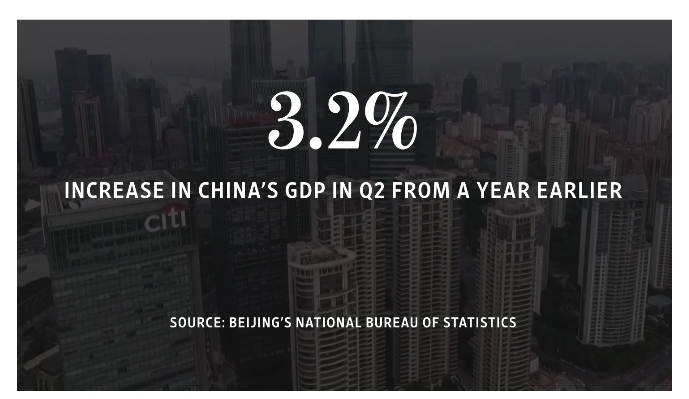
On Thursday, China said its economy grew 3.2% from a year earlier in the second quarter, as authorities benefited from an aggressive campaign to eradicate the virus within its borders.
In sequential terms, China’s second-quarter growth in gross domestic product represented a 11.5% rebound from the first three months of the year, according to data released by Beijing’s National Bureau of Statistics. For the entire first six months of the year, China’s economy contracted just 1.6% when compared with the first half of 2019.The growth figure for the second quarter beat a median estimate from economists for 2.6% growth and was at the top end of an unusually wide range of forecasts, from a contraction of 3.1% to growth of 3.5%. It followed a historic 6.8% contraction in the first three months of the year, when Beijing shut down the country in late January as the coronavirus spread across China from the central city of Wuhan.
Not What It Seems
Michael Pettis at China Financial Markets has a different take in a Tweet Thread.
- Markets drop sharply on China’s “unexpectedly” strong growth data earlier today. Like several other analysts, I full expected the data to come in above expectations, but I was completely wrong-footed by the market reaction.
- The fact that the markets dropped so ferociously on “good” news may be important, perhaps marking a long-overdue change in the way analysts interpret Chinese data.
Instead of celebrating a strong supply-side recovery, everyone seems to have focused instead on the bad demand-side numbers. - Retail sales were down by 3.9% for the quarter. Real disposable income was down 1.3%, and there is a great deal of evidence that its decline was asymmetrically distributed: richer households actually saw an increase in income, whereas for the rest, the poorer, the greater the decline.
- As an aside, a senior European manufacturer told me today that while car sales in China have been stronger than expected, purchases of luxury cars have soared, perhaps reflecting one-off response to Covid-19, while purchases of cheaper cars have plummeted, and seem unlikely to come back.
- Covid-19 is a demand-side shock, and I think there is growing recognition that China’s misguided supply-side response must mean either a surging trade surplus (which we are already seeing and which is bad news for the rest of the world, assuming…
- …it is allowed to continue) or surging domestic investment, which mainly means non-productive investment and, consequently, surging debt.
- I was particularly intrigued by Jamil Anderlini’s claim (below) that “investment by private companies fell by 7.3 per cent”.
- This is pretty bad news. It means that the share of investment driven by either state-sector spending on non-productive infrastructure or investment in real estate development is rising much more rapidly than I expected.
Behind the Recovery, China’s Economy is Wobbling
Point 7 above refers to the Financial Times article Behind the Recovery, China’s Economy is Wobbling.
China’s allegedly solid rebound took a Herculean effort and more state debt, the same tools as always. Anderlini reports that investment by state-owned enterprises in the first half of the year rose by 2.1%, while investment by private companies fell by 7.3 %.
His conclusion is amusing.
- A decade ago, some economists liked to describe the Chinese economy as a bicycle that needed to maintain a certain speed or it would tip over and crash.
- Today it is more like a bicycle laden with enormous boxes of debt, ridden by a drunk and with strategic competitors such as the US trying to knock it over.
It is not just China. So, let’s correct point 2 so that it is more accurate.
The global economy is like a bicycle laden with enormous boxes of debt ridden by drunken central bankers hoping to stuff more debt into the boxes despite the debt deflation consequences of their actions.
Mish






























Bankers are not drinkers, & I take offense to that, as I worked for banks, for a few years. When, You, don’t understand, you make up stuff, & since whe@conversation n, have You, sat @ the table to try to work out your own bank statements, without any help, from YOU! ITS LIKE GRADING PAPERS AS A TEACHER! EVERYBODY HAS THEIR OWN WAY OF DOING THE MATH! LIKE KENNY ROGERS SAID,in his song, ” DON’T COUNT YOUR MONEY AT THE TABLE,”, before the dealing is done! . SO TRUE. IT’S A NIGHTMARE FOR ME. It’s ex: every direction, on that asterisk telephone, is coming at you, trying to help. But, I’m the teacher, so, it ends up, grading papers. I, then, do my own banking later. Darn that private prayer, live TV. LoL. They’re only trying to help, but, what a pain in the butt! REMEMBER, if the Asians could talk, & wouldn’t get killed by their own gvmt, like that Dr, that died, being a Whistler blower, helping the REST of the world, leaking THE COV 19 INFO from Chinese border, well, I guess the numbers would be more honest. We will have to wait & see.
If China’s economy is so good, why are so many shelves at Walmart and Target that used to be full of Chinese products empty? They are still shut down in many areas. Their Covid 19 numbers are baloney.
Or they are keeping everything at home hoping for inflation to take off in America.
Stagflation is really the worse outcome for us at this time.
“The global economy is like a bicycle laden with enormous boxes of debt ridden by drunken central bankers hoping to stuff more debt into the boxes despite the debt deflation consequences of their actions.”
Well put!
When the bicycle will topple over and the deranged central bankers are not able to set it right is anybody’s guess. Imagination boggles at could happen to the world then! Sadly, the proletariat might not recognize we are in a mess due to central bankers and it is them and their building that we need to bring down!!
Who would believe anything coming out of China. The total number of Covid-19 cases in Sweden (pop. 10 million) has almost equaled China’s reported numbers (pop. 1.5 billion). Sounds about right!
According to the Worldmeter’s coronavirus stats today, China has 3 deaths per million, and Belgium has 845 per million from Covid-19. Does that seem possible to anyone?
Ask Taiwan or Korea or Hong Kong.
Impossible , if you believe that east asians cannot do anything better than western people.
Vietnam has ZERO death from CoronaVirus, can you fathom that? Totally impossible for people who enjoy the freedom and rights under Dear Leader tRump’s great leadership.
What is the life expectancy in Belgium vs China? Also, does Belgium finally have a government? /s
What’s not believable about it?
Compare Belgium with closer-to-its size and population density Wuhan, rather than continent sized China as a whole, and you get a different, and more directly comparable number.
I’m not saying China’s reported numbers are some sort of “correct” in absolute terms. But neither is Belgium’s. And there’s no reason to believe one is, a priori, any further from accurate, than the other. At least unless one is explicitly reporting a different number, as in “died with covid” vs attempts to restrict it to “died from covid.”
Heck, I’d be very surprised if China’s numbers aren’t more useful/accurate than at least the US’ by now. Since the commies, while hardly all that, do seem to retain at least some tiny traces of basic competence at something. While in the US by now, it hardly even matters anymore, whether the chipmunk-brains in charge of it all, mean well or not: They’re simply too stupid to accomplish, either way, whatever they may set out to do, in between tweeting childbrained stuff and “making money off their portfolio.”
Does anyone still believe anything that comes out of the Chinese government ? They never had any credibility on the global stage.
You may not believe their numbers, but most major western corporations (including IMF, WorldBank, Apple, Tsla, Costco, WalMart, etc) do. China is the world’s biggest retail market now: tell me how you can fake that.
Good article, learned a lot about the news behind the news and Trump not mentioned once.
Simply unbelievable.
For context, notice that China has almost fully reopened its economic activities since the beginning of April (btw that’s the date tRump had Famously predicted the virus would magically disappear). With this in mind, a 3.2% growth is not surprising at all, as Petis said himself. As to debts increased, yes they are invested into the economy which should help future economic growth (recall that China is still a developing country where lots of places need investments). Compare that debts with the U.S. debts which are mostly given to the rich and wallstreet gamblers, I’m not sure which way is better.
“As to debts increased, yes they are invested into the economy which should help future economic growth”
…
In China household wealth is mostly held in real estate. Ghost cities are not a myth. Much of the rest is rolling insolvent loans.
China’s total debt has grown from $8 trillion during the GFC to current $45 trillion (ish) … almost sextupleting debt in only 12 years no great concern??
Yuan devaluation looms at SOME point.
Ghost cities used to be a hot topic in the western new media, but do you still hear about it now? Chanos famously was a big short of China because of the ghost cities, how much money has he made? The fact is that most ghost cities have been occupied now. Don’t get me wrong, there are some wasted investments there, but it’s naive to think that US debts are better debts, and China debts are the bad ones. If tRump cannot manage the pandemic like many other countries have done, what makes one believe that he can manage better debts than other countries do?
“The fact is that most ghost cities have been occupied now.”
…
Really?
More to the point … please CITE.
An article … from TODAY:
“About 21% of homes in urban China were vacant in 2017 — a very high proportion relative to international standards — which equated to 65 million empty units, according to the most recent data from China Housing Finance Survey. Among families who owned two properties, the vacancy rate reached 39.4%, and among those that owned three or more, 48.2% were empty.
Rental yields — the proportion of a property’s value made annually by renting it out — are below 2% in major cities like Beijing, Shanghai, Shenzhen and Chengdu, less than can be made buying Chinese government bonds.”
China has about 50% of inhabitants still living in the countryside this year. Every year about 20 millions of them migrate into cities. They can migrate into cities Only if they can find a place to live (thus temporary empty buildings). This trend will continue for many years to come. That’s why homebuilders (Private companies) have been building and building. This is called Foresight by these private entrepreneurs. Market will determine their fortune or misfortune. Notice that the private investments (including home building) have decreased this year due to the pandemic. The GDP growth in Q2 is not generated by home builders. The new increases in investments are public ones, like all kinds of infrastructure.
Good story August. Makes me want to buy a tulip.
I guess you can’t have a speculative bubble without speculation.
Car purchases relate to a reluctance to use public transportation?
No because these are luxury cars. The rich are not only not affected negatively, they become richer with this pandemic.
Btw China is the biggest total retail market now, overtaking the US this year (google it).
“China says economy grew 3.2% from a year earlier in the second quarter.”
…
Possibly. But to do so, you must believe them. Anyways, at what COST?
This sums it up … frankly, the point here sums up “growth” … ANYWHERE …
Doug Noland:
“China’s Total Aggregate Financing (TAF) expanded a much stronger-than-expected $490 billion in June, up from May’s $455 billion expansion and 30% above growth from June 2019. TAF surged a remarkable $2.976 TN during the first-half, 43% ahead of comparable 2019 (80% ahead of first-half 2018).
It’s not easy to place China’s ongoing historic Credit expansion in context. While not a perfect comparison, U.S. Total Non-Financial Debt (NFD) expanded a record $3.3 TN over the four quarters ended March 31st. In booming 2007, U.S. NFD expanded about $2.5 TN. Chinese Total Aggregate Financing has expanded almost $3.0 TN in six months.”