

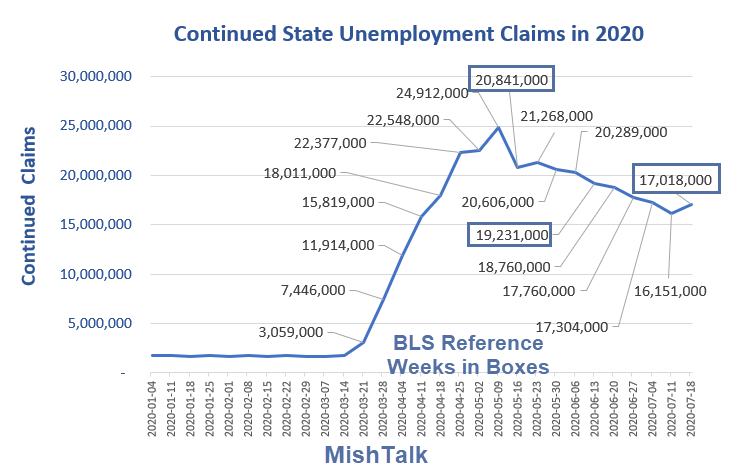
Job Warning Lights Flashing
Signs that the economic recovery is over already continue to mount.
Continued claims rose from 16,151,000 to 17,018,000 for the week ending July 18.
Initial claims rose for the second week.
Initial State Unemployment Claims

After trending lower for 16 weeks, initial claims rose last last week and rose again this week.
Note: My Initial Claims and Continued Claims charts are Seasonally-Adjusted. The following PUA and Totals are NOT Seasonally-Adjusted.
Four Continued Claim Factors
- Continued claims lag initial claims by a week.
- People can find a job and drop off the unemployment rolls.
- People can expire their benefits and drop off the rolls.
- People can retire and drop off the rolls.
Unemployment Compensation Basics
This is week 19 of the pandemic.
Workers in most states get 26 weeks of unemployment benefits according to the Center on Budget and Policy Priorities.
- Workers in most states are eligible for up to 26 weeks of benefits from the regular state-funded unemployment compensation program,
- Six states provide fewer weeks and one provides more.
- Under the CARES Act responding to the COVID-19 pandemic, all states provide 13 additional weeks of federally funded Pandemic Emergency Unemployment Assistance (PEUC) benefits to people who exhaust their regular state benefits.
- There are additional weeks of federally funded EB in states with high unemployment (up to 13 or 20 weeks depending on state laws).
- The maximum weeks of Pandemic Unemployment Assistance (PUA) for exhaustees equals 39 minus the number of weeks of regular UI and Extended Benefits (EB) received.
- No PEUC or PUA is available after December 31, 2020.
State Exceptions
- Massachusetts provides up to 30 weeks of UI except when a federal extended benefits program is in place (as it is now) or in periods of low unemployment (as was the case through February), when the maximum drops to 26 weeks.
- Montana provides up to 28 weeks of UI.
- Michigan normally provides up to 20 weeks of UI, but in the COVID-19 emergency that has risen to 26 weeks.
- South Carolina and Missouri provide up to 20 weeks of UI.
- Arkansas provides up to 16 weeks of regular benefits.
- Kansas was providing 16 weeks of UI before COVID-19, but that has been extended to 26 weeks through April 2021;
- Alabama currently provides up to 14 weeks of UI for new enrollees, with an additional five-week extension for those enrolled in a state-approved training program;
- Georgia was providing 14 weeks of UI, but in the COVID-19 emergency that has risen to 26 weeks;
- Florida currently provides up to 12 weeks of UI; and
- North Carolina currently provides up to 12 weeks of UI.
Expired State Benefits
- Alabama
- Florida
- North Carolina
Benefits South Carolina and Missouri expire after one more week for those impacted at the onset.
State Claims Provide Incomplete Picture
State claims do not provide a complete picture because many people, are not eligible for unemployment insurance.
For example, self-employed are not eligible for state unemployment insurance even though they pay into the system.
The self-employed and small businesses were eligible for loans that in some conditions will not have to be paid back. The self-employed are also eligible for 13 weeks of Pandemic Emergency Unemployment Assistance (PEUC) but that may have expired.
Primary PUA Claims

Primary PUA covers those who are not eligible to make state claims. The report lags initial claims by 2 weeks and continued claims by 1 week.
Based on state initial claims and state reopenings in reverse, I expect this number to rise in the weeks ahead but seasonality may skew the numbers otherwise.
All Continued Claims

All continued claims is the sum of state continued claims plus PUA claims and all other Federal programs.
Over 30 million people collect some form of unemployment insurance.
Double Counting?
Some suggest the “all continued claims” report double counts. It doesn’t. People are eligible for benefits at the state level or federal level but not both.
However, all continued claims is a poor measure of the unemployment rate because it includes part-time workers as well as other workers who do not meet the official category of unemployed.
Unemployment Reference Week
The BLS measures unemployment by survey in the week that includes the 13th of the month.
For July, that is the week ending July 18. Continued claims are 17,018,000. This compares to 19,231,000 for June.
Over 30 Million People About Unemployment Benefits
As noted on Sunday the Clock Just Ran Out on $600 in Weekly Unemployment Benefits.
Roughly 30 million people are receiving some form of pandemic aid.
Cutback Details
- The GOP proposes to cut the enhanced unemployment benefit from $600 to $200 per week through September. That is in addition to what recipients get from states unemployment insurance.
- The GOP also proposes to set the maximum assistance at 70% of a worker’s previous wages, with a cap of $500 per week.
Those with no pay or little pay will be hammered this week.
“So Far Apart on Covid Deal That We Don’t Really Care”
These are huge numbers, especially those who received no pay at all.
Nonetheless, Trump says “We are So Far Apart on a Covid Deal That We Don’t Really Care”
Philosophically Speaking
Philosophically, people should not make more being unemployed than employed.
Politically speaking, the Republicans just stepped on a landmine.
“We Don’t Really Care” – That Says it All.
Over 62 Million People Had No Pay Last Week
Yesterday, I commented Over 62 Million People Had No Pay Last Week
Those are not-retired people who reported having no pay last week.
87.333 million people expect an income loss in the next four weeks. Income loss is by household, not individually.
Data is from Household Pulse Surveys by the Census Bureau.
Click on the above link for five related charts.
Mish






























They should be able to find new jobs very quickly. There are Help Wanted signs everywhere in that part of Connecticut. The NYC and New England regions will lead the recovery
GDP back to normal by Q3 :
V-shaped recovery. With muppets leading the way, this country will never be down.
The Hartford Courant reported Raytheon Technologies quietly announced 8000 layoffs in its Collins Aerospace and Pratt/Whitney divisions. So you can bet there will be at least 500 local machinists affected.
Haven’t they been leaving Connecticut for decades ? I knew defense workers in CT who took layoff packages in 1999/2000 and joined commercial technology companies and never looked back.
Economy and it’s usual rot,yawn!The question one needs to ask,how long can this massive govt continue to function when you have an economy that basically been dead/collapsed for over a decade? DC borrowing a trillion $ a month with GDP that’s been deep negative (real number) since 09,how soon before the federal govt is borrowing a trillion dollar week or even a day??
It’s been dead since 2000. Everything was just cheap debt induced orgy with crack hits for everyone.
I get the idea that 70 percent wage match is to (urge) people to go back to work. But with the huge number of people out of work i would think it would not help generate demand get the economy moving again. Just slowing the fall.
“..generate demand get the economy moving again”
Economies move by generating value. Not mindlessly “demanding” stuff by waving printed up toilet paper around.
When the cheese is suddenly and drastically moved, flexibility becomes even more important than during less rapidly changing times. Any attempt at slowing down the collapse of that which may have worked before but no longer does; such that the productive means/assets tied up by those outmoded processes can be redeployed to more currently relevant uses; only results in reducing the economy’s ability to adapt to the new circumstances.
What’s needed during a major external shock, is a massive drop in the price of almost all “assets.” Since “assets” are ultimately what economists refer to as higher order goods: Meaning goods employed in the production of lower order, and ultimately consumer, goods.
Hence, the cheaper assets are, the cheaper a major cost of doing business is, hence the greater the number of new business models which become viable. Which is exactly what is needed when the external environment has been shaken up as it now has.
“Hence, the cheaper assets are, the cheaper a major cost of doing business is, hence the greater the number of new business models which become viable. Which is exactly what is needed when the external environment has been shaken up as it now has.”
…
Yes.
Just about everyone assumes they’ll print till the cows come home … and somehow that will inflate away our debt (and problems).
Never mind that it WON’T work … “they” risk losing US hegemony if $US were to collapse.
At the end of the day (you are HERE) “they” will choose Door #2 … allow assets to fall in price … like always. It is NOT different THIS time.
Oh, did I mention Federal Reserve’s balance sheet has shrunk the last 4 out of 5 weeks (including most recent)?
Nothing good, EVER, comes out of making things more expensive.
The price of something, correlates directly with it’s scarcity. The scarcer a given thing gets, the more expensive it gets.
Yet, at the same time, wealth is the exact inverse of scarcity. The more scarce things are to a population, the less wealthy said population is.
Ergo, higher prices makes a population less wealthy.
For a subset of the population, higher prices can make them more wealthy. But only because some others are then forced to give up wealth, to support that subset. Which is just a technical way of of stating the obvious that when a thief successfully robs you, the thief gets wealthier, and you get poorer. Duh!
But for a population as a whole, higher prices means more scarcity means less wealthy. Nowhere is there any magical difference between “consumer goods” and “assets.” That’s just an entirely artificial delineation to begin with. A car is a consumer good to many, but an economic asset to Uber drivers. While covered secureable space is an asset to businesses, but a consumer good to the average vacation renter. Pretending there is some sort of economically relevant difference between goods, making some “consumer goods” and others “assets”, is just plain nonsense intended for exclusive consumption by naifs and idiots.
The less people have to pay for 1/Nth share of Google’s given profit stream over the next i years, the wealthier people are. As that leaves more resources free to pursue other value adding pursuits, instead of tying up needlessly many of them in order to generate the same exact revenue stream at Google.
It is never the other way around. Rising prices are always bad. If everything was free, everyone would be infinitely rich. And if everything cost quadrillions of ounces of Gold, everyone would starve to death. Things aren’t harder than that, no matter how successful self righteous idiots have been at suckering uncritical dunces into believing otherwise.
So what are these jobs that are open because the unemployment malingerers are getting checks?
Any employers willing to pay one ounce of silver per hour under the table? Asking for a friend!
That will be at least another 100k of unemployed looking to work in an Amazon Warehouse or driver an Amazon van. Just think of all the real estate taxes these companies paid to the local city. Also the local state income taxes. The local city budgets will get hit too as these stores shut down
How much do these jobs pay. I see 18 year old kids driving Amazon Prime vans and delivering packages. I doubt this job puts someone in the to 10% of incomes in the NYC region but like I said earlier they have latest iPhones, sleeve tattoos etc
Stick a fork in Macy’s and Nordstrums. The shares short are 40% to 50% and the charts looks like they are going lower. Amazon and Shopify are killing these guys.
I see long term layoffs have now started in earnest. This with unemployment already in double digits. It turns out even most productive companies don’t need as many people as they use unless the US consumer returns. Each company is also laying off a consumer.
“I see long term layoffs have now started in earnest.”
…
Yes.
The first wave of job losses (in general) were low wage workers.
Now come the workers higher up the food chain … those with greater disposable income. Even with UE benefits, will be a big step down in household income. Belt tightening time.
I sincerely doubt all those low-income wage earners are splurging on iPhones when they are living paycheck to paycheck and have to go to food banks. In any case, the country is in a depression and the 130 million out of work are going to be very angry. (The 100 million are left over from the Great Recession and gave up looking.) And the 25 million left homeless are probably coming to your town/city soon with their tents since they couldn’t pay their car loans–which were in arrears before the pandemic hit. A little less stupidity and a better grasp of the enormity of the crisis might save your ass.
To be clear, I did not intend to trivialize this crises with my other comments about iPhones on this thread. I only meant to point out that the situation is temporarily good for sales of computers and smartphones. Make no mistake, I do not think the bigger picture is good. I am horrified with the whole thing and I am not at all certain how it is going to end.
Short of guaranteeing basic income until the pandemic ends there is no good solution.
I know 2 people in their twenties who are living at home both took the 1st stimulus check and bought a new “used” car. Another one bought a new laptop. All are waiters or waitresses who were out of a job at the time. They were confident to make the purchase because while they were laid off, the extra unemployment increased income by 40%. One told me they usually made about $1000 in take home pay every two week pay period. Unemployment was paying them $350 a week plus the extra $600 supplement boosted their weekly income up to $950. So while unemployed, this person income went from $1000 every 2 weeks to $1900 every two weeks. They bought a 1 year old $13k car with a 7 year loan. Used the stimulus check as part of a down payment. Monthly payments is about $150 a month.
Local news for Portland, OR, reports that Nike is going to lay-off 500 workers permanently. They are “downsizing”. Maybe, these people will end up in downtown Portland? I luv the smell of burning tires in the morning.
“Initial claims rose for the second week.”
…
The 4 week moving average INCREASED.
The Bulltards screeching V recovery (for H2) back in April / May have some ‘splaining.
Income loss due to buying an iPhone, and subscribing to all sorts of optional services.
ROFL. Throw these people to the wall.
Remember, many unemployed low income earners have been paid more on unemployment than they received when they were working, plus married couples also received a $2400 check from uncle Trump. Tell these people they have to stay home where a decent phone or computer is required to video chat with others, and they will spend some of that bonus income on buying a new computer or smartphone.
The setup was double-plus good for companies like Apple. I suspect it pulled future demand forward, a little bit like “cash-for-clunkers.”
Or they haven’t been paying rent and expect to stick it to everyone in the end ala America.
In the end I expect the familiar excuse : “No habla Ingles, I thought forbearance is forgiveness”.
Some people received forbearance from paying rent, but those are probably not the same people as those who were able to spend the pandemic check as discretionary income. If they care about not becoming homeless, the people receiving forbearance are saving every penny they can (unless they have already resigned themselves to becoming homeless, in which case they may have bought an iPhone).
People are expecting to be bailed out. Because in America, two wrongs make one right.