

In the non-surprise of the day, Trump Says China Meeting Might Not Happen.
“We’re not ready to make a deal, but we’ll see what happens,” Mr. Trump told reporters Friday morning. “We will see whether or not China keeps our meeting in September.”
Global markets have swung this week after moves from China’s central bank triggered fears that the trade fight with the U.S. could spread to a new front in the foreign-exchange markets.
What began as a rout on Monday–with U.S. stocks suffering their worst one-day drop of the year–reversed course as Beijing didn’t take as aggressive a stance on weakening the yuan as some investors had feared. The S&P 500 rebounded 1.9% on Thursday, before resuming its drop today. All three major U.S. indexes are on pace to finish the week in negative territory.
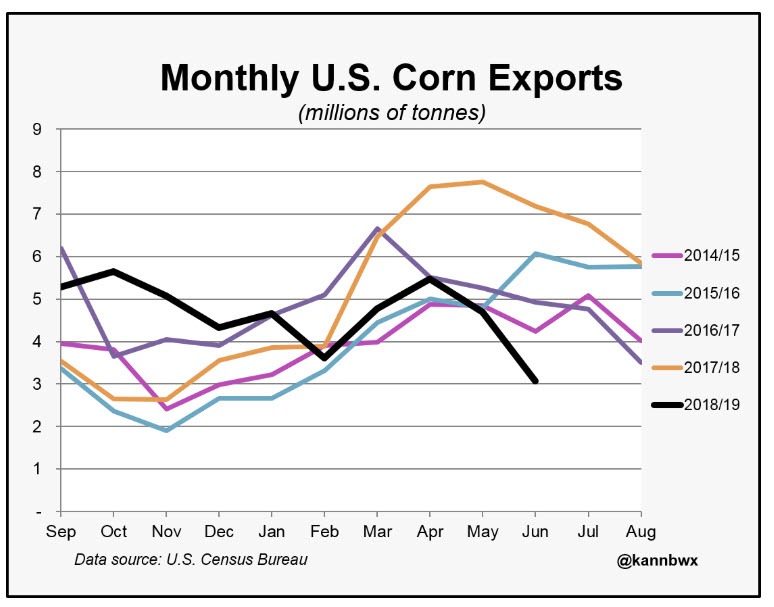
Corn Exports Dive
Reuters reports U.S. Corn Exports Dwarfed by Brazil, Soy Shipments Ride on China.
According to data published on Friday by the U.S. Census Bureau, the United States exported 3.07 million tonnes of corn in June, the smallest June volume in six years and the smallest for any month since November 2017. This was also off 57% from last June’s blockbuster performance.
U.S. corn shipments in the first 10 months of the 2018-19 marketing year that began Sept. 1 totaled 46.6 million tonnes (1.84 billion bushels). That is down 5% from a year earlier, and June was the first month in which 2018-19 corn exports slipped behind those of the previous year.
The United States still had 6.7 million tonnes of corn to export during the final two months of the current marketing year to meet the full-year forecast of 53.3 million tonnes (2.1 billion bushels) set by the U.S. Department of Agriculture. That target had been as high as 62.9 million tonnes (2.475 billion bushels) last October.
July and August shipments need to average 3.36 million tonnes to meet that expectation, which is well below the recent average, but weekly export inspection data from the USDA suggests that July may have fallen short of that mark.
Brazil Corn

Soybeans
Between September and June, shipments totaled 38.95 million tonnes (1.4 billion bushels), down 24% on the year.
Exports to China reached 1.73 million tonnes in June, some 54% of total exports for the month. That was China’s largest monthly share of U.S. soybean exports and the first time it exceeded 50% since January 2018.
Early Tuesday morning in Beijing, China’s Commerce Ministry announced that Chinese companies have stopped buying U.S. agricultural products and that China could possibly place import tariffs on any products that were bought after Aug. 3.
It appeared that China still planned to honor earlier agreements to import U.S. soybeans, which would mostly be shipped this month and next month. The trade dispute also seriously threatens the 2019-20 U.S. soybean export campaign if its top buyer plans to shun the U.S. oilseed.
Outstanding sales for the 2019-20 marketing year are already at a multiyear low. As of July 25, only 3.33 million tonnes of U.S. soybeans were on the books for the new year beginning in less than a month. That compares with 10.4 million tonnes a year earlier and 6.4 million two years ago.
Monthly Soybean Exports Non-China

Trade is Normally Fungible
On the surface it would appear that if the US did not ship soybeans to China, then Brazil would. In turn, the US would simply ship elsewhere.
That has not happened. Here’s part of the explanation.
Food Prices Surge in China
Please consider China’s Surging Food Prices Won’t Weaken its Hand in the Trade War, Economists Say.
New data Friday showed China’s July food prices jumped 9.1% from a year ago. A key contributor was the 27% rise in pork prices amid an outbreak of African swine fever, while fresh fruit prices also climbed 39.1%. The rising price of food — which may only get worse with a halt on U.S. agricultural imports — won’t have major ramifications for Beijing as it continues its tit-for-tat trade war with Washington, according to experts.
The figures come as China announced this week that it would suspend imports of agricultural products from the U.S. This was in retaliation to President Donald Trump slapping a 10% tariff on an additional $300 billion in Chinese goods.
The European Union is China’s biggest trading partner, and China is planning to import more agricultural products from Europe in order to mitigate the loss of U.S. imports, along with ramping up its domestic sustainability. Sourcing from outside the U.S. will actually increase China’s food security by reducing its dependence on the U.S. as a single provider, meaning it will no longer be “hostage to potential export restrictions” in future, said Rory Green, China and North Asia economist at TS Lombard.
This would mean rising food prices are unlikely to force President Xi Jinping into a softer stance on Washington, since authorities would rather pay higher prices for European pork or South American soybeans than cave in to the U.S.
Winning Not
Without a doubt, the US can inflict more pain on China than the other way around. But Inflicting more pain than you receive is not winning, it is still losing.
China would rather suffer than give into Trump.
China has that luxury as it does not hold elections while the US does.
Addendum
A reader comments “Nary a word on strength of $US … or record floods in Midwest.“
OK – Floods
The applicable charts are from September 2018 through June 2019.
- Does the US harvest either corn or Soybeans in May for June shipment?
- Or do June shipments represent last year’s crop?
OK – Strong Dollar

For the period in question, the yuan was primarily strengthening. The yuan weakened from mid-April through May, then strengthened slightly.
Call it a wash if you like, but on average, the yuan slightly strengthened vs the US dollar for the agriculture export period in discussion.
Going back a bit further, the yuan strengthened from December 2016 through March 2018, weakened through September 2018, strengthened through February 2019, then weakened through June.
Conclusions
- The weather in 2019 was clearly was not a factor.
- Neither was the strength or weakness of the yuan during a ping-pong match.
Mike “Mish” Shedlock






























“China would rather suffer than give into Trump.”
Until China turns into Hong Kong.
First of all, you know that time frames between currency markets and commodity prices do no directly overlap. It’s the trend that matters, and the dollar is up over 20% since 2014, and after a brief pullback it will soar much higher as the sovereign default dominoes start falling – and Trump will be impotent to stop the Invisible Hand.
Second, crop failures and shorter planting seasons have occurred around the globe. For example, a farmer in Chatham, Ontario Canada (50 miles east of Detroit 42.4048° N, 82.1910° W); whose location is always the first to plant in Canada as it is the same latitude as northern California, has reported the following climate tidbit:
– As of today, May 18th, 2019, no farmers (zero) have started planting.
– In 3 years the percentage of April planting starts has decreased to 0% from 70% just 4 years ago. Typically planting was completed by mid to end of May.
– Flooding this year from Ottawa to Detroit along with cooler temperatures can wreak havoc on winter wheat crops which are planted in the fall and has germinated. But if the heat doesn’t come to dry up the land then the wheat crop is susceptible to rot.
– soil temperatures are below the 25-year average by 23 degrees.
– more rain means less sunshine.
The wheat crop in Russia was a failure – https://www.bloomberg.com/news/articles/2018-04-25/russia-s-wheat-crop-under-threat-from-miserable-start-to-spring
The drought down under caused roos to invade cities looking for food – https://edition-m.cnn.com/2018/07/30/australia/australia-canberra-kangaroo-boom/index.html?r=https%3A%2F%2Fwww.armstrongeconomics.com%2Finternational-news%2Faustralia-oceania%2Faustralia-drought-sends-kangaroos-invading-cities%2F
The bottom line is the farmers and futures traders don’t listen to AOC and the other delusional gloBull warming propagandists. Their livelihood depends on accurate weather forecasts, and they know we are heading into a cooling cycle, that could get very ugly if the sun spot activity reaches the Maunder Minimum levels and a major volcanic eruption occurs, which is likely, as the cycle for earthquakes and volcanoes is also peaking.
https://www.armstrongeconomics.com/world-news/climate/2019-is-breaking-all-records-for-cold/
Let me start with this Trump is incompetent and will break the US economy. The US farmers provided the nail that seal their economic coffin by voting for Trump.
The Chinese, have been all over South America looking for new sources of everything the last 15 years. Do not blame Trump for that. the US abandoned the rest of the Americas long ago.
And here some facts on the soy bean subject
And this
https://www.brazilintl.com/uploads/1/0/6/2/10624420/aug_2018.pdf
According to Rodolfo, Mato Grosso is an important partner of China. Last year, the state’s GDP grew by 5%, driven mainly by
agribusiness, which accounts for 50% of the regional economy, 33% of jobs and 99% of exports. In Brazil, Mato Grosso produces
28% of soybeans, and in the world this number is 10%. The state is the first in the Brazilian ranking in the production of cattle,
cotton, corn and other grains, such as sunflower seeds, as well as soybeans.
Deputy mayor of Cuiabá participates in meeting with Chinese
Mato Grosso has 33,000 agricultural producers associated with the main federation of the sector, called Famato, the Federation of
Agriculture and Livestock of Mato Grosso, an entity with representation in the national scenario and interlocution with various
levels of government, including federal. The state is the one that produces the most non-transgenic soy in Brazil, or 17% of its
production, which is equivalent to 5 million tons. All the production of these grains is sold to Europe, due to regulations. In total,
today Mato Grosso produces 66 million tons of grains and fibers in 10% of the state’s area, which adds 9.5 million hectares of
agriculture.
Even without the need to clear or open new areas for cultivation, local farmers believe that they can increase production, thanks to
two-crop planting techniques throughout the year (which occurs on a large scale with soy and corn) and herd management bovine
further destruction of pristine forests is guaranteed….Long live climate change , it s here to stay and get worse…..much worse…
The last time we had rising food prices, a few governments collapsed (Arab Spring). China may not want further food price inflation.
The swine fever would be negative for prices, the flooding positive. There are of course supply chain frictions, and overall Chinese boycott of US Ag would be somewhat negative for prices. Europe imports soy, so buying Europe won’t affect soy. I would expect current demand to shift to US Ag (except Chinese) responding to price impulses. Supply is not that elastic — Brazil only has so much soy and corn. Farmers and crops require time to respond to changes in aggregate demand.
There will be damage to supply chains and market relationships, but on the whole, the tariffs will probably not lead to major shifts in prices for Ag or goods, unless they help a recession take hold, in which cases prices go down instead of up. And if deflation takes hold, the dollar will go up.
Any word if the Chinese are willing to drop the 57% tariff they put on US polysilicon back in 2013?
No idea. Any word if the US is willing to drop the 25% import tariff of foreign-made pickup trucks ?
Trade war. Must cut interest rates, NIRP, QE. That’s all you need to know.
“The trade war is largely a media event”
This is very real – and so will repercussions
OK trade is small part of GDP – But it is the most volatile part – And manufacturing recessions lead to full-blown recessions
Chart is irrefutable
Arms, wheat and oil. At least Russia at something of value to export. I note they don’t export much gold given their high level of mining. I wonder why?
The trade war is largely a media event. Exports make up about 12% of the US GDP and only 7.2% of those went to China in 2018.
To Tony Bennett and Bbbbb who asks “How much of the fall in corn exports is due to recent flooding in the Midwest?”
My conclusion – None
Nor is the dollar a significant factor.
See addendum in post.
“Neither was the strength or weakness of the yuan during a ping-pong match.”
…
Your first chart (US corn export) is not China only (unless mislabeled) so making a point re: strength of yuan not accurate. Needs to currency basket comparison.
As for the weather, not a question of harvesting, but transportation. Many grain elevators on river banks to off load on barges / ships. If rivers up, I assume loading had to be post phoned.
How much of the fall in corn exports is due to recent flooding in the Midwest?
1000% tariff on all Chinese and Vietnamese,Mexican,Indian crap.Trump would be the first president ever to massively shrink the deficit,fund state of the art border wall (paid for by Mexico).first president to shrink deficit and run a surplus at the same time while collapsing the Chicom slave state!
Nary a word on strength of $US … or record floods in Midwest.