

Recent housing data has been downright miserable. New home sales fell through the floor and existing home sales had a string of six consecutive declines. That trend broke last month but it won’t last.
The pending home sales index for October is down a very steep 2.6%. The lowest Econoday guess was -0.5% with the consensus unchanged.
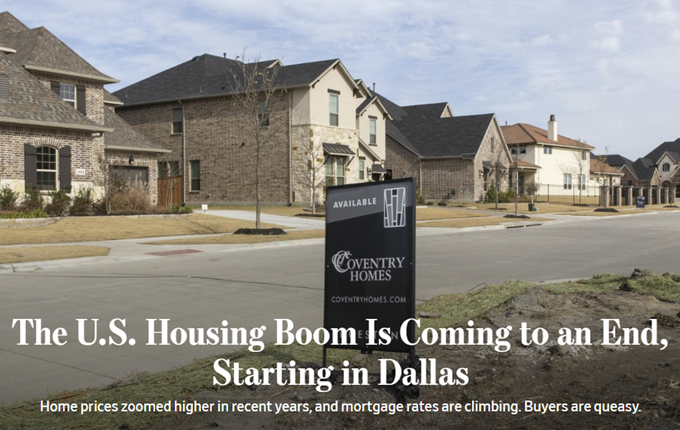
The Wall Street Journal reports The U.S. Housing Boom Is Coming to an End, Starting in Dallas.
A half-hour drive straight north from downtown Dallas sits one of the fastest-growing counties in the country. Cotton fields have been replaced with Toyota’s new North American headquarters, a Dallas Cowboys training facility and a sand-colored shopping strip with a Tesla dealership and a three-story food hall.
Yet even with the booming growth, Dallas’s once vibrant housing market is sputtering. In the high-end subdivisions in the suburb of Frisco, builders are cutting prices on new homes by up to $150,000. On one street alone, $4 million of new homes sat empty on a visit earlier this month. Some home builders are so desperate to attract interest they are offering agents the chance to win Louis Vuitton handbags or Super Bowl tickets with round-trip airfare, if their clients buy a home. Yet fresh-baked cookies sit uneaten at sparsely attended open houses.
Dallas has been the “canary in the mine shaft” this housing cycle, said Paige Shipp, regional director for Metrostudy, a consultant to home builders. Homes are taking longer to sell, bidding wars are rarer and price cuts are more common as buyers absorb the impact of higher rates.
Inventory Change and Valuations

Builder Speculation
Two days ago I commented Builder Speculation: Supply of New Homes for Sale Surges to 7.4 Months.
Completed Homes for Sale
DFWRealEstate commented to my post “There were no consequences for those who created the last catastrophe, so it’s not surprising to see a repeat of something similar.”
SMF commented “I’ve been in construction for almost 30 years in California. After the dot.com bubble, I worked on far more residential projects than my prior years. This housing explosion ended in 2007/2008. During the last few years, we’ve been involved in even more residential projects than in any prior time period. Way overbuilt, again. No one learned the lessons of a decade ago.”
Most Splendid Housing Bubbles
Wolf Richter at Wolf Street discusses The Most Splendid Housing Bubbles in America Deflate.
Case-Shiller National
Now let’s check out some real gems.
Case-Shiller Dallas
Case-Shiller Seattle
Case-Shiller San Francisco
Wolf has a series of 10 charts that inquiring minds may wish to check out.
Party Over in The Hamptons
The Wall Street Journal reports The Hamptons Home Market Cools.
The Hamptons, the chain of moneyed oceanfront villages on Long Island’s Eastern tip, are considered a highly desirable place to be—unless you’re a home seller.
“Every block has a ‘For Sale’ sign,” said Robert Hohmann, who has been trying to move his five-bedroom Southampton house for the past two years. First priced at $3.7 million, the roughly 5,200-square-foot home with a swimming pool is now listed for $2.999 million with Frank and Dawn Bodenchak of Sotheby’s International Realty.
The Hamptons saw a dramatic drop in activity in the third quarter, with home sales plummeting 13% to 448 from 517 in the same period last year, according to a Douglas Elliman Real Estate market report. That is the third consecutive quarterly decline, said the report’s preparer, appraiser Jonathan Miller, who said he hasn’t seen such a scenario since 2008. Meanwhile, the number of luxury listings (those priced at the top 10% of the market) surged to 452—the highest level in seven years.
Housing Bubble Two
I believe we’ve proven the Fed re-blew the housing bubble.
They do not see it. Nor does the Fed see the stock market bubble or the junk bond bubble.
Powell is Blind
On Wednesday, I noted Lovey-Dovey Interpretation of Powell Speech Sends Stocks Flying.
In his speech conclusion, Powell offered these lines: “Eternal vigilance is the price of financial stability. We will publish these reports regularly as part of our vigilance.”
I repeat my comment: Eternal vigilance my ass. These alleged wizards could not spot a flamingo in a pen full of turkeys.
Mike “Mish” Shedlock






























Smart readers take all these doomsday articles with a grain of salt. Remember, shocking articles generate clicks. Most of these gurus predict 10 crashes for every one that actually happens. That’s not to say that there isn’t some valuable information here worth looking at.
I’ve been trading property in DFW area for the last 2 years (buying and renovating or building) and while prices are up, every house I list for sale has sold within a reasonable time for fair market value.
Real estate moves in cycles and we may be nearing cycle highs, but that by no means implies a bubble and catastrophic bust. We will likely have a normal slowdown and an adjustment in prices that will give inventory and wages a chance to catch up – that’s called a healthy market, not a bubble. Real estate is the best long term investment out there. Dont let these “expert” predictors scare you away. I’ll bet THEY all own their homes.
The corpse just got trillions of dollars in wall street cash infusions. I suspect its artificial reanimation will take a while to die again.
A very high percentage of the houses you click on – be it on Zillow or Redfin, Trulia, etc – are sitting EMPTY. Many have been on the market for 200 days and more. How can so many sellers carry these empty homes for so long? Chinese buyers? Something just doesn’t feel natural or right.
Inflation-adjusted prices are pure bullshit to a new buyer.
For starters, income did not keep up home prices. Which is why new buyers cannot afford the damn things.
…then show the housing price growth along with wage growth rather than exaggerating housing price appreciation above the heights of the last bubble by using nominal numbers and calling it a second bubble (and starting your vertical axis at something greater than zero to amplify the effect) In fact, adjust for population growth and existing housing stock per age 25+ population going back 50 years and let’s see if we are really in the crazy zone on prices. They’re high, but not crazy high surpassing last time. Far from it and what your graphs represent. Affordability is an issue, but nowhere near where it could go and where it’s been.
For sustainability, you have to look at wage growth corrected for wages earned simply as a result of the asset bubble itself. Which is darned near impossible to do, as central bank coordinated asset bubbles infiltrate every facet of the economies they prey on.
Two realtors swapping their house back and forth every year, at double last years price, doesn’t somehow become any more sustainable, just by them pocketing a freshly printed 10% commission, each time they do the swap. Now, go look at in which lines of work so called wage growth has mostly occurred..
Attempting to correct for printing distortions, a first approximation for actual wage growth, could be the amount of energy consumed by the median worker every year.
While energy consumption is a (perhaps very) rough estimate for wages, it at least has the salient feature of being hard to fake by simply printing money and making up arbitrary newspeakian definitions for “inflation.” Energy is highly fungible, like money, as well as something for which there is universal demand. Everything takes energy, everyone needs and wants energy, and more is always, all else equal, better than less. Again, mirroring money. Hence, energy is not unlikely to serve as a decent indicator for people’s overall ability to demand stuff; which for a worker is closely tied to his wage. So using it as a check on the printing idiocy and all its obfuscations, isn’t entirely without merit.
It’s rise, flattening out and then recent decline, also seems to pretty closely mirror anecdotal sentiments from lots of (Trump voting or not) workers, wrt when their collective fortunes were improving vs declining.
Now, energy use, per capita, is lower than it was in the early ’70s. And I’d be very hard pressed to come up with any reason it, like all else, has not also been skewed towards the top over the past 4-5 decades. While an increasing share of it, again like all else since then, has been claimed by the military and other arms of government. And then, of what is left over for the worker to freely spend, more of it is likely to have been spent fulfilling “mandates….”
Resulting in the median worker’s free and clear wages, measured in harder to fudge (if a bit rough) units of energy consumption, has dropped significantly over the past 40-50 years. Any meaningful attempt at “wage correction” will at a minimum, have to take that into account.
While there is no doubt about the surge in housing prices since the last bubble, it would be helpful if folks making new bubble arguments (including this blog) would use real, inflation adjusted data. seeing it otherwise is mostly pointless.
There is nothing real, especially so wrt housing, about so called “inflation” adjusted anything, when what the dimbulbs try passing off as “inflation,” doesn’t even include house prices.
Exactly!
Floating the “inflation-adjusted” argument is nothing more than willful ignorance. I can only assume BillinCA must be looking at this nonsense from NAR trying to downplay the bubble. The problem is the inflation-adjusted argument is absolute horseshit, a complete con job. If buyers could actually go out today and pay these supposed “inflation-adjusted” prices, homebuilders would’t be tanking this year and sales would be through the roof. In the real world people have to pay the real nominal price and finance a home with the real market interest rate. Sorry BillnCA. That dog doesn’t hunt. If you want to see why most economists are utterly useless tools, this is a prime example…
The only inflation that matters with respect to housing is wage inflation, and there hasn’t been any.
I’ve lived in Dallas for about 8 years now. I know you’ve already mentioned this in other articles, but I think the apartment market is in for an even bigger crash than the housing market. Everywhere you look, they are building new 500-1000 unit luxury apartments. (All the new apartment complexes are the high end variety) I keep hearing that there are so many people moving into the area that all these apartments are needed, however I can’t imagine there could be that many people coming to fill up all these new units. If there were, the traffic would have gotten a lot worse than it has over the last few years.
The apartment I’m living in is nice and considered luxury, but it was built about 10 years ago. I started noticing about 3 or 4 months ago there are more empty units in my complex. I’m assuming if there’s nothing at all on a balcony and I’m not seeing lights on at night, that these places are empty. I’d estimate there are probably 1/5 to 1/8 of the units in my place are sitting empty right now. They’ve built at least 8 apartment / condo complexes around the man made like I’m on in the past two years. There’s at least three or four new units under construction now. Again, all of these places look like they have 500 to 1000 units. It’s just insane the number of places going up.
I agree about seeing all sorts of new apartment complexes throughout the urban centers of the country. They all seem to be charging top dollar too, yet don’t seem to be all that occupied. So, I’m baffled at how long they can keep up the wishful thinking pricing. Insight into this phenomenon is much appreciated!
I’m sure this doesn’t apply to all, but a good chunk of those are just second or third homes for people in the suburbs. Or “investment objects” the same can pass on to their kids.
When you live in an era where the more you can borrow to buy overpriced roach shacks, the more the Fed and government will steal from others on your behalf, there is literally no cost involved at all, in mindlessly accumulating empty covered space.
While self righteously cheering for policies aimed at keeping as many of your fellow Americans homeless as possible, hence desperate enough to help make your roach shacks even more overpriced in the future, of course.
The apartment scene in Dallas is similar to the housing problem. Lot’s of higher end units built for all of that growth. There have been plenty of jobs added in DFW, but unfortunately the wages attached to those jobs don’t justify the prices of either homes or the luxury apartments being added. Wealth and income inequality is the canary in the mine shaft that local economists are ignoring.
I live in the Washington DC area. Prices area bout where they were at the peak of the last bubble. Not adjusted for inflation. DC doesn’t have booms and busts like the rest of the country. The federal government is a very stable employer. Whereas some places may see + or – 25% in a given year, we see + or – 5%.
Mel Watt retires in about a month…
Just saying…
It is different from 2006, at least where I’m at in LA. West Los Angeles and interior suburbs like Studio City, Encino, Culver City, and Santa Monica are through the roof. Even transitional areas like Westchester are insanely priced. Well over the 2006 bubble. Thousand Oaks where I live is about 35 miles from downtown and still 10-15% below the first bubble peak (even before the fires). Prices on the Westside and areas like Westchester are up roughly 40-50% more than areas just a little further out. I think it’s a bubble everywhere, but there are spikes in some areas that weren’t there during the first bubble. I’m told by people I know that it’s due to jobs and proximity to downtown. We’ll see.
As it happens, earlier this year I made some comparisons of parts of the housing market in Dallas and in a rather attractive Second Tier Chinese city. Astonishing thing was that price levels were similar, despite the differences in incomes — and making hedonic adjustments for size & quality, housing in Dallas was a much better buy.
If housing in Dallas is now mean-reverting to reasonable affordability (as it must), what does that suggest about the future of the Chinese property market? And if the Chinese property market starts to fall, that does not augur well for global stability.
Can’t the Chinese govt support the banks while people default of buy the homes outright. They are so involved in central planning I would think they have more financial enginerring tricks they could deploy to keep the charade going on for a while.
hmk — This is just anecdote, but what people told me was that Chinese buyers tend to avoid mortgages as we understand them. Instead, they prefer to borrow money within the extended family and pay cash for property. Apparently, Chinese have a much higher proportion of their assets in real estate than in the West.
Implication is that a real estate crisis would not impact banks in the same direct way as in the West. Of course, if the Chinese oligarchy went back to their notional Communist roots, would they care if the bourgeoisie became impoverished by declining real estate values?
“Recent housing data has been downright miserable”
Now, what cold possibly be more miserable than being able to afford something?
Drinking water data must surely be really miserable, by that metric.
Yes, the FED re-inflated housing prices. Wasn’t that the goal, in order to avoid 10’s of millions of foreclosures?
Of course that was the goal.
Artificially inflating the purchasing power of idle, deadweight sycophants dependent on The Fed for their status, livelihood and privilege; by stealing it from productive people by way of debasement, has always been their only goal.
Heck, it is, has always been, and will always be, the sole and only goal and purpose of any form of central banking at all, period.
The Fed had to “foam the runway” for the banks and all of those giant PE outfits to snatch up of homes on the cheap. What better way to confiscate wealth and redistribute it to the top than a massive injection of liquidity to those at the top of the food chain, those with the best (and in many cases ONLY) access to that liquidity dump. It’s no surprise why wealth inequality is near century highs…the Fed facilitated/encouraged it.
Right, I didn’t mean to imply that the FED cared about the homeowners.
HARP program ends Dec 31st…amazing that in a “booming” economy that this program wasn’t sunsetted 3 years ago…3 million NINJA loans out there just waiting to roll over this recession.