

Easy Money Quotes
- Fed Chair Jerome Powell: In an interview with National Public Radio’s “Morning Edition” program on Thursday, Powell said that even with the economy rebounding faster than expected, any change in monetary policy would happen “very, very gradually over time and with great transparency, when the economy has all but fully recovered.”
- Fed Vice Chair Richard Clarida: Speaking on Thursday to the Institute of International Finance, Clarida said the central bank will stay in the game until the recovery is “well and truly complete.”
- Fed Governor Lael Brainard: Before any shift in monetary policy Brainard promised “resolute patience”.
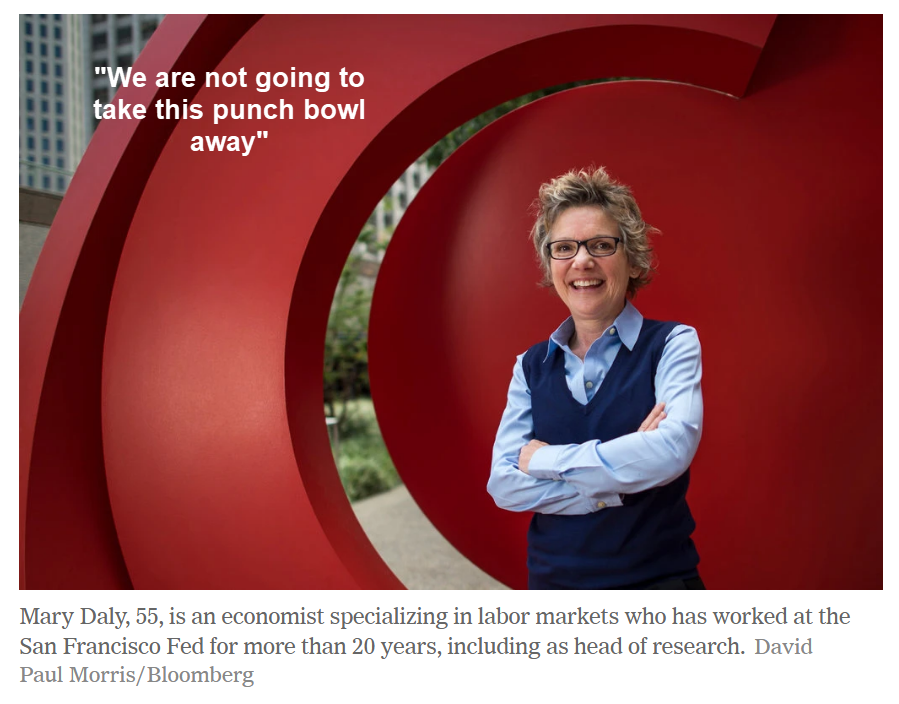
- San Francisco Fed President Mary Daly: She said the central bank would show at least “a healthy dose” of patience. ”We are not going to take this punch bowl away,” said Daly.
- Richmond Fed President Thomas Barkin: In an interview with Reuters on Wednesday Barkin said that the United States may well see economic growth remain above trend for several years given the amount of pent-up demand. Nonetheless, Barkin said “What matters is what outcomes we actually get. I am going to see where we go. I am not trying to overthink the date (of any policy change). I am trying to think about the outcome.”
The above quotes are excerpts from Fed officials press promise of complete recovery.
Short Synopsis
Powell: Monetary Policy will change “very, very gradually over time and with great transparency, when the economy has all but fully recovered.”
Clarida: Monetary Policy will not change until the recovery is “well and truly complete.”
Brainard: Promised “resolute patience.”
Barkin: Pledged to not “overthink the date.”
Daly: ”We are not going to take this punch bowl away.”
Medal Awards
- Gold Medal (by a mile): Mary Daly
- Silver Medal: Jerome Powell
- Bronze Medal: Thomas Barkin
2% Inflation Target
The Fed’s 2% inflation target is monetary insanity.
Full speed ahead with the stimulus in search of inflation that would be visible to anyone who was not wearing groupthink blinders.
I have a set of questions for Fed Chair Jerome Powell on inflation. Please read them: Hello Jerome Powell We Have Questions.
He would not recognize inflation if it jumped off the table and spit grapefruit juice in his eyes.
As discussed previously, Inflation is Poised to Soar, 3% by June is “Almost Certain”
Historical Perspective on CPI Deflations
A BIS study of deflations shows the Fed’s fear of deflation is foolish.
“Deflation may actually boost output. Lower prices increase real incomes and wealth. And they may also make export goods more competitive,” concluded the study.
For discussion, please see Historical Perspective on CPI Deflations: How Damaging are They?
Japan has tried what the Fed is doing now for over a decade, with no results.
Yet, Powell hell bent on producing more than 2% inflation until the strategy “works”.
I discuss numerous ways Powell is on the Bank of Japan’s path in Is the Fed Blindly Following Failed Policies of the Bank of Japan?
What Would I Do?
For the answer, please see Reader Question: What Would I do Differently Than the Fed?
Mish






























We can’t expect any restraint from people who can create unlimited money. There is always going to be demand from the government and other parties close to the tap. Even in countries with insanely high price increases they don’t stop.
OT….the dollar took off again to the upside and gold puked back all the days gains and then some. Not a pretty chart. I had decided to stay in, knowing this was possible….but the smackdown was a bit worse than I expected. I’m still well above my stop, but not liking this action at all. Too much volatility for my tastes, just right now.
Silver looks so much stronger than gold…..and in my view it shouldn’t….interesting though.
I found this attached link to be an interesting article from a Democratic insider who knows Biden and some of the main players. One main point is that the market is underestimating Biden’s resolve to proceed with his infrastructure and tax plan through reconciliation, and that this could cause the Fed to tighten earlier than planned, and may hit equities more than the big market players are anticipating at this point. So the period of summer-end of year may be key.
I agree with a lot of what he says. One thing I don’t agree with him on is changes to the filibuster. He thinks nothing will happen due to a few Dem Senator holdouts. I do not think they will eliminate it altogether, but I do think they will try requiring the talking filibuster first, and if/when that doesn’t stop it, as I expect, I think they will make exceptions for a small number of bills critical to the Dems, like voting rights, perhaps civil rights, and DC statehood. Some of the Senators he mentions in his article are already changing their minds on this, from what I’m reading on political blogs.
I read political blogs a fair amount. Doing so has led me to the conclusion that this group of Dems in charge know how tenuous their majority is, and feels especially imperiled without voting rights reform, given how all the republican/swing key states are passing voter suppression bills left and right. Also, in the past, big money donors had a lot more sway over Dems. Now, with the small donor revolution that Bernie brought to bear, I get the sense that the Dem pols are listening a LOT more to their base voters, and this includes a larger contingent of progressives.
Here’s the article:
You guys are also looking in the wrong place if you want to understand why the Fed is okay with asset bubbles. They know a fair chunk of the population is about to retire and start withdrawing money from the market. Also pension funds and other retirement funds need to remain elevated for the foreseeable future. If you think having this bubble pop would be a good thing and having MORE poor people then you are mistaken.
I agree….plus I love inflation since it’s already making me richer every day. Bring it on.
That really doesn’t sound like “End the Fed” at all. How is this working out for the young?Goosing asset prices is “good” for potential sellers, not so good for buyers. It is, of course, stealth redistribution. One person’s production transmuted into another’s consumption. What’s not to love?
Bad gov policies create lose-lose situations. That is not a good reason for continuing immoral policies of redistribution. Very cynical to rationalize what DC does on “practical” grounds. Scare quotes around practical because the bottom 50% at least are getting screwed.
Brad, when I was young I had nothing…and so I set about deliberately doing things to improve my chances of ending up with something. After 40 years, it’s working out fine for me. Should I apologize for figuring out how to beat the system, and trying to teach others to do the same?
Or should I advocate for a revolution? Seems to me that people who fight the Fed typically end up with a bloody nose and not much else. Good luck with that.
I didn’t make any policy, nor have you heard me advocate for the Fed. I simply play the hand I was dealt in life as best I can. And try to learn to profit from the system.that we’re stuck with…..as best I can.
No matter how you slice the cake, 50% are going to be in the bottom half economically. Your best bet is to learn how not to end up there yourself……it’s much easier than achieving economic and financial equity for 8 billion people.
Mish…you’ve got to address the fiscal side of the equation in that it’s huge, huge and the Fed has to support it. I’m forecasting a CY2021 deficit of $6T ($2.3T [CBO Feb. FY21 deficit estimate] + $1.9T stimulus [not included in CBO estimate] + $3.OT [Biden’s just announced infrastructure/green programs] – $1.2 tax increases [for corporations and the “rich”.]) This is an insane amount of money, considering that the CBO estimated total Congressional budget for 2020 was $6.6T (one-third of GDP) or one-half more than the previous year. You’ve got to talk about the debauching of and the watering down of the dollar’s value. Gold, which used to be an inflation hedge, is being heavily manipulated by the Fed and other central banks – so we can’t get any reality check there. Crypto currencies are so new, volatile and not yet universally accepted, it’s hard to figure upon what their value is based.
Yep. It is called monetizing the budget and the debt. Japan has been doing this for 30 years. It can go on longer than people think.
If the debt keeps growing, is it really being “monetized”?
They only care about it’s size relative to gdp, which is also manipulated.
Doesn’t matter what they say. Like Japan, out national debt is way too high to ever normalize rates. We would be instantly insolvent if they did. So they can say whatever they want about reasons for keeping rates low, but the correct answer is to prevent the gov’t from becoming insolvent.
And…to keep the money printing monopoly in the hands of the central banks.
Those two things are all that matter..
And by “printing” I mean money creation,@Casual_Observer.
It is all just little bits of data. I understand what you mean but its just electronic money. There is very little printing that is going on that is actually getting into the hands it needs to.
I’m not talking about MMT helicopter money. I just meant the way the banks normally create money, by lending. That’s the gig they want to preserve…..forever, no matter where the market goes.
I hope you can put the spammed post about the 68 y.o. dad back up, because there were some interesting things to discuss there, and I was too busy this morning to do it justice. Just sayin’.
Sorry Sechel. That was a boo-boo. I meant to aim that at Mish, obviously.
Yea, I was scratching my head
What is the alternative? Raise rates to cut off inflation? Raise rates to deflate bubbles? Raise rates and go into a depression with 25% unemployment? Raise rates and have those unemployed be seduced by radical ideologies?
Is it really inflation of all the new money is kept out of the hands of the filthy poors?
Of course it’s inflation. It doesn’t matter who gets the money.
Also the more new money that’s created, the wider the wealth gap gets. This is because regardless of who gets the money, it all funnels down to those who own productive assets (the only question is how long it takes to funnel down).
Not sure if they do this, but Fed should be required to publish the data as to their estimates to how much low rates cost the elderly in terms of lost interest, the insurance industry and how much low rates is subsidizing banks as well as estimate the probability and cost of a bubble.
They can’t take it away. Actually, the longer they don’t change interest rates and say they will never change them, the more stable the new equilibrium becomes. I had advocated for leaving rates and 2% and then having Congress take away the ability for the Fed to change rates forever. This way, you can do whatever you want but the rates will be stable forever.
How will 2% rates forever solve anything? At some point the risk won’t be worth 2% (it will be higher) and there will be 0 lending. Why does the Fed need to set any rate at all anyway since no one borrows directly from them (they borrow from a bank who should be free to set whatever rate they want).
Is it totally fair to blame the Fed. Very few in Congress, Administration or business scream over low rates and easy money. Raise rates and lots of complaints. Sure many are hurt by low rates but those voices don’t have a megaphone.