

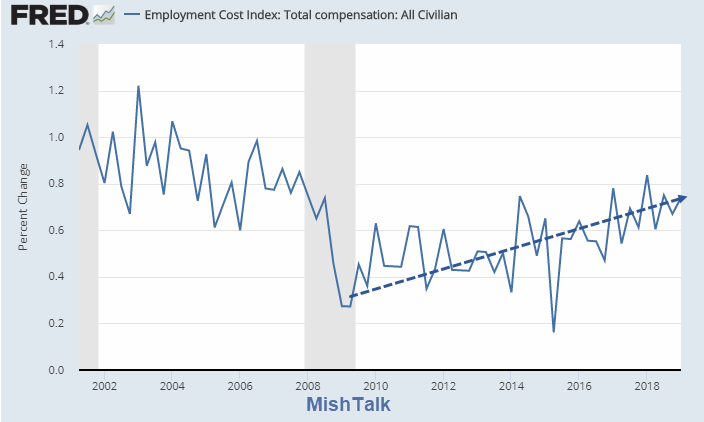
The BLS Employment Cost Index rose 0.7% in the first quarter, the same as the fourth.
Compensation costs for civilian workers increased 0.7 percent, seasonally adjusted, for the 3-month period ending in March 2019, the U.S. Bureau of Labor Statistics reported today. Wages and salaries (which make up about 70 percent of compensation costs) increased 0.7 percent and benefit costs (which make up the remaining 30 percent of compensation) also increased 0.7 percent from March 2018.
Civilian Workers
Compensation costs for civilian workers increased 2.8 percent for the 12-month period ending in March 2019 compared with a compensation costs increase of 2.7 percent in March 2018. Wages and salaries increased 2.9 percent for the 12-month period ending in March 2019 and increased 2.7 percent for the 12-month period ending in March 2018. Benefit costs increased 2.6 percent for the 12-month period ending in March 2019. In March 2018, the increase was also 2.6 percent.
Private Industry Workers
Compensation costs for private industry workers increased 2.8 percent over the year, the same increase as in March 2018. Wages and salaries increased 3.0 percent for the 12-month period ending in March 2019 and increased 2.9 percent in March 2018. The cost of benefits rose 2.4 percent for the 12-month period ending in March 2019 and increased 2.5 percent in March 2018.
Year-Over-Year Civilian Workers

Year-Over-Year Private Workers

Year-Over-Year Health Care Costs

The health care chart seems nearly unbelievable. Those buying their own insurance have seen their costs rise much greater than 1.9% over the past year.
Of course, quality of the employer care might be (and probably is) falling with higher deductibles and weaker plans. If so, such events are not properly reflected in the costs.
And part-time employees may not receive coverage at all. In that case, zero is still zero.
Mike “Mish” Shedlock






























Trump calls on Fed to cut rates by 1% and urges more quantitative easing
2019 Trump would probably declare 2016 Trump a terrorist. What happened to the big, fat, ugly bubble?
That is the best comedy I’ve every seen.
TOP NEWS
LISTEN LIVE
Central banks have almost eliminated recessions, venture capitalist Palihapitiya says
After a decade with no recessions, it is not too hard to claim with a straight face that the age of no recessions has arrived. Even though that is retarded. It’s still a market economy, the Fed doesn’t get to eliminate all “bad” market reactions. If Alphabet can drop 8% in one day, anything is possible.
Insurance across the board skyrocketing,hyperinflation shock by summer?Gas rockets past 4 dollars a gallon all bets are off.
Gas prices are ALREADY over $4.00 a Gallon in California but the states economy continues to boom.. Millenials are paying $3500 a month for a one bedroom apartment and are driving $60,000 SUVs
My company’s health care costs are projected to go up about 6% next year. The company will pick up 1/2 of that and we’ll jack up contributions and deductibles on employees for the other 1/2.
We also structure the health program so that there is an enormous price differential between covering just yourself vs your entire family. That makes it essentially impossible for lower paid folks to cover their families. Our lower paid employees are mostly factory line workers, mostly younger and male. They’re a lower cost group to insure anyway. The assumption is that their wives will work and cover themselves and they won’t have children.
Directors and the C-Suite have 100% coverage though in a way that’s not obvious. We still have the standard deductibles. We just submit any bills to HR and its paid back from as a company performance bonus.
The work force will get a 3% bump. That’ll actually be about a 2.7% increase in take home after increases in bennies.
One shouldn’t be ‘starting a family’ if they are low paid or have no motivation to move up in a company or increase ones skills (other than playing victim).. I bet these ‘lower paid factory workers’ have the latest Iphone, drive $40,000 vehicles and have sleeve tattoos but expect that ‘someone’ else should pay for their health care.