

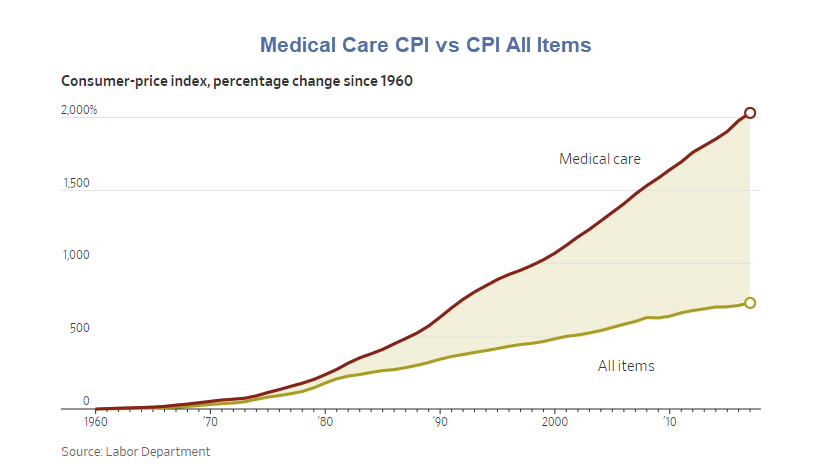
The Wall Street Journal has an interesting article on healthcare: Why Americans Spend So Much on Health Care—In 12 Charts.
The U.S. spends more per capita on health care than any other developed nation. It will soon spend close to 20% of its GDP on health—significantly more than the percentage spent by major Organization for Economic Cooperation and Development nations.
What is driving costs so high? As this series of charts shows, Americans aren’t buying more health care overall than other countries. But what they are buying is increasingly expensive. Among the reasons is the troubling fact that few people in health care, from consumers to doctors to hospitals to insurers, know the true cost of what they are buying and selling.
Contributions to employer-sponsored health coverage aren’t taxed, which makes it less expensive for companies to pay workers with health benefits than wages. Generous benefits lead to higher spending, according to many economists, because employees can consume as much health care as they want without having to pay significantly more out of their own pockets.
The prices of many medicines are hidden because pharmacy-benefit managers—the companies that administer drug benefits for employers and health insurers—negotiate confidential discounts and rebates with drugmakers.
Price Growth Since 2000

Hospitals are becoming more consolidated and are using their market clout to negotiate higher prices from insurers.
Tax Benefits

Contributions to employer-sponsored health coverage aren’t taxed, which makes it less expensive for companies to pay workers with health benefits than wages. Generous benefits lead to higher spending, according to many economists, because employees can consume as much health care as they want without having to pay significantly more out of their own pockets.
The tax benefit is the country’s biggest single income-tax break, costing billions to government revenue.
WSJ Misses the Big Picture
The charts are interesting but the WSJ misses the big picture: There is no incentive anywhere to reduce costs.
No Skin in the Game
Where the hell is “skin in the game”?
- Those covered by Medicare have no skin in the game. And that is precisely why Medicare for All would be an abomination.
- Those covered under company plans have little incentive to reduce costs. Once deductibles are met, there is “no skin in the game”.
- Lobbyists wrote Obamacare. The results speak for themselves.
- Congress had a golden opportunity to allow drug imports but failed to act. Drug companies can charge what they want and insurers will pony up.
- There is no right to refuse service. Hospitals take anyone and everyone whether or not they have insurance. As such, many don’t have insurance. They have no skin in they game. Bankruptcy is a way out.
- Massive amounts of money are wasted to keep terminal patients alive. Why? Because hospitals get paid by insurers. If hospitals didn’t get paid, and had they had right of refusal, such nonsense would stop.
- Obama himself: Obama dictated what had to be be in healthcare plans. They labeled them Gold, Silver, and Bronze. Lovely. Arguably they should have been called dumb, dumber, and dumbest. Why? Millennials and healthy people had to overpay to support everyone else. The millennials dropped out, just as free market principles would have dictated.
Let the Free Market Work
Please, let the free market work. Let insurers offer whatever plans they want. Let people buy whatever they want. And let those without insurance pay the price. I assure you, prices will plummet.
If you need a liver transplant and your insurance doesn’t cover it. Sorry, you lose.
Costs for routine services will plunge because hospitals will not have to pay $200 for one aspirin to make up for the cost of an unpaid liver transplant.
Insurance plans ought to be able to force treatment overseas if someone is healthy enough to travel. A heart bypass operation in India is 10% of the cost here.
At a bare minimum, insurance companies ought to be able to offer such plans.
Personal Experiences – Stop and Smell the Lilacs
I seriously wonder if chemotherapy is more of a torture than a blessing. I watched my mom die in misery. The cost today is surely thousands of times higher. For what? To prolong someone’s life for six months? At what cost? And who should pay?
When my mom stopped breathing, they asked my dad if he wanted them to try and revive her. He said no. Had he not been there, what would they have done? Why?
My wife, Joanne, died from ALS (Lou Gerhig’s Disease). She was on extremely expensive drugs paid for under Medicare. Note that one does not have to be 65 to be under Medicare. Rather, Medicare picks up all costs on some terminal diseases.
Did those drugs do her any good? I doubt it. We also need to define “good”. If they kept her alive for another three months (which I highly doubt), it was another three months of pain and suffering.
I sponsored a raffle for the benefit of the Les Turner ALS Foundation. And we put on a economic conference. John Hussman did a generous match of non-raffle proceeds. All told, we raised $500,000 for the Les Turner foundation.
This was an early post promoting the fund raiser: My Wife Joanne Has Passed Away; Stop and Smell the Lilacs
I am very proud of that, and also the amazing support from the Hussman Foundation.
That’s skin in the game. Thanks again John!
Brass Tacks
We really need to get down to brass tacks.
Other countries seemingly have better healthcare because they control the cost of education, doctors fees, etc. They get cheaper drugs from the US than we have here.
Unless the US wants to control the cost of education, the cost of drugs, the cost of hospital care, and literally the cost of everything related, the US will not compare favorably to other countries.
In case you missed it, please consider “Free Stuff”: Medicare for All Cost Pegged at $32.6 Trillion for 10 Years.
Medicare for All cannot possibly work here, even if it “seems” to work elsewhere. I suggest we try the free market, not more Obamaism.
Mike “Mish” Shedlock






























Your dissatisfaction with market-based solutions is understandable, but I suspect you misunderstand how markets work.
You are correct, desire for life-prolongation is infinite, but there has to be some way to allocate resources. Mises irrefutably showed in 1922 (almost a century ago) that it is quite literally impossible to efficiently allocate resources in the absence of market-established prices. You can posit any “plan” you wish, but I doubt much that you can provide one that doesn’t end up squandering an ever-growing share of (finite) capital.
Where we have problems in medical services is equality. Our current obsession with equality of access binds us to systems that simply don’t work (in the current case, medical services and the systems to pay for them are a Black Hole, promising economic catastrophe sooner than later.) No one wants to accept that a poor person will (and should) receive a lower level of services than does a rich person. Somehow, people magically think that medical services are “different” from food, potable water, transportation or any other good that must be produced by someone. People say, “healthcare is a right” but how can “A” have a right to something that must be produced by “B” without “B” being “A’s” slave?
The current system is unsustainable. It is based on “cost-plus” cartels, it has no means of discriminating between high value, low value and actually-harmful medical services and has no means of reining in the ridiculous costs of treatments (Hep C as the poster-child.) But Job #1 is to utterly destroy the collusion between hospital systems and insurers. Do that, and then see what happens.
Medical Services is a vast asset-stripping regime whereby Hospital Systems collude with Medical Insurers to price-fix and run guaranteed-income cartels.
Just as Universities simply use naive 18-23 year-old college students as a conduit to arrogate vast sums of money from lenders (who use the system to loot borrowers’ first 15 years of adulthood), hospitals and insurers are increasingly using patients to simply loot employers, savers (patients whose assets can be seized to satisfy vast bills) and now even Social Security (recent reports show how much of an old person’s SS now goes to Medicare “copays,” and such.)
None of this is market-driven. None of it is voluntary. None of it is disciplined by competition. Instead we are treated to BS euphemisms like “evidence-based medicine” and endless commercials touting $40,000/yr biologics for eczema, the entire goal of which is to sift the population for patients (or hypochondriacs) with deep pockets or employer-paid (deep pocket) insurance (and the insurer gets paid cost-plus, so hitting their “forecasts” requires MORE BODIES, that’s all.)
Step #1 should be to eliminate the legal cartels. Repeal all laws that interfere with free-market insurance contracts and rigidly enforce anti-trust and price-fixing laws against Aetna, BC/BS and all the others.
Mish is on track with most things but free market idealism can’t fix health insurance costs. Clearly the cost of insurance is set by the care givers, who are free to charge as much as they can. A free market brimming with competition might help if those care givers were selling bread or household cleaning products but they are not, they’re selling “life”.
The desire for life and health goes beyond simply supply and demand economics. This truth is exemplified by the fact that people, even outside the USA, mortgage their houses to get hold of the life giving drugs and services their governments and hospitals haven’t approved or don’t yet provide.
Given infinite demand what incentive is there for pharmaceuticals to spend more to increase supply when they can simply charge as much as they want for the little they do produce.
On the other hand a society suffering more and more obesity or cancer increases demand for life saving or pain mitigating medicine, compounding an already distorted level of demand.
By Mish’s own admission the quality of medicine is clearly weighted towards producing services and drugs for diseases that sell. Meanwhile research into the treatment of rare diseases like ALS has to rely on second class funding from fund raisers.
Nevertheless by attacking the obesity issue, for example, reduction of physical demand could have a slight positive effect on pricing. That means getting people to eat the right foods, as opposed to the fast-food or tv-dinner, sugar rich swill the food corporations would prefer to peddle.
Clearly however, the high emotional demand for dopamine inducing foods, like a desire to live without pain or live longer, can’t be regulated by a freedom of commerce. The only way to stop people eating rubbish and getting sick is to regulate the food companies. Similarly regulating the medical industry by controlling prices and production or perhaps by making the Hippocratic oath legally binding, would help to keep prices in line with physical costs.
The bottom line is that governments, whose sole function is to police society NOT control it or offer support for profiteering, needs to protect people from the food producers, factory polluters and other industries making them sick while at the same time regulating to avoid price gouging and exploitation.
Societies problems are inevitably stem from deeper complications. And can’t just be fixed with a band-aid. Superficial analyses like the one Mish offers in this article belong in the same bin as the other ineffectual government policy being proposed today.
Partially agree with article. Having some skin in the game is important. Unlimited medical care for free would be nuts as there needs to be cost benefit analysis to control expenses. But realize that it is over the head of the majority of consumers to intelligently shop for medical deals even if they would have the time to do so. The free market does not work if the consumer can not choose the best product. That is why the free market has failed in this area and instead has selected insurance companies that best filter out sick people and insure only the most healthy. That end point for healthcare is perverse and insane. If the USA was a civilized democracy, it would provide a limited base level of Medicare for All. And the wealthy would be able to purchase any extra insurance they desire. Instead we have a corporate oligarchy that somehow finds it more valuable to update our nukes and spend unlimited sums on an ill defined unwinnable wars on terror that promote an endless spiral of blowback. I doubt our forefathers had any concept of how badly their conception would turn out.
Our “leaders” plan is quite simple. Lower taxes on the rich, increase spending on the military, police, security, etc. Then after the deficits go out of control use that to cut benefits to lower-middle class, and as necessary print money and produce inflation which is in effect a flat tax that targets those that need to spend most of their income for survival.
Drug imports are spilling into the country, 70% comes from India, markup is about 3000% though. Oh their are ways, once you learn them. Oh, lol, they refuse service alright, with a myriad of tricks. Doctors are coached, and outnumbered by administrators 10 to 1. Keep in mind America is the sickest country on the planet, #1 for heart disease, cancer, auto-immune, and the third leading cause of death is iatrogenic or death by doctor. What you need to understand Mish is that we sell the disease and the elixir. We see commercials on TV, insurers and health care groups taking turns bad mouthing each other, see it’s the insurance companies who are actually turning the screws now, they decide what the doctors do, how they do it, and who gets what. It’s a hard pill to swallow when your health care system is ranked about 38th among developed nations, and dead last among the commonwealth. I just hired an independent IFM, cost me thousands but could save me hundreds of thousands in the future because her game is root cause diagnosis majoring in nutrition and lifestyle science. It’s not about reducing costs, it’s about healing, they are not healers, the U.S. health care system thrives on sickness, their is no money in wellness, only sickness pays. Go to a socialized health care country oh they are all better than ours, ask about insurance, deductible or co-pays, they don’t know what those things are! A friend in a forum I frequent reached out last week with some kind of health issue, refused to see a doctor, don’t have the $, I said you call me on Sunday to go over symptoms, to busy!, he died that day!!! He was a good man!!!!!
In my general transactions I’ve noticed that when it is clear that I am the one paying then the seller instantly becomes more attentive to my needs. In health care generally this is not the case so the services are directed to the insurer’s needs instead. The ability to charge you for services you don’t request also plays in. As a result most often you don’t get what you are paying for (ie. a cure).
Millennials and healthy people had to overpay to support everyone else. The millennials dropped out, just as free market principles would have dictated.
Uh no, millenials get to stay on parents policy until age 26 then they pay a rate of usually less than $200 a month or the cheapest rate available. $200 a month is the price for standard CABLE TV service or what is spent on a week of eating out..
See what the rates are for a healthy person over the age of 45 (who will never find a job if laid off due to the rampant and blatant AGE DISCRIMINATION in most white collar jobs)
I mean get the fact straight before spouting off such nonsense.. Remember that millenials usually rely on mommy & daddy to make their rent and student loan payments as well
The reason why healthcare is so expensive is BECAUSE of insurance, both public and private. Doctors and hospitals work on a reimbursement system, which is negotiated with insurers. The amount they get reimbursed ranges from 0%-40%. Private insurers pay the higher rates, while public like medicaid and medicare pay next to nothing. The true cost of care is about the average of what insurance pays, otherwise there would be no hospitals or doctors. Nobody can run a business discounting the true cost of care by 60-100%. Where people get shafted is when they are uninsured. Many hospitals and doctors are forbidden by contract from billing the uninsured less than what is billed to insurance. Bankruptcy is what usually results. Some have been moving to a cash only based system which is encouraging.
“Insurance”, as they like to call it, certainly has an effect. But cost of care itself, is needlessly inflated by lack of freedom to barge in and compete with existing providers. Remove any and all restriction even tangentially related to the he cost of care provision (up to, including, and above getting rid of steel tariffs which is making pill packing machinery a tiny bit more expensive….), and care gets cheaper. Cannot be otherwise. Hence won’t be.
The only way to control the personal cost is to benefit from the rising costs. The US puts investors and owner class first and everyone else last. There will be a revolt at some point.
Exactly who is the US? I haven’t met him.
Is it just a coincidence that the only group of people in the US with socialized medicine are the elderly? They have wealth and incomes way above average and they vote in their own self interest. They use a disproportionate share of the health care pie but they don’t pay their share. Yet any suggestion that the rest of the population get the same deal is met with derision and dismay. I am looking forward to the day that the younger people decide to exercise their voting rights to eliminate Medicare and Social Security completely. Then we will see how the pigs squeal!
Funny how you don’t mention the millions of illegals and muslim “refugees and their free government provided medical care.
For most of the seniors I know, they would gladly take a check for all their years of paying into social security and Medicare to walk away (with interest, of course).
Go ahead and make them squeal..
Oh, wait. You are talking about paying into a forced government retirement system, at the point of gun, and then taking it all away when it is time to actually use the system.
There is a word for folks like you.
It was all taken away as it was “paid in.” There is nothing left to “take away.”
All that is left now, is a bunch of geezers, claiming that because the Man on TV they voted for stole their money and spent it on self aggrandizement and running around the world playing fashionably socialist; somehow it is right and just for them to run around robbing other people’s children at gunpoint.
Moral of the story is: If you want something for the future: Safeguard it. Willingly handing it over to known thieves and liars doesn’t really accomplish much.
Also, robbing children is wrong, period. There are no excuses. That you yourself was robbed by someone else at some point, makes exactly not one lick of difference whatsoever.
When this unsustainable construct (medical services is a part of the whole) collapses, there will be plenty of pain to go around.
Pensioners will be lucky to eat generic dog food. Young people will be worse off than now, having to face the fact that their “business” or “gender studies” degree won’t buy a cup of coffee.
Getting to this precipice took over 50 years. When the dam breaks it will take a couple decades (at best) to reconcile the losses and then move forward. A whole lot of people will give up along the way, and suicide (overt or via drug/alcohol abuse) will rise exponentially.
You are such an asshole. Go back to the shithole you came from and quit using up our welfare resources
There is a very good reason why this is so… becuase in the US, unlike in every other advanced country, for some odd reason your health insurance is tied to your employer (very strange since you don’t get your car insurance from your employer, or your groceries or your mobile phone service; why should you get your health insurance from them?).
As such, with an inane system like the one in the US, once you stop working, having reached retirement, there is no place you could get insurance from at that age and therefore the government stepped in to fill that void.
In all other countries which have their act together on healthcare seniors/retirees are covered under the same system everyone else is covered under.
Young people are registering to vote at a record clip, and they also support universal healthcare, not the abolition of what little we already have.
The only way forward is for universal healthcare…free market principles will never work in healthcare..
When you come up with a way to rationally allocate resources (medical or anything) without a price system, do let us all know.
Socialism in any form axiomatically cannot work. Mises irrefutably proved this almost 100 years ago, yet people still insist there’s a free lunch somewhere.
I don’t know what the future holds, and I won’t be surprised if the next stop is some sort of “single payer,” but I do know that without market prices (and we haven’t seen market prices in medical care since the 1950’s) there’s no way to know the relative value of disparate services. The result is waste on a vast scale, often hidden for a time, but with the passage of time the perverse incentives under a socialist regime are every bit as bad as are the ones under today’s crony-capitalist cartel system.
Recent reports show that Medicare copays and such are consuming over half of an old person’s Social Security payments. This is evidence that the Medical-Insurance Cartel has figured out how to asset-strip oldsters, too, even parasitically reaching through the oldster to take Social Security, too. People over 65 are a rapidly-growing part of rising bankruptcies, so I guess you might be over-broad in painting old people as rich parasites.
The real parasites are the insurers, followed closely by EVERYONE in the medical field (from docs to drug co’s.) All of them are simply responding to perverse incentives that are as far from “market-driven” as imaginable.
The reason that the underlining cost of health care is so expensive these major companies are in criminal violation of the Clayton, Robinson-Patman, and the granddaddy Sherman Anti Trust Acts. These laws have been on the books close to and over 100 years! The President could instruct his Department of Justice to begin prosecuting violators for civil fines and possible PRISON SENTENCES. These companies routinely collude in order to price fix and now have moved from local to regional monopolies.
Having skin in the game is important but what is far more important is to put a stop to these OBVIOUS criminal actions. Also one needs to have transparency in prices such as highlighted and illustrated by The Surgery Center of Oklahoma where prices are posted [no log in required]. These prices are an all in situation. If their diagnosis is not completely correct and additional work is required “They eat the extra cost!” Get an infection “They eat the extra cost!”
Why hasn’t this been enforced by so many Presidents from both parties? Simple the Medical Industrial Complex lays out far greater campaign dollars than their cousin the Military Industrial Complex. Simple as that.
Mish has it correct when it comes to re-importation of drugs which is OUTRAGEOUS that Congress plus whatever President signed into law making a normal business transaction illegal. My wife before having laser eye surgery imported glaucoma medication from Canada at a large discount. My wife and since I was party to this is a commission of a FELONY!
Legislation passed allowing re-importation of drugs. Enforce vigorously all three Acts previously mentioned the underling cost of health care will plummet depending on complexity of illness from 65% to high as 90%! And that is not a typo!
Skin in the game let’s start by seeing HANDCUFFS for many of these CEO’s!
Well said. The free market can’t work without transparent pricing and with rampant racketeering.
Another reason NHC might save money overall is that many people are deliberately staying out of the workforce or working less to qualify for free obamacare. It would encourage people into the workforce and also allow people to switch jobs to something more suitable for their skill level or even start a business. Also without the burden of heatlhcare premiums our companies may have a more competitive cost structure. I think financing for healtcare coming from a national sales tax would spread the costs onto the consumers. Finding the optimum solution via the free market is a good idea but it hasn’t happened to date and I don’t see it ever happening. To many special interests. Remember we have the best government money can buy. People are getting sick of this crap and when a democrat promises NHC they will get lots of votes as a result. Republicans will lose control as they have been a miserable failure in healthcare reform as have the democrates. Obamacare FUBB’d the healthcare system beyond belief.
Here is an interesting quote from a link from a Q Post about “Ask the FBI Anon”:
Q: Is the FBI working on the mystery surrounding the deaths and disappearances of holistic health care professionals?
A: We are aware of them. However, we have not been given a green light to move forward. This has everything to do with Obama era policies, but it’s a good question and the feeling among some of us is that we would not be surprised if there are connections between these deaths and disappearances and a concerted effort by the reigning health elites. Understand that during the Obama era, we were instructed to avoid investigating anything that would harm his circle. Obama’s circle or Hillary’s circle to be exact.
I am no expert in the matter, but I understand close to 70 people in the holistic or alternative medical profession have ended up with strange and unexplained deaths or have vanished completely, under strange circumstances. It seems many of the deaths seem connected to either FDA or Big Pharma. I would personally be interested in data grazing this one.
End of quote.
Those are precisely the sort of people would have discovered if, how and why ALS is a nutritional issue and recommended lifestyle changes. Changes that threaten to prevent the “disease” in the first place and cost The Cartel Billion$.
Mish is taking after CHS, commenting on the crime scene that is the MediCartel today. In the long run there is only one solution. It will most likely be part of the “end of empire” collapse, because there are no voices raised against it strong enough to implement a common sense glide path to lower, then zero, regulations.
The solution is Repeal. Repeal each and every law pertaining to medicine. The entire legal edifice supporting the cartel and its beneficiaries is anti-moral and anti-constitutional. The cartel beneficiaries will scream in terror that the sky is falling and the economy will collapse. Well, duh. Their Owners will collapse it anyway, stealing every last dollar from the tax cattle’s pockets on the way down.
It’s time to rip off the band-aid and let the pieces fall where they may while the system still some reserves to buffer it. While we are still in the Info Age and the lights are still on. While supply can be matched with demand with the existing currency rather than Reichsmarks or Bolivars. While soon to be useless administrators still have job opportunities asking “paper or plastic?”
Denninger projects 80% price cuts. Demand will probably fall 50% as patients realize insurance CANNOT pay for routine “oil changes”.
I know the tax cattle will bleat all the way to the collapse slaughterhouse while failing to act. Everybody wants everything. Nobody wants to pay anything. The “system works”, so why change it. “I got mine.” Orwell says the Proles never start revolutions anyway.
WSJ of course, missed the biggest picture. When some men claim legitimacy and rule quietly by violent domination (regs), armed robbery (irs), and mass theft (fed), their rule is against nature and nature’s laws, which include economics. The current Medi-Crime-Scene is not just part of the scenery of collapse, it maybe the trigger. When we accept the idea that collapse is inevitable, anything short of that is a bonus.
Repeal!
Denninger lives in an ivory tower when it comes to healthcare. The fact is that there is not a single example in the advanced world where the solutions he proposes have been implemented.
…which is why there isn’t a single example in the “advanced” (in their dreams) world of a functioning health care system.
The US has high costs but it has nothing to do with “skin in the game”. There are many many other advanced countries who’s skin in the game from their citizens when it comes to healthcare is waaay lower than US citizens’ skin in the game and yet, their overall costs are way lower while their overall health outcomes are either as good or better than the US.
All other advanced countries seem to have this mostly figured out except for us. Instead of trying to break our heads on this and reinvent the wheel on this issue we need to borrow the best ideas from the places healthcare works well (have good, accessible care provided at a lower cost than here — with as good of or better outcomes).
If you had any exposure to any health care “system,” and the people who work for/in them, you would know firsthand that none of them “work well.” Not the European ones (look at what Euros are squabbling over every election), not the current US one.
Picking what you believe to be the (temporarily) “best,” (And I would agree than system wide, many European and Asian ones are preferable to the current US one) is, at best, akin to picking the nicest plantation on which to be a cotton picker. It still sucks!
But, the upside is, they all suck in entirely predictable ways: There is no incentive to offer the most/best care for the lowest cost. And for the same reason: Because the people able to rank better vs worse care (those receiving the care) is not in a position to direct spending to the ones doing a good job, and away from the ones doing a bad one.
Instead, third parties are the ones deciding what care is rendered by whom to whom, and consequently who gets paid what. So, entirely predictably, you have a situation where what prospective care givers compete for, is the attention of “administrators” of various sorts. With the patient being, at best, incidental to the whole process.
The whole process, and incentive structure, in no way different than what led Soviet cars to suck compared to Western ones: Soviet car makers weren’t trying to please the ones buying the cars. But rather some planner/plan administrator. As the latter was who held the purse. And, as America shows, pulling a Newspeak sleight of hand by pretending the whole thing is somehow more “free” by nominally insisting the administrators are somehow “private,” makes not one lick of positive difference at all.
But, just like in every other area; IF the one paying is the one receiving the service, service providers have to choice but to please the patient as best they can. With the ones doing a good job succeeding, while the ones who, despite their best effort, can’t; going out of business, to be replaced by someone better at it.
It isn’t that hard. Economics never is. Except for in the wet dreams of those who stand to benefit from obfuscating the underlying simplicity of it all, using the claimed complexity to insert themselves into value and influence chains where they contribute nothing, yet take lots out, both in terms of money and perceived prestige.
As long as insurance companies exist, there is no free market to control costs.
…For auto repair shops, you mean?
If you’re looking for an example of universal healthcare, Exhibit A is the British NHS. Formed after WWII, it was the pride and joy of the UK for years. Now it is terminal. What happened?
The result is remarkably similar to the VA’s Tricare: massively expensive, bureaucratically incompetent and corrupt, and a disaster for its customers who cannot get the basics while waiting for the extravagant.
Yeah, but ask 100 people on the street in London whether to keep the NHS or borrow the US system instead and you won’t find more than oh, I say 5 people who would take the US system.
Most Brits want to reform the NHS to make it better to be more like say the German or French systems. They would never consider any of the idiotic, disjointed solutions the US keeps trying.
And then, go ask 100 people in the streets of Kandahar about whether they would want Sharia or Western law…..
Ergo, the West should impose Sharia as well…
What does that have to do with anything? I am comparing how people in one advanced country would respond vs. in another advanced country.
Your analogy would only apply if you asked the Sharia law question in say Pakistan and Afghanistan. You’re likely to get an overwhelming “yes” in both.
The point is that the vast majority of people in ALL other advanced countries would rather keep or improve on the health system they have (at the core of which is some variation on a government-imposed universal coverage scheme) rather than adopt the moronic US system. None would never conceive of relaxing their universal coverage requirements. They have the US as the one shining example of what happens if you don’t have a universal coverage scheme implemented in an advanced developed country.
Polling people about things they have no clue about, doesn’t give meaningful answers at all…. And arbitrarily claiming those who agree with you are “advanced”, while those who don’t aren’t, doesn’t change that.
Medicare for all is where we are heading. There is no semblance of a free market in our healthcare system. Nor will there be. If someone is on vacation in another region of the US and has a major medical event, he or she is not going to be shopping for the best deal.
Absolutely right. I posted yesterday that the government must take proactive steps to create a true market in health care. Things like enforcing transparent, and simple, pricing. And you’re right. There are situations where you can’t shop. So that has to be taken into account.
The current system is completely untenable and unsustainable. And, IMHO, there are only two possible outcomes. Either the leadership of the current healthcare communities step up with a plan that is against their best, short-term interests and lobby the government to create competitive, market based healthcare system with the caveat you mention, or the population will demand medicare for all.
I don’t believe the current leadership of the medical communities have the intellectual capacity nor the ethical courage to do what is in their long-term best interests, so a socialized healthcare system we will have.
Needing health care while on vacation or in an accident is a tiny sliver of health care costs. And could easily be solved without nationalizing the other 99% of the health care market.
Nonsense. There is very little “free market” in all other advanced countries when it comes to healthcare and yet, their costs are waaay lower than ours while their health outcomes are either as good as ours or better. I dare you to hit up 100 people in the street in any other advanced country and as the question “would you prefer the healthcare system you have or what the US has?” and find more than 5 people out of the 100 who will say “yes”.
Medicare for all, And Venezuela. Both where we are heading…. Kind of sucks, but hard to dispute.
The primary problem is CONgress is aiding and abetting big “health care” companies, killing competition and price transparency – both are currently illegal. Existing law is not enforced because career politicians are paid off. Nothing will change until the career politician is made extinct by voting out every incumbent, every election.
If anyone looks around, the other problem/fraud is the food industrial complex, which has intentionally sold a food pyramid that is literally killing people. The recommended food and drugs (i.e. statins) are the opposite of what is needed. Step-4 of 5 is still valid.
Another comment and why this isn’t a “skin in the game” issue:
From the article:
“As this series of charts shows, Americans aren’t buying more health care overall than other countries.”
And:
“Generous benefits lead to higher spending, according to many economists, because employees can consume as much health care as they want without having to pay significantly more out of their own pockets.”
So, as many of you know, Americans generally have far more “skin in the game” than folks in other OECD countries, but DO NOT consume more health care. Obviously, when tested against the real world, economic theory, as usual, is simply falsified.
But why wouldn’t this be the case? Here’s why: if I had an insurance policy that paid for the vast majority of my sports car’s price, I’d have a showroom full of Porsches and Ferraris. Why? Because I love high end sports cars. I can’t get enough of them. But health care? Am I going to drive into a brick wall at 90 mph so that I can collect on some of that sweet, sweet healthcare? Of course not. I hate going to the doctor even when I’m sick. Most mentally balanced people are the same. They aren’t going to waste their time in a doctor’s office if they don’t have to.
So a secret that is impossible for economists to understand: Products are different and have different types of value and utility to people.
Secondly, the comments about lasik and plastic surgery not performing the same way as other healthcare spending. Is there something different about those products? Yes! They are fully optional from a standard of living perspective. I have another option to lasik of which I am fully aware of the price: glasses. Lasik is fully bounded, price wise, to the marginal increase in my standard of living by not having to wear glasses.
Compare that to your kid having cancer. I have no options. I will spend every penny of my and your money to save my kid from cancer. And I don’t know the price of doing that (nor care). So even within “healthcare”, products have different types of value and utility to people.
“So, as many of you know, Americans generally have far more “skin in the game” than folks in other OECD countries, but DO NOT consume more health care. Obviously, when tested against the real world, economic theory, as usual, is simply falsified.”
Economic theory cannot be falsified. You may as well try falsifying math. Economics is literally just straight deduction from first principles. Not some hodgepodge of empirics. And even economic first principles, are largely inevitabilities. Again, like math……. Good luck falsifying either… 🙂
Besides, shouldn’t “More skin in the game” lead to LESS consumption? At the point of making a demand care/no care decision, many US health plans have smaller copays than many European ones. And vice versa. Whether someone in the US is mandated to fork over fixed sums every month to a nominal “insurance company”, while the European is forced to fork over similarly, albeit often a bit less, to a nominal government; those costs are sunk, and hence have no bearing on a spend/no spend decision. IOW, there is no clearcut difference in how much effective “skin in the game” a prospective health care service consumer has.
And, if “skin in the game” refers to providers; for them, the goal is to render as little service as possible, for as much pay as possible. IOW, in that case, increased skin in the game should lead to less care rendered, for higher prices…. Just like in other government-meddle “industries,” like education and housing. And, matching real world observations.
If your kid’s car fails mid Death Valley, and he’s out of water, you’ll spend whatever to get water to him as well. Charter a plane. Which…. You can’t afford, so kiddo dehydrates to death. IOW, he dies from something which could have been prevented in some Utopia where resources is genuinely infinite.
OR, you could surround your kid with a motorcade carrying all conceivable supplies whenever he leaves the house. Or prestash water every 1000 feet…. As in, insuring him against dying from the above predicament.
Both methods work, if you have and don’t mind spending the money for a low probabilistic gain. Most parents just cross their fingers and hope the car don’t break down at such an inopportune moment. While attempting to teach their kid the benefits of staying hydrated, of some minimal levels of “prepping” etc.
Just as they try teaching their kids to live healthy, and not take undue risks. And hope they don’t get hit by neither meteors nor cancer while still children. While perhaps insuring against as many of the remaining risks as they can afford.
And while some may be convinced/suckered into throwing low probability Hail Marys on last ditch whims when under duress, most don’t. It’s not as if every single wealthy person in history pre government health schemes, spent his entire fortune every time his kid got sick and died…… Kids have been dying since forever. It sucks, at least for those close to the dead kid. Yet it’s not as if arbitrarily classifying some causes of death as “medical”, and the others something else, somehow changes the economics surrounding risk-of-sht-happening mitigation nor amelioration.
If you read “Man, Economy and State,” which is (unfortunately…) still the most up to date and unassailable economic treatise out there; there are no weird classes of products and services which somehow, magically, defy economic laws. Markets don’t “fail.” People don’t systemically pick the worst of available alternatives, if free to choose etc…., such that they would be better off letting orange haired witch doctors take their money and choose for them instead.
Instead, what you can take to the bank, is that those with something to sell, will always attempt to pretend what they are selling is somehow diiiiiifferent, and cannot be compared to anything anyone else can offer. That their product, is somehow special. Such that they, unlike everyone else, need to be treated differently. Given more privilege. Being able to make decisions for others, instead of letting said others make them themselves. And hence, of course, being able to avail themselves of the resources of said others, as well.
Of course, all that, in every instance, is nothing more than a simple salesjob. Health care being no different.
I made a comment on the last healthcare post. And I got an opposing, but good response from Stuki. What I realized, along with Mish’s post here, is nothing can change without the government taking some action. Even if that action is backing out of healthcare altogether. So my question becomes: what is going to cause elected representatives to forego the “campaign contributions” they receive from the medical community, health insurance community and their owners, and change the system? Isn’t that the core issue?
The expensive and deteriorating US healthcare system makes total sense when one realizes that most of our government managed programs are this way. Government aims to make housing more affordable by providing financing (housing becomes less affordable). Government aims to make higher education more affordable by providing financial aid (higher education becomes less affordable). Government aims to pay generous pensions to government workers (most government pensions face future insolvency). Government aims to control budget deficits (budget deficits breach new records). The track record is abysmal.
As I see it, the US Government may be the primary reason for the broken US healthcare system, starting in the 1960s. It also has tremendous say in how the system operates today. No other business in the US can legally, continually, charge higher prices to those who can pay more depending on insurance coverage and ability to pay. Why is that okay for medical businesses? Answer: The US government wants it that way and it chooses to selectively ignore established law. The whole thing stinks. Those who think a single payer system will solve the problem are kidding themselves (it will be run by the same crony capitalist lawyers that run the current system).
I agree with Mish that graft has taken over and I seriously doubt a medical free market will be reappearing anytime soon. It is more likely the whole thing implodes about the same time that the US starts looking like Venezuela. I do not want that, but that is the direction we are headed. “US fiscal policy [has been] on an unsustainable path for some time.” (Jerome Powell)
The idea that costs will somehow balance in a free market offering “more life” as its biggest product clearly seems hopeful. Supply and demand isn’t just about the quantity of demand and denying the sick access to health care is the inevitable result of a business free to control its sales of health.
Government regulation of prices, as abhorrent as that is to the believers of the American corporate dream, does work in other countries and would work better if applied globally. As for real hospital experiences… when everyone gets health care equally the hospitals get full. I once had to wait a week for a bed in an Australian hospital drowning in obese people recovering from complex compound fractures and diabetes related joint disease, for an operation to repair a broken elbow. While there I had to watch the nurses rush around giving insulin to everyone after the morning’s AMA approved breakfast of sugary cereals. “Epidemic” doesn’t begin to describe the obesity and diet-illness problem. The point ultimately is that health insurance is about getting help after an accident, its not about compensating someone’s smoking habit or food addiction. Rather than more hospitals for more needlessly sick, the government should consider having less sick people in the first place.
How a libertarian analyst inadvertently made a good case for Bernie Sanders’ Medicare for All
By Michael Hiltzik
Jul 31, 2018
Medicare for All would be a drastic improvement over the promulgated price-gouging, monopolist cartels that currently run the U.S. system. At least under Medicare you would establish some pricing power with the major players to bring down prices. Mish makes some great points, but this is where the libertarian “free market” dream falls flat on its face. There are no “free markets! It’s the “free market” that allowed capital to organize against the interests of healthcare consumers into the monstrosity that we currently have. That’s what capital always does. It’s the “free market” with lax regulation or lack of enforcement of regulation that allowed drug companies to price-gouge consumers to death. Our current sickcare system is nothing but a giant wealth-extraction machine, with deteriorating outcomes. Why? The primary focus isn’t on healthcare, but healthcare profit, aka the “free market”!
Missing the point as usual because everyone focuses on one specific detail instead of looking at the big society picture which takes into account more science and history than just economic theory.
Health care price rises follow a general trend of the population (globally) toward obesity and diet related disease. A trend which corresponds exactly with reduced fat (an essential macro-nutrient) and increased starches (derived from corn and sugar) in our food chain. Consequently people are no healthier than they were 70 years ago, they just live longer due to medical intervention. Hence the “aging population” rhetoric.
70 years ago most people died before they could collect their pension. In fact the pension age was carefully matched to average life expectancy. Today everyone works half the number of years they live (or less) and those unworked years are the ones in which the most medical intervention is needed.
In addition the usual “supply and demand” economic rules can’t possibly apply to the health industry because the demand for life in the face of death or disability is effectively infinite. Clearly life givers/sellers can charge as much as can be paid.
Ultimately if you want to reduce health costs you need to reduce demand by making people healthier… the only way to do that is to teach people how to eat properly, stop bending over for the sugar and corn industries, abolish feeder-lot farming and like practices along with false hard-core advertising for low quality food full of potentially toxic levels of sugars and starches.
We have to get people off the drugs we call food before we can talk about rehabilitation and health costs. Otherwise society gets what it voted for, a corporate driven world of legalized drug-food peddlers propped up by a pharmaceutical industry selling palliatives to the resultant addicts.
“In addition the usual “supply and demand” economic rules can’t possibly apply to the health industry because the demand for life in the face of death or disability is effectively infinite. Clearly life givers/sellers can charge as much as can be paid.”
So, supply and demand somehow doesn’t apply to life boat maker either? Or food and bottled water producers, since absent food people will starve to death?
Just as wrt the others, “life givers/sellers” can only charge as much as the cheapest competitor offering the exact same service. Noone wants to overpay. Whether for life giving water, or for life giving food, or for life giving pills.
So, instead of weird displays of economic illiteracy; focus on the ability of newcomers, to offer “life giving/selling” services cheaper than the current providers. Meaning, let anyone from anywhere anytime have a shot at it. Ditto drugs. Ditto medical equipment and hospital building. For every little facet that contributes to the cost of medical care, make sure there are NO restrictions whatsoever, on anyone from anywhere coming in and undercutting current providers. Then you’ll have the lowest cost care obtainable. There is no other way. No “but thiiingz aaare diiiiferent wiiiith heeeealth care…”
Making people healthier doesn’t solve anything. All it does is delay the inevitable serious condition that costs a small fortune to treat. People think cigarettes are a major economic problem. In reality they’re a financial boon. Not only are they heavily taxed, but people who smoke die younger and die faster, They save a fortune in health care costs and pension/retirement costs.
“We have to get people off the drugs we call food before we can talk about rehabilitation and health costs.”
Step 1: We should be taxing fast food like we do cigarettes while eliminating taxes on running shoes. Also, food stamps, if not completely abolished, should only be good towards raw (or canned sans sodium) fruits and vegetables and perhaps good quality bread.
Step 2: Get the government out of the healthcare marketplace.
Look, forget these “Free Market” wet dreams some of you people dream about. There are too many stakeholders in every aspect of how our economy works, including healthcare to allow any sort of free market. Creating a free market would create huge dislocations for years while the new free market was established.
No, in healthcare, there are too many people are making a lot of money at the expense of the people they serve, which ironically includes themselves, to support the changes listed above. Some type of apocalyptic event or a revolt and revolution is the only way the current system is going to get changed.
Great analysis. Have often wondered why the US doesnt copy Australia’s health care system. Australia has a mixed public and private system. The public tier called Medicare Australia provides free world class care to all australians and is funded by a levy of 2% on the taxable income of Australians. Most Australians still have private health cover for which they get a tax rebate. The upshot is australia provides free health care to everyone and spends about 6% of it’s GDP to do so. Maybe Trump should send someone down under to check it out.
This is what I suggested in the other post. Study the different systems throughout the world and create a model incorporating best practices. Some of the ways to finance it could be a national sales tax capturing taxes from illegal income, which can be quite a bit as well as many of the welfare cheats also is quite a bit. Also getting a secondary policy self paid to cover non covered expense should be possible. A universal healthcare system will have to have the dreaded “death panels”. As Mish posted, many terminally ill patients are treated to the maximum extent with no real addition to quality and or length of life. Also maybe give a tax rebate to people who maintain a health lifestyle and weight. It would be more effective to tax smokers the obese and others who don’t take care of themselves but it would be shot down as cruel and discriminatory.
The Austrialian model is a good one. Have a basic “floor” coverage provided by the government and if you want to buy more insurance privately then go for it. A lot of countries use similar models (Israel for example). The thing is that society needs to decide what is a reasonable “floor” that it’s willing to pay for publically. So for example we might decide that a $150,000 hepetatis treatment is ok but spending $100,000 on a cancer drug that extends life for say an average of 8 months isn’t something that society should bear. Here in the US the universal coverage fear mongers used the “death panel” argument to try to and kill the “floor coverage” concept.
The claim that our health care costs are high because people “can consume as much health care as they want without having to pay significantly more out of their own pockets” is nonsensical. If that were true health care in Europe, England and Canada, which do not have the deductibles and copays that the US requires, would be higher that in the US. Instead, the countries which charge the consumer zero, the ones in which the consumer actually does not have any “skin in the game,” have far lower costs than we do.
They don’t have much lower costs than comparable US HMOs. Which are what the European systems are. HMOs can slow you down almost at will, by delaying doctors visits, specialist consultations, diagnostics etc. Controlling costs that way.
In the US, many are bypassing HMOs for plans, like PPOs, which allow more direct access to specialists, alternative therapists etc…. All the way up to pay-for-play concierge doctors. Which does increase costs tremendously, as care can no longer be rationed by non monetary means the way they can by an HMO. So you cannot compare systemic costs directly, as you are not comparing like for like.
If every European had a 50 patient limit concierge doctor, you’d see a very different level of health service demand, than if they have to wait 2 months for a primary care appointment, only to be told to lose weight the first 6 appointments; before finally being scheduled for an MRI. While in the US, with the right plan, you can be scanned the next day, if you feel like it.
Since far and away most procedures don’t affect ultimate longevity, the outcomes of the two “systems” may look the same from a Krugman like inveterate Macro perspective; but for the guy with knee pain, getting an MRI yesterday for the asking, is nice. It’s low risk, and while most of the time it doesn’t invalidate the default, conservative treatment that he would be receiving even without one; some times it does. And every single time, it increases certainty and reduces doubt. Which, when it comes to medical conditions, is a nice thing.
IOW, having a doctor across the hall, Trump style, is better than having an HMO plan. But also more costly. And the only one able to determine whether the added cost is worth the benefits, is each individual patient. Not a bunch of others, having all manners of opinions about what is best for him; what he “needs,” what “studies show he needs” blah blah blah.
This is not true (the concept that limiting services leads to lower costs). There are many advanced countries whose citizens utilize healthcare services more than folks in the US and yet their overall spending on healthcare is lower than the US, while their health outcomes are as good or better than the US’.
Here you go:
To FelixMish – see my response in this thread with a link. For some reason it’s not tagging my reply to you specifically.
I don’t doubt that. In fact, given price discrepancies of drugs, doctors’ salaries and hospital stays, it would be hard for it not to be true. When in Europe, despite having about as good a health insurance as anyone; I generally just pay as I go; treating insurance the way it ought to be treated: As a catastrophic. Being stitched together after a bike accident, may cost a thousand or two dollars in Europe, but in the US, the same treatment would run ten. Plus require a day’s worth of signing all manners of pointless legal mumbo jumbo than is not even designed to be read by anyone signing it. And another day’s worth of freaking out, because care providers don;t even have price lists for pay-as-you-go. Instead, every insurance plan has a different price list, so noone knows what to do with someone who just wants to OneClick it, Amazon style.
But the problem, is just one of the US maintaining artificially high prices for care. Banning people from buying the same, or similar enough, drug cheaper abroad, being the most obvious. But also the hospital having to fork over to the ambulance chasers that are treated as holy in the US. And doctors similarly needing higher salaries, so they can fork over to the FIRE racketeers for being able to raise their kids outside of a warzone. Which, while unfortunate, doesn’t mean at least a large chunk of Americans’ greater spending, is due to many more people having plans allowing for more discretion over what care they get, and how it’s rendered, than in European (and American) HMO like structures.
Stuki: I would actually be okay with a system whereby there is universal coverage for catastrophic coverage and self pay or private insurance for other items. However, it is the fact that you have that universal catastrophic coverage within the context of nationwide system that everybody belongs propagates to other services and is what facilitates having reasonable costs for more mundane services — which allows you to pay that $1000 for stitches rather than $10000.
It’s all about having that nationwide framework in place. I don’t remember the exact statistics but something like 5% of patients account for 80% of health spending. In other words — catastrophic coverage is the lynchpin of a healthcare system.
The best healthcare systems (at least from a patient satisfaction perspective) are probably ones who use this type of two-tiering approach and have that approach built in to the system from the get go. But the point is to have that universal coverage catastrophic framework, alongside with the price negotiation between providers and payers that goes along with it in place since like I said, most spending as a proportion of total spending actually comes from what most would consider catastrophic cases.
Unfortunately, in the US (for those under age 65) we don’t have this. Instead, we have a hodgepodge of different structures in place with no synergy between them.
Before even starting to consider exactly how “insurance” is sold, the first order of the day, has to be to lower costs of care itself. Such that any procedure is done cheaper. Europe is doing a better job than the US, literally by Soviet style central planning Which should tell you something a bout how horrid things are in the US…..
The US is basically the Soviet union, plus, in addition to all the other pathologies, a guaranteed 100% built in rake paid to ambulance chasers, for no reason other than them running the government. And a similar rake going to banksters, property owners, insurance hacks, various yahoos engaged in nothing but promoting pointless PCness etc. When you manage to be several times less effective than a gaggle of central planners……
Once you have efficient care provision, as always the result of free, unfettered and unmanaged and unrestrained competition, care will be enough cheaper that the exact details of how people buy insurance covering those things that are still costly, become a much less daunting issue.
Sorry stuki, but the utopian model you speak of where free markets solve high healthcare costs simply doesn’t exist ANYWHERE in the advanced world because it’s un-workable. If it was someone would have tried it already. There is not one single advanced country that’s made healthcare affordable without having universal health insurance coverage as the central part of the equation.
I only care about solutions that have a proven track record to work. What the US is doing is obviously not working given the insane costs and mediocre outcomes. There are better models, or combination thereof out there than what we are doing here. We don’t have to reinvent the wheel.
Mish, your comment about chemo raises one of the fundamental problems with health care.
We don’t know if a “medicine” is going to work. We don’t know the future. We wish we did. We want someone to be a witch doctor and fill us with some kind of certainty. Some security.
And we’ll never get that.
So we try to feel secure in any screwball way we can.
That, to me, explains some of the bizarre thinking and behavior in the health care world and discussion.
BTW, I had chemo. It worked. My Dad also had chemo. It didn’t work. My experience: Be in great shape going in. Know the statistics before pulling the trigger. Cut yourself slack – by design, chemo is not good for you.
In any complicated field, like “hard” cancers, the best you can hope for, is a 51/49 edge. If you could obtain better odds than that, you’re not dealing with anything complicated anymore. Beyond that, it’s all random.
Once under care of a cancer specialist, at least assuming you are not beyond ancient; whether in Europe or the US; I doubt there is much systemic influence of whatever treatment the doctor recommends. In both the US and Europe, the resources are there to provide whatever care is available. And medicine at that level, is very international. But again, it;s still just 51/49 vs the “second best” alternative.
There MAY be a tendency to overtreat in the US, on the theory that potential juries will prove more sympatethic to “he tried to do something” rather than “save money”; and conversely a tendency to define people as “too old and frail to tolerate the treatment” in Europe, to save costs. But, if at all, that is only at the fringes. Once you get as deep into the bowels of modern medicine as you do with a confirmed cancer diagnosis, your care is largely determined by doctors. Educated at the same institutions, and who stay on top of the same field by reading the same publications, regardless of which advanced country you happen to be in. The American guy may pay 3x the “rent” for a bed with clean sheets every day; and 2x the cost for the same drug; but the treatment will be largely the same.
Upon reflection, I notice I dropped in to “telling someone my experience” mode.
That’s all right, but, consider: In the US we are supposed to have a public outfit that’s targeted at serving the public.
Now, wouldn’t you think their web site would be chock full of information about results of various therapies, etc? Maybe the FDA should assemble information about provider results and get it out to us rather than suppress information by trying to make all heath care practice identical.
Prices for services should also be posted by law. My auto mechanic in California is required to post his rates both hourly and for each service. Hospitals and doctors can do the same, at least online. It wouldn’t surprise me at all if a patient could find providers that charge less than their co-pay, especially if they’re on a 60/40 plan.
I strongly believe price quotes are coming. I am heavily invested in a private placement startup that will do just that. It is amazingly illiquid as in it sometimes trades zero shares, literally. There is no tradeable float. Will post when I can.
Try to influence them, such that whatever methodology they use, allow non-US providers to post costs as well…….. Within the US, the whole thing will just be hollowed out by mandated new Newspeakian terminology, aimed at keeping the graft rackets afloat and the donor money flowing.
Try paying cash for a service, they have no clue on what to do, its so corrupt that if you try to pay cash, they all want to bill you something separately, this system is so defunct, so screwed from subsidies for tens of millions of CEO insurer pay that the only fix is to eliminate it the whole system and start over…never going to happen
As wrt the rest of US institutions; there really isn’t anything left worth preserving anymore. It’s all graft, all abuse, all idiocy and all garbage. All the way down. Without anything in the way of a bright spot anywhere.
The US was a great country with a gold backed dollar, at $22/oz. A $7mill/year Federal budget. No standing army, no restrictions on anyone arming themselves as one. But until the useful idiots stop being so singularly focused on remaining maximally useful for their bankstermasters; I somehow doubt a rerun of that particular comparative Utopia is forthcoming anytime soon. So instead, “we” will continue “our” ever accelerating race to become the next Venezuela. Where “we” can pump our fists for illiterate caudillos saying mean things about our neighbors, while wallowing in the inevitably results of “our” own illiteracy and incompetence.
There are still people crossing into Canada to buy pharmaceuticals for a hell of a lot less. My neighbor got arrested a the border on the way back from his “casino” trip with his fellow senior citizens along with nearly everybody on the bus. Obviously, they were going to the casino to escape the US Casino.
You can buy Canadian drugs online. I take Synthroid and before Obamacare it was $75 for 3 months after Obamacare kicked in its $175. The pharmacist had no explanation for the price increase. I bargained it down to $100 but now order it from Canada for $25 for 3 months. Same drug brand name. I was skeptical but after taking it no change in my labs or side effects. I thought it may be counterfeit but I can tell the difference. I had side effects from when the pharmacist switched me to a generic without telling me.
Somehow everybody thinks medicine functions outside of economics and that “the system” is duty-bound to do everything medically possible for every patient, no matter how old and how close to death they are. In reality, a lot of what we do under the umbrella of “treatment” simply prolongs dying and misery. Great column!
Great article Mish. Some other points. First of all, the lack of price transparency in health care is ridiculous. Try to call a few hospitals and clinics to get an estimate on a procedure before you go, and you will seriously get a run around and diversion tactics. There should be a published price list of procedures and you should be able to shop around for the best clinic and hospital.
I am self-employed, way under 65, and make above the poverty line. So I am one of the few people I know that has to take the full hit of the massive Obama Care premiums and giant deductibles. And very restrictive options available. So since I have a $8.5k deductible (after paying a huge premium!), I hustle and shop around and find out what things will cost before I get stuff done. Because I have to pay or it out of my pocket! People who get subsidies and/or have low or zero deductible plans could care less what something costs because they don’t pay it!
The only people I have ever met that like Obama Care are either people who are below the poverty line that get it for free, work for the gov’t, or liberals who work at company’s that cover their insurance. So those people never see the real costs. I have not met one person to date who actually has to PAY for Obama Care who likes it.
Before Obama Care I had a high deductible catastrophic Blue Cross plan that was really cheap. In 13 years of having that plan, the premium barely rose over all those years. As soon as Obama Care kicked in, my premium doubled the very next day. And now has more then tripled. Because now I am thrown in the pool with the broke and sick people, and it falls on my shoulders to pay their health care costs.
There is no incentive to have a job and stay healthy with Obama Care. I exercise and eat healthy, but my reward is now massive premiums to pay for sick broke people who don’t take care of their health. Why shouldn’t a broke fat unemplopyed person not smoke 2 packs a day, drink like a fish and never exercise if healthy working people pick up all their medical costs??
Thanks MtnGoat. I never thought I would see a bunch of readers insinuating that I was unfaithful or remarried too early. WTF!!!
Let those who have been in a similar experience offer comments. Joanne died a slow torturous death over three years. She actually wanted me to marry one of her two single friends. One of those friends helped me find Liz.
That was a beautiful photo you posted back then, Mish, of Joanne smelling the lilacs. Really touching.
Long time ago, Ben Stein (yes, that Ben Stein) wrote a book in which he pointed out that about half the lifetime money spent on health care for the average person is spent in the last 6 months of life. It makes one wonder how much of that expenditure is ill-advised. I watched both my mother & father age and deteriorate for far too long. My mother waited for God for a long time, and used to say there was a reason pneumonia was once called the old man’s friend.
Underlying all your good points about giving people skin in the health care game, there is a huge unaddressed issue about morality and the inevitability of death.
Catastrophic plans are the only plans that have anything in common with actual insurance. The no/low deductible wealth-transfer-and-cost-obfuscation rackets the useful idiots have been told is health “insurance”, makes about as much sense as an auto insurance policy covering empty fuel tanks.
Insurance works by allowing multiple people to pool resources, to hedge against highly unlikely risks that, in the unfortunate event they do occur, are ruinously expensive. Picking up the tab for highly predictable doctors’ visits, and equally predictable end of life care, have exactly nothing whatsoever in common with that.
Instead, the latter is nothing more than a cost obfuscation racket. Aimed at lowering the price consciousness of shoppers for health services; by forcing others to pick up the bill in a distributed manner. Such that the actual costs, gets obfuscated by a mush of background noise that is virtually impossible for the average Joe to sort out.
Another data point. Medical procedures NOT covered by the government or healthcare (cosmetic surgery, lazik, boob jobs, liposuction, etc.) have actually gone DOWN in price and with better quality. Why? The Free Market.
But hard to buy votes that way…
Bingo
It’s the shining bright spot in US health care. And increasingly, on account of increased economic stratification and increased global communication, in European health care as well.
It is insulting for you to say people have no skin in the game. Can I ask that you send me a check each month to forward to my insurance company? How about all the seniors who pay hundreds of dollars each month for supplemental medicare coverage because, shock, medicare doesn’t cover everything? And those ’employer sponsored health plans’ – employees are paying for those via reduced income.
I suppose you say the same thing about those who have ‘maxed out’ their deductible on their auto policy after totaling their car. Just getting as much car care as they possibly can! Never mind the years of paying into the system.
Further – it is ghoulish that you suggest that an insurer should be able to ship any one off to a hospital in some distant country for surgery. Please, next time you require hospitalization (and we all do at some point), let us know which facility in India you have selected.
You are clueless. The cost of operations in India, with US-trained doctors and a 24-hour private nurse, is about 15% of what it is here. I support competition, and if we had it, costs would plummet. Please get a grip on reality instead of proving your ignorance.
LawrenceBird, I didn’t read it as Mish saying people don’t pay for insurance, but rather that as things are set up now, people have no reason to price-shop medical. Mish just leveraged the current “no skin in the game” phrase to describe the situation.
BTW, in our minds, “expensive” equals “good”. A powerful reason to price-shop for the most expensive deal.
The “No Skin in the Game” phrase was (re?)popularized after the 2008 housing “crisis.” People could get a no-recourse loan for 97+% of the cost of the house, so for them, it was essentially all upside: Prices go up, you sell and make a killing. Prices go down, you mail the key to the bank. With incentives structured like that, people overconsume new housing investment.
Mandated, low percent deductible heath insurance is very much an analogy to that. Once the, this time mandated, premiums are paid; whether by you yourself at gunpopint, by your employer as a tax break, or by Bernie Sanders by holding hands and feeling it badly enough; it doesn’t make a lick of difference what the doctor you go to charges. Do most patients even check what their doctor actually bill their insurer? Nor what the drugs they are prescribed costs. Nor the billed cost of their hospital bed. Have you heard of anyone fully insured cross shopping hospitals for price?
This goes for all the big costs in health care. The fact that some senior may still crosshop Uber vs Lyft for a ride to the doctor he has to pay for himself, doesn’t really weaken the argument all that much. After all, 2007 house buyers also had to pay the water bill.
It’s not practical to have folks in the US go to India on a large scale for Medical Treatments..
Then have Indians come to the US to offer treatment. Like they already do for out computers…
I’ve been reading your blog daily since 2008. Never posted. Your economic analysis is generally spot on, in my judgment. I think it’s, perhaps, because you’ve made some money and appreciate the science of how the common person can make money. However, every time you venture outside of economics I tend to disagree with your posts vehemently. I think it’s because you lack the moral compass you have for economics. If I remember correctly, you married your new wife not long after your last wife passed. And that, sir, tells me everything I need to know about your social compass. Keep up the good work on economics. Do yourself and your readers a favor and skip your comments on social issues.
What a fucking joke. My wife wanted me to move on. She even suggested that I marry a close friend of hers. You do not know a god damn thing about what it’s like to stick through what I did. Our pastor congratulated me. I am a very loyal person, and I stuck through it. Most don’t.
Taking other people’s money, at the point of a gun, and giving it to other people is NOT compassion. But it makes folks like you feel so good. Never your own money.
Compassion to you is free health care like in Cuba and Venezuela. It doesn’t exist except for the elite. But it feels so good. And folks like you always think you will be in the elite.
You know real compassion is? Health care that is affordable. Without a government hand out. Like America used to have before government decided to make things “fair.”
Government has destroyed everything it has touched. Health care. Housing. Education. Etc. The more “compassionate” government gets, the more expensive it all has become.
But easy to buy the votes of fools like you.
That’s a deplorable thing to say about Mish or anybody else that gets remarried after the passing of their spouse. Who are you to judge? Are you the marriage police? Like a radio sports show host used to say to his callers when they stated something about an athlete….”You don’t know him from a can of paint”
Whoa, that’s way out of bounds. Also IIRC his wife was ill for quite a while, so there was plenty of time for planning ahead. You’d be amazed the conversations and agreements two adults are capable of when circumstances arise.
If this was your first post, it should also be your last.
I lost my love of my life to breast cancer a few years back. We talked about me dating and finding someone else before she passed and she told me not to dwell in the past and be there for my daughter. Yet still some folks got their knickers in a knot about me dating 5 months after she passed. Made things all the more difficult for me, my daughter and my new girlfriend. Because of all of my “friends” animosity to my girlfriend it made our relationship that much more difficult and now we are just close friends. Really sucked and hurts on top of all the pain and loss I have
On top of what the added commenters have added: “Issues” costing trillions of dollars, aren’t non-economic, “social” ones; where being economically illiterate is somehow an advantage.