

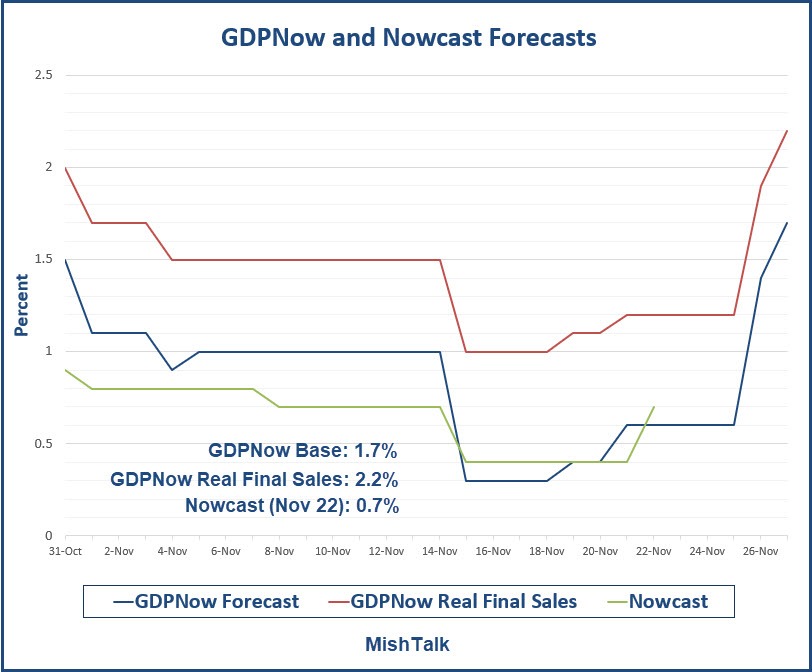
The Now York Fed updates its Nowcast Forecast on Fridays. Its next update is November 29.
The Atlanta Fed updates its GDPNow Forecast following significant economic reports.
It did so today.
Latest forecast: 1.7 percent — November 27, 2019
The GDPNow model estimate for real GDP growth (seasonally adjusted annual rate) in the fourth quarter of 2019 is 1.7 percent on November 27, up from 0.4 percent on November 19. After this morning’s and yesterday’s data releases from the U.S. Census Bureau and the U.S. Bureau of Economic Analysis, the nowcasts of fourth-quarter real personal consumption expenditures growth and fourth-quarter real gross private domestic investment growth increased from 1.7 percent and -3.0 percent, respectively, to 2.0 percent and -1.7 percent, respectively, and the nowcast of the contribution of net exports to fourth-quarter real GDP growth increased from -0.20 percentage points to 0.39 percentage points.
1.3 Percentage Point Jump
The GDPNow forecast jumped a whopping 1.3 percentage points since the forecast on November 19, split into several pieces as the chart shows.
Some of the move is related to a huge jump in military spending as noted today in Durable Goods Orders Jump on Defense Spending.
The end of the GM strike will also have a positive impact.
We hear from Nowcast on Friday and GDPNow again on Monday.
Mike “Mish” Shedlock






























One contributor to GDP is inventories and it is a plus for the GDP, but, I have never really understood why because it can be a leading indicator of impending slowdown. The government economists see inventory builds as positive because they say it shows business confidence that they can sell all that stuff sitting on shelves. To me it has always said that business has misjudged what they can sell and ordered too much inventory and will have to sell at depressed prices and possibly even a loss.
But, more important to me is that I see the cost of living going up at near or in some cases over double digits very reminiscent of the 70’s. GDP is “deflated” by an inflation calculation so when they say inflation is 1.6% (that was the final number for 2019 and will be the COLA for 2020) then they deflate GDP by about 1.2% . So, whatever they say they expect for the next quarter of GDP that is a number that has been reduced by the anticipated inflation, but, what if inflation is really 8%? Then they have not reduced the GDP estimates by nearly enough, and in fact all growth in GDP is due to simply inflating “growth” where there really isn’t any. Printing money can make it look like we are growing when we are in fact contracting. This leads to massive levels of malinvestment. In other words a downward spiral that is masked by artificial price increases that they will never properly measure and certainly won’t report.
I wouldnt believe any numbers coming out of this administration, or the Fed. Gasoline prices, now THATS something you can believe in! 🙂
Among the many absurdities of GDP as a measure of “growth” is that a declining US trade deficit is seen as a strength – when all it takes is one glance at a chart to see that it signals the exact opposite.
What “growth” is supposed to measure, is increase in wealth. That is also what most laymen think of as growth: The population getting wealthier.
Problem is, how to measure wealth, much less delta wealth, directly, is far from obvious. So activity is measured instead.
Which is a reasonable approach, like a lot of even current-day pseudo-economics, IF one assumes complete freedom hence free markets. After all, the wealthier people are, the more they have to spend, and the more they feel comfortable spending. And also, the more things there are to spend on.
Problem is, growth in spending in and of itself, is not meaningful. Only growth in spending which results from free people making free choices to spend more, based (at least partly) on their increased wealth, is.
So, once the assumption of complete freedom is violated, and you have policies targeted at increasing spending directly, increases in spending no longer measure growth in wealth. Hence no longer measures what it purports to measure, and what people are told it measures. Instead, serving no more of a useful purpose, than making you car go “faster,” by directly grabbing the speedometer needle and moving it.
I wonder how much of GDP is from tariffs?
Not sure that 1 percent increase in GDP will be noticed on the level of most individuals. More like a rounding error or within the margin of error. Down 10% would be noticable.
One trillion dollar deficits amount to about $3000/person the govt is pumping into the economy.
GDP driven entirely by big govt spending (borrowing/printing),military/welfare/prison industrial complexes booming as big govt continues to grow and matatasize at lightin speed.Trump regime will be the first to “officially”run a one trillion dollar montly deficit (to nowhere).
Don’t get me wrong, Trump is failing. But the system is essentially on autopilot to rack up more and more debt with social security, Medicare, and similar systems being the biggest drivers.
No politician has the guts to reign in spending and raise taxes.
Huh SS and Medicare reduce the Deficit. You need to get reality based. Overall spending is not the problem, it’s a revenue problem from tax cuts for the free loading rich & corporations. Tax the wealthy & corporations – HEAVILY. It’s a revenue problem not a spending problem.