

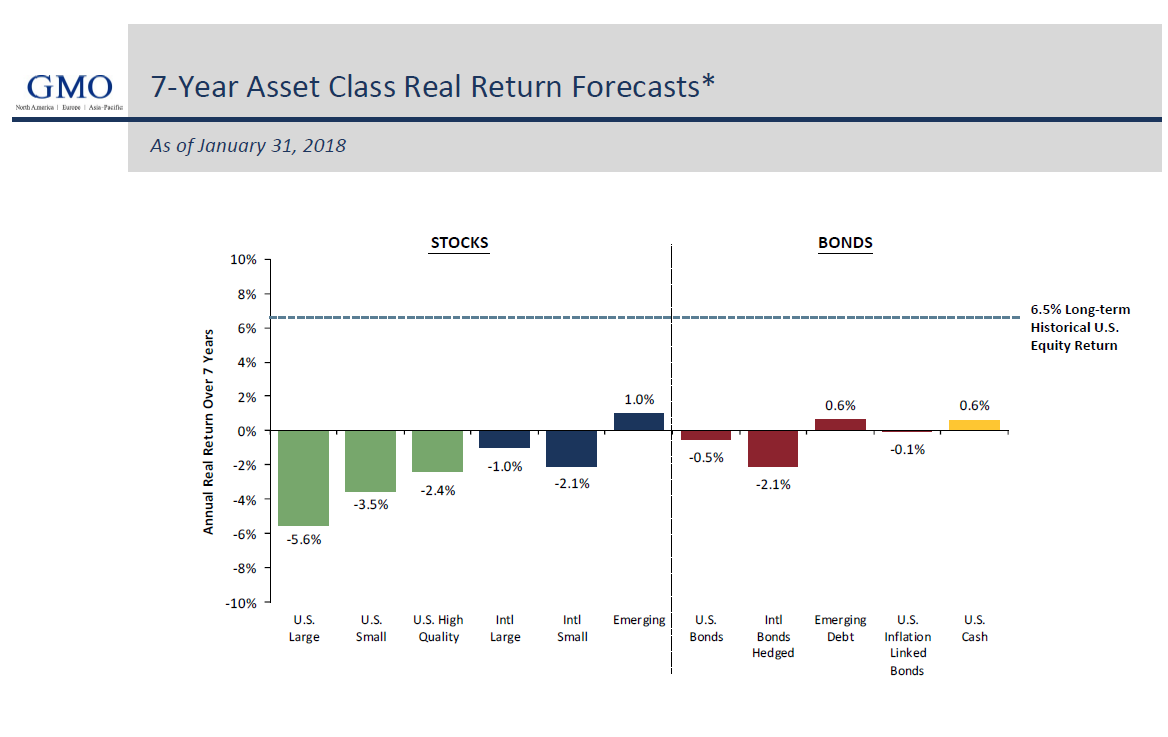
GMO offers this disclaimer.
*The chart represents local, real return forecasts for several asset classes and not for any GMO fund or strategy. These forecasts are forward‐looking statements based upon the reasonable beliefs of GMO and are not a guarantee of future performance. Forward‐looking statements speak only as of the date they are made, and GMO assumes no duty to and does not undertake to update forwardlooking statements. Forward‐looking statements are subject to numerous assumptions, risks, and uncertainties, which change over time. Actual results may differ materially from those anticipated in forward‐looking statements. U.S. inflation is assumed to mean revert to long‐term inflation of 2.2% over 15 years.
Measuring the Bubble
If one assumes 2.2% inflation per year, then the nominal decline is on the order of -3.4% per year for seven years.
Compared to Hussman, GMO is outright optimistic. In Measuring the Bubble, Hussman forecast stocks will decline by two-thirds over twelve years.
I expect the S&P 500 to lose approximately two-thirds of its value over the completion of this cycle. My impression is that future generations will look back on this moment and say “… and this is where they completely lost their minds.” As I’ve regularly noted in recent months, our immediate outlook is essentially flat neutral for practical purposes, though we’re partial to a layer of tail-risk hedges.
I side with Hussman but even GMO’s optimistic forecast would crucify pension funds.
Mike “Mish” Shedlock






























http://pasutri-makassar.com/jual-hammer-of-thor-asli-di-jogja/
http://obatperangsangmanjur.net/
Not so sure this is going to blow up so badly. After all the central bank is there to protect the financial “system” – why won’t further money printing and zero/negative rates not fix any short-term declines? The question is when do investors lose faith in the Fed’s ability to manipulate markets… and even if they do, where else will they go? Europe and Japan also printing like crazy and demographics are against them. China isn’t so open, other markets don’t have the depth to absorb so many investor inflows… Conclusion: Fed can continue to act with impunity for now!
“U.S. inflation is assumed to mean revert to long‐term inflation of 2.2% over 15 years.” What effect would WW3 have on that assumption?
Not only the Fed but all the central banksters acting in tandem. What coordination!
Amazing to read so many comments on this thread dismissing a Hussman-magnitude drawdown when we’ve seen two such drawdowns in recent history. Are memories that short? They recovered eventually, but only after significant pump-priming by the Fed. One day the Fed will have no ammo and then what? Fire up the money printers to warp speed? Get the Dow to 100,000? The proceeds will only buy you three eggs (h/t Kyle Bass) but hey …
In case it isn’t obvious, you only ‘miss out’ if you get out at (or near) the top. The vast majority who have ridden the bull all the way up will ride it all the way down again – such is investor psychology – which means you ‘missed out’ on nothing and have borne the opportunity cost in being invested in a worthless bubble. You could argue that bears have ‘missed out’ on all those dividends — but that assumes they weren’t re-invested.
Tiger said: anyone who refrained from investing based upon that forecast has missed out on tremendous gains the past 5+ years..
I’m a fan of Huffman and follow his reports. It should be noted that he’s been forecasting roughly flat 10-year returns since at least 2013 (if not earlier). Whether or not he’s “eventually” right, anyone who refrained from investing based upon that forecast has missed out on tremendous gains the past 5+ years.. He admitted to have underestimated the Fed’s role in the rebound, and I imagine he may have underaccounted for the effect of buybacks as well (20% of the total shares outstanding of the S&P500 have been removed via buybacks, $4-5T worth).
A link to the GMO piece would be helpful for your readers, thanks.
“Given that the risks of 2007 blew up the system…….”
Had we only been so lucky….
In case you haven’t noticed, The System is still here. Only now even more influential. And propped up even higher. With another few trillions stolen from (actual and potential) productive people.
The 30s (as opposed to 2007), when combined with WW2, did manage to, at least temporarily, shake The System the tiniest bit. Which is why we those were followed by what at least looked like a golden era, for a generation or so. Until The System again struck back. This time with a vengeance.
That one says it better!
“At the very least, an entire overhaul is needed to end these centrally engineered boom-bust cycles that are causing ever greater damage. All this is suggested in attempt to acknowledge economic reality, accept the acutely painful short term rebalancing, and focus on a sustainable long term common good.”
https://www.zerohedge.com/news/2018-02-18/how-did-america-go-bankrupt-slowly-first-then-all-once
In 2007, it was just the sub-prime which nearly blew up the system.
Compared to 2007, now you have:
1. subtantiallyhigher debts – The Institute of International Finance (IIF) says global levels of debt held by households, governments, and non-financial corporates jumped by over $US70 trillion in the past decade to a record high of $US215 trillion, equating to 325 per cent of global GDP (http://www.smh.com.au/business/the-economy/10-years-since-the-gfc-20170526-gwe5f2.html)
2. NIRP, ZIRP everywhere — Interest rates pinned to the ground – lowest in 5000 years
3. QE everywhere
4. Central banksters invested in stocks
5. Central banksters coordinated actions
6. The Fed trying QT and raising rates
IMO, all of the above would mean tremondous risks and I therefore would subscribe to Hussman’s view… My impression is that future generations will look back on this moment and say “… and this is where they completely lost their minds.”
Loony is what the central banksters actions have been since 2010, more so since 2012 (“Whatever it takes”). At that stage, you might have got a blow-up but now you are going to get a conflagration. The only way they could have come out of the hole they have dug themselves into since 2012 would have been tremondous growth. Is growth there, yes, but it may not be enough!
Given that the risks of 2007 blew up the system, I cannot understand how the impact will be lesser this time around. Also in 2008, the Fed (and other central banksters) could do a lot of things because their balance sheets were in better shape. This time around, their hands are tied to a larger extent.
May be the Fed would opt to keep the banks safe and let the others go to the slaughter house. But a reset is a given, IMO.
Earnings will drop as well. Especially as the higher cost of credit kicks in. The S&P500 and its customers are perilously dependant on credit.
A 65% drop in the S&P 500 – without some black swan event – would have stocks around 8 times earnings. I don’t see this as a serious prediction.
“mish it would be useful to get some historical performance of both GMO and Hussman forcasts..Both are left tail outliers in the outlook space – hence what weight should be attached to them ?”
Historical performance is no guarantee of future results.
More formally, the weight that should be attached to any forecast, is the exact one that is already priced into markets. Meaning, there is no predictive value left in any of them, wrt “beating the market.
I suspect GMO is better
Their eventual track record is very good. Short-term timing, not so.
mish it would be useful to get some historical performance of both GMO and Hussman forcasts..Both are left tail outliers in the outlook space – hence what weight should be attached to them ?