

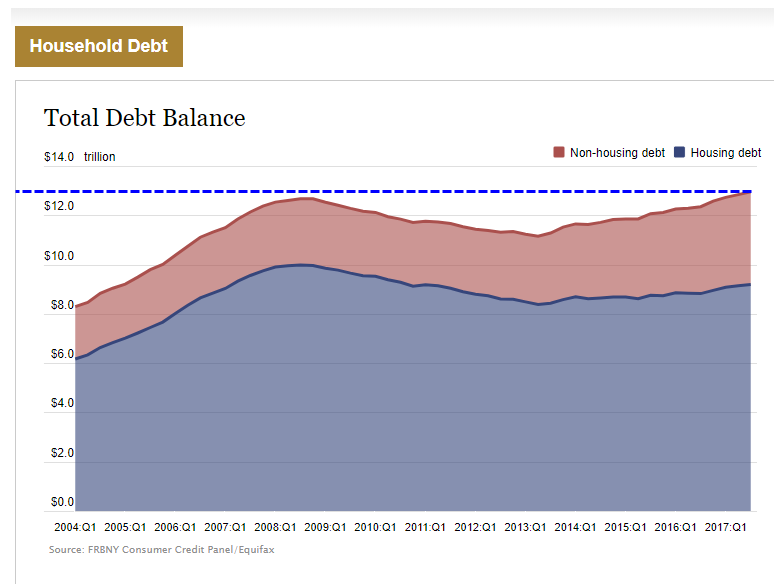
Hooray! A New York Fed report on Household Debt and Credit shows household debt hit an all-time high in the third quarter of 2017.
Mortgage balances, the largest component of household debt, which stood at $8.47 trillion as of September 30, saw a $52 billion uptick from the second quarter of 2017.
Balances on home equity lines of credit (HELOC) were declined slightly, and now stand at $448 billion.
Household Debt Composition

Loan Types
Mortgages by Credit Score
Auto Loans by Credit Score
Deflationary Setup
With stagnant real wages, how precisely is this debt supposed to be paid back?
Here’s a hint: It won’t.
This increase in unpayable debt is a very deflationary setup.
Mike “Mish” Shedlock






























An increase in debt is inflationary until the tipping point when it becomes clear to lenders that it can’t and won’t be repaid. When that happens, credit markets seize up. The rush to liquidate occurs and assets go on sale (i.e., “deflationary forces”) up to the point that the Federal Government steps in to rescue the Really Important People.
Mish, how is an increase in debt deflationary? I don’t recall reading about that in your column and I have to say offhand I don’t see why it would be. Unless no one has any money to buy anything since they’ve paying off the minimum balance on their credit cards…
Is the economy really 20% larger? The population hasn’t increased that much since 2008 and my personal economy is, in real terms, less than it was in 2008. Seems like if the economy had really increased 20% it would be noticeable. Or, it is just a case of people giving each other shoeshines or money being created out of nothing that accounts for the putative increase? Serious question.
Student loans look like the only concerning area here. Car loans are also up, but that’s likely peaking due to cyclical reasons. Mortgage debt is still below 2008, credit cards are less than 2008 and the economy is about 20% larger today than before the great recession.
Debt/GDP has dropped from 93% to 75%, seems a positive development.
People should also know that the feds never had any intention of paying back the federal debt, and that has not stopped the buying of debt. After all, where is all the wealth suppose to park? If pensions can be financed with treasuries, why can’t student loans, car loans or credit card debt? With Fedcoin anything is possible. None of this is reality, but the theoreticians with no practical experience that call the shots need only satisfy their beliefs (things one wishes were true).
And well over $1 trillion of that is variable rate debt, where monthly payments are about to increase again – thanks to the Fed raising interest rates. As usual, they will be tightening right into a huge credit bust.