

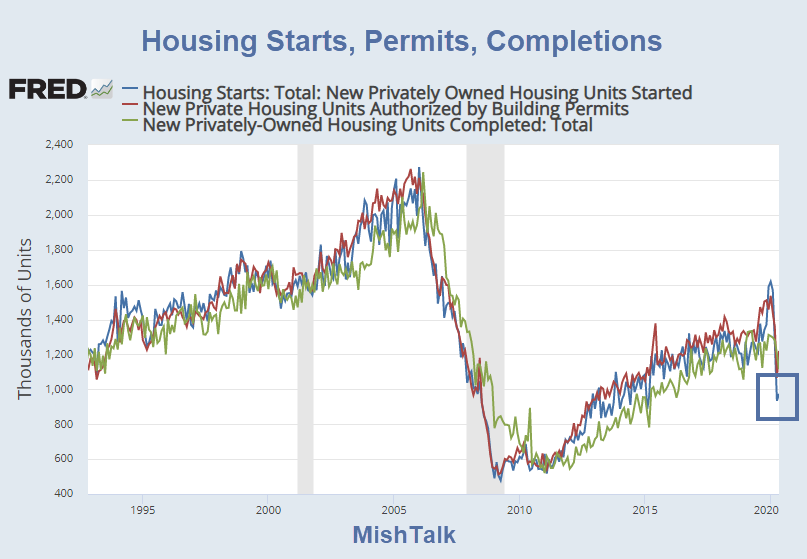
According to the New Residential Construction report from the Census Bureau, housing starts rose to a seasonally-adjusted annualized rate of 974,000 units in May
Housing Starts: Privately-owned housing starts in May were at a seasonally adjusted annual rate of 974,000. This is 4.3 percent above the revised April estimate of 934,000, but is 23.2 percent below the May 2019 rate of 1,268,000. Single-family housing starts in May were at a rate of 675,000; this is 0.1 percent above the revised April figure of 674,000. The May rate for units in buildings with five units or more was 291,000.
Housing Completions: Privately-owned housing completions in May were at a seasonally adjusted annual rate of 1,115,000. This is 7.3 percent below the revised April estimate of 1,203,000 and is 9.3 percent below the May 2019 rate of 1,230,000. Single-family housing completions in May were at a rate of 791,000; this is 9.8 percent below the revised April rate of 877,000. The May rate for units in buildings with five units or more was 310,00
Building Permits: Privately-owned housing units authorized by building permits in May were at a seasonally adjusted annual rate of 1,220,000. This is 14.4 percent above the revised April rate of 1,066,000, but is 8.8 percent below the May 2019 rate of 1,338,000. Single-family authorizations in May were at a rate of 745,000; this is 11.9 percent above the revised April figure of 666,000. Authorizations of units in buildings with five units or more were at a rate of 434,000 in May.
New Home Construction is Officially Picking Back Up
Mortgage News Daily reports New Home Construction is Officially Picking Back Up.
To Where, From Where?

Comparisons
- In January of 1959 there were 1,657,000 housing starts.
- In May of 2020 housing starts rebounded to 974,000.
- The number of housing starts in May 2020 were 41.8% below the level in January 1959.
- The recessions in 1960, 1970, and 1980 had better numbers.
Meaningful Numbers
The rebound in May was weaker than the Bloomberg Econoday consensus of 1.1 million units.
Econoday provided this humorous analysis: “The full virus effects of the month of April did not devastate either housing starts or permits which, though falling to 6-year lows, still came in at meaningful levels.”
Apparently, 1959 levels and 6-year lows are “meaningful”, not devastating.
I get this effort to build confidence, but need it be so obvious?
Mish






























Powell came from Private Equity. He is going to bail out his buddies by buying their junks bonds.
It’s America. By Idiots, for Idiots. And nothing but. Ever.
Surprisingly, the home sales report I got from a local realtor shows no change in the March/April y-o-y numbers for my town.
Since no one wants to play …
Powell moving into picking winners (and losers) arena:
“The Federal Reserve’s landmark corporate bond buying program eventually will entail mostly individual company debt rather than exchange-traded funds, Federal Reserve Chairman Jerome Powell said Wednesday.”
This is pretty much buying company stock. The Fed is trying to head off a crisis by going to the source but they will have to write off most of the debt.
Weak housing rebound meet Broke America:
“As the United States continues to face record unemployment due to the coronavirus pandemic, 30% of Americans missed their housing payments in June, according to a survey by Apartment List, an online rental platform.
That’s up from 24% who missed their payment just two months earlier in April and about on par with the 31% who missed payments in May.
…
At the same time that this “historically high” rate of Americans are missing their housing payments, eviction protections put in place at the beginning of Covid-19′s spread in the U.S. are beginning to expire. Additionally, the current 30 million unemployed Americans will lose the extra $600 per week in federal unemployment benefits at the end of July.
Taken together, experts warn of a coming housing “apocalypse” unless the government intervenes. Some 37% of renters and 26% of homeowners are at least somewhat worried that they will face eviction or foreclosure in the next six months.”