

Done Deal
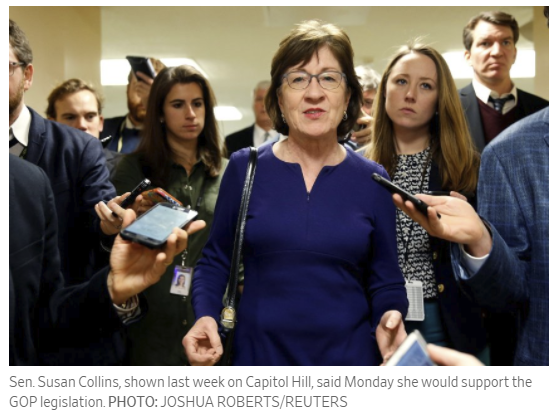
On Tuesday, House Republicans will vote on tax reform legislation. It will pass easily. In the Senate, the Wall Street Journal reports GOP Gets a Key ‘Yes’ Vote for Its Tax Bill, Senator Susan Collins.
That makes it a done deal.
Collins reiterated her confidence that Senate Majority Leader Mitch McConnell and President Donald Trump would honor an agreement they made with her on two bills addressing cost-sharing payments to insurers and high-cost claims.
The Republican leadership lied to Senator Bob Corker about the deficit, so why Collins believes anyone now is a mystery.
Then again, the promise (or lie) does provide cover for Collins in case McConnell or Trump reneges. And as we all know, the one thing politicians do not like is anyone pointing a finger at them. Collins is covered.
How to Benefit
The New York Times has an interesting “Upshot” on Ways to Profit Off the Republican Tax Bill.
Some of the ideas are quite lame, such having a kid now rather than later.
I suggest having a kid when you are 100% sure you are ready, and not before.
Another lame idea is upgrading your personal jet this year. Yes, they did write such advantages into the tax bill, but how many people can take advantage?
The “Upshot” is reasonably on target with one key idea.
Turn Yourself Into a Pass-Through Business
If you run a pass-through business that earns up to $157,500 a year if you’re single ($315,000 if you’re married), you get a 21 percent tax break on all profit that comes through your company — in other words, only 80 percent of that income would be taxed. That might make it worthwhile for some workers to switch from salaried work to freelance, though there are a few complications, like obtaining health insurance and getting your employer to agree. Those earning more might still be better off as a pass-through, but there are more rules about what types of income qualify for the deduction.
This shift is something that actually happened. In 2012, Kansas instituted even more generous pass-through rules, leading many people — perhaps 1 out of every 500 workers — to persuade their employers to pay them this way.
Who Benefits? Me, Corker, Hatch
100% of my income is pass-through. Hooray for me, only 80% of my income will be taxed.
However, I would have voted against this bill in a heartbeat. That’s how bad I think the tax “reform” is.
No, I am not going to donate money to this corrupt government. I will find a genuine charitable use instead.
Corker

Senator Bob Corker was against this bill until the very last second.
What happened?
There was a last second change regarding real estate that will benefit Corker greatly. He denies the change had anything to do with his vote.
I commented on Corker’s flip-flop in Let’s Compare Corker’s Tax Benefit to a Married Couple Making $30,000.
Hatch
ZeroHedge reports “Corker Kickback” Scandal Grows As Orrin Hatch Suddenly ‘Misremembers’ When Provision Was Added.
Senator Orrin Hatch (R-UT) admits that he drafted the controversial language that helped flip Corker to a ‘yes’ vote, but his memory is a little more ‘fuzzy’ when it comes to recalling whether or not the provision was already incorporated in previous versions of the bill.
In his letter explaining the situation, Hatch did not dispute that Corker and other Republicans who have large ownership stakes in real-estate-related LLCs stand to reap a personal windfall from the legislative language he added to the final bill. Instead, Hatch insisted the controversial provision wasn’t new, but was in fact included in the version of the bill passed by the House earlier this month. He wrote that the claim “that a new pass-through proposal was created out of whole cloth and inserted into the conference report is an irresponsible and partisan assertion that is belied by the facts.”
Hatch’s characterization of the provision was disputed by tax experts Monday, who said the Republican senator’s process argument was factually false.
“Chairman Hatch’s letter is an exploration of an alternative tax universe not previously known to science,” Edward Kleinbard, former chief of staff of Congress’s Joint Committee on Taxation, told the IBT.
Meanwhile, adding fuel to the fire is the fact that financial disclosures show Hatch’s wife, who owns a real estate LLC worth up to $500,000, would also directly benefit from his lucrative new policy modification.
Nothing to See
Clearly, there is nothing to see here. Move along, please.
Be Like Me?
Let’s return to the New York Times suggestion to “be like me,” more specifically, to become a pass-through business.
For starters, most companies will not allow it, for good reason.
It opens up corporations to lawsuits regarding who is or isn’t an employee. Corporations have to pay 1/2 of the total FICA deduction of every worker. If you work for yourself, you have to pay that on income.
If individuals complain they were really employees, corporations could be responsible for back taxes and penalties.
Second, corporations cannot just hire people for indeterminate periods of time. Contracts generally need to be project-based, not time-based.
Third, it’s not possible for corporations to offer healthcare or other benefits to contractors. With individual costs spiraling out of control, unless one has a spouse, is prepared for a jump in costs, or is otherwise covered, loss of healthcare benefits could be crucial.
Finally, in case of an economic downturn, contractors are the first to go. Key employees are the last to go.
Superficial Advice
The New York Times mentioned the benefits but none of the potential problems.
I am not saying “Don’t do it.” Rather, I am saying there are tradeoffs and risks.
In 2004, I was out of work for three years. I lost my contracting job after 911 and was on the verge of losing my house. I am now debt-free and refuse to go into debt ever again.
I truly believe I was then (and probably still am), one of the best mainframe computer analysts in the county, but I could not find a job to save my life.
Out of desperation, I started a blog. It worked, but I cannot exactly recommend my career path.
Best Way
The best way to take advantage of tax breaks should now be clear: Become a senator, then you can write laws that benefit you personally.
Mike “Mish” Shedlock






























That’s a good point, that 80% of the 37% bracket (29.6%) is still higher than 28%. The 37% bracket doesn’t kick in until $600,000 of income, MFJ, so the primary effect of the AMT on pass throughs might be clawing back the lower marginal rate on the first $600,000 of income.
I’m not sure about the AMT. Section 199A(f)(2) of the proposed bill says that for purposes of AMT, qualified business income is determined without regard to adjustments in Section 56 through 59 (so no difference in the base between Section 1 and Section 55, and in effect the related SALT is fully deductible against regular tax and AMT). As the marginal rate on AMT is 28% and the marginal rate on QBI for the rich will be 29.6% (obviously average rates will vary), there may be little or no impact of AMT on QBI.
The AMT will effect far fewer people now. It doesn’t kick in until $500,000 of income for single filers & $1,000,000 for joint filers. Currently, the AMT wallops upper-middle income folks, but the items that triggered that AMT for them – SALT, property taxes & misc. work expenses – are limited to $10,000 anyway. But, there are plenty of small business who hire people who earn less than $1,000,000 a year.
Seems to me individuals with pass-through income won’t see a savings because the AMT was kept for individuals. Therefore, the 20% deduction on the pass-through will be voided, at least in part, by the AMT. This is exactly why the corporate AMT was dropped.
Anyone with half a brain will realize this tax plan is intended to benefit the wealthy. Problem is the dems won’t capitalize on it. They’re too focused on the Mueller probe, which I believe will blow up in their faces just prior to the 2018 elections.
I’d be interested in the logic behind taxing pass-through’s at 80%. I get that the self-employed have to pay their own matching share of FICA and healthcare, but the FICA ends around $120k. Why not just give tax deductions for those items, if you pay for them?
Looking forward to seeing what Trump’s definition of a wall is down on the Mexican border…
https://i.pinimg.com/736x/a5/1f/4f/a51f4f6bb54ab3b8df6722a5c034482a–edging-landscape-brick-brick-edging-garden.jpg
LLC’s will now need to be relabeled as LTLC’s (Limited Tax and Liability Corporations). Wondering how the CBO scored this last minute change to the legislation, as I’m betting that there will be a huge number of conversions and restructurings to this tax entity.
If the companies are not offering healthcare or other benefits it’s more likely to be advantageous