

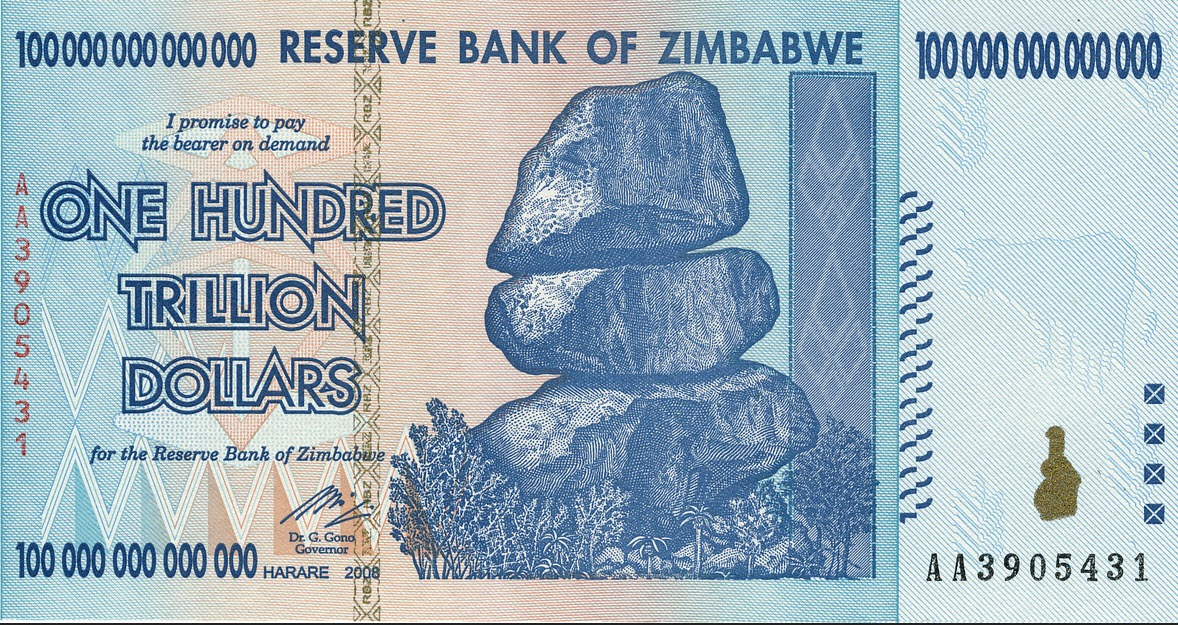
Zimbabwe Hyperinflation is Back
Hyperinflation in Zimbabwe was a period of currency instability in Zimbabwe that, using Cagan’s definition of hyperinflation [50% in a month], began in February 2007. During the height of inflation from 2008 to 2009, it was difficult to measure Zimbabwe’s hyperinflation because the government of Zimbabwe stopped filing official inflation statistics. However, Zimbabwe’s peak month of inflation is estimated at 79.6 billion percent month-on-month, 89.7 sextillion percent year-on-year in mid-November 2008.
In 2009, Zimbabwe stopped printing its currency, with currencies from other countries being used. In mid-2015, Zimbabwe announced plans to have completely switched to the United States dollar by the end of 2015. In June 2019, the Zimbabwe government announced the reintroduction of the RTGS dollar, now to be known simply as the “Zimbabwe dollar”, and that all foreign currency was no longer legal tender. By mid-July 2019 inflation had increased to 175% sparking concerns that the country was entering a new period of hyperinflation.
The above from Wikipedia, I added the link and the note about 50%.
It’s hard to grasp numbers like 89.7 sextillion percent year-on-year in mid-November 2008.
Here is one way to visualize it: The Zimbabwe dollar and the US dollar were supposed to be pegged 1:1 but it took the staggering sum of $2,621,984,228 Zimbabwe dollars to buy one US dollar. Buying things with Zimbabwe dollars became next to impossible.
Zimbabwe hyperinflation stopped in 2015 but returned in 2019 when the country went back to the Zimbabwe dollar.
Zimbabwe Raises Benchmark Rate to 70% as Currency Plummets
Bloomberg reports Zimbabwe Raises Benchmark Rate to 70% as Currency Plummets
Zimbabwe’s central bank has raised its key interest rate to 70% from 50% to try and stabilize a plummeting currency and surging inflation.
The Zimbabwe dollar, which was pegged to the dollar at parity as recently as February, is trading below 11 to the dollar and annual inflation, which wont be released until February, is estimated to be between 230% and 570% by economists.
500% in one year qualifies as hyperinflation in my book whether or not 50% in one month is attained.
Hyperinflation a Political Event
Hyperinflation is a complete loss of faith in currency. I propose It is best viewed as a political event not a monetary one.
Zimbabwe hyperinflation began when president Robert Mugabe embarked on an Economic Structural Adjustment Programme in which the land of white farmers was forcibly taken and given to blacks who did not know how to farm.
Production plunged and capital flight (money and white flight) began. Unemployment rose to 80%.
To halt the economic slump, the government printed money. But confidence in the currency was lost with Mugabe’s “reforms” not with the printing. It ended on a political note, adoption of the US dollar.
Another political event, tossing the dollar, led to the current round of hyperinflation.
Weimar Germany hyperinflation also began as a set of political events: War followed by war reparations.
In Venezuela, government took over the oil wells in a set of “reforms” and production collapsed. Hyperinflation eventually followed.
Hyperinflation in the US?
No. Ignore the silly hype.
What would get me to change my mind?
Some sort of government takeover accompanied with AOC’s $90 trillion spending plan and a guaranteed “free money’ living wage and free housing for everyone. Note that those are political events.
The final requirement is the US would have to do something major in isolation because if every country did similar things, the dollar would not drop relative to the Euro, Yuan, Yen, etc.
Mike “Mish” Shedlock






























It’s not the value of the dollar relative to the yuan that is important. It’s the value of the dollar relative to the value of a loaf of bread. If a loaf of bread is worth $1,000,000 and 2,000,000 yuan, then congratulations – you have had hyperinflation.
Otherwise, all correct.
Superb critique of Mugabe and the trail of tears he put Zimbabwe on. His people fell for the free lunch opera.
I can hear the same fat lady warming up in South Africa.
Nature doesn’t care if we are politically naive and gullible; Even worse, she’s utterly indifferent to our greed and fear.
“I can hear the same fat lady warming up in South Africa.”
And North America…
Given the EU is desperate for some inflation maybe the ECB and Draghi should ask them for some advice?
Zimbabwe can measure inflation? That’s positive. If they could outsource production to some low cost country, maybe they could slash it to a forward targeted 1-2%?
Lets hear from the MMTers
You mean the supporters or the detractors?
Well I’m a detractor.
“What would get me to change my mind?”
How about trump loses the election, declares it fake, and installs a fed gov that sets interest rates to negative 10%?
Here is a more likely scenario would be for Dems to win and actually do what they have promised. That would initiate capital flight.
Zimbabwe — yet another socialist “success” story.
Meanwhile, Ecuador, Timor-Leste, and Panama sail on. Who hears about hyperinflation in those countries?
Just because they don’t make the news in the USA doesn’t mean their local economies are better. Ecuador continues a slow decline, but its not worthy of a news article in western european countries.
Not sure why Mish (or really Bloomberg) zeroed in on Zimbabwe today. Its been circling the drain for years. Bloomberg the man is probably trying to distract attention away from how bad things are in NYC, and ordered his “media empire” to draw attention elsewhere