

The Rent Cafe reports High-Income Americans Are the Fastest Growing Renter Segment — Up by 1.35 Million in a Decade.
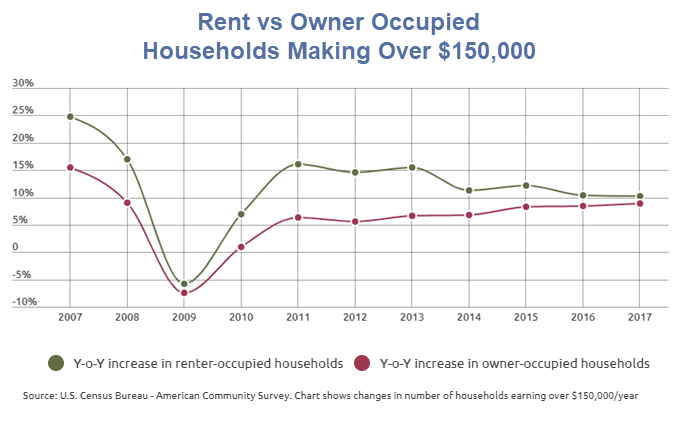
The most recent U.S. Census data tells us that the annual increase in the number of high-income renter-occupied households – defined here as those earning $150,000 or more – has been consistently faster than owner-occupied households. As a matter of fact, from 2007 to 2017, the numbers of those rich enough to own, yet who still prefer to rent grew by 175%. That’s compared to a decade-long increase of 67% in homeowners within the same income bracket.
Top-Earning Renters Are Growing Faster than Any Other Renter Income Bracket
Of the 43.3 million renters nationwide, 2.1 million are top earners. High-income renters represent the demographic that experienced the largest boom across the U.S. given that, back in 2007, there were only 774,000.
Breakdown
- Over $150K — ↑175%
- $100K – $150K — ↑111%
- $75K – $100K — ↑66%
- $50K – $75K — ↑32%
- Under $50K —↓0.2%
High-Income Renter-Occupied vs Homeowner-Occupied Households 2007-2017

Debate Over High-Income Definition
Arguably, $150K may not be enough to qualify as high-income in places like San Francisco or New York City, which is probably why the two cities have the largest numbers of renter-occupied households inside this bracket.
NYC’s upper-bracket renters outpace owners not only in net numbers but also in the rate of increase. Wealthy renter-occupied households in New York doubled in the course of a decade, going from 125,000 in 2007 to the largest number of wealthy renters in the U.S. today — 249,000. As for people earning $150K or more who own a home in the Big Apple, their numbers have increased by a lesser 63% over the course of a decade (189,000 in 2007 to 306,000 ten years later).
Top 10 Cities With High-Income Renters

American Dream
The Rent Cafe concluded. “The attitude toward renting at any income level is changing. With renters becoming the majority population in many U.S. cities, the spike in the national population of wealthy renter households could mean a change in attitude toward an American Dream that no longer belongs to this generation of renters.”
Marriage Rates Down, Cohabitation Up

Not Just Student Debt
The Rent Cafe article ties in nicely with my previous report: Marriage Rates Down, Cohabitating Rates Up: It’s Not Just Student Debt to Blame
Attitudes, Attitudes, Attitudes
A Fed study on Consumers and Communities released last month had an interesting comment on homeownership.
“We estimate that roughly 20 percent of the decline in homeownership among young adults can be attributed to their increased student loan debts since 2005. Our estimates suggest that increases in student loan debt are an important factor in explaining their lowered homeownership rates, but not the central cause of the decline.”
The rest is explained by changing attitudes and affordability.
Attitudes about marriage, having kids, mobility, and debt have all changed.
This is not 1960 or 1971.
To top it off, houses simply are not affordable. That’s what the cohabitation rate shows. Wages have not kept up with home prices even without the burden of student debt.
American Dream
Even when high-income households can afford a house, many choose to rent instead. Why?
- Changing attitudes about the “American Dream”.
- The Marriage Tax Penalty
- The Remarriage Penalty
Reader “Cecilia” thoughtfully added “Liquidity and Walk Away Arbitrage”, which also ties into the remarriage issue.
Remarrying can greatly complicate divorce financial arrangements. It’s easier to live with someone. No one wants a second divorce, especially if the first one was messy.
Mike “Mish” Shedlock






























I remember Jim Rogers once said you should pay off your residence before doing any serious investing. Find the cheapest place your family can live comfortably. Anything more is just charity to the county tax authority. Use a 15 year mortgage since it pays a decent amount towards principal from the beginning.
In many areas you can live better for less by renting, you give up the possibility of capital appreciation but also the risk of loss, runaway property taxes and abusive HOAs
I think it boils down to how long you think you’ll live there. For me, buying a house in 1995 was the smartest thing I ever did. Financially speaking. For the past 10 years, I’ve only had to pay property tax and homeowners insurance. Maybe $400/mo for a 5 bedroom 3.5 bath home. Renting a similar home would cost $3k/mo.
If I had moved after say 5 years, it would have been a terrible investment.
The new tax bill doesnt favor buying over renting. High paying jobs also go down when a recession hits.
I bought my house 5 years ago. According to Zillow it has appreciated by about $100,000. Of course I like to say if someone offered me the “Z-Estimate” for it I’d sign right now, but even 1/2 to 2/3 that price is still a major gain that is outpacing official inflation. For sure it is outpacing working class income gains over the same period.
If you didn’t buy at the bottom you’re back to priced out again. And this time if you want to play the refi and flip game you’re up against hardened professionals.
It’s simpler than that. Renting rates are up because Blackrock has bought all the homes. We all know who to thank for that…
Blackrock does not own one home. Blackstone did, but they went public with INVH.
OK I was close. The point is institutional ownership pushes up the share of renters.
Off subject a bit but this is starting to become a big subject:
If I lived in Chicago, I absolutely would rent rather than own. We know that the other shoe will eventually drop, and they will have to address their massive debt. Will it be a massive hike in property tax? That seems more likely than the chances they will reduce the pensions, when you consider who controls the government. The best choice, of course, is not to live there at all, but if I had to, I’d rent.
“Will it be a massive hike in property tax? That seems more likely than the chances they will reduce the pensions, when you consider who controls the government.”
The voters control the government- they elected democrats. Apparently the new governor just said no reduction in pensions. The people of Illinois voted for higher taxes.
The more money one makes (or the more specialized one’s skills) means the less likelihood of finding a job paying the same or better where you live. Mobility is key to staying employed.
In this economy you are likely to have to move which itself is probably worse than 3 root canals. Then Homes aren’t liquid and some are hard to sell even if they are in perfect condition. Other problems can include the HOA from hell, group homes for the mental problems, things like the stupid Ill proposal to raise taxes.
There is a reason that in Detroit some properties were listing for $5k or less, and if that starts to encroach…
Successful rent-seeking by academe has made indentured servants of an entire generation of college kids. If you look at the aggregate college cost trendline, it’s in lockstep with aggregate government financial assistance. Congrats to colleges everywhere. Your K Street lobbyists have served you well. In fact, your total take is second only to environmentalists, but you’ve gone them one better in assuring that whatever is owed you can’t be discharged in bankruptcy. Of course, they’ve bettered you by directly accessing the taxing power of the state to rake in subsidies for their boondoggles, so I guess you need still more lobbyists to pull ahead.