

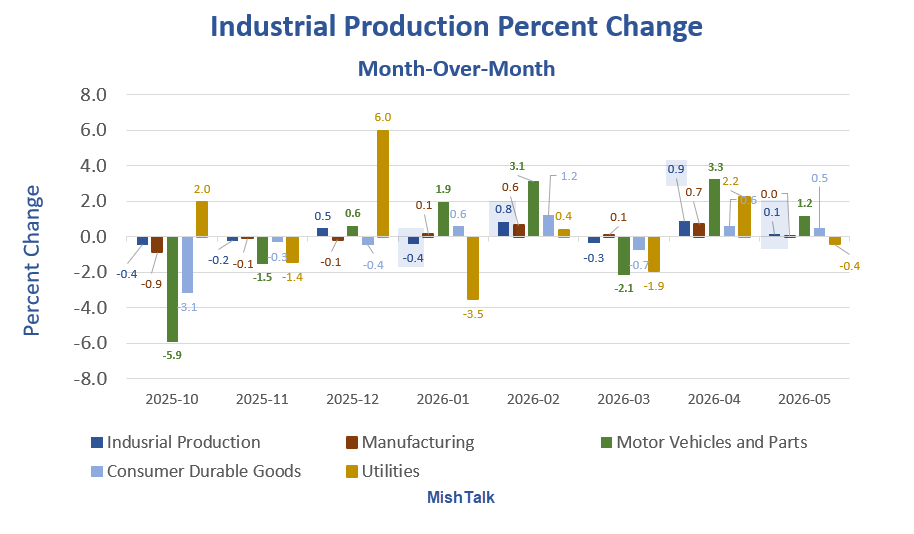
Following a strong April, IP posts a small gain in May.
Please consider the Fed’s Industrial Production and Capacity Utilization report for May 2026.
Industrial production (IP) edged up 0.1 percent in May after rising 0.9 percent in April. Manufacturing output was unchanged in May after increasing 0.7 percent in April. In May, the index for mining rose 1.3 percent, and the index for utilities decreased 0.4 percent. At 102.6 percent of its 2017 average, total IP in May was 1.7 percent above its year-earlier level. Capacity utilization edged up to 76.2 percent, a rate that is 3.2 percentage points below its long-run (1972–2025) average.
Month-Over-Month Industrial Production
- Production: +0.1 percent
- Manufacturing: +0.0 percent
- Motor Vehicles and Parts: +1.2 percent
- Consumer Durable Goods: +0.5 percent
- Utilities: -0.4 percent
Industrial Production Year-Over-Year

Utilities are on a near-continual tear, consumer durable goods are in a constant state of disaster, Motor vehicles and parts swing wildly, and manufacturing has mostly stabilized at small positives since January 2025.
Industrial Production Detail

The index details highlight how manufacturing weakness and Utilities strength.
Manufacturing peaked right at the onset of the Great Recession at 106.6. Its highest rebound just prior to the Covid recession was102.0.
The Manufacturing index has been rising lately but sits at an anemic 98.6 now, down 7.7 percent in the past 19 years.
Related Posts
June 15, 2026: Three Reasons the Price of Oil May Have Bottomed Despite a Deal
West Texas Oil is down another 5 percent to $80.52. Brent is $83.27. Still looking lower?
June 15, 2026: Core CPI Inflation Looks Contained. It’s a Mirage Ignoring Services
Let’s discuss goods and services. The latter is 63.4 percent of the CPI.






























Inflation eating into margins of industrial producers?
2008 was the year the demographic death spiral became real. That was the year the oldest baby boomers, born in 46, hit age 62 and the youngest boomers born in 64, turned 40. The classic pig in a python.
Take a look at the labor participation rate chart.
https://fred.stlouisfed.org/series/CIVPART/
The pattern and link is all there: demographics -> debt -> debauchery -> destiny -> death. That’s when I started my exit strategy planning because back then I knew what would be coming and here we are but just wait tin 2030 and it will become more clear and real.
That labor participation rate chart crystalized the death spiral very nicely, it will continue to go down. The inverse, chart of the social security snapshot ballooning to the moon, is the other end of the misery piece.
Got exit strategy?
Exit plan is continually revised. However, I await my full measure of debauchery before before implementation.
But Trump will bring the costs of gasoline and food down in the next two weeks. They’ll be lower than you’ve ever seen. It’ll be great. Zzzz Zzzz Zzzz. Wha? huh? It’s Bidens fault and the radical left luna- Zzzz Zzzz Zzzz
I wanted to be sure about your point, but I am assuming you are referring to a labor shortage? We don’t and won’t have a labor shortage, by all accounts moving forward.
We are slowly eroding our need for workers, and AI and Robotics and the like will assure this will happen.
I am so sick of that nonsense. The same thing was said when cotton gin came online and then the Internet came online, same thing. Yes AI and robots will eliminate some jobs but new ones will be created.
There are 8 billion people on the planet who can provide cheaper labor than a robot. There isn’t enough electricity or materials to build and run 8 billion robots.
Sheesh, we are already approaching hard limits on electricity alone. Are you willing to go without electricity so your robot can have it?
You must not understand AI very well. The robot scenario isnt it. The desk job is toast.
Hard limits on electricity ? Solar has less limits.
I understand AI better than anyone here. I have AI agents running all over the place for my investment activity. You want to know what no one talks about with AI? The cost. There is no free lunch.
https://fortune.com/2026/05/22/microsoft-ai-cost-problem-tokens-agents/
Using the tech is more expensive than paying human employees.
Any questions?
Why AI Will Accelerate Health Care InflationWhere AI Performs Best
https://www.healthaffairs.org/content/forefront/why-ai-accelerate-health-care-inflation
Yet another reason to GTFO out of the country but we all know US healthcare will collapse at some point, too many pigs feeding at the trough.
exit plan for what. USD probably? Are you moving into to stocks and real estate.
Stocks:.
SP500 companies get almost 50% of their revenue from overseas. This share is only going to grow with AI leadership. Other countries are growing population.
Housing:
Just open the boarders again. Inflation will cause house price to go up even with a dropping population. Japan hit peak population in 2020 and has been dropping ever since. Well that is the year housing prices bottomed in Japan have been going up as population is going down. Why? because the YEN is being devalued.
“exit plan for what”
The irony of you answering your own question without you even realizing it re: housing, currency arbitrage and investments.
Like Mike Tyson said, everyone has an exit strategy till they get punched in the face.