

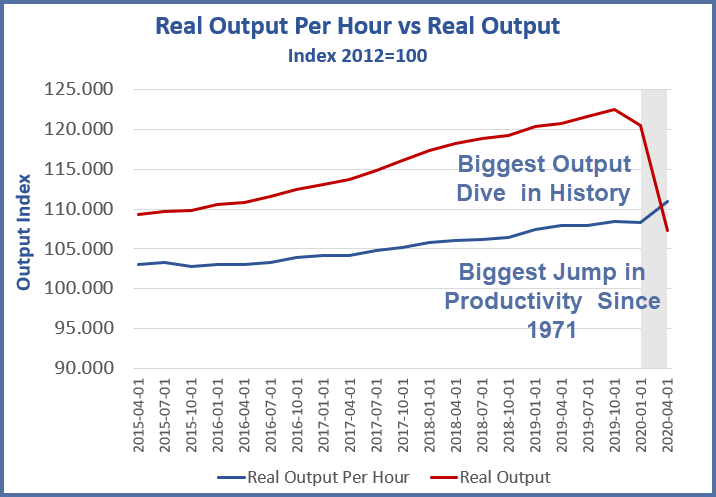
Productivity vs Output Disaster
Inquiring minds are diving into the BLS Productivity and Costs Report for the Second Quarter of 2020.
BLS Charts on Productivity

Productivity Good News and Horrible News
- Good News: The BLS notes that the 10.1-percent increase in nonfarm business sector labor productivity in the second quarter of 2020 is the largest quarterly increase since the first quarter of 1971, when output per hour increased 12.3 percent.
- Horrible News: Output decreased 37.1 percent and hours worked
decreased 42.9 percent.
Hours worked decreased more than output so productivity rose.
Hooray?
Unit Labor Costs
- Unit labor costs in the nonfarm business sector increased at an annual rate of 9.0 percent in the second quarter of 2020, as a 20.0-percent increase in hourly compensation outpaced the 10.1-percent increase in productivity. Unit labor costs increased 9.6 percent in the first quarter of 2020, and 4.9 percent over the last four quarters.
- The 20.0-percent increase in hourly compensation in the second quarter of 2020 was the largest increase in the series which begins in 1947. Also, the labor share—defined as the percentage of current-dollar output that accrues to workers in the form of compensation—increased to 59.8 percent in the second quarter of 2020, the highest level since the fourth quarter of 2008 (60.1 percent).
This sort of sounds like good news (assuming you are not an employer) until you understand what it means.
Compensation reflects higher-paid employees working from home while lower-paid employees did not work many, if any hours.
Manufacturing Disaster

In contrast to overall productivity up 10.1% manufacturing productivity dropped 14.6 percent annual rate in the second quarter
of 2020, as output fell 47.0 percent and hours worked dropped 38.0 percent.
These were the largest quarterly declines in each of these series, which begin with data for 1987.
Long Term Productivity vs Output

Those charts put a much needed perspective on this alleged jump in productivity.
Mish






























It’s hard to disagree. Really, you should never overwork whatever you do and no matter how enthusiastically you do it. Otherwise, you can just quickly get tired and forget about everything. This situation is well described here https://studybreaks.com/thoughts/toxic-productivity/ In reality, work and any business, in general, is not a race for records. Do not do too much so that one day you will not be completely exhausted.
Hey Mish. The US death rate from Covid-19 just passed Sweden. Since you were so spectacularly wrong in your criticism of Sweden, why don’t you apologize for being so ignorant? You were intelligent until you became anti Trump and now your articles are just plain dumb. What happened to you? Are you getting dementia?
This@Mish posting is wonderful. And might say more about the measurement than about the reality it’s sometimes confused with.
could supply bottle necks of materials have restrained manufacturing output?
Trimming the fat. The least productive are first to go. Those remaining are the more productive.
There is some of that. Countered by processes optimized for running at X volume, with n employees, now being ran
But the far and away overshadowing effect, the only one which matters practically, no different from any other “economic” “measure” drummed up by the clowns, is that “output” is measured in a unit which is simply arbitrarily debased at a rapid pace. Such that the overridingly only thing any of the “measures” ever actually “measure”, is credit growth. Or, in cases such as this, credit growth in the numerator, over a “real”, less arbitrary, measure, hours worked, in the denominator.
Hence, conveniently for the indoctrinators and their pliant indoctrinati, all of these nice-sounding-in-Newspeak “measures” magically “go up” when the Fed prints to “rescue the economy”, and “go down” when they don’t. Now, who would have thunk?
That’s really all that any of these spews signify.
Increases in productivity occur over the long run, so these numbers mean nothing.
How much productivity is lost if 30 million students and pupils lose 4 months of education? How much is gained after 18 years of education? Pretty hard to measure.
At the IT department there is a lot of emergency spending and emergency projects to better facilitate people working from home. Are those people working more efficiently? No. But there are no measurements to quantify this. Meantime, a lot of other projects for the future (to enhance productivity) have been put on the back burner.
These numbers mean absolutely nothing one way or the other.
tRump will certainly brag about this great win!
It looks like the work at homers have been very busy seeing as the major platforms like yahoo, FB, etc., have all been getting major ‘facelifts’ that include censorship, paywalls, force fed advertising and fake news, spyware, service denial, and so much more as the noose tightens. As the inflationary depression deepens and the trap closes, more and more of these pyjama clad drones will be cut loose to forage in their suburban woods for food as they are no longer needed.
Anti trust against Google?
That would be huge … and hopefully the first of many.
Much better to start with antimumbojumbo against any organization so big, monopolistic and powerful that it could engage in anti-something against someone as big as Google.
Antitrust is the poster child for non-objective law. No one can know if they are breaking antitrust law or not, until Congress has a feelsies that they did.
It is obvious that there are an awful lot of “bullsh*t” jobs out there that produce little or nothing of value.
Initial claims report interesting.
Initial claims for covered employees dropped … but claims for ALL (most recent number for week of August 15th) …
“The total number of people claiming benefits in all programs for the week ending August 15 was 29,224,546, an increase of 2,195,835 from the previous week. There were 1,639,622 persons claiming benefits in all programs in the comparable week in 2019. “
Thanks for this, it puts everything into perspective.
A lot of employers are pulling demand forward.
You get what you measure.
all articles should end with a statement of whether it is bullish or bearish.
You need to qualify – for worker or owners of capital?
Higher unit labor costs means worker winning … can’t have that … so look for layoffs to boost earnings.
Most news is both bullish and bearish depending on who is presenting it and who is receiving it …
And sure, isn’t the owners mantra “do more with less …” which at the limit becomes the absurd “do everything with nothing …”
And owners might say that the workers’ mantra is “do less for more …” which at the limit becomes the absurd “do nothing for everything …”
“Welcome To The Working Week” — Costello
“which at the limit becomes the absurd “do nothing for everything …”
It’s only absurd if The Fed don’t rob others to hand you everything you have, free of charge. As they have done to pretty much everyone who has anything, hence can afford to be heard on any subject, in The West by now.