

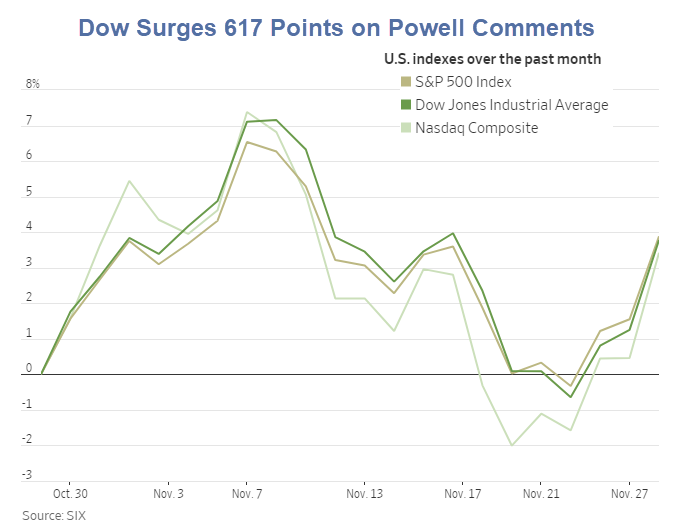
Fed Chair Jerome Powell’s speech today on the Federal Reserve’s Framework for Monitoring Financial Stability sent the stock market flying today.
Here’s the key paragraph:
“About three years ago the FOMC judged that the interests of households and businesses, of savers and borrowers, were no longer best served by such extraordinarily low rates. We therefore began to raise our policy rate gradually toward levels that are more normal in a healthy economy. Interest rates are still low by historical standards, and they remain just below the broad range of estimates of the level that would be neutral for the economy‑‑that is, neither speeding up nor slowing down growth. My FOMC colleagues and I, as well as many private-sector economists, are forecasting continued solid growth, low unemployment, and inflation near 2 percent. “
The key words are “just below neutral“. The market’s apparent interpretation is that the Fed is about done hiking.
The Wall Street Journal noted Mr. Powell appeared to retreat from a comment he made in early October that described the Fed’s benchmark rate-setting as a “long way” from a neutral level.
1929 Flashback
In his speech Powell made reference to 1929.
For Economic Club of New York trivia buffs, I will note that the second ever presentation to this club by a Federal Reserve official was about this very topic. The date was March 18, 1929. Weeks before, the Fed had issued a public statement of concern over stock market speculation, and had provided guidance frowning on bank funding of such speculation. William Harding, a former Fed Chair and then president of the Federal Reserve Bank of Boston, defended the Fed’s actions in his talk. He argued that, while the Fed should not act as the arbiter of correct asset prices, it did have a primary responsibility to protect the banking system’s capacity to meet the credit needs of households and businesses. At the meeting, critics argued that public statements about inflated asset prices were “fraught with danger;” that the nation’s banks were so well managed that they should not “face public admonition”; and, more generally, that the Fed was “out of its sphere.” Of course, Harding spoke just a few months before the 1929 stock market crash, which signaled the onset of the Great Depression.
The implied message here is the Fed won’t let another crash happen again.
Fed Monitoring Triggers
Powell stated the Fed was “Monitoring Likely Triggers for Financial Distress.”
Powell’s own assessment: “My own assessment is that, while risks are above normal in some areas and below normal in others, overall financial stability vulnerabilities are at a moderate level.”
The implied message is the Fed has everything under control.
Valuations and Forward PE’s
Looking across the landscape of major asset classes, we see some classes for which valuations seem high relative to history. For example, even after standard adjustments for economic conditions, valuations on riskier forms of corporate debt and commercial properties are in the upper ends of their post-crisis distributions, although they are short of the levels they hit in the pre-crisis credit boom. We see no major asset class, however, where valuations appear far in excess of standard benchmarks as some did, for example, in the late 1990s dot-com boom or the pre-crisis credit boom.
The asset class that gets the most attention day-to-day is, of course, the stock market. Today, equity market prices are broadly consistent with historical benchmarks such as forward price-to-earnings ratios. It is important to distinguish between market volatility and events that threaten financial stability. Large, sustained declines in equity prices can put downward pressure on spending and confidence. From the financial stability perspective, however, today we do not see dangerous excesses in the stock market.
PE Silliness
Referencing forward PE’s is a complete joke. Forward PE’s always look good at market peaks and they always look horrendous at recession bottoms when sales are dismal.

Cyclically adjusted PEs smooth out tops and bottoms. The Shiller CAPE shows market valuations today are about where they were in 1929.
Eternal Vigilance
In his speech conclusion, Powell offered these lines: “Eternal vigilance is the price of financial stability. We will publish these reports regularly as part of our vigilance.”
The implied message is that not only does the Fed have everything under control, it’s also exercising “eternal vigilance” so that it stays that way.
Eternal Vigilance My Ass
The Fed blew major bubbles in 2000, 2007, and again now.
- Greenspan failed to recognize the dotcom bubble. Instead he embraced a “productivity miracle”.
- Bernanke repeatedly denied there was a housing bubble.
- Yellen and Powell both failed to spot obvious stock market bubbles.
Eternal vigilance my ass. These alleged wizards could not spot a flamingo in a pen full of turkeys.
Mike “Mish” Shedlock






























The public is full of lemmings who believe the financial media hype about the Fed and stock prices. Near term the Dow on an intraday basis had lows of 24,122 on 10/29 and 24,268 on 11/23. Since 11/23 the Dow had already been rising. The Dow rose from the low of 24,122 on 10/29 to a high of 26,277 on 11/8 before dropping to the second swing low on 11/23. The first up swing was almost twice as large as what has occurred since 11/23 (so far).
The day of Powell’s speech saw a smaller daily move (low to high) than the intraday low/high swing on 11/15. Nobody mentions these other days that can be easily found on a simple chart. I trade the Dow and these stories always make me laugh. Suckers fall for the hype of financial media and their “reasons” for moves. Markets move because people herd and they are either fearful or greedy. Mass psychology and herding is neither efficient nor rational. Take a look at the Dow the day following the speech. These events cause some short term traders to change their trades intraday but the net effect is meaningless. I will change my intraday trades just as the others do if I am in any positions intraday. You follow the trend or you get hammered.
We are at the end of a long term credit and debt super cycle. See John Mauldin and Ray Dalio’s theses on this. The Fed will be trapped once the economy gets to stall speed. We saw the dollar break the buck in 2008 and credit contracting but if the comorbidity of private and public debt hit at the same time it will be worse than the 1930s.
Hi Mish,
I’d like to know what’s your take on Martin Armstrong’s theory regarding the US stock market, i.e that we are at the end of a cycle where trust in government’s debt is disappearing, which should lead to the flight of capital from Public to Private, from bonds to equity, leading to stock markets going up in the “most hated bull market” in history.
Can this counterbalance standard anticipations of high PE ratios and market krach ahead?
Thanks for your time,
Until government formally and finally defaults, they’ll tax, steal (via debasement as long as they can, then more directly) and cut services, before doing anything they worry can cut them off from the credit spigot.
Which is why a formal, and final (as in non challengeable), default is so important. Until then, noone can assume anything the government can get its hands on, will be left unstolen.
It’s the same wrt private debt. As long as unpayable debt is out there, and The Fed (and their sycophants and beneficiaries) view it as part of their mandate to prevent it from being written off in bankruptcy, it will act as a brake on anyone considering investing in anything productive now and in the future.
It is 1929 all over again except with tons more debt.
Powell stated the Fed was “Monitoring Likely Triggers for Financial Distress.”
Those would be ZIRP, QE1,2,3. Financial distress is baked into the cake. $250 trillion in global debt.
Pay no attention to the crashing oil price and cratering home sales.
Buy! Buy! Buy!
I say sell sell sell.
How does QT play into this? Won’t QT cause interest rate to rise? Draining liquidity can’t possibly help asset prices. Am I missing something unless Powell intends to end QT as well?
Coming off a period of so much liquidity that most of it is parked away as “excess reserves,” draining liquidity would only have an effect on asset prices if the draining was assumed to be permanent. Powell just said not to worry: the Fed is eternally vigilant in protecting it’s constituency. Translated: They’ll rob the rest on behalf of Wall Street, for as long as there is even a single firstborn left to rob.
What’s keeping asset prices high, is not just static measures of interest rates and liquidity right now. But rather, faith that The Fed is in firm control, and both can and will be as accommodating as Goldman Sachs needs them to be, in order to ensure executive bonuses aren’t forced to take too uncomfortable a hit.
It’s interesting that neither you nor Powell even mentioned the elephant in the room – global capital flows. Even if it was visible, the Invisible Hand would NEVER be seen attached to the arm of any Fed member, politician, or bankster. Global investment will continue to seek out the RELATIVE safety of dollar-based assets, even if news causes stocks to retest support.
It’s almost as if Jerome got an offer he simply couldn’t refuse.
Indeed. Comical cartoon circus if I ever saw one. Powell was practically giddy a week or two ago when he visited Dallas, talking about how great the economy was because of the Fed’s policies.
If Powell studied patterns of human behavior, he would never have taken the job as Fed Chair. The entire world has been rolling over into negative mood. During times where negative mood is dominant, recessions and bear markets occur. Quantitative Easing won’t work when people don’t want to invest or spend.
Maybe the “eternal vigilance” line was a dig at the obvious lack of vigilance under Greenspan and Bernanke. While I doubt that, I do think The Fed Uncertainty Principle will be back in play very soon.
Carl – The Fed Fund rate to Stock PE method, Is ridiculous, no matter who created it, but I think Greenspan proposed it
The fact that 1/PE is the implied rate of return on stocks (which can take the form of either appreciation or dividends) is simply standard financial theory. If a stock is $100, and earns $10, they can give you a dividend of $10, in which case you can get a 10% return (1/PE). Alternately they can give you nothing, in which case the stock should go up $10, again giving you a 10% return, which again is 1/PE. Now, if they retain it, the stock can actually go up more, or less than $10, depending on how efficiently they invest it, but that’s another problem altogether. In theory, if they can invest it efficiently, they should retain it, and if they can’t, they should pay it out in dividends, but things in real life are never as tidy as theory.
The fact that people expect a higher return on stocks than on bonds is again nothing more than standard finance, not a controversial theory. At the current time, with low interest rates, stock investors are apparently happy with making 1% more than the interest rate. Historically the risk premium has been more like 2-3% more return expected on stocks than on bonds.
The fact that these cores premises of financial theory are not crazy, take you graph of the Case-Shiller PE over time, and turn it into an implied PE by taking 1/PE, then plot it against the interest rate, and you will find a very strong correlation. The deviations you find will reflect increases and decreases in the risk premium demanded by investors.
Powell now trump’s boy,he’s a “team ” player,no rate hike,no prob,rack up mountains of dept…that’s what Qe’s for.Know that powell on board (got his mind right) could QE4 be far behind?
“[The Fed] could not spot a flamingo in a pen full of turkeys.” That’s pretty humorous. Since their salaries depend on them not being able to spot the flamingo, flamingo blindness it is.
I was waiting for Powell to say, “The Fed is cognizant that falling asset prices affect how tight overall credit conditions are. If stock prices and other asset decline enough, it will obviate the need for the Fed to continue raising rates. Depending on market conditions, the Fed might pause at any time to evaluate where we are.” He did not say that, however.
If Powell had said that, he would have had a way out no matter how things unfold. Instead, he gave the impression the Fed will hike for certain in mid-December and stock market prices are not very significant in the Fed’s decision making. He only acknowledged if other fundamental aspects of the economy choke, then the Fed might pause. I think we all already knew that. Beats me why stocks thought his announcement was so great.
The argument for looking at the retrospective PE is that prior earnings are a fact, while future earnings are speculative. On the other hand, you can’t drive very well looking only in the rear view mirror. One thing we know for a fact is the corporate tax rate is today 21% versus 35%. If you are going to look at retrospective earnings, you should adjust them for the current tax rates, because if they earn the exact same amount, but with lower taxes, they would show more taxable earnings and a lower PE. That adjustment moves the retrospective PE to about 25, still high, but not quite as extreme.
Next, you have to account for the interest rate. With a PE of 25, that implies a return of 4% (1/PE), which is about 1% over the 30 year bond rate. Accounting for interest rates explains most of the fluctuation in the chart Mish posted above. It is not surprising to find that in the 60’s, when interest rates were low, the PE was high, nor to find that in the 1978-82 period, when interest rates were high, the PE was low. Similarly, it’s not surprising to find that in the past few years, with very low interest rates, we find very high PEs.
So, what can we glean from this? To the extent that interest rates “normalize” at rates higher than today, we will see lower PEs. If the 30 bond goes back to the 4% range, the retrospective PE should go to about 1/(.04+.01), or to about 20. That implies that if the bond rate goes up about 1%, the stock market will fall about 20%. Of course, if bonds fall, stocks could go higher yet.
Unless I’m mistaken, Mish has stated that he expects bonds to fall, and stocks to fall. These are unlikely to happen at the same time, barring some external event, such as a major economic crisis. For both to happen together, that implies a significant increase in the risk premium between the implied return on stocks and the return on bonds, which as I showed above, is currently about 1%.
The US is the most powerful nation on Earth. To bet against the shenanigans that such power can conjour…………….good luck with that.