

Please consider Tesla Says Robotaxis Coming to U.S. Roads Next Year, Slams Rivals’ Use of Lidar.
Chief Executive Elon Musk said Tesla Inc robotaxis with no human drivers would be available in some U.S. markets next year, continuing a habit of bold pronouncements that have excited many investors while often missing deadlines.
“Probably two years from now we’ll make a car with no steering wheels or pedals,” Musk predicted, while acknowledging he is often late to meet aggressive targets.
Central to this promise is a new microchip for self-driving vehicles unveiled by Musk on Monday during a webcast presentation. Made by Samsung Electronics Co Ltd in Texas, the chip now in all vehicles is hoped to give Tesla an edge over rivals and show its massive investment in autonomous driving – described by Musk as “basically our entire expense structure” – will pay off.
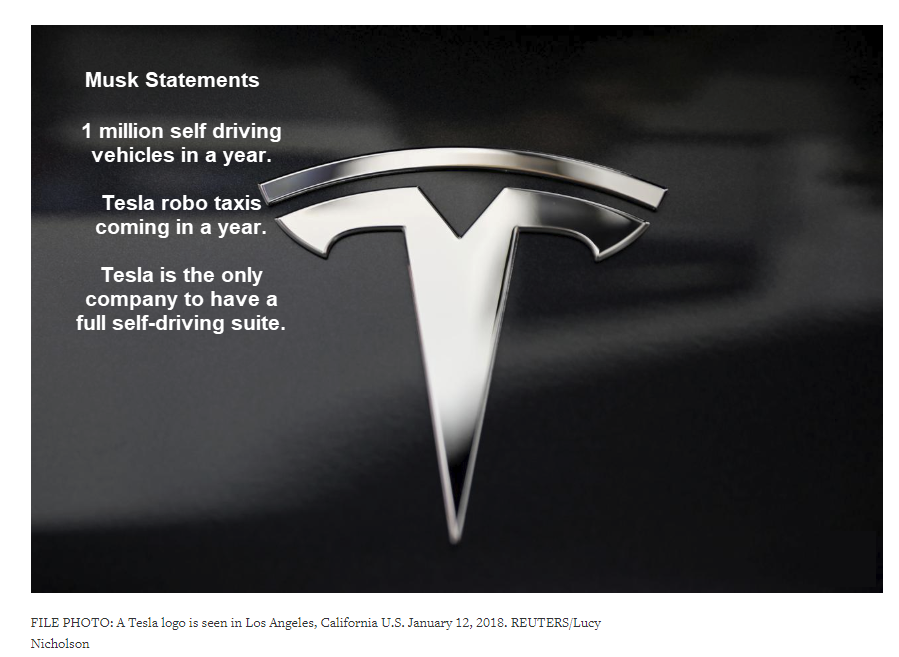
“The fundamental message consumers should be taking away today is it’s financially insane to buy something other than a Tesla. It’s like buying a horse,” saying Tesla was the only company to have a full self-driving suite of hardware.
“A year from now we’ll have over a million cars with full self-driving, software, everything,” Musk predicted.
Tesla Tracker

The above chart courtesy of Bloomberg’s Tesla Tracker updated April 22, 2019.
By sending digital requests to the National Highway Traffic Safety Administration website, we can get a good picture of how many VINs have been registered for Model 3s at any given time. We track the number of VINs between batch registrations and use the number of intervening days to estimate a production rate.
There are limits to this method. Automakers register VINs in large batches that anticipate coming production, which means that numbers will be assigned before a new car starts its journey down the assembly line. There’s theoretically no limit to the number of VINs Tesla might register in a batch.
Production vs Targets

Crash Record
Tesla’s crash record shows its software is not remotely reliable.
For discussion, please consider the LA Times report An agency hid Tesla crash data for nearly two years. Is that any way to build trust in driverless cars?
In May 2016, when Tesla’s Autopilot — a so-called Level 2 system that legally requires constant human attention — drove a car under a semi truck crossing the highway, decapitating the driver. NHTSA investigated the accident. The driver was inattentive, the agency concluded in a January 2017 report, and the Autopilot technology was not to blame — even though the system could not tell the difference between the silvery side of the trailer truck and an overcast sky.
In March 2018, after a Tesla driver was killed when Autopilot drove the car into a concrete barrier, Tesla posted a response on its website that included a reference to the NHTSA study: “Over a year ago, our first iteration of Autopilot was found by the U.S. government to reduce crash rates by as much as 40%. Internal data confirms that recent updates to Autopilot have improved system reliability.”
For the small minority of cars for which mileage data were provided both before and after Autosteer was installed, Teslas were involved in 60% more crashes, Whitfield [ R.A. Whitfield, director of Quality Control Systems Corp. and an expert in statistics] calculated. That could mean cars with Autosteer were more dangerous than cars without.
The exercise makes clear that NHTSA’s conclusions are “not well founded,” he said.
Tesla’s self-driving ability is behind Uber which in turn is far behind Waymo.
Musk’s claim that Tesla is the “only company to have a full self-driving suite of hardware” is absurd.
Elon Musk’s promises are a joke.
Mike “Mish” Shedlock






























Tesla’s claim is absurd
Mish, could you write up something on Tesla’s claim on fatality? Tesla claims that Autopilot is safer than human driver. That is almost certainly bogus. Their data is “correct”, but it does NOT count how many times the human drivers need to take over to prevent an accident. Yes, “Compared to the overall U.S. rate of one fatality every 94 million miles, Tesla claims that the Autopilot is 38 percent safer than driving without this feature.” It is 38% safer with Auto-pilot PLUS when the human is ready to take over. However, there is no statistics for auto-pilot alone.
I can’t get to NHTSA. Plus I also like to inform you & public that the forward collision warning system on Tesla will sound alarm ONLY IF your speed is accelerating. I tried testing its warning system by attempting to crash to front cars > 10 times at Tesla dealership. It essentially does NOT work. The test is repeatable (until Tesla updates their software). Just go into a dealer, and try any model 3. Pretty sure that model S/X are the same. I tested with an available lane to be changed to at the very last second. There was absolutely no way that the Tesla car can stop in time. However, its forward collision system does NOT sound any alarm. Therefore, I’m not surprised that in the recent fatality, the driver didn’t take ANY actions, because most likely no warnings were issued at all.
This all assumes there is enough copper left in the world to facilitate the electric motors and wiring of a million cars…
Wow. Really? You think the world will run out of copper? Please, use google to help you think before you post.
The last gasps of a company about to either go bankrupt or be bought out on very unfavorable terms. Holding equity in Tesla is moronic as the equity is near worthless. Sometimes It takes a while for the market to figure it out.
Lets have a serious discussion about self driving vehicles. For them to “work out” and become viable certain things have to happen: (a) legislation, (b) cost and (C) performance.
The first is obvious and since all car manufacturers are working towards self-driving, it will be the car lobby that pushes… the second I will leave for last, the third is performance. On average fatal accidents occur every 100 million miles — hey there are 300 million Americans so it adds up! Right now, autonomous cars are working out at about 200,000 miles between accidents (that includes where the “driver” has to take control of the vehicle), so we are looking at a 3 order of magnitude increase in reliability (again we are talking mostly of level 2 self driving right now).
Back to “2” the cost is almost irrelevant — currently, most cars (excluding taxis) are operated 1 or 2 hours a day. If you buy a $100,000 and divide by the number of hours used per annum, including maintenance and fuel etc, you get an hourly cost. However, self driving cars should operate more hours per day…that means that their hourly costs will fall — even if the car is $200,000, but if its used 6 hours a day, the hourly cost will fall dramatically.
Will Tesla be the one? Don’t know or care, but the reality is that every car manufacturer is working on the premise that it will because it provides them with price freedom!
As for Tesla — its not so important that it be the one that survives, you could make an argument that Apple could probably buy the company out of petty cash, that Tesla and Apple’s philosophy are well suited — you look at the interior of a Tesla (or Space X capsule) and the first thing that you think of is minimalist design. Still what is interesting with Tesla is that it is changing the way we think of vehicles. Less as an asset and more as a tool you “rent” when you need it.
Whitfield’s statement is startling. It comes at the end of a two year run of the Freedom of Information Act. If I were at the NHTSA or SEC, I’d be fully-occupied just now in understanding why Director Whitfield, a guy who knows data and how to slice and dice it, dared to make the statement that Tesla owners are paying more for a 60% HIGHER accident rate when opting for Autosteer.
This would seem fertile grounds for perpetual lawsuits for injuries and deaths, taking it out of the realm of just Elon off his meds.
Downhill mountain bikers pay 1000% more for a 10,000% higher accident rate than regular cyclists…. Those whose sole goal in life is to pay as little as possible for as low an accident rate as possible, is best off staying in bed with their helmet on.
Radar cruise and lane keep assist, significantly enhances the experience of longer road trips, while still keeping accident rates acceptable for many people. Lane keep can still get a lot better, and over time slowly will, but work well on properly marked divided highways and many other reasonably well marked roads. It gets tripped up when lane markings no longer match lanes, as is sometimes the case in construction zones etc. Over time, better “road-authorities to vehicle”, and “vehicle-to-vehicle” (crowdsourced) communication will very likely provide better heads up about where such areas are, such that the driver can take over until past the hard points. More precise road mapping and vehicle location will help as well.
The thing I find so interesting about Tesla is that most of the people who buy their cars are true believers in the company. They put up with a very high number of problems, and work their way through them, because they desire to be cutting edge—kind of like an enthusiastic beta tester who is honored to have the ‘first look’ at new technology. I’m sure it is partly a ‘style’ thing, that people feel special driving a Tesla. But style is fickle and lasts only until the next new thing.
I have also been amazed at the popularity of Land Rover, despite consistently having one of the worst reliability records in the auto industry. If people feel special driving it they don’t seem to mind taking their car into the shop all the time.
I’d bet that 97% of Tesla owners are Apple junkies.
And wear gray socks with Birkenstocks.
OT but related. Yesterday I found out about hedonic adjustment, the practice of reducing rising costs by factoring in some squishy accounting for technological advancements. So instead of the price of a new car rising nearly 30% or so over the last 10 years, the “adjusted price” is only 10% or less. Really? So because you can no longer buy a new Dodge Omni, today’s cars are actually cheaper than they were in 2000?
Bring on the self-driving cars! They’ll be cheaper than anything ever put on the road!
Suppose you went into the car dealer today, and they had a brand new, fresh off the assembly line car comparable to a mid 70’s car: no air bags, manual transmission, 70hp, carburetor, not that reliable, but easy to work on, probably AM radio, maybe had factory AC, 23 MPG around town, no computer, no cup holders, etc. What price tag would take to get you to consider buying it?
Ford would sell an even bigger truckload of F150s than they already do, if the lineup also included a mid 70s package for $3K… Mid ’60s for $2K even more so.
Not a direct analogy, but weight and accessories are closer to the 1970s econoboxes than today’s overweight, oversized, over-accessorized vehicles.
Remember the original Honda CVCC? It wasn’t much bigger than an Elio.
Honda CVCC was a motor that featured four valves per cylinder, and which didn’t need a catalytic converter. I think you mean the Honda N600 Coupe. By the way, the reason that Elio has only 3 wheels is because that technically makes it not a car, so it doesn’t need to meet safety requirements, including air bags. The original price for a 1971 Honda 600 Coupe was $1300. Using the CPI, that would be $8308 today, not far from the Elio at $7840:
Airbags and other safety equipment adds weight, lots of it. I’m not saying safety is without value (although there are diminishing returns after a certain point), but saying that they shouldn’t be included in the ever increasing price of automobiles because they somehow increase the subjective value seems like a great way to hide inflation.
Yet not accounting for it at all is dishonest as well. Back in the 70’s, a phone would have cost $30 and plugged into the wall. Is it reasonable to compare the price of that to the price of an iPhone, and call the difference inflation? That was why I asked what price you would pay for a modern car with similar features to an old Omi, or an old Honda N600. The answer tells you a great deal about which part of the price increase reflects price changes, and which part reflects a change in the underlying product.
I prefer the GDP deflator because you don’t need to concern yourself with that. If, on the other hand, you are going to use a CPI style index, to keep it accurate, you need to rapidly made changes in the product mix to reflect changes in consumer tastes, and you have to find a way to account for improvements (or decreases in quality) in the underlying product.
Comparing Apples and oranges (sorry, couldn’t resist). What we call a phone actually has more in common with a programmable pocket calculator of the day.
Note the cost of the HP 65: $795 (in 1974). Inflation adjusted price: $4,099!
Haha, yes. I had numerous programmable HP calculators, back in the day. I didn’t have a 65, though. I think i had a 55, though. And the HP 12C (which I still have) and the HP 16C (which I seem to have misplaced over the years) were both programmable, and I actually used to program them to do various things, though for the life of me, I can’t remember what.
To show the connection to the Phone, i have very few apps on my phone, but i do have a 12C emulator on it. I think the better comparison to today is, not to phone, but to a laptop or tablet. It could do the computation, but it couldn’t communicate. Even there it was more limited as it couldn’t deal with text.
It also goes to show the futility of trying to maintain a CPI style index, and to keep it “accurate”.
Humpty-Dupmty style Newspeak, allowing Dear Leader to arbitrarily “adjust” the “reality” his underlings are told that they perceive, is the fundamental pillar upon which the progressive delusion is built and maintained.
Once you start looking at measures which are harder for the Party to just arbitrarily “adjust” and fake, pretty much nothing at all lines up with what the propaganda ministries preach anymore.
Remember, the purpose of the Fed is to bail out the big banks after they have inflated their favorite asset(s) through reckless lending. However, the price they pay for this privilege is they must give all the money our politicians want when they ask for it. Well, any fool could tell you that creating money from thin air and handing it over to spendthrifts will devalue the money (i.e., cause inflation). So, the solution is to announce that inflation is actually good and then proceed to measure it in a screwed manner, so that we never have quite enough! The Fed is correct when they say our dollars buy more today than before. The difference is that this (i.e., deflation) is great news for everyone who doesn’t make a living off the money scheme, whereas the Fed looks at it as a concern and an excuse to continue their currency devaluation practice.
“Your faith in self driving technology is surpassed only by you’re hatred of tesla and elon musk.”
I do not hate either Musk or Tesla. Both are best viewed as a joke.
Short sellers seem to like Musk and his company these days. Are they right? Only time will tell.
Your faith in self driving technology is surpassed only by you’re hatred of tesla and elon musk.
If not, then what would change your mind that Tesla is ahead of competition in autonomy? Obviously no other manufacturer (even Waymo) has a commercialized product that stands even close to what Tesla has today.
Should we assume the W in your name is short for Wagner?
send me whatever you want – I have never seen so many complaints about a car ever. Perhaps you are lucky and got a car produced well. This guy has never met a promise. Debt will eventually kill the company.
” I have never seen so many complaints about a car ever”
Do you have real quality statistics to back that of? Or you are basing your opinion on social media unverifiable posts? Just saying
“This guy has never met a promise.” Well, I don’t know about that. His promise of a future of electric cars (may be no Tesla’s) it is coming to fruition. The thing that Tesla did was to carve a new path into a future of electric cars. In other words it took them out of the lab into the real world. Just like SpaceX is doing to space exploration. I still remember when I criticized Trump for being a failure in business (serial BKs) . I was told: Well he is a billionaire are you? So I must ask Musk is a billionaire several times over are you?