

Global Leader
The US is the global leader in Green New Deal nuttiness both on the number of advocates and the cost of the proposals.
We have AOC, Elizabeth Warren, Al Gore a a field of Democrat candidates all of whom have their eyes on your pocketbook with schemes to save the world.
For example, please consider AOC’s Green New Deal Pricetag of $51 to $93 Trillion vs. Cost of Doing Nothing.
UK Attempt to Catch Up
In the UK, the Labour Party, proposes being completely carbon free by 2030, in little more than 10 years.
Jeremy Warner rips the idea in Labour’s Green New Deal? No, Just Puerile, Delusional Nonsense Dressed Up as Industrial Strategy.
Warner asks “Have these people ever been to that great, centrally directed communist utopia China, now adding to the world’s carbon footprint at a rate unprecedented in the history of humanity?”
Labour also wants to spend £250bn on loft insulation, double glazing and renewable, low-carbon technologies in all the UK’s 27 million homes at an average cost of £9,300 per house.
After blasting the absurd nature of those ideas, Warner then offers his own set of nonsensical ideas.
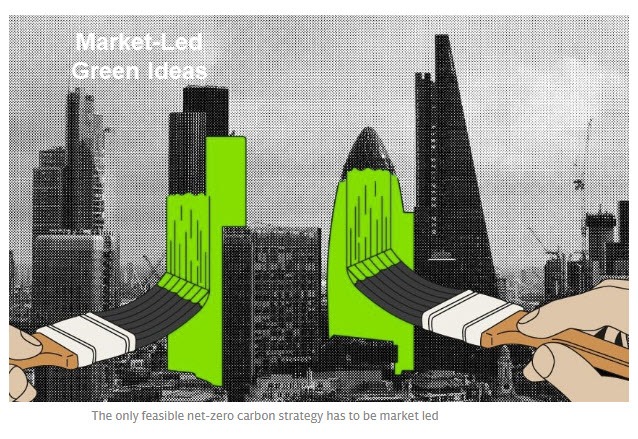
Decarbonization Perfectly Feasible
“Decarbonisation of the UK economy is perfectly feasible, but it has to be done in a market driven way by removing hidden hydrocarbon subsidies and the imposition of revenue neutral carbon taxes, backed by carbon tariffs to prevent rival economies undercutting UK producers,” said Warner.
Got that?
Carbon tariffs on China and carbon taxes on those who utilize carbon will allegedly make decarbonization “perfectly feasible”.
In a way, Warner’s idea is far worse. This is why:
Whereas few would be stupid enough to actually try to decarbonize by 2030 or spend $51 to $93 trillion to save the world from sure destruction in 10 years, many people would be stupid enough to try Warner’s non-market-driven, nonsensical proposal.
Delusional nonsense dressed up indeed.
Mike “Mish” Shedlock






























Love Mish’s analytical approach to Labour’s ideas – scientific and economic terms like nuttiness, delusional, stupid, & nonsensical are so useful when trying to dissect an already misrepresented branch of climatology as well as explain the benefits of ALL countries contributions to a solution (and, of course, the UK’s zero power to significantly alter carbon emissions in China).
All naysayers bleet loudly here in fear of change, but not a single one of those has a single idea, not a single solution to offer. If you don’t want your DNA to survive though the next few decades do nothing, but at least get out of the way of those actually doing something. I worship mother Earth because I can prove she exists, and gives all of us life. If only the rest would care about her all of our lives would be better. Whale oil merchants ballyhooed like y’all when change came too.
While there are many new and exciting ways to recycle and cut energy waste it seems public officials are almost afraid to talk about conservation. It is as if they will offend someone or that big business and their lobbyist have made this subject taboo.
The fact is a lot could be done at little cost. While it could be argued that cutting back on waste would lower the GDP it would have many positive benefits such as improving our standing in the world community. The article below delves deeper into the dreaded “C” word, conserve.
Climate “scientists” and their Malthusian death cult fellow travelers have been SURE the world will end in ten years time since the late 18th century. Here are examples. https://www.youtube.com/watch?v=1dNYtcdX3Io
Actually, a revenue neutral carbon dividend (complemented by import tariffs on embedded carbon, which would persuade the exporter to collect a price for it before export) is what experts have been advancing for 4 decades as the best way to unleash market forces and tilt the playing field in favor of encouraging alternative energy. Not doing so treats eventual costs as an externality which we are pushing onto our progeny, without amortization, possibly treating them to sudden ecological bankruptcy greater than all the money in the world.
Of course this crowd is going to crow that the chances of said bankruptcy to occur is less than the chance of your house catching fire outside of California, for which eventuality you purchase fire insurance. And ignoring the fact that one day our progeny may have to substitute all exhausted natural resources (including fossil fuels) in the solid religious conviction that the market is Providence.
Alex Epstein just debated Robert F Kennedy Jr about fossil fuels. Alex starts at 27 minutes. https://youtu.be/IyDpf_GpEW0?t=1656
“We have AOC, Elizabeth Warren, Al Gore a a field of Democrat candidates all of whom have their eyes on your pocketbook with schemes to save the world.”
Nothing to do with saving the world. Totalitarianism is about power over others.
Ron trying to do something, anything to repair the damage from idiots poisoning the planet for profits is a good thing. This has nothing to do with totalitarian government. It amazes me the BS fearmongering the capitalistic pigs produce.
Meanwhile, back at reality, U.S. CO2 emissions have dropped to 1992 levels due to fracking freeing up enough natural gas to make it possible to switch from coal. This all thanks to technology, enabled by capitalism.
Nonetheless, nuclear, the only viable path forward out of fossil fuels, continues to be hysterically resisted by the new AGW Earth-worship cult and the largest utility in California resorts to rolling blackouts for a decade due to $2.2 Billion annually having been diverted from line maintenance to rent-seeker maintenance and tree hugger growth.
I knew this green stuff was political crap once I read how biomass energy is basically burning trees. But according to Paris Accord, burning trees is ‘carbon neutral’.
Well, I agree with the BS about biomass, but dissing a single policy distortion does not translate very well to “this gree stuff is political crap”.
It’s a massive one, and not the only one. https://www.rainforest-rescue.org/topics/biofuel
Market heading up. Yield curve no longer inverted. Grumpy, old kibitzers speechless.
Not Powell though. Neighbors say they heard a man yelling from his bedroom late last night “WHO just saved the freaking WORLD baby?!”
Apparently, $60B to $100B per month in new credit is still enough to buy some people bonuses.
With historically low rates and enough intervention the jawboning will continue. <2% growth means more jawboning.
This coming from the guy who thinks self-driving cars will be here tomorrow. Always tomorrow, right Mish? How come you never addressed Wozniak’s change of heart on the subject? He’s someone a lot closer to the ground game on the topic, and he said it won’t happen anytime soon.
If you want to reduce carbon emissions, there is only one rational way. Government can never do anything but fester fraud by trying to fund green options. The only rational thing is to tax carbon emissions, and let the free market sort do what it does best, sort out the things that will actually work to reduce carbon emissions. What should government do with the tax receipts? Flow them back into the economy, of course, by reducing other taxes. I would suggest a uniform tax credit, say a $2000 per person credit, with a carbon emission tax that would average the same.
Obviously the tax would appear as a price increase in all products, but ones that use the most carbon would be harder hit than others. Using an overly simple example, with one product, and one tax, let’s say that the average person uses 1,000 gallons of gasoline a year, and the tax goes up by $2/gallon, but the person gets a $2000 check. Is he worse off? No. Will he just keep buying 1,000 gallons of gas? He could. Or, perhaps he will make some changes, say, driving less, or getting a more efficient car. In that case, he’ll be better off.
In the end, government doesn’t spend anything, and yet the carbon emissions go down. You don’t have to blow up the budget to accomplish what you want.
“tax carbon emissions, and let the free market”
“free market”? You keep using that word… A carbon tax is the opposite of keeping the government out of the economy.
The free market works exceptionally well at allocating resources, and is far, far more efficient than a planned economy. However, it ceases to work when the resources are not priced appropriately. Thus, suppose no value is placed on “public resources”, such as health, clean water, clean air, etc? Then the free market values them at zero, and since have have no value, businesses use them up until they are gone. But, then, with health gone and no clean air and clean water, society must pay in other ways. Is that an appropriate or efficient solution?
To avoid that result, you have two options. The first is for government to engage in a planned economy, i.e. they regulate. They place specific limits on who can do what. The result is a cleaner environment. Is it the most efficient way to achieve a cleaner environment? Perhaps it is, if the regulators are infinitely wise, and can determine the optimal solution. The second option is to place a tax on using the resource, then slowly you raise the tax until you achieve the desired goal, a cleaner environment. In the second case, the businesses that have the most expense in cleaning up continue to pollute (though probably at a reduced rate), but the ones for whom cleanup is easiest clean up even more than they would under a regulatory system. The result is an environment that is cleaned up at the lowest possible expense. Also, the first solution, regulation, increases government burden on the economy, while the second solution, using taxation to place a cost on a public resource, produces revenue, reducing the need for other taxes.
You get into these issues in other areas, too, with essentially the same three options. For example, let’s consider cigarettes. The three options:
How do you propose taxing carbon emissions? By taxing gas bought in San Diego, but selling a product made an inch south of the Mexican border during a southerly, whose production took more fossil fuels to make, tax free?
While no approximation is perfect, (nor honestly close enough to have any business being used as an excuse for “policy” in any society aspiring to something even resembling freedom), few if any easily measurable quality track total economic activity, hence total spending, as well as total energy consumption.
Ultimately, the cost of an end product, with all the intermediate stages as well as complementaries it presupposes factored in, rarely strays too far from the cost of the amount of energy going into it’s creation. So, you could just levy a tax across the board, on all and every good and service, and you’ll do as well as you could wrt Global emissions of CO2 as possible. Since CO2 is pretty much just a measure of energy usage.
Which would work. After all, since activity, spending hence wealth ultimately boils down to energy access, making people less wealthy will make them able to consume less energy.
Stuki, you are correct that it is not an easy thing to do. That doesn’t mean that the best solution is to ignore the problem. Nor does it mean that the best solution is to regulate. The best you can do is to try to estimate the costs, and use a tax to approximate it.
The best you can do, is to not interfere in the lives of others on the basis of “I don’t know anything, but “we” must do something!”
I would agree with that but it is certainly possible to try to compute a cost to society for things that harm the environment. It may not be exact, but it will be closer than if you just ignore it, and the resulting solution that the free market finds will be less expensive and more efficient than if a bunch of regulators just tell people what to do.
Unless you 1) Know for sure something obviously, without any doubt whatsoever, “harms the environment” in a darned near universally recognized way, 2)Can compute how much so, with a great degree of accuracy and 3)can fairly cheaply assess the costs of all proposed efforts at mitigation; all you end up doing, is subsidizing and underwriting lobbyists and “look at me! I’m famous!” pseudoscience peddlers bent on influencing your guesses at the above three, for their own benefit.
When you have no idea about something, the only way to get a better idea, is not only to run the experiment, but in fact encourage as many independent and differing experiments to be ran as possible. IOW, just sit back until you do know the above three for pretty much sure. Then there is no longer much of a debate as to what, if anything, harms “the environment”, to what extent, and the costs of various mitigations. Kind of like the situation is, wrt locally warming Times Square by dropping massive amounts of burning Napalm there on New Years Eve: There simply won’t ever be much of a constituency for denying the “science” that the resulting “Local Warming”, is worth “doing something” to mitigate.
I think we agree more than we disagree. Some forms of harm to the environment are fairly apparent and easy to assess, such as solid waste, water pollution and air pollution. Yet, even with these, we don’t simply add the environmental costs to the system, and then let the free market solve the problem. Instead we take the regulatory approach, which is more expensive and less efficient.
The reason regulation is always the preferred solution is because the regulatory system expands government, and puts money in the pockets of lobbiests. Since government regulations “solve the problem”, politicians can claim credit. If they added in the costs, and let the free market solve the problem, then businesses would claim the credit, and what would get politicians re-elected?
As far as CO2, if you go back to my original post, I began “If you want to reduce CO2 emissions…”. I did not say “You want to reduce CO2 emissions.” I was simply pointing out that it is always much more efficient to tinker with the system and let the free market solve a problem than it is to over-ride the system with regulations. Don’t worry, I recognize the futility of my post. We will not adopt a free-market solution. For the reasons I gave above, it is inevitable that we will go with regulation instead. Besides, with regulations, you don’t need to justify a “cost to the environment”, you can just wing it, and make up rules that “sound good”.
off topic….but it s about the UK anyway…..Happy faces this morning on CNBC as the BOE might cut rates because of ‘uncertainty’….1% something is of course way too high an interest rate in this insane economic environment …
There isn’t enough money in the world for these nutty ideas. AOC and others live in an alternate universe where the world ends in 2030.
I remember bumper stickers more than 40 years ago that read, “Split wood, not atoms.” Now those very people don’t even want us to split wood. Talk about moving the goal posts
the greens rejection of nuclear power shows their real agenda
world communism
How does rejection of the most deadly form of energy production, in any way communism? Chernobyl is communism!
Seems the text seems OK when writing and when pressing the ‘submit’ button it becomes one big mess…
“Labour also wants to spend £250bn on loft insulation, double glazing and renewable, low-carbon technologies in all the UK’s 27 million homes at an average cost of £9,300 per house.”
Remembering how I was freezing in some house visits while in UK, I see this as a very sensible idea. Most old UK houses have single glazing and are leaking from every corner. Fireplaces are not the type that store energy and only 5% efficiency (Heat storing ovens can be as high as 70-90% efficient depending the moisture% of burning wood).
9300 pounds per house could be probably the best investment in the long term. If the energy used for heating could be cut in half the yearly saving could be around 1000-2500 pounds a year (average 120m2 house with electric heating uses around 23000 kWh/year).
Not all ideas are to be doomed. I suppose best approach is to demand upgrading when the properties are renovated. Not at one go.
Insulation etc, may be a very good idea. The bad part of the labour party proposal is who pays for it. It should be up to the homeowner to pay for their own benefit. It is simply wrong for someone who has already sorted their home out insulation wise to then have to pay for others to do the same when they have blown their own money on who knows what in addition to their extra heating costs.
It’s well known that conservative thinking prioritizes a sense of fairness over other things, and often that’s ok, but where it fails is at the societal level. So at a micro view, it’s not fair to make people who already fixed their insulation help pay for people who didn’t, but at a macro view, by paying to help the scofflaws, they’re actually helping themselves and their own progeny by acting to curb harmful climate change. It’s the big picture where conservative reasoning doesn’t work well. They get so hung up on interpersonal fairness that they are willing to cut off their nose to spite their face.
Well, I am in favour of putting conditional renovation permits to encourage this kind of development. Not forcing anyone to do it on a short notice or putting the tax money on it. Also, educating people more on the benefits of improvements and related costs/benefits could be on government agenda.
If you let people build houses like they build cell phones, uncomfortable houses are a thing of the past in no time. As is “unemployment.” Noone clings to outdated cellphones, nor “need” government grants to keep them functional, after all.
Now, if you do live in a dystopia with a population so indoctrinated, and so utterly devoid of even the remotest traces of economic literacy, that zoning, land use and building restrictions are a given, then there really is no negatives, and lots of benefits, accruing from mandating upgrades costing all the way up to the nominal cost of current dwellings, minus the cost of physically erecting a structure of similar quality “next door”.
In most places in the West, at least anywhere near population centers, as well as in desirable rural areas, thanks to the above mentioned near universal economic illiteracy and the obsession with totalitarian “Dear Leaders” and wealth transfers by legal dictat this results in, that delta; between nominal price and cost to construct; is massive by now. With every penny of it, representing nothing but crass, totalitarian government facilitated theft.
As long as a falling down shoebox in San Francisco sells for $10 million, a totalitarian government mandating even $9million in upgrades in exchange for letting the owner live another day, would still not cross the threshold into net economic inefficiency of capital allocation. (Of course, in practice, falling down shoeboxes would no longer sell for $10mill if they came with a requirement to turn them into $10million worth of actual building mass……., but at some price between the cost of construction and the current cost made up solely to facilitate crass theft from productive people to idle, connected leeches, an equilibrium would be arrived at.)
Germany, pre the ECB going completely insane in 2010, was a decent example of this kind of “two economically destructive, totalitarian policies somewhat cancelling each other out” wrt housing. They did, like the rest of the West, keep all manners of illiterate building restrictions in place, but also mandated very high building standards. For new construction, and also for all upgrades and renovations. So while you still had misallocation to some extent, at least the additional misallocated, stolen money bought something, anything, of value, in the form of improved quality of the building mass.
As opposed to in the Anglo countries, where the theft is instead being handed over darned near 100% in exchange for absolutely nothing, to purely idle leeches. You can still see remnants of the “success” (relative….) of these policies, in the general quality of the German building mass compared to in Anglo countries, in the sophistication of German building industries and tool suppliers, in the wages and employment of German tradesmen and tool builders etc., as well as in how German housing costs did not rise appreciably for decades leading up to 2010, keeping German competitiveness across the board strong, by sparing productive Germans from having to spend half their earnings subsidizing idle leeches (They were still subsidizing, but at least the ones they subsidized were building something of high quality. Not sitting idly on the couch guessing random numbers and cheering for totalitarian government to make their neighbor’s children as homeless as possible.)
Of course, once the ECB caught up to, and even blew past, The Fed in wealth transfers to idle leeches, things aren’t looking nearly as rosy in Germany anymore, either.