

Am considering taking Tesla private at $420. Funding secured.
— Elon Musk (@elonmusk) August 7, 2018
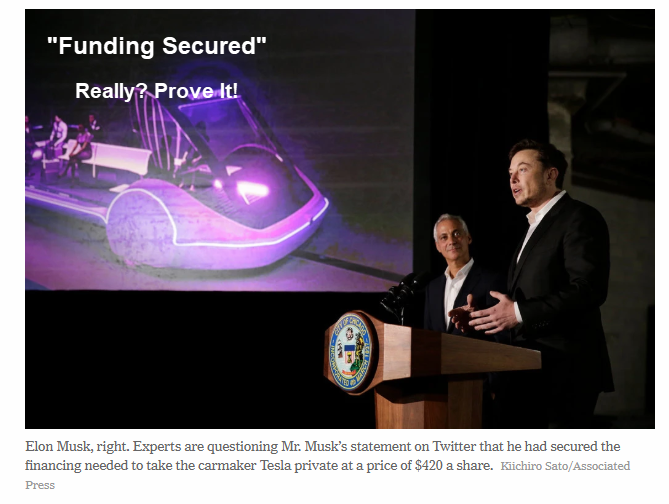
“Funding Secured” is a material statement that can affect stock prices. It better be true.
The New York Times asks Did Elon Musk Violate Securities Laws With Tweet About Taking Tesla Private?
Mr. Musk’s audacious offer to take private Tesla, the innovative auto company he founded and leads as chairman and chief executive, will surely go down as one of the most unorthodox takeover bids ever.
At two sentences and just 53 characters — “Am considering taking Tesla private at $420. Funding secured.” — it was probably the shortest offer ever. (General Motors’ prospectus in 2010 was over 230 pages.)
Mr. Musk offered no basis for the $420 offering price, which would ordinarily be arrived at after reams of analysis by investment bankers and negotiations with a committee of independent Tesla directors.
It was Mr. Musk’s “funding secured” statement on Twitter that may put the iconoclastic founder most at risk. He provided no details about how much funding had been secured, from whom or under what conditions. His email to employees did not mention anything about the funding.
“That’s a clear factual statement,” said John C. Coffee Jr., a professor at Columbia Law School who specializes in corporate law and securities fraud. “If it’s not fully secure, that’s potentially a very material misrepresentation, and a very straightforward violation of Rule 10b-5” of the securities law — in short, securities fraud.
It is illegal for a director or officer of a public company “to knowingly or recklessly make material misstatements about that company,” said John Coates, a professor at Harvard Law School who teaches mergers and acquisitions. Mr. Musk’s “tweets seem cryptic at best, and it is hard to see how he has complied with his duty to not be misleadingly incomplete.”
Even at a time when Twitter is the preferred medium for presidential communiqués, this is no way to commence a takeover bid. “It’s crazy,” Professor Coates said. “If I assigned this scenario to my students, the list of legal issues would fill many pages.”
For one thing, it is doubtful that a private Twitter account provides adequate notice for a public announcement of a $72 billion deal that is likely to move a stock’s price. (By the end of the day, Tesla shares had shot up over 10 percent.)
Mr. Musk has also put the company itself in an awkward situation. “If I were their lawyer, I’d tell them to have an 8-K filing at the S.E.C. the first thing in the morning,” Professor Coates said, referring to a regulatory filing used to disseminate information that may be important to shareholders. “It needs to explain if this was a joke or a mistake, and if not, what he really meant.”
Largest LBO in History
Bloomberg discusses the math in Musk Mulls Taking Tesla Private, Valuing Company at $82 Billion.
At $420 a share, Tesla would have an enterprise value of about $82 billion including debt. To take it private, the billionaire would have to pull off the largest leveraged buyout in history, surpassing Texas electric utility TXU’s in 2007.
The buyout is “highly unlikely,” said Joel Levington, analyst at Bloomberg Intelligence. “Funding $50 billion plus for a negative free cash flow business would be difficult, if not extraordinary.”
Yesterday, I wrote Private Lies: Musk Tweets He Will Take Tesla Private.
He better be able to prove his statements, and soon.
Mike “Mish’ Shedlock






























The largest buyouts so far have been ~$25-$30B and they were funded mostly by debt with ~$10-15B equity checks. This would be a ~$75 billion buyout and I doubt leverage would increase dramatically as the company has negative cash flow. In fact, Tesla has negative Operating cash flows before capex and debt repayment. Therefore, the equity check would be at least $50B. Who’s going to make that investment? BTW, many of the record setting buyouts either went bankrupt or went through a period of financial distress (TXU, Hyatt, EOP…). Tesla won’t go private unless the valuation is <$50B which means the equity value gets cut in half from here.
I wonder if Elon picked his imaginary $420 number because that number has special significance to a certain group of people? Later he’ll probably say “I was obviously just joking”.
Obviously Mr. Market does not believe Elon’s claim of buying out at $420, otherwise the stock would be $420 right now. Seems Elon actually gave new shorts a golden opportunity (if you can find any shares available to short).
FASB was told by congress to allow banks to lie about the value of their assets. The current bull market began immediately after. Why is Musk being held to a different standard than the banks?
Elon’s desire to engage in a LBO to take out existing shareholders would be monumentally stupid. With negative earnings and a $370 share price, TSLA’s equity is the cheapest component in the company’s capital stack. Replacing the no cost equity with higher yielding debt would ensure that the company would never earn a dollar of profit and would likely see the company end up in bankruptcy. If anything, TSLA should be issuing more equity hand over fist at the current share price.
Taking TESLA private reduces liquidity in the financial system. It’s going to take more effort than a mouse-click to sell Tesla shares once delisted from the stock market.
I would be very surprised it the race to the courthouse hasn’t already begun. I would expect to see at least a couple class action suits filed very soon, then merged into one. They just need to find some people that lost money as a result of the tweet, which won’t be hard to do. The case should be a slam dunk.
Interesting article regarding this topic:
As I’m no lawyer, I can’t speak for how securities law is interpreted; but I’m personally sad that off the cuff remarks on Twitter isn’t literally protected by free speech; no matter who is making them. It’s simply pointlessly restrictive if people, including Musk, isn’t allowed to “think loudly” about things that concern him, without him doing so being construed to be formal communiques about intended serious actions.
Kind of like interpreting every utterance by someone of: “I’m gonna kill that MF’er” as a serious death threat.
Most of what people, at least those not unusually dour, say, is just casual banter. Ditto catchy Twitter punchlines. It isn’t that hard to differentiate between a hipfired tweet, and a serious communique.
Fraud is an intentional misrepresentation of the facts. If he told the truth there is no problem. However, saying “funding secured” as the CEO of a company when the stock price is well below the stated price to go private can reasonably be expected to move the stock price. As expected, the price moved. If he was lying about the funding, many people are likely to lose money as a result of the lie, whether long or short. He should have kept Tesla private if he wanted to discuss the company publicly in this manner. Free speech does not extend to fraudulent manipulation of the share price of your company. The funding better be secured.
It’s hard to “misrepresent” anything, when you’re just mindlessly bantering about, without even much of a concern for “facts.”
For misrepresenting to even possibly occur, one would first have to be in a venue where there some expectation that what is being thrown out there, is intended to represent anything seriously vetted for factualness to begin with. One liners on Twitter doesn’t even come close to that. Just as banter about kicking ass and killing someone, when playing a game of pickup basketball, doesn’t either; even if some woman may “lose money” by acting as if she will soon receive a life insurance settlement s a result.
Free speech refers to free speech. There are pretty clear definitions of free, as well as of speech. No amount of Newspeakian “but thiingz aaare diiiiferent thiiiiiz tiiiime” changes that.
Which is exactly why societies have gone through the trouble of creating limited, specific venues where what people say are held up to higher standards. Written, legal contracts being the most common. Priests when wearing specific garb signifying they are now speaking on behalf of the Church another. People speaking under oath, etc….
The fact that some rocket scientist, or Musk, may trow out there that he has found a cheap way to get to Mars safely, doesn’t mean he’s misrepresenting any facts. As he isn’t representing anything.
If, OTOH, he is saying so under oath during a Senate hearing, things are very different.
In the latter case, someone who heard them, then went out and spent a fortune on preparing some Martian business, may have a case for complaining about them lying.
But in the former case, of “but he works at/is an officer of a Space company, and said ‘I’ve got it’ during a party. Na-na-na-na-na-na, he didn’t say ‘I think I got it,’ but ‘I got it’ so he lied!!!”…. not so much.
Twitter oneliners are much closer to the latter than the former. And the fact that it is not treated as such by everyone, is really just another sad example of far America has fallen. From a country vested in the ideals of freedom, to one where petty rats get to run around and drag people into court on no more than cheesy, childish, simpletonian “look ma, I got him!”, “he said the F word”, “he told a lie” nonsense.
While free and speech are easily defined, the right to free speech does not extend to spreading lies that damage other people for your benefit. Musk and Tesla clearly benefit from a higher share price, while investors short the stock lose if Musk was lying.
Musk’s right to free speech means he is allowed to rant and state personal opinions, he just can’t make factual statements about the public company he runs that are untrue. He didn’t say, “I think if Tesla went private a fair price is $420.” That is an opinion. Saying he may take Tesla private at $420 “funding secured” is much different. Any reasonable person is going to think that will impact the stock price and it did. If Musk wants to acknowledge he is crazy and his Twitter ramblings should be ignored, maybe we should give him a pass, but I don’t think he’ll agree to that. Everyone is entitled to their own opinion, they are not entitled to their own facts. That is why opinion is protected as free speech, but intentional misrepresentation of facts that damages other people (such as stock price manipulation) is not protected. Musk has absolute freedom to tell the truth, which is why, for his sake, the funding better be secured.
The stock went up 10% on the news. Clearly, a lot of people took his tweet seriously.
Good thing you’re not a lawyer as you would likely be a terrible one. I can’t see how anyone could be so blind as to why a CEO shouldn’t be allowed to post things such as this without anything to back it up.
Those Tesla shareholders that will want to participate in private Tesla won’t need to be bought out at $420. Including Musk himself who owns ~20% and is not selling.
So in reality less than $72B will be needed of the whole secured amount.