

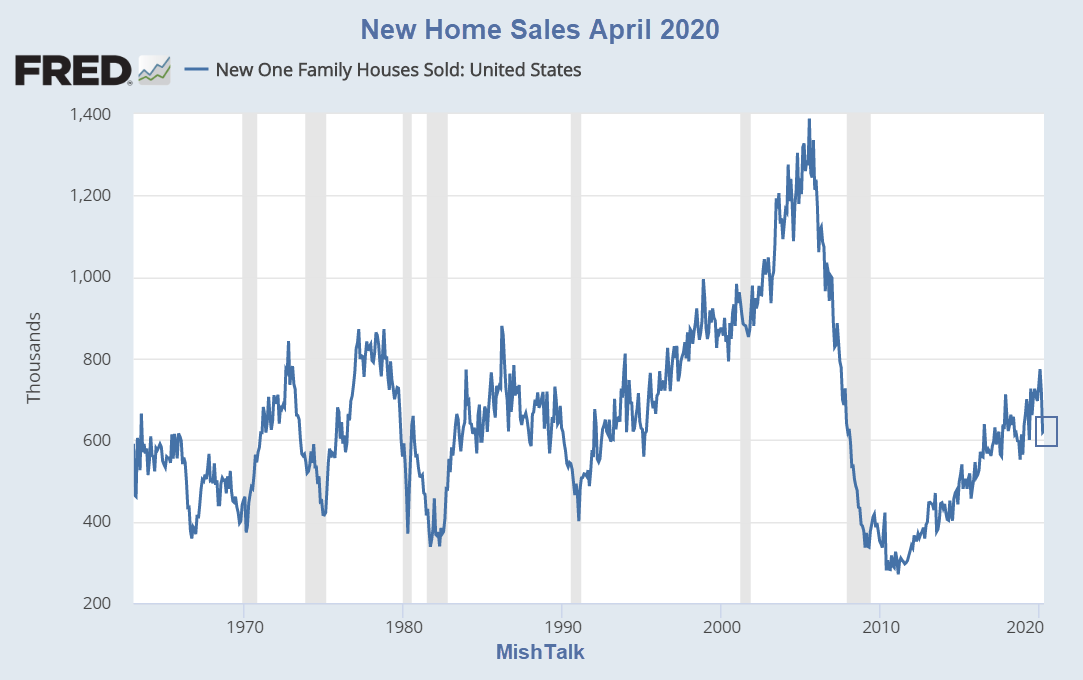
The U.S. Census Bureau announced new residential sales statistics for April 2020.
Key Statistics
- New Home Sales Sales: 623,000 at a seasonally adjusted annual Rate (SAAR). This is 0.6 percent above the revised March rate of 619,000, but is 6.2 percent below the April 2019 estimate of 664,000.
- Sales Price: The median sales price of new houses sold in April 2020 was $309,900. The average sales price was $364,500.
- For Sale Inventory and Months’ Supply: The seasonally-adjusted estimate of new houses for sale at the end of April was 325,000. This represents a supply of 6.3 months at the current sales rate.
Revision Notice
With this release, seasonally adjusted estimates of housing units sold, housing units for sale, and the
months’ supply of new housing have been revised back to January 2015.
March Revision
The Census Bureau revised March from 627,000 units SAAR to 619,000 SAAR. Factoring out the revision, sales fell by 0.6%.
Let’s call the whole thing “essentially flat”.
New Home Sales April 2020 Detail

Expectations Crushed
Bloomberg Econoday economists missed the marke badly this month.
The consensus estimate was 495,000 SAAR.
Stocks are flying on this “beat the street” performance. The Dow is up 2.7%, the S&P 500 up 1.9%, and the Nasdaq up .7% as of Noon central.
Mish






























Combine this upbeat news with all States opening up one way or another. As I talk to others, I’m hearing a lot of people who are ready to go out to as many public places as they can.
Home Sales. Have you fled Illinois yet, Mish? Compare https://seekingalpha.com/article/4349885-arrival-of-unavoidable-pension-crisis for the fine shape Illinois is in.
Seasonal adjustment or Coronavirus adjustment.
Is there anyway to get non adjusted numbers?
Prices are up. 65% of America owns homes (or a mortgage) and that’s all people care about. The Fed will always prioritize homeowners over renters.
Not just 65% of Americans. Many properties are owned by REITs. The TBTF kind. Housing prices will hold.
That’s guaranteed in the short term. With loans available to any corporation at rock bottom rates the REITs will buy up housing like crazy.
I would argue though renters are more important than home owners at this point. With the large amount of our housing being rented, if rental rates start to fall because of lack of qualified renters so goes with it the housing market as investors start to sell. It will be a trickle at first but could turn into a flood.
If the credit market tightens further this will be even more pronounced because of tightening volume of buyers that are not investing.
I believe that rents will not fall for lack of qualified renters. The residential RE market does not operate on supply and demand as textbooks tell us the rest of the economy does. Landlords have fixed overhead that is HUGE compared to most businesses that have a lot more categories of overhead and thus more places they can make cuts when demand hits a rough spot. If demand starts drying up for landlords they have no choice but to raise rents on those units that are occupied in order to generate the revenue they need to remain a going concern. So it is one sector of the economy that not only does not respond to supply and demand in the intuitive way you think, it is actually the opposite.
If landlords are convinced that there will be serious demand disruption that threatens their business and ability to pay the overhead they will not just rent empty units at a lower cost that does not support their own costs, they will sell the units. There will always be a buyer for their RE out there at a given price level, and they simply would lower the price to attract offers if they can’t get the original asking price. That does not translate to lower rents, the new buyer would simply be able to stay afloat even with the empty units, even if that is speculated to be a temporary situation, they will run the losses till the economy recovers. Having bought the units at a discount they can afford to do that.
What I am saying is that RE owners can/will take a temporary hit to the unrealized new values on their properties as long as they can, but once the property is threatened say with foreclosure because the rental income is insufficient to cover the mortgage they will sell at a discount rather than have their credit impaired. The new value remains unrealized till sale of the property. When they do sell at that new value the new owners will not lower the rents to reflect the lower amount paid just because the mortgage payments are lower than the sellers were. After all it was the lower rental revenue that drove the sale in the first place, so the new owners will keep the rent steady (or raise them) till they can remain solvent given the lower occupancy rate.
This is all because the renters of a property are the ones actually paying the mortgage if any on the property, the taxes and insurance, the upkeep and any profit the landlords are making. In fact what most people don’t know is that renting out residential real estate has traditionally been a negative cash flow business. Landlords try to have rents cover the hard cost overhead they can’t get out from under, but rents rarely have been enough to pay all expenses related to the property and a profit. Instead the total return to the owners is the rents plus the capital gains plus the tax advantages, like deductions and depreciation.
We have seen governments gut the tax advantages, and capital gains are now known to be vulnerable, RE does not ALWAYS rise. Though we now have values above the pre GFC peak it is not a guarantee they are going to bet all their capital on.
One thing I noticed when I returned to the US from Ireland was that these days rentals are being expected to make an actual positive cash flow, or a lot closer to it. And I know the town I just left to move to Florida saw a 90% increase in rents between 2013/14 lease period and 2019.
The other relevant aspect of this market is yes some people can move out of their rentals in with Mom and Dad in an emergency, and a few will have to just go homeless, or couch surf till nobody welcomes them in anymore, but the vast majority of the market is one of the least elastic for demand there is. Even food is more elastic because someone will feed you for free before watching you starve, food banks, missions, but nobody will house you if you can’t afford it. If they did we would not now have millions of long-term homeless. Yes a few can qualify for HUD section 8, usually the very (and permanently) disabled poor, and unmarried women with minor kids. And even then the waiting list can be many years.
I say the overall effect here will be rents will either remain stable in most markets or rise. The higher the proportion of renters in a given market the more rents will have to rise to cover expenses of landlords. Basically markets that were already hot and rising/high priced, like LA and Denver, will have to rise more. And just to guarantee that happens some landlords will sell, units will leave the market, that means lower vacancy rates, that means higher rents, it is self reinforcing. Even when real estate values/prices cratered in the GFC rents did not go down. In fact they went up because millions were thrown out of homeownership and the demand rapidly rose for rentals.
Let’s call the whole thing “essentially flat”.
…
Go back further.
New home sales adjusted
March report:
January … 777K
February … 741K
March … 627K
April report:
January … 774K
February … 717K
March … 619K
April … 623K