


In a New York Times Op-Ed, Veronique de Rugy, a senior research fellow at George Mason University explains Why the U.S. Should Drop All Tariffs.
On trade, the president has been all over the place. One day he threatened to impose tariffs on our NATO allies on national-security grounds. Another day, he exempted these allies from the tariffs. A few weeks later, he changed his mind.
The United States should stop the scattershot, pointless nonsense on tariffs and go the other way, and hard: It should drop all tariffs, even if the rest of the world doesn’t follow.
Economists since Adam Smith have understood that free trade is the best policy. Studies show that countries with freer trade have both higher per-capita incomes and faster rates of productivity growth.
Yes, the world would be a better place if there were no trade barriers at all. But the United States should abolish its barriers even if China, Canada or others do not abolish theirs. As the economist and Times Op-Ed columnist Paul Krugman explained in an academic journal, “The economist’s case for free trade is essentially a unilateral case: A country serves its own interests by pursuing free trade regardless of what other countries may do.”
It defies logic for an American president to punish American consumers in order to prompt Justin Trudeau to be kinder to Canadians.
The case for low trade barriers is not simply theoretical. It’s currently on display in several places in the world, including Singapore, the Netherlands and New Zealand. Hong Kong is a case worth highlighting. Thanks to its history of free trade under British rule and current special status in China, it’s widely regarded as one of the least restrictive economies in the world. Among the policies that have fueled its growth is unilateral free trade.
Far from suffering from its free-trade stance, Hong Kong’s economy has experienced multiple periods of rapid growth. In 1950 its average per capita income was about one-third the average United States income, but by 2017 it was slightly higher. In 1960 life expectancy in Hong Kong was three years lower than in the United States, whereas by 2017 it was five years longer.
If Mr. Trump insists on acting unilaterally, he should cut rather than raise tariffs.
There is not a single thing in that article I disagree with. Of course, I have been saying the same things ever since I started blogging in 2003.
Has it really been that long? Yikes!
Krugman on Free Trade
The Krugman reference was was old but interesting. It dates to March of 1997. Here is the lead paragraph followed by a couple of other interesting paragraphs.
IF ECONOMISTS RULED the world, there would be no need for a World Trade Organization. The economist’s case for free trade is essentially a unilateral case: a country serves its own interests by pursuing free trade regardless of what other countries may do. Or, as Frederic Bastiat put it, it makes no more sense to be protectionist because other countries have tariffs than it would to block up our harbors because other countries have rocky coasts.
Anyone who has tried to make sense of international trade negotiations eventually realizes that they can only be understood by realizing that they are a game scored according to mercantilist rules, in which an increase in exports— no matter how expensive to produce in terms of other opportunities foregone—is a victory, and an increase in imports—no matter how many resources it releases for other uses—is a defeat. The implicit mercantilist theory that underlies trade negotiations does not make sense on any level, indeed is inconsistent with simple adding-up constraints; but it nonetheless governs actual policy.
When the United States recently imposed utterly indefensible restrictions on Mexican tomato exports, an Administration official remarked off the record that Florida has a lot of electoral votes while Mexico has none. The economically correct rebuttal to this sort of thing is to point out that the other 49 states contain a lot of pizza lovers.
Somewhere along the line Krugman’s mind turned to mush, but in 1997 he was thinking clearly.
Trumpian Nonsense
Voluntary Agreement
Donald J. Boudreaux at Cafe Hayek wrote an Open Letter to Trump in response. Here are the key paragraphs.
Excuse me, sir, but your tweet is incurably incorrect. First, the 2017 U.S. trade deficit in goods to which you refer ignores American exports of services; you’d have been less inaccurate had you used $566 billion rather than $800 billion.
Second, the $566 billion that foreigners didn’t spend last year on American exports were dollars invested in America – dollars invested that increase America’s stock of productivity-enhancing capital goods and services, both directly and by reducing the amount of American capital drained away to wasteful uses by Uncle Sam’s profligate deficit spending.
Third and most importantly, each and every one of the transactions that gives rise to the U.S. trade deficit is a transaction to which an American voluntarily agreed. In each of these transactions, an American believed himself or herself to be made better off. How can America in the aggregate be “down” when in each of the hundreds of millions of transactions every American who was party to it found his or her economic welfare go up?
A friend of mine summed things up this way.
In response to Trade War Stupidity: US Chip Makers to Pay Tariffs On Their Own Chips the same friend commented:
“Yep, good point. That’s because our high tech guys can kick the shit out of the world competitively and don’t want stinking tariffs, so they’re not in there getting protection. In truth, trade protection is not about workers. It’s to protect the grandees of noncompetitive US firms that want to kill competition and enhance their firm’s stock value.”
Bingo.
That’s what it’s all about. Politicians accept bribes from weak an inefficient companies. In return for campaign contributions,the inefficient companies get the trade legislation they need to survive.
The US sugar lobby is a classic example. Steel is another.
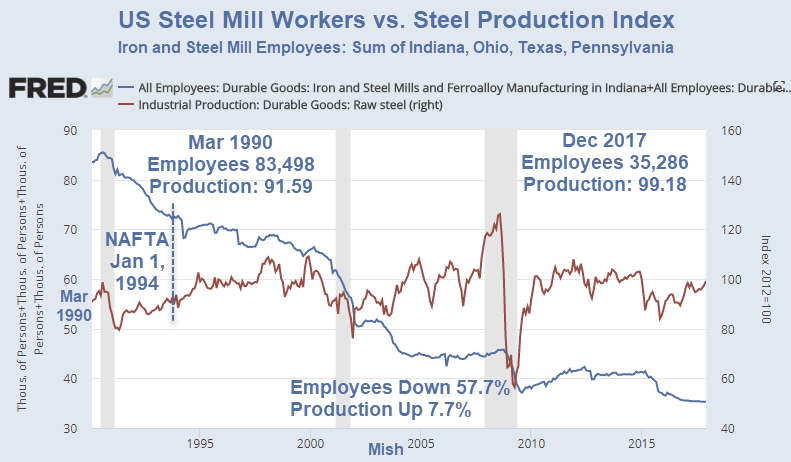
As I have pointed previously, there are about 6.5 million workers at manufacturers that use a lot of steel, but only 140,000 steelworkers, according to Moody’s.
I created this chart in Fred.

To save those jobs (more accurately to buy rust belt votes), we are on a crazy path as noted in Pandora’s Box: Another Look at Steel Tariffs.
China Doesn’t Play Fair!
My inbox and comment box is filled with reader comments and emails telling me “China doesn’t play fair”.
So what?
More importantly, fair to whom?
If China really is flooding the US with steel below cost, that is to our benefit at the expense of China. There is no other logical conclusion. To subsidize exports, every person in China has to pay a cost, via taxation, pollution or both.
For further discussion, please see Reflections and Reader Comments on Free Trade: “China Doesn’t Play Fair!”
Trump is Clueless on Trade
Nearly every day someone tells me Trump “needs” to do this to bring other countries to the table. It’s idiotic.
The correct thing to do on trade is to get rid of all tariffs and all subsides no matter what foolish actions other countries take.
Let’s play a game.
What If the US Went to Free Trade Unilaterally?
- Foreign investment in the US would soar. We would build more foreign cars here rather than their, creating more US jobs.
- The US would get steel cheaper than the rest of the world. Our cars would be more competitive globally.
- Every company that uses steel in the US would benefit, not so in the rest of the world.
- The price of sugar would fall in half to the benefit of candy makers, bakers, and consumers.
- We would get ethanol from Brazil rather than corn. Gasoline prices would drop.
- We would get more lumber from Canada making US homes cheaper to build.
- Standards of living would rise.
That item list came off the top of my head in 30 seconds. One could triple it easily with a bit more thinking. But the last point is the most important one: standards of living would rise.
Tariffs may be a smart political ploy temporarily (Trump’s rust-belt stance helped get him elected), but tariffs are a piss poor economic policy, no matter what any other nation does.
Mike “Mish” Shedlock






























While in a forward-looking, informed, well-led nation I might agree with you wholeheartedly, with the minor exceptions that benefiting from slave labor and global pollution doesn’t sync up well with my desire to “get ahead” ethically, in a nation running trillion dollar budget deficits we are giving our competitors the noose with which to hang ourselves. Either they will use the dollars accumulated to buy up the means of production here, over time stripping the wealth from the short-term-obsessed, savings-deficient American public, or, if prevented from that (as Trump is now threatening to do) they will bludgeon the U.S. with a collapsing currency and accelerating inflation while reorienting their domestic production to serve their own citizens’ consumption desires. That is the dilemma faced by nations who have allowed their trade balance and the associated external financial liabilities to balloon out of control for decades.
Copyright infringement is an issue for the entertainment industry, as their output is losslessly copyable for pretty much free. Which doesn’t necessarily make government running around banning people from retelling a joke they once heard, such a brilliant idea. But in entertainment, at least a utilitarian case can be made for some artificial restrictions on straight up copying, in order to incentivize resources being committed to it’s production.
Some people in the “tech industry” likes to complain as well. Mostly, they aren’t exactly the ones who are advancing the state of the art of technology. The exact same arguments they are using to get the government to harass Chinese guys, they are employing to stifle competition from guys at home as well.
In technology, or any “industry” really, if what it takes to copy an end product is so simple anyone can do it, the end product is a commodity already. Meaning, government banning someone else from building something similar (but not a 100% straight up copy) more efficiently, does nothing but enrich rent seekers. To the detriment of technologists, rather than to their benefit.
Banning the rest of the world from putting a one-click order button on their website, just because someone managed to convince a taxfeeder to issue them a “patent” on it; does nothing but render both America and China less competitive, hence less technologically advanced. In the process transferring value from technologists and their customers; to the usual cadre of tax feeders, ambulance chasers and other leeches living off of government harassing others.
Laws banning people from performing certain jobs, do tend to lower the number of people holding said jobs , yes. Duh!
Not many job opportunities for Blackjack dealers and slot machine technicians outside of Nevada. Bloody Chinese! Let’s cheer for Dear Leader to tweet something mean about them!
“Free Markets” is not some special entity in a vacuum. It is simply whatever markets result from people being free to do as they please. As opposed to people being forced to do what some taxfeeder pleases at the point of a gun.
Unless some free individual chooses to use his unrestrained freedom to arrange for his pockets to be picked, they won’t be as long as he is free. Once he is no longer free, Dear Leader is free to pick his pockets at behest of lobbyists anytime he pleases, of course.
The German government making it’s citizens toil away making free Mercedes’ for Americans, must be really unfair for the latter….
Back in the real world, what makes “errant countries” toe the line, is running out of stuff to hand the rest of the world for free. As is often pointed out on this blog, there is an unlimited demand for free stuff. No different for luxury cars than for social services.
The more free stuff (aka subsidies) that Chinese and German tax payers supposedly hand Americans for the asking, the more Americans will demand. Until neither Germans nor Chinese can afford to keep throwing it in any longer. At which point, they will “toe the line of fairness” again.
China already does let its own tech companies build equivalent products and flood the market with them at a lower price. They even go a step farther and help with the theft of trade secrets and look the other way on all intellectual property theft.
P.S. Mish: this comments system is an abomination.
IP theft is another matter but it comes primarily when US companies voluntarily manufacture in China
I agree with you on tarriffs generally, but the real problem that needs addressed is Chinese IP theft in exchange for access. That presents a huge risk to our high-tech sector over the long-term. I agree with Trump there.
BS, not all countries have the same levels of pollution, labour laws etc. Companies in NA have higher standards to abide by, while some where like China they don’t.
Free Markets are a wonderful and elegant starting point but let not its charm befuddle you into getting pick-pocketed.
“tariffs are a piss poor economic policy, no matter what any other nation does.”
In fact the opposite! Tariffs are a good way to make errant countries (countries that do not play fair) toe the line of fairness. It may be painful for the consumers but then is there any other way to ensure all play fair. Also It is not as if it has not been painless otherwise.
100% free trade provides an economic mechanism for circumventing local government policies that make a nation less competitive. That is all it does. That is also why many governments do not favor 100% free trade. They are unwilling to remove noncompetitive local policies and they do not want those local policies to be circumvented.
By all means let’s have 100% free trade. Let’s also get rid of all local policies that make us less competitive. (Pardon me if I don’t hold my breath.)
Meanwhile, let’s do the best we can, yes?
“If China really is flooding the US with steel below cost, that is to our benefit at the expense of China. There is no other logical conclusion. To subsidize exports, every person in China has to pay a cost, via taxation, pollution or both.”
This sounds good. But you are looking at it from the cost angle of producing steel only. IMO, that kind of thinking is unidimensional and is good in theory. You are not looking at it from the angle of loss of jobs, purchasing power of people, impact on society etc.
Also now let us extend to all products. All countries try to sell their products below cost to the US. Great news but then who is going to buy them and how? What happens if it continues for decades? Imagine the society that you end up with (IMHO, similar assessment is needed for AI also)
In short, it is as simple as you are making it out to be and cost is not the only angle this should be looked from and you need to assess the impact from many angles.
all black markets prove free trade works
What a bunch of non-sense, let’s lower the tariffs so we can buy more goods from China, with borrowed money while we ship more American jobs to China. So completely clueless! Similar to babys r us sponsoring Planned parenthood to basically kill their customers. They literally paid money to get their customers killed, very similar to what this “article” is proposing.
Hypothetical Question: What if China imposes tariffs on all US technology companies, then lets its own tech companies (e.g. Alibaba) build equivalent products and finally, these companies start selling these homegrown technologies at a much cheaper price to the rest of the world (undercutting the US tech firms)?
Just lowering tariffs doesn’t mean everyone will rush to build software products in USA. Offshore IT engineers are cheaper and much larger in number than those in the USA today – and can be incentivized to develop software while sitting in their own countries – isn’t that what most of them do today anyway? Basically, what happens when software production starts getting outsourced – just like manufacturing did in the past…
Seems like the primary purpose of a tariff is to protect non competitive industries.
For those in favor of tariffs, how would you feel if you produced product X and wanted to sell it at Y, but were told you couldn’t sell it at Y, because your competitors can’t sell it at Y and make a profit? So you are forced to sell it at no lower price than Y+5.
This is getting dull. When the main support for unilateral free trade comes from the discredited Mexican-owned New York Times and the laughable Paul Krugman, unilateral free traders ought to be embarrassed.
Unilateral free trade is crack cocaine: Day 1 feels great, but the long term effects are destructive.
Multi-lateral free trade? Now there is an idea which makes sense! If only other countries would join President Trump and pursue genuine free trade.
More winning…..
Wow, Mish ya on fire…..another excellent on point article. This is what real libertarian talk is. Only one thing possibly inaccurate. Krugman knew what he was doing, he sold his soul to remain in the limelight just like Greenspan did. Mind didn’t turn to mush, his ethics did, just another media whore……..
Label every article sold under real free trade (without ANY tariffs), where it was made and what ingredients it has (honestly and in detail) and mandate it…..let the consumer decide.
How is easy is that?
There’s no “free trade”, we can’t even get price discovery on many items/services in our own country. Whether it’s competing against slave labor in other countries (i.e. Mexico/China) or corporate tax inversions (and criminal behavior), any major tariff war will hurt further. We’re still not going to lose our global economic position, at least not for a long time.
Krugman referring to Bastiat! And not in order to attempt twisting his words to fool the peanut gallery! That is surely something!
Krugman’s mind turned to mush when he decided to stop being an economist, in favor of being a partisan hack. Following in the footsteps of his idol, Keynes. They were both sharp as rapiers before that.
It’s a fundamental problem of progressivism, as it exalts government as some sort of useful institution. Rather than what it really is, which is simply newspeak for Mafia. Being well indoctrinated progressive minions despite their otherwise brilliance; both economists figured they had some higher calling, discarding economics in favor of nonsensical populist and/or partisan drivel spouting.
In of itself, tariffs are silly. If a country dumps steel, then we buy at discount.
But:
What if another country dumps certain products due to strategic reasons, which concern our longer term interests? [and suppose nobody manipulates their sector into “strategic”]
What if another country has unacceptable manufacturing practices , e.g. child slavery or pollution at global scope?