

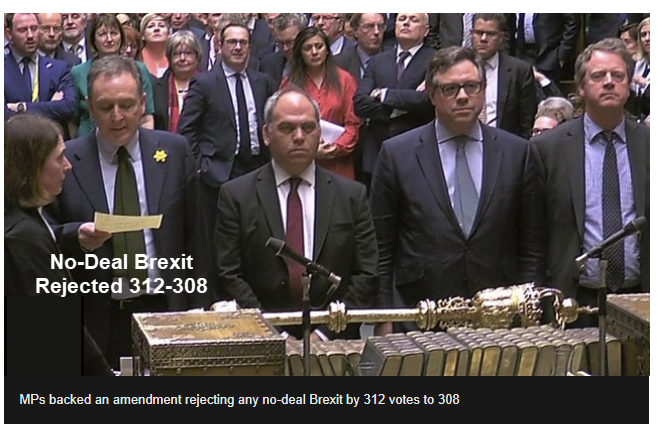
The BBC reports MPs Vote to Reject No-Deal Brexit.
MPs have voted by 312 to 308 to reject leaving the EU without a withdrawal agreement. It is not a legally-binding decision – and it does not rule out the UK leaving the EU. But it means MPs could now get a vote on delaying Brexit. That vote would take place on Thursday, and if it is passed – and the EU agrees to it – the UK will not leave the EU as planned on 29 March.
MPs voted by 374 to 164 to reject a plan to delay the UK’s departure from the EU until 22 May, 2019 so that there can be a “managed no-deal” Brexit. It was known as the Malthouse Compromise – after Kit Malthouse, the government minister who devised it.
Not Legally Binding
The vote, as I have mentioned numerous times, is not legally binding.
Moreover, the closeness of the vote suggests there could be a different vote the next time it is tabled.
On the whole, I suspect the no-deal odds just rose although the currency markets reacted the other way.
Consequences
In the Guardian Live Blog, Theresa May Spoke of the consequences.
Here is the key passage from Theresa May’s statement responding to the two defeats tonight.
“The motion we will table [tomorrow] will set out the fundamental choice facing this house.
If the house finds a way in the coming days to support a deal, it would allow the government to seek a short limited technical extension to article 50 to provide time to pass the necessary legislation and ratify the agreement we have reached with the EU.
But let me be clear, such a short technical extension is only likely to be on offer if we have a deal in place.
Therefore, the house has to understand and accept that, if it is not willing to support a deal in the coming days, and as it is not willing to support leaving without a deal on 29 March, then it is suggesting that there will need to be a much longer extension to article 50. Such an extension would undoubtedly require the United Kingdom to hold European parliament elections in May 2019.
I do not think that would be the right outcome.
But the house needs to face up to the consequences of the decisions it has taken.”
Minimum Requirements
Those are minimum requirements from the point of view of the UK only. The EU would have to agree to them.
Before that, the UK parliament would have to agree to a plan the EU would accept.
However, there still appear to be far too many factions to make that likely.
Point of Law
Jacob Rees-Mogg, the lead Tory Brexiter, asked the Commons speaker, John Bercow, to confirm that a motion of the house does not override statute law.
Bercow confirmed that is the case. Legally, today’s vote is not binding. It is a request.
EU Commission Responds
Again, that’s just what I said, and have said all along.
16 Days
The UK now has 16 days to agree to something. And it has to be something the EU will accept.
Remainer Feuding
May Votes Against Her Own Proposal

Appearances Deceive
Most believe May’s deal is dead. That’s not the case.
If it appears a new motion would come close to gathering a majority, I would expect Theresa May to re-table a vote on her deal. Vs an option of Remain, it would likely win Tory backing, DUP backing, and some from Labour.
There no majority for remain and no majority for a Norway-style customs union. The customs union is the official policy of Labour. Tories would not go along, DUP would not go along, and even some in the Labour party would not go along.
Moreover, Norway already ruled out UK membership in the EFTA. Thus, Norway would be dead even if it did pass the UK parliament.
A Norway-Plus option that granted the UK trading rights while allowing the UK to void EU freedom of movement clauses is theoretically possible, but it would require UK parliamentary approval, EU approval, and it would have to be a separate agreement or Norway would reject it.
For discussions of the problems with Norway-Plus, please see Brexit and the Three Pigs: A Modern Fairy Tale
Default Setup
Today’s bottom line suggests the odds of no-deal just rose despite the vote for the simple reason today’s votes are not legally binding and various UK factions keep hoping for options that cannot fly.
The odds are slim that the UK votes to remain, May resigns, the UK votes for another referendum (to which the EU would have to agree to wait), or that the UK agrees to any action that is not rejected by either the EU or Norway.
My default setup remains:
There will be one more vote at the end of March for Theresa May’s deal. It will either pass or it won’t. There is no majority for anything else.
Today’s vote was not meaningful, except perhaps that it made no-deal more likely.
Mike “Mish” Shedlock






























OK, so the 312-308 vote was on amendment A to the bill, not the bill itself, which was “No Deal, No Leave on 3/29” – in other words, the amendment significantly tightened the bill, making it “No Deal, Never Leave” and thus was a big deal – it indicated that the House did not want a “No Deal” Brexit – and thus it was expected to be a lot tighter. As pointed out, it is not binding, but then the same can be said for the Referendum, if you want to go down that line of thinking. Also, it opens the door for May to cancel Article 50 and point to this vote. She can then say that when the House agrees to a deal that the EU approve of, Article 50 can be re-invoked (i.e. Brexit is off, because that will never happen).
There will be a vote today on an extension, but it will be meaningless unless a good reason is given. Good reasons are: a new referendum and a General Election. I can’t think of any other reason for the EU to accept an extension, delaying a deadline vote is just extending the agony, and it is very unlikely that the EU will allow any extension that comes close to the May elections where they either need the UK to participate or not be part of the EU (otherwise, under EU law, the elections are not valid).
In my opinion, the most likely outcome is a deal whereby the House will vote for May’s deal with a proviso that it includes and extension and a referendum that asks “May’s Deal or Remain?”, and is valid only if the EU agrees to the extension. Then the EU will be asked for an extension to allow the referendum, which I would expect them to accept, and it will go back to the people.
This mess will have to be reversed in 10-15 years when the UK reapplies to join the EU, and it will have to do so under much worse terms than Thatcher negotiated in the 1980s. Bloody madness, and a strong headwind against younger Brits, but this is what happens when you mix Libertarian morons with populism.
You misunderstand: it wasn’t a ‘bill’. It was on a Motion. The amendment to the motion had no legislative effect whatsoever. Leaving the EU on the 29th March is both UK Law and EU law, in their case under Article 50. For the UK the date of leaving, because it was written into Law can only be changed by either another Act which amends that date or via a Statutory Instrument.
Thanks for the clarification on terminology Andrew – I’m mixing up US and UK terminology – my bad.
You are correct, as Rees-Mogg pointed out on BBC last night, that only the law is binding, however there is a simple out from the law, revoke Article 50.
Well indeed, by thanks to meddling Gina Miller Article 50 was triggered by an Act of Parliament and so can only be revoked in the same manner ! I do not think that, because of this and the Withdrawal Act, it could be done merely by the Prerogative but would require primary legislation.
Why on earth would any, non third word and hence not simply angling for transfers, country want to join what the EU has now become? And in 15 years?? When it, per anything resembling current trajectory, will be more dysfunctional still? If it’s still around.
Like many highly limited agreements/institutions, the EEC provided lots of benefits back when the UK joined. But, also like all limited agreements/institutions (and cancers) once in place, their once-were limits almost inevitably keep growing. Just look at the once supposedly limited US Federal government, compared to the current totalitarian train wreck…
By now, even mighty Germany is being destroyed by the money printing and regulation lobbying which Brussels facilitates. Pull the rug of unsustainable wealth transfers by way of money printing away, and watch as even German industry wakes up to the sheer level of malinvestment it has, acceleratingly, engaged in over the past decade or two.
And that’s Germany. By far the most functional and resilient of the bunch. Compared to that, the UK really got the short end of the stick: Being used as little more than dumping grounds for the “financial” rabble that the ECB has empowered at the expense of everyone else.
If the EU over the next 15 years gets knocked back to something like the 70s era EEC free trade agreement the UK once signed up for, the UK may well want to join again. But extrapolating current developments, in 15 years, Brussels will have a Wall Street. A K Street. And a defense department. The latter empowered by a draft. To provide soldiers for the armies fighting Coco Cola over CO2 in soda. Who the heck, aside from the usual rabble consisting of aspiring “financial,” “legal,” lobbying and other similarly negative productivity middlebrows, will want to join that kind of out of control manureshow?
I think the brutal reality is that the EU has been of very little, to no, to an impediment to the UK. The growth rate since 1973 compared with before shows little advantage and I fail to see what advantage is gained by paying a net of £10 billion a year to have a £90 billion trade deficit. The UK is really the EUs captive market for overpriced manufactured goods and agriculture. As for all the happy clappy stuff about ‘being together’ and ‘building Europe’ that makes me want to baff. I think the more power is accumulated at the centre the more tyranny there will inevitably be. The Continental Europeans have a history of creating tyranny: we Anglo Saxons have a history of destroying it. So it will be again.
EU likely to want a longer Brexit extension and if so there will be EU parliamentary elections in UK.
Meanwhile, Nigel Farage is urging the EU parliament to reject any proposed extension lest they be swamped with EU sceptics when EU elections take place in May. Neither pro-EU people nor the sceptics want that. It itonly takes one of 27 EU members to veto any proposed extension.
I want No Deal, not the idiot May’s hideous so called ‘Deal’. How she could even think that pile of cr*p was worthy of being signed and placed before Parliament is a mystery. She is deluded.
It gave a quick door to re-enter the EU. Her Mansion House speech in around March 2018 spelt out she wanted wide and deep EU relations. Her settlement would be that. It also met the needs of the UK group that met with Barnier/Verhofstadt asking for a settlement that would allow an easy rejoin in future – Cable, Soubry and a few others went across to discuss after Christmas.
Below, she really means “the country” in the place of “the house”. France will try to poach a massive amount of business and Brussells cannot be used to stop them. The threat is real but our leaders have been lacking, for many years.
“But the house needs to face up to the consequences of the decisions it has taken.”
The problem (one of them) with re-entering the EU is that the UK would, amongst other things, have to join the Eurozone and Schengen area. That is a requirement for ALL new entrants.
If the majority don’t want to belong to the EU under ANY circumstances, there is no chance at all that the population would want to not only rejoin with all the existing problems it caused Britain, but would actually countenance using the economy-killing
Euro and the job-killing Schengen zone.
I do expect the UK to break-up. Not much ordinary people can do to stop it but when it does the implications are substantial.
England/Wales/Cornwall will have to make sure Scotland carries it’s own proportion of the national debt and all their own pensions/health etc. No English/Welsh/Cornish tax payer monetary transfers to Scotland or the Irish. The maths looked horrendous not so long ago and now probably worse.
We will be back to the pre-1707 days and have to make a new way in the world.
Andrew, you can bet there have been substantial threats from EU countries to poach major business (Airbus, automotive, financial), allow Scotland to join on separation, block passporting of financial services from London, block UK bids into EU projects, even block flights. Blocking flights was threatened by the Irish PM, say no more about that piece of work.
As a consequence May is probably scared stiff whilst we ordinary folk are unaware. If we were aware there could be anger.
One extreme possibility is a poor settlement leading to English nationalism waiting for a leader. Stranger things have happened. French have a track record of encouraging that sort of thing, WWI settlement etc.
What we have not had is a coherent UK leadership able to carry the people with them. Not since mid 1980’s. The politicians wondered off and left the population in the wilderness. When they then offer a referendum all the leadership can do is try to frighten people to vote as desired because they never bothered to ask then about Maastricht or Lisbon – they signed away voters rights without consultation. Now it bites us all in the ass.
Lastly, sovereignty doesn’t belong to the Gov or the people alone. It belongs to both. Neither should give it away without consulting the other. The UK Gov gave controls away at Maastricht and Lisbon and didn’t consult the people.
Once every few years control is handed back to the people for a day – the election. On that day the people should have the same rights and power they had at the previous election unless they had agreed to some change in their rights in the meantime.
Politicians don’t get this, the electorate are seen as an inconvenience.
The UK will need a few years to find it’s way and it won’t be pleasant.