

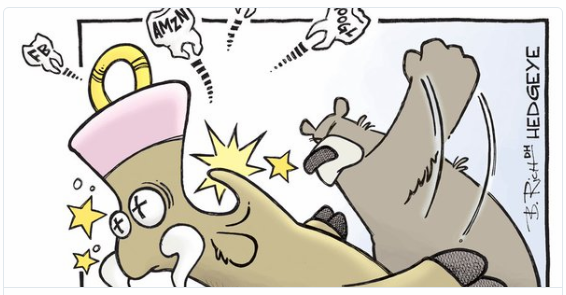
“With the FANG stocks faltering lately investors are starting to become concerned about their impact on the broader market. And there is certainly something to this.”https://t.co/rcB6ObZaZn
— Hedgeye (@Hedgeye) August 3, 2018
Echo Bubbles Abound
Pater Tenebrarum at Acting Man discusses Stock Market Manias of the Past vs the Echo Bubble.
The Big Picture
The diverging performance of major US stock market indexes which has been in place since the late January peak in DJIA and SPX has become even more extreme in recent months. In terms of duration and extent, it is one of the most pronounced such divergences in history. It also happens to be accompanied by weakening market internals, some of the most extreme sentiment and positioning readings ever seen and an ever more hostile monetary backdrop.
The above combination is consistent with a market close to a major peak – although one must always keep in mind that divergences can become even more pronounced – as was for instance demonstrated on occasion of the technology sector blow-off in late 1999 – 2000.
Along similar lines, extremes in valuations can persist for a very long time as well and reach previously unimaginable levels. The Nikkei of the late 1980s is a pertinent example for this. Incidentally, the current stock buyback craze is highly reminiscent of the 1980s Japanese financial engineering method known as keiretsu or zaibatsu, as it invites the very same rationalizations.
We recall vividly that it was argued in the 1980s that despite their obscene overvaluation, Japanese stocks could “never decline” because Japanese companies would prop up each other’s stocks. Today we often read or hear that overvalued US stocks cannot possibly decline because companies will keep propping up their own stocks with buybacks.
Of course, this propping up of stock prices occurs amid a rather concerning deterioration in median corporate balance sheet strength, as corporate debt has exploded into the blue yonder (just as it did in Japan in the late 1980s). The fact that an unprecedented number of companies is a single notch downgrade away from a junk rating should give sleepless nights to fixed income and stock market investors alike – as should the oncoming “wall of maturities”.

A giant wall of junk bond maturities is looming in the not too distant future. Unless investors remain in a mood to refinance all comers, this threatens to provide us with a spot of “interesting times”. Something tells us that “QT” could turn into a bit of a party pooper as the “Great Wall” approaches.
It should also be mentioned that past stock market peaks, as a rule, coincided with record highs in buybacks. This indicates that record highs in buybacks are mainly a contrarian indicator rather than a datum providing comfort at extreme points.
Of course, what actually represents an “extreme point” can only ever be known with certainty in hindsight, as extremes tend to shift over time – particularly in a fiat money system in which the supply of money and credit can be expanded willy-nilly. What can be stated with certainty is only whether the markets are entering what we would call dangerous territory.
Buyback Explosion

From an anecdotal evidence perspective the continued existence of curmudgeons like us who are aware of the above and are pointing out that this is a dangerously overstretched market may actually be a good reason to believe it will become even more overstretched. When the bubble pops one of these days, we may superficially look like the proverbial stopped clock that finally showed the right time – note though that our views on the big picture and our short-term tactics are two different cups of tea.
After all, we even trade cryptocurrencies, which are well beyond fundamental analysis – this is to say, we don’t believe it is possible to assign a “proper” valuation to them. We don’t know if a Bitcoin is worth nothing (that seems unlikely though) or a million dollars. What we do know is that it is a market that is extremely suitable for short-term trading based on technical analysis.
In terms of long-term investment strategies we prefer methods that eschew market timing altogether. We mainly rely on a specially adapted version of the permanent portfolio (which is extensively discussed in Austrian School for Investors, a book we modestly contributed to and warmly recommend, mainly for the contributions of the other authors).
Moreover, the “big picture” can only be judged once the cycle has fully run its course.
There are many additional charts and comments by Pater in the above link. Please take a look. Here is his final comment.
“The conclusion from all this is obviously that risk is currently very high. Of course, risk also spells opportunity, and anyone who has to have exposure to the stock market should at least consider hedging it while hedges can still be had for a song (which invariably is the case just before things go awry). “
Mike “Mish” Shedlock






























I never tire of noticing that most of a firm’s Market Cap comes from nowhere, and can return there with a simple change of the wind among trader/investors.
If a firm with a billion shares outstanding has a single share trade a dollar lower, the buyer’s and seller’s bank balances are a wash, but a billion dollars in “wealth” disappears. It happened on the way up. It happens on the way down. It’s all just belief, nothing more.
During the bond bull market of 1981 to 2016 issuing debt was a two-fer. A dollar of GDP-producing spending was sent cascading at the velocity of money through the economy, and a second dollar, accounted for as as ASSET, was put in the “wealth column” of the balance sheet somewhere. Because humans lack any cognitive ability to grasp the relevance of very large numbers, a veritable ocean of IOU’s was issued, and as rates fell, the capital value of all that debt kept rising, a wealth gusher, on a leveraged basis the same as the market capitalization example for stocks. Now that an ocean of IOU’s exists, each uptick in rates destroys a massive amount of “wealth.”
Attributing control of interest rates to central banks et.al., seems like an astonishing example of post hoc logical fallacy, especially if one notices that most of the time, market rates change before central banks’ rates change. Have we not witnessed the largest rally in mass-minded trust and overconfidence in recorded history? Only Santa Claus himself could possibly bring into being the sugarplums of future cash flows (IOU’s, pensions, exponentially rising medicare, etc.) that now dance in everyone’s heads.
To me, there are a couple necessary precursors to an asset price collapse of historic proportion:
Someday this will matter, I think.
Thank you, caradoc-again.
As I have posted before, it is important to remember that a stock buyback is mathematically identical to a one-time dividend. The price of the buyback is irrelevant. So long as you sell a proportional share of your shares at the same time, the company effectively passes cash to you, and you have the same percentage ownership as before. The only difference between the two is the tax consequences.
It isn’t surprising that stock buybacks tend to happen when the stock price is high. Stock buybacks happen when companies have excess cash. They have excess cash when they are doing well, and making profit. When they are doing well, and producing large amounts of cash, the stock price is going to be high.
Correct me if I’m wrong; aren’t most stock buybacks financed by borrowing? If so, then is it normal or prudent to fund a dividend (one time or not) via issuing debt?
Stock buybacks always look to me to be a way for the firm’s executives to hit their stock price triggers for executive compensation packages that have 7 or 8 zeroes ahead of the decimal, and do it by borrowing the sun/moon/stars, “selling” their debt to other firms. What you end up with is a corporate system whose “cash” is just everyone else’s IOU’s.
John Mauldin and David Rosenberg highlight all this in their recent letters. The next crisis will be long and ugly.
The stimulus for the stock market is ending in 2018 and the political climate will turn in 2019 as the economy rolls over.
The next several years will be bewildering for many.
China Minsky Moment. US over valued markets might still look better to some than the alternatives in China, for now at least.
China slowing will ripple through commodity suppliers and give a deflationary punch to the globe. US $ could benefit as a consequence pushing EMs right to the edge as a major customer ( China) slows and their debts being in $ cause excess stress on $ stren. How will it will unfold?
Felix, Here’s one clue depending on your currency. $ might strengthen & it be a better hedge if bought in other currencies.
Commodities, Farmland (depends) etc.
Will this be the blow-out crash that has been predicted by the most people?
Normally there are a few lone voices in the wilderness.
Many, many more not so lonely voices this time.
What might that mean?
Crash will definitely come in 2021 based on that chart.
If the crash would happen in 2019 then Trump would most likely not get re-elected because the good economy is so important to Trump’s popularity.
On the other hand a crash would force Trump to actually keep his immigration promises instead of just talking about them and Trump would have to hire some more qualified people instead of Stupid Sessions and Kirstjen Nielsen whose solution was to start separating kids from parents in detention creating a public relations and image catastrophe since they believe USA can NOT stop people at the border if they ask for asylum.
Of course USA can STOP people at the border since Mexico is SAFE enough country where government does NOT persecute Mexicans and where government does NOT persecute passing Guatemalans, El Salvadorans, Nicaraguans and Hondurans and Mexico is signatory to Geneva Convention.
France does NOT accept asylum claims on their border with Italy and instead keeps people in Italy and immediately catches illegals if they are in France and returns them to Italy.
Hollande was forced to start this in summer of 2015 when Italy PUSHED in 2014 and early 2015 tens of thousands of migrants to France to get them out of Italy and this led to more people coming to Italy because they heard one can get through Italy.
“whose solution was to start separating kids from parents in detention creating a public relations and image catastrophe “
You know good and well that that was the policy for more than a decade and the Trump admin didn’t start it, they ENDED it. It was a totally manufactured catastrophe so folks like you can continue lying to the public. That’s how you got Trump in the first place by the way.
NOPE. Sessions and Kirstjen Nielsen first created this crisis by Kirstjen Nielsen stupidly running ads in local radio in Guatemala, Honduras, El Salvador and Nicaragua only telling people to come if they are seeking asylum (this was meant to stop illegal immigrants from coming but it encouraged more asylum seekers to come), then Kirstjen Nielsen said the same thing in congressional testimony that was reported in media in Central-America. So this was a DOUBLE-FAIL by Kirstjen Nielsen. Then Sessions instructed all the kids to be separated from their parents including babies after Kirstjen Nielsen had first LURED people to come.
This was a difference to the Obama policy in that Obama only separated kids when the parents were suspected of a crime like bringing drugs or not being a blood relative etc. The images Drudge ran of kids wrapped in foil were underage kids that came by themselves in 2014
Both Kirstjen Nielsen and Jeff Sessions are INCOMPETENT and should be fired. Both are wrapped around with the idea that USA has to accept the asylum requests at the border and then do STUPID thigs like separatings kids from their parents while Jeff Sessions has authority under current law to instruct authorities to NOT accept asylum claims at the border and the law specifically states there is NO judicial review of this decision by Sessions if he would just make it and Sessions can make it because Mexico is mostly SAFE and signatory to the Geneve Convention.
All the trouble you have seen with Trump keeping his promises is caused by INCOMPETENT hacks like Kirstjen Nielsen (no knowledge whatsoever, got her position because John Kelly recommended her) and Jeff Sessions (recused himself on the advice of same Obama-era DOJ people that whitewashed the Clinton investigation and were involved with the FAKE dossier of lies about Trump, Sessions recusal caused Rosenstein to become the de facto leader of DOJ despite him being involved in getting FISA warrants based on lies on the Trump campaign, Rosenstein caused the Muller investigation) Sessions could STOP the flow of asylum sekers to USA in 1 day by telling authorities to STOP accepting asylum requests but he is too INCOMPETENT to realise he has that authority without judicial oversight on black letter law.
Gonna be some sad retirees and pensioners out there in the coming years. Too bad they were forced to chase yield in the markets due to artificially low interest rates.
By the time the crisis hits, I wonder if they’ll be too old to storm the Eccles Building with their torches and pitchforks.
Sadness for all, I suspect. We live in a world and in a country (USA) whose economy is addicted to credit-created demand.
If Uncle Sammy were cut off from the debt market due to rising rates, what would happen to employment in the Medical Services sector, the area where so many good paying jobs were created these past decades? There aren’t too many industries left that aren’t heavily dependent on monetary demand borrowed into existence.
Imagine if rates begin a distrust-spiral higher. If “inflation” is perceived to hit 10%, who will lend money at anything less than that? What entities that currently sustain their spending via borrowing can service their EXISTING debt as it rolls over at such rates? It strikes me as far from unthinkable that Borrow-to-Spend economics could hit a hard stop one day, maybe soon. What industries in America would remain in current form under such a condition?
The entire economic model of the last 50 years has been a catastrophe, a Mount Vesuvius awaiting the time of eruption. The entire edifice rested on a lie, that Say’s Law was irrelevant, when no amount of sophistry can undo the fact that in order to consume, you must first produce. Any economist who says otherwise should be stripped of all credentials and handed a shovel, because it’s the only tool he or she is likely capable of handling.
What “hedges can still be had for a song” does he refer to?
A shrubbery!