

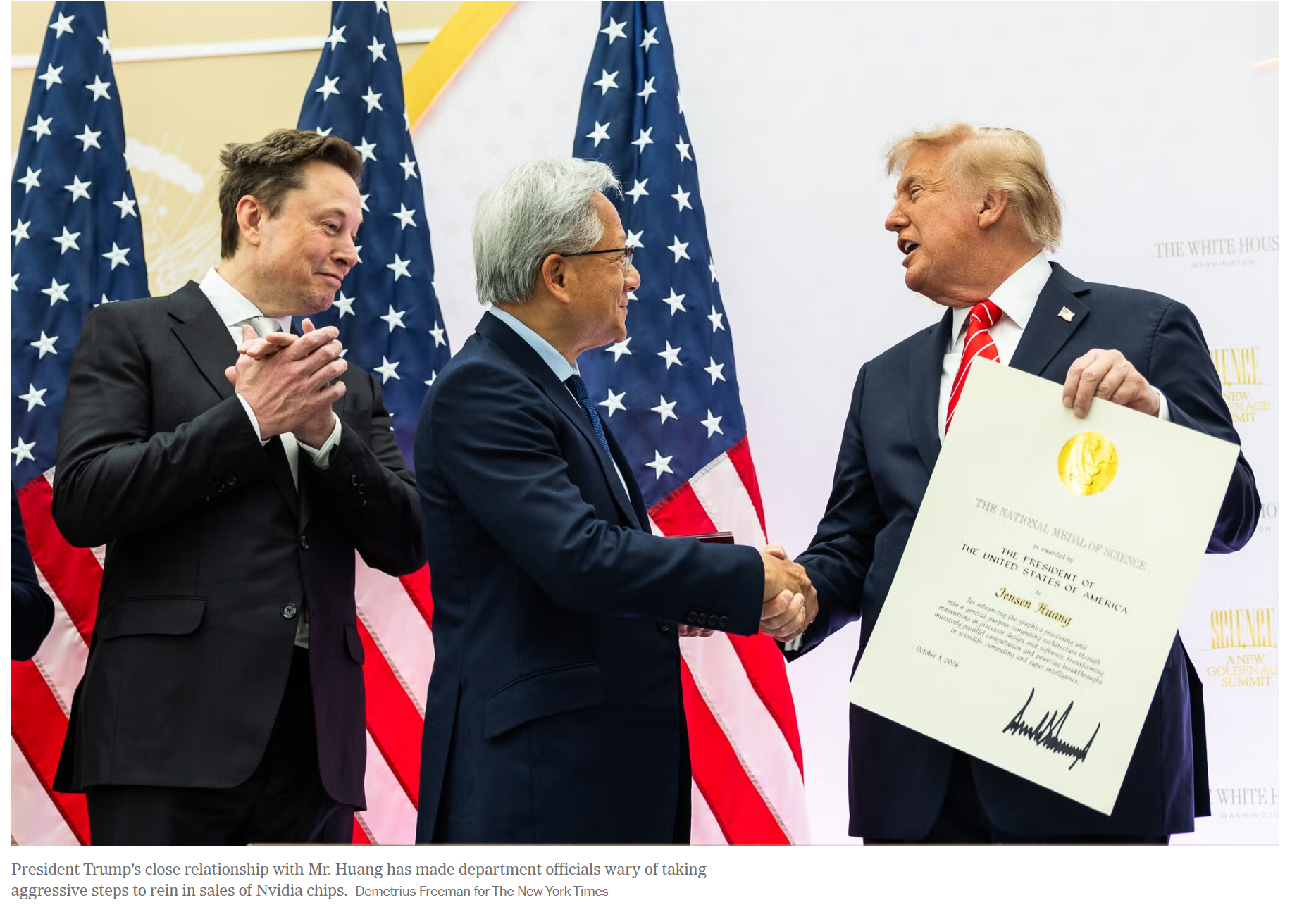
The evidence trail is too great for the Trump administration to sweep under the rug. 
Advanced Chips at a Chinese Project with Ties to Megaspeed
Bloomberg reports Nvidia Blackwell Tech Used at China Site Tied to Alice Huang
A pair of Chinese firms installed Nvidia Corp.’s powerful Blackwell semiconductors in a Shanghai data center linked to Alice Huang, the woman at the heart of a controversy surrounding the US chipmaker.
The gear installed at the Yangtze River Delta Project included a GB300 NVL72 rack, among Nvidia’s most powerful products, according to a serial number specified in documents submitted to Chinese regulators in November. Shanghai Shuoyao offered the hardware as collateral to obtain a 96 million yuan ($14 million) loan from Shanghai Innovation Bank, according to filings from the lender that were reviewed by Bloomberg News.
A second firm, Shanghai Kezhan, controlled by a Tokyo-based parent, described a GB200 server — which also relies on Blackwell chips — at the facility. That description was provided in documents when it obtained a 90 million yuan loan in late 2025 from a finance-leasing firm wholly owned by a local Shanghai government agency.
The submissions reveal for the first time that Nvidia’s Blackwell processors found their way into a Chinese data center that has ties to Alice Huang and Megaspeed. These processors were until recently Nvidia’s most powerful data center products, and they’ve always been illegal to ship to China without a US license.
President Donald Trump has explicitly said he doesn’t want these chips — which OpenAI and Anthropic PBC use to train their most cutting-edge models — going to the Asian country, at least for now. Nvidia Chief Executive Officer Jensen Huang, meanwhile, once claimed they were too big to smuggle: a standard two-meter-tall GB300 NVL72 server rack, which contains 72 Blackwell Ultra chips and 36 Grace processors, can weigh more than 1,500 kilograms (3,300 pounds) and is about the size of a gigantic fridge.
Shanghai Shuoyao — the company that procured the GB300 rack and offered it as collateral — is active at the data center linked to Alice Huang and also has significant overlap with Singapore-based Megaspeed, which is under US investigation over concerns that it smuggled Nvidia chips to China.
The Trump administration this month put Megaspeed on a US trade blacklist, citing a significant risk of involvement in chip diversion.
Companies bought the chips, took out loans on the chips (providing a paper trail), then shipped the chips to China.
Lutnick Greased the Way
The New York Times reports Lutnick Took a Softer Line on Nvidia as Calls for Tougher Controls Grew
Over the past year, Mr. Lutnick has frequently clashed with top officials over how to regulate sales of advanced technology, particularly Nvidia’s chip sales to Asia. That has drawn accusations from others in the administration and in Congress that the Commerce Department has become too cozy with Nvidia and its co-founder, Jensen Huang, and failed to adequately police the firm’s chip sales to China, in particular.
The issue has exploded into public view in recent weeks with the revelations from The New York Times that Nvidia’s chief executive, Jensen Huang, was in a relationship with a woman believed by U.S. intelligence agencies to be a Chinese spy. The woman, Alice Huang, was a top executive at a Singapore-based company, Megaspeed, that is suspected of smuggling Nvidia chips to China. On Thursday, Mr. Huang announced that he was stepping down from the company, sending the company’s shares tumbling.
The astonishing developments have thrust Mr. Lutnick into an uncomfortable spotlight and raised questions about whether he went too far in protecting Nvidia’s interests. And it has focused attention on whether the influence of Mr. Huang, an ally of President Trump’s and among the most high-profile and successful of American business leaders, kept the United States from moving faster to clamp down on sales of Nvidia chips to companies like Megaspeed.
Within the Commerce Department, Nvidia is treated differently than other firms, current and former officials say, with its issues given high priority and sent through specific channels.
Mr. Lutnick frequently calls and messages with Mr. Huang, and the department prepares carefully for their private meetings together in Mr. Lutnick’s fifth floor office. All Nvidia matters are routed through Jeff Kessler, a top deputy to Mr. Lutnick, who is said to rarely take any significant action without the commerce secretary’s approval.
Nvidia’s general counsel, Tim Teter, is known within the Commerce Department for his aggressive outreach. An inquiry inside the agency into whether Megaspeed was smuggling Nvidia chips into China was shut down late last year and transferred to the Justice Department after Mr. Teter reached out directly to Commerce Department investigators, invoking Mr. Kessler’s name in doing so.
In the wake of the revelations about Mr. Huang, the frictions within the administration about how to deal with Nvidia’s interests erupted last week. Treasury Secretary Scott Bessent confronted Mr. Lutnick during a White House meeting over his handling of Megaspeed, demanding to know why the United States had not already banned chip sales to the company.
Speaking on CNBC Friday morning, Mr. Bessent declined to comment on White House conversations, or to say what he would do if he were Commerce secretary.
A spokeswoman for the Commerce Department denied that the interaction happened and said that the department had worked in concert with other agencies to issue export controls. She also denied that Mr. Trump’s relationship with Mr. Huang had put a chill on the department’s actions, calling the idea “false and reckless.”
The spokeswoman, who declined to be named, said the department had charged defendants in multiple major criminal investigations targeting billions of dollars of chip smuggling, and imposed a license requirement on Nvidia’s H20 chip, unlike the Biden administration.
Nvidia declined to comment. The White House did not respond to a request for comment.
Summation
- White House: No Comment
- Commerce Department: No Comment
- Nvidia: No Comment
But …
But Mr. Lutnick has repeatedly delayed or deferred technology controls, slowing down efforts throughout the year, according to people who described the discussions.
Mr. Lutnick told his colleagues that he didn’t understand the rush.
Mr. Lutnick’s defenders have repeatedly argued that when it came to Nvidia, he was doing what the president wanted. One person who witnessed a number of discussions about chips policy and Nvidia, who discussed internal deliberations on the condition of anonymity, said that the president was more often than not the person most sympathetic to Mr. Lutnick’s position. Mr. Trump, another official said, wanted to have a good relationship with President Xi Jinping of China.
By December, Mr. Huang achieved a notable victory. Mr. Trump agreed to allow the company to sell its more advanced H200 chip to China, as long as the U.S. government got a cut of the revenue — an idea that prompted widespread outrage about American national security being for sale. Commerce Department lawyers were deployed to figure out a way to sidestep a U.S. law banning export taxes and realize Mr. Trump’s proposal.
There are also concerns about possible conflicts of interest given that the investment firm that Mr. Lutnick steered for decades, Cantor Fitzgerald, operates in a wide range of industries, from cryptocurrency to data centers, that rely on Nvidia chips and could be affected by rules Mr. Lutnick is currently weighing. That business is now run by Mr. Lutnick’s sons.
Cantor Fitzgerald has served as a financing or placement agent for several companies that are involved in developing or operating data centers in Southeast Asia, like Gorilla Technology Group and Bitdeer Technologies Group, which could be hurt by tougher U.S. limits on chip sales to the region.
The activities of Mr. Lutnick’s sons have been a source of irritation for Mr. Trump and concern for some other Trump advisers, despite the fact that Mr. Trump’s own sons’ businesses have prompted similar criticisms.
The Commerce Department has approved licenses for Nvidia to sell its chips to Chinese firms that The Times found to have links with sanctioned entities or military contractors.
The tighter ties between Nvidia and the Commerce Department also gave Tim Teter, Nvidia’s general counsel, unique influence over the department and its rule-making process. When department staff reviewed drafts of policies under consideration, they sometimes found themselves looking at comments and critiques in the document that had been inserted by Mr. Teter.
While commerce officials often meet with industry representatives to discuss the impact on business of potential rules, this was viewed as an unusual amount of influence.
Shareholder Lawsuits in Delaware Chancery Court
Yahoo!Finance reports Nvidia board’s idolatry of Jensen Huang could open the door to shareholder lawsuits in Delaware Chancery Court
The Caremark doctrine, established in 1996 in Delaware Chancery Court, establishes that corporate directors have a fiduciary duty of oversight, and that directors breach their duty of loyalty when they make no good-faith effort to monitor the risks central to the business, or when they consciously ignore red flags.
Under this doctrine, and derivative variants of it, several boards have run into trouble in Delaware Chancery Court for similar sins of omission when it comes to oversight. In 2019, Delaware’s Supreme Court revived a suit against the directors of Blue Bell Creameries, an ice cream maker whose board had no system for overseeing food safety before a deadly listeria outbreak. In 2021, the Court of Chancery let claims proceed against Boeing’s directors, who had no board committee responsible for airplane safety before the 737 MAX crashes. That case settled for $237.5 million. The lesson of both: on risks that can sink the company, the board must watch for itself: the board cannot simply trust management, even when those risks were unforeseeable or unanticipated.
So plaintiffs’ lawyers will ask the questions directors should have asked many months ago. Who conducted the review that cleared Megaspeed? Did it report to independent directors or to management? Did any director know the CEO had a personal relationship with an executive of the customer under review? Did the board ever discuss Megaspeed at all, or Jensen Huang’s relationship with Alice Huang? Did any board members even care to ask any questions about these topics?
The answers are in the board meeting minutes, and alarmingly for Nvidia’s board, shareholders can now get those minutes with nearly complete transparency. Nvidia knows this better than most companies for a very ironic reason. In 2022, it fought a books-and-records demand all the way to Delaware’s Supreme Court. Even after Delaware narrowed those inspection rights last year, board minutes and board materials remain within reach for plaintiffs litigation.
When the questions first surfaced, Nvidia said it had visited Megaspeed’s sites and had no reason to believe chips were diverted. That assurance came from people who report to a CEO with a personal tie to the customer being cleared, a tie no investor had been told about. Bloomberg reports that Nvidia’s general counsel went so far as to contact a senior Commerce Department official about the government’s Megaspeed probe. Did the board authorize that call? Did it even know?
Nvidia makes the most strategically sensitive product on earth; and The Information reported today that companies tied to Alice Huang helped Chinese buyers obtain $7.5 billion of Nvidia chips, including banned ones that were laundered through neutral parties. That report is unconfirmed, and Megaspeed denies wrongdoing. But the penalties for export violations run from fines to criminal prosecution to the loss of export privileges, and a board should not have been waiting for verdicts before it starts asking questions. According to Nvidia’s own proxy statement, the board committee responsible for trade compliance met three times last fiscal year, and the company has no chief compliance officer. How much did they know, and when?
How Nvidia’s board could be exposed to potential liability
Delaware needs no new invented legal theory for measuring whether Nvidia’s board did its duty as a board in providing oversight. If shareholders bring Caremark claims against Nvidia’s directors, the court will ask what the board knew and what it did to find out. We have called out the Delaware Court of Chancery when it overreaches, and we will be again. But failing to question a celebrated CEO about a customer under federal investigation is no business judgment at all. Nvidia’s directors were paid to provide oversight over Jensen Huang, however brilliant. And in that duty, by all outside appearances, they apparently whiffed.
Aristotle famously warned, “There is no great genius without a touch of madness.” Psychiatrists call shared disorders “folie à deux.” It is up to the board to ensure a company’s owners benefit from the genius of founders but are protected by the madness.
Can a Delaware Judge Upset this Tippy Cart?
Legal AF Summation
Popok breaks down how a Delaware Chancery Court Judge could override Trump and JD Vance and throw Jensen Huang out of Nvidia along with the compromised board of directors, and how new reporting proves that Nvidia’s most powerful “weapons grade” AI chips ended up in China through Nvidia and Jensen’s affair with a Chinese Sex spy.
The above stories seem like more hype than reality.
Google’s Gemini
For board-oversight claims, Delaware sets a high bar—plaintiffs generally must show the board utterly failed to implement reporting systems or consciously ignored red flags. If a transaction involves conflicts or lacks standard protections, a judge may apply heightened scrutiny or “entire fairness” review (fair dealing and fair price).
While extreme remedies like appointing a receiver or forcing board/management changes exist in theory, Delaware judges far more commonly address governance failures through monetary damages (often via settlement or derivative recovery), fee awards, injunctions or structural governance reforms in deals/settlements, or dismissal if claims fail to plead demand futility or bad faith.
The Congressional Investigation Greater Risk
A Congressional investigation is a much greater risk.
It’s not only guaranteed, but guaranteed to be be bipartisan as well.
For starters, I do not believe Howard Lutnick survives this. Then we see how wide and deep this web goes.
At least seven Republican Senators are hopping mad about this, so Lutnick will be the tip of the iceberg.
Meanwhile, Jenson Huang Is Back as CEO. So What? It Cannot Possibly Matter.
Unpopular Opinion
Jenson is back as CEO. So what? It cannot possibly matter.
Related Posts
November 25, 2026: PCE Inflation Spotlights the Huge Problem the Fed Made for Itself
The Fed is undoubtedly behind the curve in rate hikes.
November 26, 2026: How Much Did AI Spending Contribute to Third-Quarter 2026 GDP?
The charts below show the AI impact for every quarter starting 2025 Q1.






























The issue isn’t the chips. It’s how they got there
And the most advanced Chinese rare earth metals are in US weapons systems.
Remember, pardons are a cool mill each. Factor that into your business plan and it pays to be corrupt in America and China.