

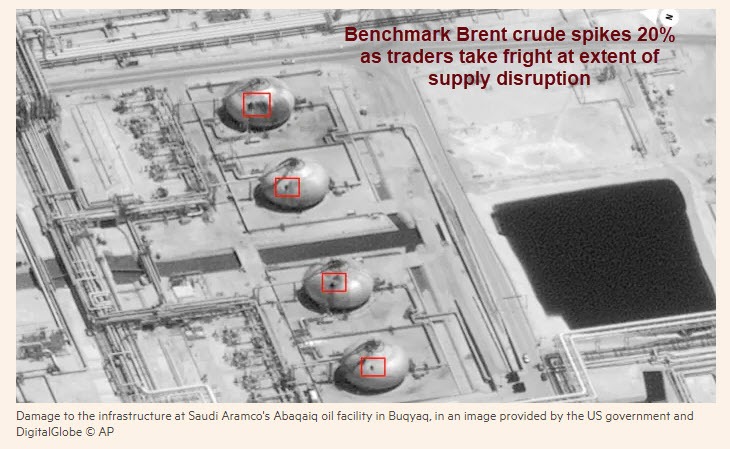
Oil Futures Up 20%
The Financial Times reports Oil prices jump 20% After Attacks Halve Saudi Output.
This is in the wake of a Saudi Oilfield Attack over the weekend.
Questions Abound
By Yemen, Iraq, or Iran? Israel?
Production Back Up When?
See the above link for discussion.
Treasury Yield Flat
Meanwhile, I note US Treasury yields are flat.
As of 8:20 PM central Sunday evening, there is no change in 3-month, 5-year, 10-year, or 30-year treasury yields.
Economic Sense
I propose there is little economic sense to this reaction.
Oil shocks are inherently recessionary.
Theoretically, this could be an inflationary recession like the 1970s.
But really?
Global Fairy Godmother
With stocks priced well beyond perfection, a collapse in global trade, a UAW Trade Strike Involving 48,000 Workers, and trade war threats between the US and Europe (and the UK and Europe), this all seems strange.
Then again, perhaps the Global Fairy Godmother will solve all the issues and restore global inflation (as measured by central banks).
Mike “Mish” Shedlock






























The treasuries were right not to react … Oil markets were hasty to react to an event which will have little bearing on prices after a couple weeks, when supplies are to be fully restored.
I suppose you think investors should park their money in euro or yen-based assets???
This attack hasn’t broken the long-term downtrend in oil. It looks like a hiccup. If you can take out a significant proportion of the world’s oil capacity and still get what amounts to a rather muted reaction, this says the world economy is in far poorer condition that policymakers make it out to be.
I don’t think it says much about the world economy. Rather it says that Saudi oil is far less important than in the past. Supply is much more diversified and has expanded greatly since the 70’s. Therefore the shock to demand is lessened.
We’re going to blame Iran, no matter what evidence is uncovered. And with the Saudis and Israel hell bent on eliminating Iran, a war is inevitable. Particularly if a dem wins in 2020.
Mish,
Regarding the 70’s inflationary recession…
How many times has the U.S. experienced an inflationary recession? I was under the impression the 70’s was a one-off due to the dollar being un-tethered from the gold standard in 1971.
“How many times has the U.S. experienced an inflationary recession?”
Only once. It began, as you noted, in 1971.
Thanks@Stuki . Is my understanding of the root cause (free floating fiat currency catching up to the real inflation from the 1960’s) correct?
Yes.
May be you are trying to find co-relation between two things, when there is very little co-relation to be had. Oil has fluctuated between $65-55 range for last six months and hardly had any impact on inflation on the up or down side. The one day spike is likely a panic reaction, such things subside within a few days. Even if not, it has taken oil to $60, almost middle of its trading range.
For financial types, maybe a big deal, but treasuries represent our economy and this spike is going to have negligible impact, hence negligible reaction.
“You never let a serious crisis go to waste. And what I mean by that it’s an opportunity to do things you think you could not do before.”
“I have also informed all appropriate agencies to expedite approvals of the oil pipelines currently in the permitting process in Texas and various other States.”
What the post-event behavior of oil and bonds shows is they are separate markets. One does not necessarily have to move with the other.
Well, at the open bonds are up, yield down, but not the whiplash inducing levels that oil is up by. I would have to speculate that they are priced about as much as they can be given the ridiculous NIRP levels they are already at. Remember that the bond market is many MANY times the size of the oil market, a few pennies upward in price on debt is a whole lot of money when spread over the entire bond market. The only reason for debt price to go up is if the speculators driving price think that the Fed is now going to be forced into lowering rates. They already have the ECB saying as Mish posted the story “how ever long it takes” about Euro QE, and now the bet is the Fed will capitulate and start slashing as well, they have to or the dollar will make the US noncompetitive (as if we are bothering to compete now).
A side note, my ss COLA for 2020 is said to be calculated at 1.6% increase and that was based in large part on falling oil prices, part of the reason August and September are the base months for the CPI calculations is oil routinely falls in those months as the end of the summer driving season along with the need by refineries to dump any leftover stocks of fuel so they can gear up for the winter fuel cycle of production, gasoline goes on sale.
Then we have higher prices starting very shortly after they begin the winter blending season, this year they could not wait, less than two weeks after Labor Day we see an attack on SA oil facilities and a spike in prices, continuing tension in the region will likely keep prices higher. Higher inflation is a goal of the Fed, this will set them just a little freer to do what they have been constrained in up till now.
Am I misinterpreting the top photo or do those strikes look quite accurate and well defined? Carefully placed.
Very capable rebels or someone else?
My untrained eye agrees with what you are seeing. Those look like precisely guided strikes, all from the same direction, all at the same height, all in a row. I think someone is sending a message that they could have disabled more of the facility if they had wanted to.
Given how the market is mostly unimpressed this morning, I guess many people take it for granted that this will be resolved without any more successful attacks on the facility. I think I am going to give this at least several days before I start to feel at all comfortable with what just happened.
If this really did originate with desperate Houthi in Yemen, then the strikes will probably continue until Saudi Arabia either loosens the blockade or destroys the Houthi bases.
Some strange conspiracy theories, including it could help the Aramco float achieve towards target valuation so there might be incentive there.
Too clean and clinical looking to be a slap-dash rebel attempt without assistance.
A little Google Earth investigating shows the impacts facing north/north west. Looks more like it came from Iraq, Syria, Isreal. Yemen or Iran would need to make some serious turns to hit from that direction.
Yes, “clean and clinical” is a good description. These were accurate precision strikes. It is also absurd to suggest that Saudi Arabia did this to themselves.
Recent news reports quoting “US sources” are now saying the weapons were cruise missiles launched from Iran. It is hard to know what is accurate reporting and what is not, but it seems clear the weapons are too high tech for Yemen. We also have the Russian Kremlin now stating these attacks are a “consequence” of the Yemen crises, effectively warning the US not to take this out on Iran. This begs the question, why should Russia weigh in so soon? Do they have an interest in this?
The extremely bad scenario (for the US) is Iran, Russia, and possibly China are allied to put “maximum pressure” on the US and restrain President Trump’s cowboy diplomacy.
Next you know, Lindsey and friends will demand Google Earth be scrambled. It’s too dangerous if the minions know anything at all, you know.
Knew there would be an oil jump, which is why I filled my car gas tank yesterday. I’m so smart!
wow…you must have made a staggering 5 euro profit !
“No growth in wages? You must be kidding me. My company payroll went up 25% YOY. Stop this nonsense.”
It is beyond absurd to propose that what is happening at your company represents a national trend.
Mish
Maybe he hired some people…
They both are wrong. Everyone is stuck right now. No one knows how to play this current economic environment.
I may be the only one on the planet feeling this way, but I no longer view Treasuries as a safe haven bet. I think they’ve been massively over-bought, driving yields into the mud. We can debate how far into the mud, but it’s mud. A run back above 3% on long bonds will result in a capital loss rivaling an average junk bond default haircut.
Treasuries still have a good run in front of them.
For multiple reasons, but I’ll just give you one. Dominoes.
Nothing has blown up yet. And when things start to blow up (and they will) safe haven needed. Stocks? Real estate? Corporate (especially junk) debt? Municipals? State debt? They will go first … and only then will treasuries be at risk.
Any rise in interest rates on treasuries will act like a governor on economy.
And Gold is…up about 1%…
“Were the Soviet Union to sink tomorrow under the waters of the ocean, the American military-industrial establishment would have to go on, substantially unchanged, until some other adversary could be invented. Anything else would be an unacceptable shock to the American economy.”
― George F. Kennan
Huh? What does this post have to do with oil?
I’m just guessing, but perhaps numike is suggesting that our nation is guilty of ‘inventing’ a new global adversary in Iran to justify continuing expenditures to our military. Our present plans to spend $700+ Billion on defense will only grow IF we have a ‘need’ to increase the spending. A new war in the Middle East is a possible justification for increased spending.
Looking at the utter incompetence of our so-called leaders, experts and central bankers, the out of control debtlevels and geopolitical madness…how can this not end in a massive downturn and depression. All this posturing and negative interest-rate madness does not work. The filthy rich got ever filthier rich, meanwhile there’s no real wagegrowth for the average worker and they’re reaching recordlevels of private-debt. Mish…how about a segment on the disparity between said groups? And thanks for the great articles of late.
No growth in wages? You must be kidding me. My company payroll went up 25% YOY. Stop this nonsense.
For most U.S. workers, real wages have barely budged in decades
Pew Research: But despite the strong labor market, wage growth has lagged economists’ expectations. In fact, despite some ups and downs over the past several decades, today’s real average wage (that is, the wage after accounting for inflation) has about the same purchasing power it did 40 years ago. And what wage gains there have been have mostly flowed to the highest-paid tier of workers.
Please keep in mind that the inflation rate has been “adjusted” a number of times so the official headline rate is a lot lower than reality, using the methodologies that were in place prior to the advent of faux inflation stats real wages are actually a lot lower and real inflation has eaten a bigger chunk.
“In fact, in real terms average hourly earnings peaked more than 45 years ago: The $4.03-an-hour rate recorded in January 1973 had the same purchasing power that $23.68 would today.”
I can’t see how that will change but is an example where some deflation might have at least helped purchasing power.
With more global labour than demand, plus more automation, plus CB induced inflation of housing costs and essentials, plus weak productivity growth, plus poor demographics in the primary consumer countries, plus debt levels etc. The list goes on.
What to do about it? All roads look like having to pass through corporate profits squeezes, increased unemployment and inverse wealth effects before much improves. Alternatively print and give the money to Joe-sixpack to pay down debt or spend or invest.
Am I jaded or are we in a cul-de-sac?
Mine went up an infinite percent.
I can’t see how that will change but is an example where some deflation might have at least helped purchasing power.
With more global labour than demand, plus more automation, plus CB induced inflation of housing costs and essentials, plus weak productivity growth, plus poor demographics in the primary consumer countries, plus debt levels etc. The list goes on.
What to do about it? All roads look like having to pass through corporate profits squeezes, increased unemployment and inverse wealth effects before much improves. Alternatively print and give the money to Joe-sixpack to pay down debt or spend or invest.
Am I jaded or are we in a cul-de-sac?
Yes C-A, but really it would not help to have deflation because so much of the economy and even personal consumer finances are built on a mountain of debt which in deflation becomes a near intolerable burden. You have to repay all that inflated debt with new deflated dollars. Any serious level of deflation would crash the economy is no time. You might be able to make a $1,695 or more per month house payment for 30 years as long as inflation continues, but, as soon as it stops or reverses those payments become unpayable for too many people.
You don’t have to repay that debt. Defaulting on it works just as well, as a means of reducing it.
Defaulting, and bankruptcy, sounds onerous to each individual. As he is “losing everything” and have to “start over.” But the math becomes much more agreeable to most people, if the default is genuinely systemic, as it would be with an overnight shutdown of The Fed and a rollback of the debasement driven theft by again pegging the dollar to Gold at $20/oz. “Everyone” “loses everything.” Yet, at the same time, nothing has been lost. Houses don’t disappear just because of a BK. Neither does factories, roads, schools, nor anything at all. No real wealth “lost.” No people added. Hence, systemically, “noone” loses anything at all. Other than the debt.
Of course and the economy in general will have to default on a lot of that debt, however there is a drawback, the ownership of the property changes hands if it is pledged as collateral. That might seem like nothing is actually lost, but if it is to me then it is lost.
And go to Detroit, or the Bronx, Camden, Baltimore, look at the miles of streets that are empty lots or burned out and boarded up wrecks, beyond salvation, they are lost. Shame too because so many were built long ago during more prosperous times with exotic woods and fine stones, only to become crack houses and derelict. Irreplaceable materials that I do wish could have been saved.
I remember that gold was seized at $20 only to be repriced at $35 shortly after for a huge devaluation of the dollar, but since they also outlawed private ownership it really only affected external payments.
The Fed may be transformed and could even be made more accountable, but I doubt it will go away, much as we would like to see the banking industry turned into a utility that is strictly regulated and leave speculation to private investment houses who risk only speculative accounts and which are not insured or otherwise guaranteed by any government insurance or bailouts.
But, if it were nationalized, that is the banking system taken over by the treasury or subject to direct interference from congress, well I think that would be an even worse situation than we have now because politician simply cannot resist the urge to print their way to reelection, rather than tax our way out of problems. The only advantage to that would be that politicians are ultimately accountable through elections where the Fed appears to be accountable to nobody now.
“..however there is a drawback, the ownership of the property changes hands if it is pledged as collateral. That might seem like nothing is actually lost, but if it is to me then it is lost.”
Change of ownership, from beneficiaries of nothing but Fed mediated theft from others, back to said others, is not a societal “drawback.” Like returning stolen goods to their rightful owner, it may be a drawback to the thief who stole it, but for a functioning society, it is nothing but an unmitigated boon.
Of course, well over a century and a half of persistent Fed mediated theft, guarantees that any such return, will inevitably be incredibly imprecise. But that is no excuse for simply continuing to perpetuate the theft. Even a pure random reset, is a system wide improvement, over any distribution resulting almost 100% from the actions of a purely zero value add redistributing thief; which is all we have today.
I agree Stuki, but that does not answer the question; how would getting rid of the Fed be better than having the US Treasury in charge of our money and banking system? At least the Fed has theoretical background, the same bastards that working at the Fed will instead just transfer to the Treasury department if the government takes over their duties.
The problem is not who is running it all from what building, it is that the population is seen as nothing more than a means of theft, a cow to milk, given just enough hay and grass to stay productive with all the benefit going to an elite 10% and mostly 1%. Ending the Fed is not going to end that mindset. And in fact could make it worse because politicians have the same mindset and the same greed, but they also have the added pressure of elections to win.
We have to state our goals, e.g. a stable currency, fairer distribution of income, and many more. But, then we will also have to reform our political system because that is really at root corrupt, and corrupted for the top 1%, transferring the duties of the Fed to the government (or anyone else for that matter) is simply transferring the problem.
I know we need to do SOMETHING and soon, it is not just the destruction of our economy we are discussing here, it is the destruction of our nation and the people in it, maybe the world, but simply ending the Fed is not the answer, before we make any rash moves we need to figure out just exactly what it is we need to accomplish. Debate the best ways to get there. Not forever, but enough to hopefully improve matters and not make them worse. I have read some opinions here that are nothing short of genocide for the bottom quintile of the population and harsh social Darwinism for the rest of the bottom half rending the poorer half little better than permanent sub-classes, slaves. That is the goal of many who want the Fed’s elimination. Of course it is already happening with the Fed in place also, but on a slower pace.
Thanks to Uncle Joe and his gift to the creditors called BAPCPA of 2005, bankruptcy is not the option it once was.
.
Treasuries are an artificial “market” controlled by the Fed. NY Fed closed for the weekend. Seems rather straight forward
.
The economy is so dead (collapsed) for so long,300 dollar oil couldn’t make any difference,full scale nuclear attack from China and Russia simultaneously wiping every major US city and futures would still be at record highs,welfare checks will still go out…..(maybe a couple days late)and the dead ass zombie economy will hardly skip a beat!
Well duh, imagine how much stimulus the economy would receive from rebuilding! /sarc
Yup. I think investors would see nuclear war as a positive. Just think if the stimulus package!
It’s nothing but broken windows from here on out.