

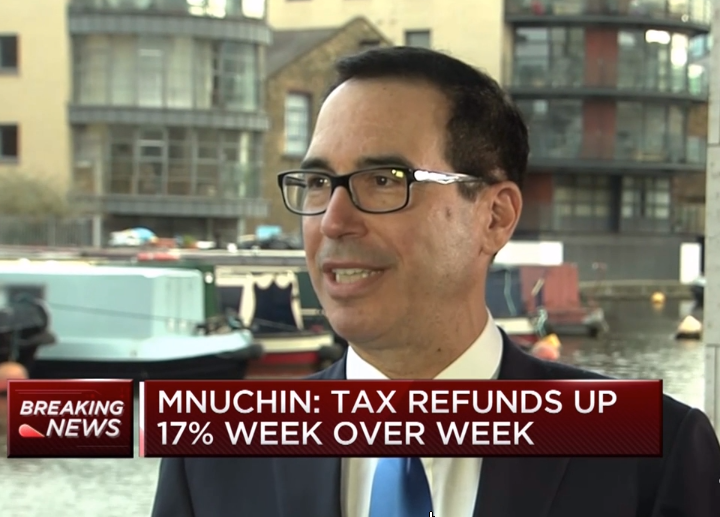
The Trump tax cuts front loaded the impact by giving people more money weekly. The net benefit was positive for most people, on average, but because the IRS chose to pay the benefit out of every paycheck, year-end returns will be smaller.
Outraged but Shouldn’t Be
The New York Times explains Why People Are Outraged at Lower Tax Refunds (but Probably Shouldn’t Be).
Both these things are true: Most Americans received a tax cut in 2018. But many will see a smaller tax refund than they are used to when they file their 2018 returns.
And plenty of those people are irate about this, as evidenced on Twitter and in news coverage.
But Economics 101 would suggest that this trade — getting the money early and receiving a smaller refund or owing money to the I.R.S. at tax time — is the better deal.
Anger Mounts
- The Washington Post writes Millions of Americans Could be Stunned as their Tax Refunds Shrink.
- The New York Times says Smaller Tax Refunds Surprise Those Expecting More Relief.
- ZeroHedge commented today Millions Of Americans Are Getting Angrier: Tax Refund Shortfall Hits $46 Billion
Tax Cut Tweets


Wait a Second
The US Treasury says Average Tax Refunds Up 19 Percent from Last Week and Consistent with 2018 Refunds.
Through four weeks of the filing season, the average tax refund in 2019 increased to $3,143, a significant jump from last week’s average of $2,640. The average refund at this point in the filing season is now up 1.3 percent over last year based on 47.7 million individual returns processed thus far in 2019 compared 49.2 million returns processed in 2018.
As previously stated, the increase in the weekly data is primarily due to the remainder of the Earned Income Tax Credits and Child Tax Credits being paid out this week. Despite the higher refund average, we remind taxpayers that weekly filing season data is variable and will continue to fluctuate. We caution against drawing broad conclusions on refunds overall this early in the filing season.
So are refunds up or down? Yes and yes.
And as one of my readers noted, averages are misleading. A few big winners can balance out a huge number of losers.
Beauty is in the eye of the pocketbook.
Mike “Mish” Shedlock






























Perhaps looking at the median refund is more appropriate?
Surprise surprise, the con man wants the largest con in history to continue.
“….IRS choose to pay the benefit out of every paycheck”. Say what? Benefit? We’ve been reading to much AOC lately. Her motto is “if we take your money, we can keep your money”.
…. And as long as we know exactly what you make, and who pays it to you, taking it all is pretty darned easy. Even behind your back. Not a darned thing you well indoctrinated dupes can do about it…
In those examples it looks as if socialistic redistribution is already here.
That Michael K Richards tweet makes no sense. How does a middle-income guy in a low-tax state end up paying more? There’s more to the story.
He owns a home, before new tax law he would itemize the interest. Withholding is much lower now that standard deduction is much higher, he paid no more in taxes if same structure. Refund difference is huge for middle class earners that own a home and itemized before new tax law, however they don’t pay any more taxes. Many take home much more like myself, who don’t own a home and cannot itemize.
You’re confusing the issue. Withholding is irrelevant to total tax liability. If he under-withheld, that’s a different issue. But he’s claiming his withholding was unchanged and that his total tax liability went up.
That makes no sense. It would take an enormously expensive home for the property tax to overcome both the lower tax rates and the higher standard deduction. People making $83,000 can’t possibly have such high state and local taxes unless they’re living in a mansion given to them by mommy and daddy.
U.S. personal income posts first drop in over three years
There are many where I live that have to pay a lot more because property taxes are so high. And these are the people who complain and make the news because the news loves anything anti-Trump.
The only reason I claim 0 dependents on my W4 is because I don’t wish to make quarterly payments. Over the last few years any refund I receive goes right to paying down the mortgage, so I won’t really miss it anyway.
Wouldn’t we all pay much closer attention to government spending if payroll deduction were eliminated and we all had to write out a check for the full amount of our taxes each April 15?
I did a comparison. I computed my taxes based on both old and new rules. My tax bill is lower under the new rules. Single, no kids, renter. Results may vary depending on one’s situation.
The L.A. unified School District is putting a property tax increase on the ballot, to pay for their capitulation to the teachers union. The teachers union will be happy to take anyone’s tax refund.
Yes, and judging from their published test scores, I have a Ridgeback that can read better.
Munchkin is a Skull and Bones member, so you can’t believe anything he says anyway.
This was an unforced error by Republicans. Big tax returns are something working class people can understand. Giving a big lump of money at return time would have been a big win when they needed it. Instead they got trashed on the tax break when it happened, and trashed again at tax time. Washington Republicans don’t understand working class people.
People living in high-tax “Blue” states are now feeling the sting of the $10,000 SALT cap. Boo-hoo!!
Those people are not who Republicans need to worry about. You’re kidding yourself thinking the fallout of this is limited to wealthy folks in blue states. It’s a political disaster for a party already saddled with numerous disasters.
To some degree, yes, but many people who lose significantly due to SALT limits will save due to the AMT changes. They already lost SALT deductions to the AMT anyway. I’m in a dark blue state and overall I benefit significantly from the new tax law. Ironically, it is the people who exceed the SALT cap, but don’t earn enough to pay the AMT, that are the big losers in blue states.
You are right, and there are plenty who fall into that category.
But rather than complain, these ungrateful bastards should just think of all the valuable “guvvamint services” they are receiving.
So my question to you, next time there is a democrat president and he/she uses the tax code to penalize the red state where you live you will also be saying Boo-hoo?
That change in the tax code was passed by a Democratically-controlled House of Representatives by a WIDE MARGIN.
Please go somewhere else with your inane, ignorant comments.
Dude inane all you want your president will eventually be wearing an orange jumpsuit
The prior system essentially had the Federal Government subsidize the high tax states. Under the new system, residents of all states pay the same tax. It is true that those that live in a high tax state now pay more total tax than people that live in a low tax state. If they don’t like their local tax burden, I would suggest they it take up with their local taxing authorities, not look to the Federal Government to take money from lower tax states to give to them.
But aren’t you republicans all in favor to “more power to the states” philosophy? What can give more power to the states to be able to keep more tax money from the federal government?
I’m not a Republican, but I do favor more power to the states. The old system took extra tax from low-tax states, and less tax from high tax states. That in essence transferred money from low tax states to high tax states, which is inherently unfair. By eliminating the SALT dedcutions, the local and Federal taxed are now unconnected, as they should be. Each person pays the same Federal tax, regardless of where they live. They also pay State and local taxes that do depend on where they live, and which are used to provide benefits locally.
The new system is much more fair. If a person chooses to live in, say New York, which has more taxes and benefits, they get the benefits, and they pay the taxes that support them, but they can no longer transfer a portion of their costs to the states that don’t have high taxes.
It’s easy to believe that people in high tax areas liked being able to transfer part of their tax burden to people in other parts of the country. It’s difficult to believe that anyone would argue that that is “more fair”.
“That in essence transferred money from low tax states to high tax states, which is inherently unfair”
That is not at all how the federal government transfers money to the states. If what you say were true we would be seeing and increase % wise of the total pie to go now to red states
I agree that I worded it poorly, and money is not transferred from one state to another. To be completely accurate, what I should have said is that “The old system required people in states with low tax rates to pay more in federal income tax than people with the exact same income in states with high tax rates. Under the new system, people with the same income will pay the same Federal tax, regardless of their state’s tax system.”
“”The old system required people in states with low tax rates to pay more in federal income tax than people with the exact same income in states with high tax rates”
Which takes me back to my first comment: The states keep more and the federal government less. Isn’t that what all of you always asking for: More for the states?. Perhaps you all should vote for candidates that would allowed for higher deductions from state taxes so that more money stays at state level?
It is also true that a few big losers can average out for a lot of winners. Certainly those in high tax states, with big mortgages are probably worse off. Meanwhile, those in low tax states, and/or without mortgages, are probably better off. The ones who are worse off are going to make a lot more noise than those who are better off, so of course it will seem that there are more of them.
So… where is your source of ultimate truth?
The ultimate truth is that the difference between dead broke, and dead broke plus or minus a couple of percent, is so far below the noise floor as to be irrelevant.
If you’re going to do anything meaningful, make it 30%. People notice that. Not just in some silly technical sense that only the biggest molehill hype machine ever assembled, can make a mountain out of.
The only people systematically benefiting, from wanking around at the tiniest margins, of the incomes of other people who have something more useful to with their lives than woodshed on tax code minutiae, are those explicitly out to nickle and dime others to death behind their backs.
If you are going to have a “democracy,” for it to have any chance of being even semi functional, at the very least the things people vote over have to be clear cut and obvious enough for all to see. Otherwise, all you have is rule by intentional obfuscation.
Just goes to show you how misleading news headlines can be. Especially in the era of internet based news.
I know a couple of folks who were shocked when they had to pay $2000+ when they were used to getting small refunds. I think there are a couple of issues here:
The big tax payment is psychologically much more painful than the happiness of a small bump in the weekly paycheck. It’s not like the average Joe starts working on investment strategies for the $50 bump. He just buys better beer.
The big jump in the standard deduction was a throat-cutter to middle income folks who have big mortgages and live in high-tax states. I bet Mish got a little kick in the tail on that one.
A whole bunch of pro-Trumpers are burning their MAGA hats. As for me, after dumping $30k+ into non-taxable retirement systems on a decent six-figure salary, I’m getting $39 back. And I paid Taxact $29 for the privilege. I’m going to buy a six-pack of some decent beer with the $10 difference.
Total taxes paid by the middle class are down. Don’t try and do too many mental gymnastics on this. And don’t believe the biased mainstream media. Some refunds are down ONLY because many people saw their take home pay go up due to withholding.
excellent comment shamrock. I added this line: And as one of my readers noted, averages are misleading. A few big winners can balance out a huge number of losers.
“Average” refund is up, “typical” refund is down. The 1% getting big ones?