

It will be a stretch for the Fed to pause for many reasons, not just the CPI.
The Fed’s preferred measure of inflation is the Personal Consumption Expenditures (PCE) price index, specifically core PCE, not the CPI.
However, the next FOMC rate decision meeting is September 16, but the August PCE report is not until September 30.
Therefore, the CPI announcement on September 11 and the Jobs report on September 4 are going to determine whether or not the Fed hikes or remains on pause.
CPI and PCE Year-Over-Year Percent Change plus Projections

CPI and PCE Year-Over-Year Projections
- CPI: 3.37 percent, unchanged
- Core CPI: 2.38 percent, down from 2.48 percent
- PCE: 3.79 percent, up from 3.70 percent
- Core PCE: 3.40 percent, up from 3.34 percent
The only measure that remotely supports a pause is core CPI. But after being reliant on PCE for decades, that would be quite the switch.
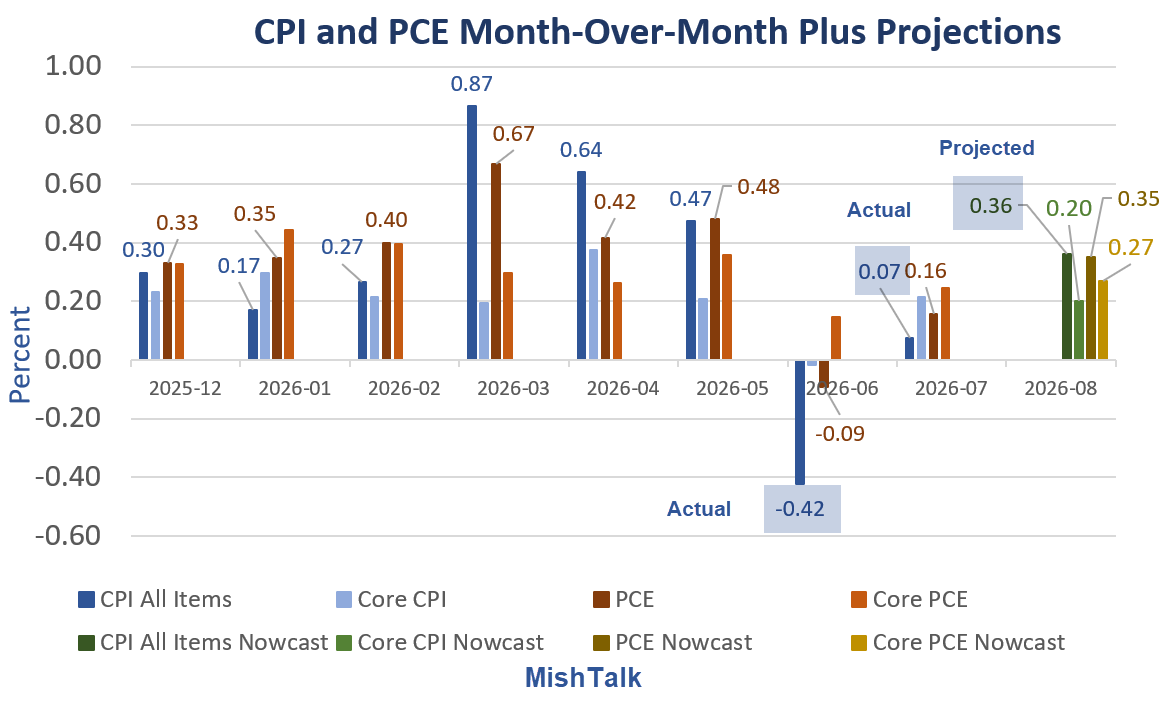
Month-Over-Month Details

There is nothing about month-over-month details that suggest the Fed should pause.
The CPI moved from -0.42 percent to 0.07 percent to a projected 0.36 percent. That’s an annualized 4.41 percent.
Core CPI at 0.20 percent is 2.43 percent, still substantially above Fed target.
The PCE projections are on the hot side, but we won’t see them in time.
Cleveland Fed Accuracy
The Cleveland Fed Inflation Nowcast is widely recognized as one of the most reliable real-time tracking models for U.S. inflation. Historical evaluations by the Federal Reserve Bank of Cleveland and independent market researchers show it consistently rivals or outperforms major alternatives.
- Outperforms Professional Forecasters: Long-term data shows the Cleveland Fed model regularly yields smaller prediction errors than the consensus from the Blue Chip Economic Indicators Survey and the median forecasts from the Philadelphia Fed’s Survey of Professional Forecasters (SPF).
- Strong Headline Inflation Accuracy: The model is particularly dominant at projecting Headline CPI and PCE. It synthesizes daily shifts in high-frequency data—like oil spot prices and retail gasoline tracking—giving it a substantial edge over sticky multi-week survey groups.
- Competitive Core Performance: For Core CPI and Core PCE, its accuracy is roughly neck-and-neck with top Wall Street economists. Because core metrics strip out volatile food and energy, high-frequency updates add less massive variance advantages month-to-month, but it remains an elite baseline.
- The Timeliness Advantage: Because it updates every single business day, its accuracy increases as the target month progresses. A Nowcast generated on August 30th for the August cycle carries immense statistical weight because nearly all intra-month agricultural, energy, and primary consumer data have already been logged.
CME Fedwatch Odds

The CME Fedwatch rate hike odds are 59.7 percent. The odds jumped from under 40 percent on Fed Chair Kevin Warsh’s Jackson Hole speech on August 28.
Odd Too High or Too Low?
Because I expect the Cleveland Fed to be close on its inflation nowcast, I believe those odds favor a rate hike.
A decision to hike also depends on the jobs report on Friday September 4. If the report is OK to strong, the Fed will have more reason to hike.
But even if the report is weak, a headline CPI of 0.4 percent will be hard for the Fed to ignore.
Politics is another huge hurdle that will force a hike sooner rather that later. But first let’s discuss Jim Bianco’s take.
Bianco’s Take
Bianco Part II
Hints from Warsh
On August 28, I commented Expect a Fed Rate Hike. Odds Jump to 60 Percent on Warsh’s Speech
“We must be confident that underlying inflation is moving to our objective, clearly and at sufficient speed. Otherwise, we have work to do,” he said in his first speech as Fed chairman, a highly anticipated debut at the Kansas City Fed’s annual symposium in Wyoming.
“I would be hard-pressed to describe broad financial conditions as restrictive,” said Warsh.
Indeed!
The Final Hurdle is Political
While macro indicators including credit and the strong Cleveland Fed Nowcast provide the fundamental backdrop for a rate hike, the final hurdle is purely political and institutional.
Jim Bianco’s tracking model places the FOMC in a rigid 5-5 gridlock, thrusting former Chair Jay Powell out of the background and directly into the role of the ultimate swing vote.
However, treating Powell as a true ‘unknown’ ignores deep-seated institutional inertia. Historically, Powell has fiercely defended committee cohesion and has never dissented against a sitting Chair. For the Fed to project long-term stability under newly minted Chair Warsh, a public fracture between current and former leadership is a line the committee will desperately want to avoid crossing.
Consequently, if the incoming September 4 labor report shows basic stability, Chair Warsh will have the necessary data to leverage his executive influence. When the most influential person in the room pushes for an inflation-fighting hike, historical precedent dictates that Powell will fall in line to preserve institutional unity.
But there is sill one more wrinkle to discuss, and that is the election.
The Election
Convening less than two months before the November mid-terms, the FOMC will operate under an intense political microscope.
Historically, the central bank prefers to fade into the background during election cycles to avoid accusations of interference. Dovish voters will undoubtedly attempt to weaponize any minor softness in the September 4 payrolls as an excuse to hold steady and dodge political crossfire.
Yet, under Chair Warsh’s newly minted regime, delaying a mathematically justified hike to appease politicians would represent the ultimate failure of institutional independence.
If the Cleveland Fed Nowcast proves accurate, a hot inflation print will effectively strip away the committee’s political cover. In a fractured Fed of 12 independent voters, hiding behind election-year precedent will no longer be an option.
October 28 Rate Hike Odds

Is the Fed really going to hike, not just two months before the election but days before the election?
The Extraordinary Tactical Trap for Warsh
Ignoring politics, the odds of an aggressive policy tightening would be much higher right now. As Jim Bianco explains, the internal fragmentation of twelve independent voters acts as a natural dampener on rapid market repricing.
However, the other, more obvious problem for Chair Warsh is Donald Trump. Warsh was hand-picked by Trump under the explicit expectation that he would cut rates, not hike them. Compounding this personal friction, the midterm election is now just two months away.
That political gravity is why we must heavily discount the odds of the Fed executing two distinct rate hikes before voters head to the polls.
Yet, the CME FedWatch data for the October 28 meeting shows an exceptional 71.3 percent cumulative probability of a higher target rate. The market firmly believes a hike is coming; it is merely unsure of the precise date.
This creates an extraordinary tactical trap for Warsh.
If Warsh postpones a hike in September, but the August and September PCE prints are hot, he will be forced to either hike interest rates six days before the election or freeze policy. Hiking would trigger a huge political firestorm but pausing would look entirely partisan in defense of Trump.
Moreover, there is no meeting in November. Delaying necessary policy tightening until December would allow hot inflation to fester for a full quarter, creating a reputational nightmare. In contrast, hiking would create a political nightmare.
Conclusion: The Strategic Imperative for September
The upcoming September meeting represents the Fed’s cleanest and most viable window to execute.
Unless the jobs report is miserable and the CPI is tame, look for Warsh to hike rates in September.
To avoid any look of politics or uncertainty, I think Bianco will be wrong on the number of dissents, say three or less.
Related Posts
August 26, 2026: PCE Inflation on the Hot Side, Lack of Progress in Pictures
Let’s discuss the Fed’s preferred measure of inflation and gasoline.
August 28, 2026: The BLS Annual Benchmark Revision for March 2026 Is -178,000 Private Jobs
The total revision was -79,000. This is the smallest benchmark revision since 2021.






























Token each point of interest is a major load to USA which cannot finance the interest. Think they are playing musical chairs hoping the other country defaults first starting the dominoes falling.
I doubt if they will hike, because they know that if they do one hike in September, they will be doing 4 cuts in October!
Right On! You are likely right – one interest rate hike right now will TANK the economy. And yes,
Lol,’they would likely follow by four rate cuts (or one mega cut) in October. Red (bloody) October?
Nothing new. The FED “follows the market”
“CFS Divisia M4, which is the broadest and most important measure of money, grew by 7.9% in July 2026 on a year-over-year basis versus 7.8% in June.”
Bond vigilantes will force the Fed to raise rates.
The FOMC is a band of fools. The last FOMC meeting was clearly the best time to hike, on both financial and political grounds. All the data was in place, despite any claims to the contrary.
Not touched upon is the element of Bessent selling more short-term debt to buy long-term debt (yes, paying the mortgage with your credit card). That puts pressure on the Fed to monetize Bessent’s new debt issuance, the more so if it means to not raise short term rates.
Interestingly, the 30-yr yield is approaching the level today that provoked Bessent’s manipulative intervention.
Increasing oil prices pressures Japan to sell Treasuries, ceteris paribus. Perhaps the main conduit whereby oil prices and long-term rates have lately correlated?
Someone, fat and orange, will blow out his diaper.
There was some great youtube commentary by Patrick Boyle over the weekend in which he describes the non-resolvable conflict between what the Fed wants and what the Treasury wants. If interested, just search on youtube for the title…. Scott Bessent Is at War With Prices — and Prices Are Winning!
Not sure about a “political firestorm” – Trump may have a fit, but Americans pretty much tune him out.
Like Powell, Warsh is likely not afraid of Trump.
Delusional Trump Says He’s ‘Largely Taken Care Of Inflation’
During a softball interview on Fox not “news” this Sunday, Trump once again proved he’s living in some alternative reality.
TRUMP: And frankly, know, with the inflation, I’ve largely taken care of inflation. By the way, the gasoline is going to go down. The oil is going to go down like a rocket going in the opposite direction as soon as we win that war, complete the war.
All this “sturm and drang” over the prospect of a measly 25 bps rate increase when inflation is running at almost double the Fed’s “target”.
Sheesh!
Yep. We are due for a Volker moment.
Hi mish early this year i said PMs were in bubble territory. I got some kickback on this blog for this but obviously they were and silver esp collapsed. I think PMs can attract a cult like following. I think at times your blog has contributed to that but overall gold has been a good investment.
In fairness you said it would make sense to take some money off the table.
What do you think about PMs now. I agree inflation is here to stay and rates will go up.
My take is that gold has corrected and will do v well. Trump is nuts as are the Dems and gold loves uncertainty. Silver could be the best trade of the next five years. Thanks from UK.
My guess is higher – May depend of how aggressively Fed hikes
They won’t hike. What was the vote last time? 3-9 in favor of raising the rates. This time, it will be 4-8 or maybe even 5-7. So, no hike – again! But everyone will be commenting on how “hawkish” the Fed has been getting!
PMs will be back soon enough when the market inevitably crashes and burns from stupid AI circular investment. Gold went bananas after 08 and it will again just because it’s the oh crap buy of many traders.
I’m not sure what a one and done 0.25 bp hike will do to stem inflation that is 5-10 and even 15%, depending on the sector. You can’t create trillions in phantom wealth without there being consequences (see spacex, the new astro-bridge to nowhere).
I see a raging house fire and the Fed trying to put it out with a single glass of water. So what do they really want? They want burn the house of debt to the ground with inflation.
https://finance.yahoo.com/real-estate/article/more-than-i-expected-to-pay-rents-are-rising-at-the-fastest-rate-in-over-a-year-160229184.html?g
Looks like Japan might be dumping US treasuries and Stocks today to strengthen the Yen. Could be like 2024 if it gets bad. I’m guessing they’ll pull back because such a move would anger the great orange one.
A hike won’t do anything.
It all depends on when the AI bubble pops
I like simple logic: If Warsh has a spine, there will be a hike in September. In his second term, Trump hasn’t appointed a single person with a spine. Therefore, there will be no hike in September.
This is the correct take.
Plus, Warsh knows he will be fired and face legal actions byt the DOJ if he dares to raise interest rates.
SCOTUS already made very clear that the fed chair is untouchable. It was an explicit point that came up during the Lisa Cook case so Trump didn’t get any ideas.
But Warsh will be sure to sound “hawkish”.
This is a sensitive time for the Fed to imagine stopping its kicking the can down the road. That has been its default move since the advent of Greenspan (in what, 1987?). That bias is toward rate cuts or timidity. Government entities generally find can-kicking to be by far the path of least resistance (as in Exhibit A, the federal deficits and debt), even when an election is not pending.
There are many politically consequential things that might appear and come to a crescendo this fall. I definitely expect lurid October surprises from Trump via executive orders. But I expect the Fed to take the politically cowardly way out. That is the deepest institutional inclination in the USA. Even Trump as a disruptor frequently TACOs out of dramatic moves he loves to momentarily trumpet about.
“Kicking the can down the road” is more or less what the Fed or any central bank was created to do. The purpose of a central bank is to fund the government’s deficit. Inflation is a hidden tax. How often do these simple truths have to be repeated before they sink in?
Gossiping about it and confusing the issue is what the Fed and the government want you to do. People who live by fraud want confusion. They want silly remarks. They don’t want clarity.
And, let’s be real here: RATES do not affect the lowest rungs of our culture who are simply trying to make ends meet. We live near VERY poor people here in our Summer Home and we know them through connections.
One of them complains of having her SNAP bene’s discontinued (we ran into her at a Festival this past weekend). She said that her friends, mostly Middle class retirees and hurting, “have had enough of this shit!”
I cannot tell what she meant: TRUMP and BIDEN in a row, or TRUMP BEING WORSE! MOST people cannot spot the fact that when it comes to R OR D: they are all doing the same shit, peppered with news headlines swaying the facts.
From the perspective of Trump being worse, the local news (which my wife watches) is being peppered with Tina Kotec “fighting against Trump.” Funny shit.
They are probably angry that as middle class retirees their ‘lifestyle’ is going down. Unfortunately for them, that’s the reality of how it’s meant to be. Retirees in general should have a lower lifestyle than what they had when they worked because obviously they are no longer earning money / contributing to society via work combined with the fact they are aging / using more health care.
The fairy tale that you retire and then whoop it up traveling and doing all kinds of wonderful things is just that, a fairy tale. Yes, a few people like you who sold a company and made millions lives that fairy tale but for the vast majority that’s just not possible.
I have found that whooping it up aint what it used to be.
They should be grateful we don’t Old Yeller ‘em when they stop being productive.
If you’re retired and receive SNAP, then you have financial challenges.
This begs the question: “which underlying force” (Politics, or Voting or ???) weighs heaviest towards a very surprising hike?
When is it going to dawn on all the highly educated economists, like “top of his class at Wharton” Trump, that a temporary increase in the income tax is a vastly better way to control inflation than these stupid interest rate adjustments? People can’t spend – bid up the prices – the dollars the government steals from them.
Plenty of economists would recommend tax rises. They are not all of one view. (I’m recalling Truman wishing aloud for a one-handed economist, given their reciting “on the other hand ….”)
Tax increases are the most politically difficult thing to do in a democracy, especially one as geared culturally and ideologically to self-centeredness as ours. The last one federally I can recall* is, George H. W. Bush signed off on one about 36 years ago, which led us toward a balanced budget, but was his political death warrant. *Depending on how one defines Obamacare. The US Supreme Court says it was a tax, Lo and behold, the GOP has campaigned off that ever since.
Tariffs are also tax increases. Nobody in the Republican Party dares say this aloud. What does that say about our “self-centered” culture?
Show me a Politician that’s honest about his/her votes, and I will show you a retired, or soon to be, Politician.
While true, it’s also the fastest pill you can swallow, to have most feel like everything is going to be alright.
Many have a lot riding on this particular direction, and when it’s changing, and by how much.
After all is considered, don’t they usually cave around 33% to each of the 3 parties, when all is said and done and added up. All 3 matter.
tariffs tax the poor and I think a billionaire tax increase would be very popular with the masses no one becomes a billionaire in a vacuum they use the infrastructure and society to become billionaires. IMHO there should be no billionaires when you hit 10 million you get a nice trophy you won capitalism and the rest goes back to the society that made you rich.
They should just completely liquidate Elon, as a warning to the others.
It is supposed to work “Independent” from Political influence. I know Trump and others before him, try to do so, but in the end, the decision is to be made free of such pressure, no matter what they decide.
Push the issue if needed, by calling the rules being broken, and not fairly represented as they are supposed to be. Sort of like all the law suits going on now, for political reasons, and are being questioned. A prominent figure, with no political attachment, would be a good choice to do so perhaps?
Love the analysis, Mish, but I think only a tiny fraction of the voters pay attention to these minutiae.
A hike would be a firestorm for a nanosecond.
I had lunch with my MAGA relatives in Wyoming a couple days ago, and they were talking about Dolly Parton, how much Trump annd her loved each other, and renaming Lake Ontario.
That’s one of the more insane MAGA delusions I’ve heard. There’s just no bottom with these people.
A big part of Trump’s shtick is that he operates like a magician.
He distracts you to look ‘over here’ at renaming Lake Ontario while the important things are being done elsewhere while you looked away.
Every time he announces something inane like renaming Lake Ontario you can bet something important is being covered up while everyone is distracted.
That would make a lot more sense if whatever the distraction was didn’t also bleed votes from his box.
You kidding? Morons LOVE a bully.
It:s something they can understand.
It really depends upon what you think the primary goal of the Fed is now. If the primary goal remains controlling inflation to the 2% level, then the statement “There is nothing about month-over-month details that suggest the Fed should PAUSE.” is accurrate. However, if a hidden agenda of continuing the nascent era of financial repression is now the primary goal, then I would modify the statement to “There is nothing about month-over-month details that suggest the Fed should HIKE.” Warsh’s actions over the rest of the year will tell far more than words in regard to whetther the Fed truly still wants to control inflation or whether it wants to begin the long term process of reducing the real value of US debt.
Don’t forget there is a dual mandate that the Fed admits to which is that they also want to keep maximum employment along with the inflation rate at 2%.
I see the FED rate as some kind of “how much wealth should be transferred from the poor to the rich this year” setting… Money creation favors those who can borrow against their assets, right, at the expense of the others.
money creation really enriches the folks with their hands on the newly printed money. that’s the bankers.
– “how much wealth should be transferred from the poor to the rich this year” > The true “Poor” have no wealth to be transferred. The wealthy “Hide” money from being able to be transferred. Maybe the question should be “how much wealth should be allowed to be hidden”, and therefore “Not Taxed”
Isn’t the bottom line, the amount of taxes being collected against how much money is out there sloshing around? If we are only taxing ex. 60% percent, then we have another 40% to yet collect, and is rightfully owed, but hidden from the ability to do so.
Obviously you haven’t heard of wage theft.
https://en.wikipedia.org/wiki/Wage_theft
If the Fed continues to demand independence then it must first BE independent and just do its job. I see absolutely nothing that spells a slowdown in anything that offsets its OBVIOUS need to hike to tamp down inflation — its PRIMARY job. I mean my god if you’ll let a weekly wobble or hiccup of a thousand jobs take you off your PRIMARY mission of price stability of even their ridiculous 2% then just disband them. Prices affect everyone, jobs affect the job holder and MAY eventually be significant enough to affect the economy as a whole, forcing a revisit. But inflation hits everyone every day and the job market has been resilient thus far.
And if they are now worried about the politics of it all then hells bells we have elections every 2 years, the cycle starts earlier, then you have holidays, data is delayed or seasonal or skewed, and you get exogenous events concerning you–you’ll soon be saying that over a 2 year period, factoring out rare between-meeting moves, only have about 8 chances to move the needle instead of 24?
Analyze, come up with words like contained or transitory, engage PR machinery but keep the printer running, refuse to act, find excuses while maintaining intellectual high-horsedness.
My God! Just do your damn job, which on its face now clearly is to:
Enrich those with assets and access to first money by keeping inflation high.
Enable the government to run deficit spending by devaluing the dollar and providing them dollars, keeping inflation running hot. Oh, and the landing place of that deficit spending, which cannot be directly controlled but ultimately ends up right back in the stock market, enriching asset holders yet again or grifting state and local governments which have proven to fraudulently mismange those funds.
Pretend you have any idea what the price of money/credit should be or that your control of it is possible in the long run or that either of those are beneficent in nature.
It is an unabating sure-to-end-the-Empire attack. It’s happening with more frequency and amplitude. Paul Volcker managed to hammer rates to insane levels by today’s standard where apparently 4 is high–I guess 40Trillion in on-book debt and trillions more in off-book, soon-to-be-on-book debt does have a downside? Who knew.
Surely our refusal to do the right thing repeatedly where we had ZIRP enriching and protecting a certain large demographic group not to be named and fueling a inept and lazy Congress is finally boxing the perpetratory (Fed) into the corner it drove itself into.
It wouldn’t be as hard to watch if I could escape being on the US dollar train while living in the US. I guess i needed an exit strategy–but to where?
Once you are out of the US your mind expands and your myopia is improved. The brainwashing stops and the worldwide reality begins. Pick any 1st world country and even a few of the third world and you will realize where the real shithole country is. litter everywhere, dirty water, polluted air, .healthcare bankruptcies morons voting against their own self interest and the betterment of mankind. entitled selfish drivers, Thank god every day we moved.
it’s been an empire of warmongering nihilists for a few generations. democracy works. assholes elect assholes to do asshole things.
Just met someone from the 2nd/3rd world whose friends went to study in Oceania and now say standard of living is lower there than back home.
So glad to have moved.
naive to think the FED gives a hoot about inflation. they were set up to bail out the bankers. they are owned by the bankers. all the other fed commentary is claptrap for little innocent school girls to lap up.