

The Hutch Report has a fascinating 44-page PDF on Quantum Computing.
If perfected, existing methods of encryption will cease to work. Your bank account password and passwords to cryptocurrencies will easily be hackable.
The ability to break the RSA coding system will render almost all current channels of communication insecure.
This is a national security threat.
The benefits are also huge: Quantum computers will be superior at hurricane detection, airplane design, and in searching DNA for markers to help find cures for diseases such as Autism, Alzheimer’s, Huntington’s, and Parkinson’s.
Classical Computers
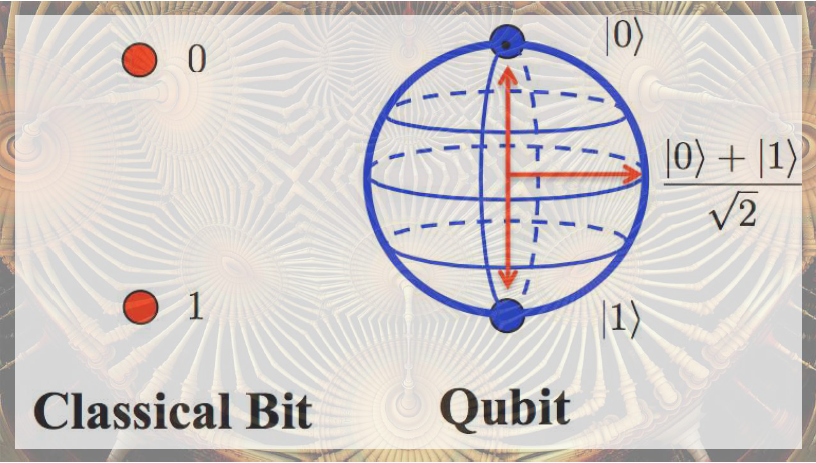
Classical computers use strings of 0’s and 1’s with a single digit a “bit” and strings of bits a “byte”. A bit is either a one or a zero.
Excerpts from the Hutch report now follow. I condensed 44 pages to a hopefully understandable synopsis of the promise and problems of quantum computing.
Quantum Background
Quantum computing does not use bits, but uses qubits which can be one, zero, or both zero and one at the same time. This state or capability of being both is called superposition. Where it gets even more complex is that qubits also exhibit a property called entanglement. Entanglement is an extraordinary behaviour in quantum physics in which particles, like qubits, share the same state simultaneously even when separated by large distance.
In comparison, a classic computer using bits of zero and one can only store one state at a time and can represent 2ⁿ states where n is the number of bits. In the case of two bits, this would be 2² which is four states: 00, 01, 10, 11.
A normal computer would require four operations to examine each state. Two qubits could store the four states at one time. When the number of states are low there is not a major processing difference.
If you extend the computation to 32 bits – used to store a typical integer value in modern computing, 2(raised to)32 = 4,294,967,296. That’s over 4 billion states!
As the number of possible state combinations increases, the difference in processing time between quantum computers using qubits and a classic computer using classic bits, increases exponentially. The following chart depicts this well showing that 20 qubits can represent simultaneously over 1 million permutations of classical bits.

Quantum computing is in its infancy and is probably comparable to where classic computer technology was in the 1960s and 1970s where it took an entire room to house a computer.
The qubits are extremely sensitive to interference and one of the main challenges in constructing quantum computers is creating an environment with no interference and enabling stable qubit states. To achieve stable environments, the majority of quantum computer platforms require vacuum states as well as superconductivity. Superconductivity, in turn, requires cryogenic cooling (e.g. refrigeration to extreme low temperatures).
In addition, each quantum computer must be specifically built to run a specific algorithm. To change or run a different algorithm requires rebuilding the computer. Two of the better known algorithms built to date are Grover’s Algorithm, which uses quantum computing to conduct searches on unstructured databases much more quickly and efficiently than a classic computer; and Shor’s Algorithm which is an algorithm for finding prime factors.
Although the U.S. currently remains at the forefront of quantum information science, their lead is slipping quickly as other nations step up efforts to get there first. China holds the top two positions in the Top 500 list of the world’s fastest computers, and the Chinese understand very well the potential power that quantum computing promises. For this reason, they have allocated extensive funding towards the goal of producing a functional quantum computer before anyone else. On 37 hectares (nearly 4 million square feet) in Hefei, Anhui Province, China is building a $10 billion research center for quantum applications. This news comes on the heels of the world’s first video call made via quantum-encrypted communications and the completion of a quantum-encrypted fibre optic trunk cable.
Factoring Large Numbers Very Rapidly (Shor’s Algorithm)
[Mish Note: current encryption methods involve multiplication of extremely large prime numbers. Bitcoin “mining” rewards the computer that solves such mathematical puzzles first.]
Utilizing a specialized algorithm such as mathematician Peter Shor’s, a quantum computer can compute large integer factoring in polynomial time versus classical computing’s sub-exponential time. Therefore, quantum computers have the ability to solve, in a quick time frame, problems that were previously too difficult to solve in any reasonable time. Typically, these are problems involving extraordinarily large amounts of data or large amounts of possible combinations.
Aviation
Large aircraft companies are working to develop quantum algorithms that will greatly reduce research time in achieving aeronautical efficiencies. For example, the potential to predict the flow of air over a wing–something that would take classical computers more than 7 years of computing time. This would enable the development of robust, efficient aircraft with low noise and CO2 emission to be achieved in a much shorter time period. It currently takes several years for engineers to test the design of an airplane wing and model airflow at different angles and speeds. A good design will reduce operating costs, save fuel, which in turn means less carbon emissions.
Secure Communication Technology
Once quantum computers become readily available, today’s security encryption protocols will be easily broken. Quantum-resistant and improved cyber security techniques are being developed. Therefore, the impact of cyber-attacks on artificial intelligence and major databases and other sensitive systems may be significantly reduced.
Weather Forecasting
The flow of air, water or other liquids are the foundation of many practical applications. The current underlying models are based on Navier-Stokes equations which describe the motion of viscous fluid substances and are extremely challenging problems in computational physics. Quantum computer simulators could potentially provide models for a large number of areas from turbulence and flow in industrial furnaces to the protection of low-lying countries for sea-water flooding.
Medicine and Healthcare
Quantum computing’s ability to model molecular interactions at an atomic level will allow us to gain insight towards developing new medicines and a greater understanding of diseases such as cancer, Alzheimer’s, Huntington’s, and Parkinson’s. In order to find breakthroughs for treatments, it is crucial to understand the structure of proteins and how they fold. Simulating protein folding is extremely expensive in terms of time and cost, which include access to supercomputing facilities. A quantum computer should be able to work out the best possible treatment for a given patent, achieving not only a more precise result but, in theory, much faster as well.
Mish Comments
Quantum computers offer many promises. They also pose security threats.
The first country that succeeds could hack into bank accounts or the pentagon.
How close are we? I have no idea. Nor do I know if they will ever work, but I strongly believe they will.
This I do know: It is a national security threat if China perfects quantum computing first.
I initially wrote, “A quantum computer could also mine nearly every bitcoin,” but a reader disputes that. See the addendum below.
Addendum
Reader ThroughNothing adds these thoughts.
Hey Mish, thanks for your posts, I’ve been a longtime reader and have gained a lot of value and education from your posts. I do want to point out that there is currently no known quantum algorithm that can “break” sha256, which is the algorithm that bitcoin uses for mining. Additionally, if you don’t use a bitcoin address more than once, the private key to your coins remains “quantum resistant”, because your public key (which can be used by a quantum computer to “factor” your large number) is not revealed to the network until you spend coins from an address. Until that point, only a hash of your public key is provided, which, similarly to sha256 hashes mentioned above, cannot be “broken” by known quantum algorithms. I know this may be technical for your audience, but I think those are important details. For my background, I’ve been in computer software and security/cryptography for over 12 years now. Thanks again!
Thanks to reader Jay, an equation was modified as follows: In comparison, a classic computer using bits of zero and one can only store one state at a time and can represent 2ⁿ states where n is the number of bits. In the case of two bits, this would be 2² which is four states: 00, 01, 10, 11.
If you extend the computation to 32 bits – used to store a typical integer value in modern computing, 2(raised to)32 = 4,294,967,296. That’s over 4 billion states!
Mike “Mish” Shedlock






























existing encryption is constantly being rendered useless and replaced. So what?
Heh mish do you think the quantum computer can provide a cure for the common cold? It seems this has never been solved. I am sure its included in the 44 page paper.
Question on bitcoin being ‘hackable’: Sorry if this is dumb but wouldn’t bitcoin be hackable because with just one (the first) quantum computer you would single handedly control the largest CPU pool ? Per the bitcoin white paper “As long as a majority of CPU power is controlled by nodes that are not cooperating to attack the network, they’ll generate the longest chain and outpace attackers.” With one quantum computer that condition would be trivially broken, no?
My email server uses strong passwords and if one wrong login attempt is passed it automatically bans the IP address of the quantum computer that tried to hack into it. The quantum computer is totally at the mercy of all the rest of the non-quantum systems it wishes to attack. If you didn’t ban IP addresses at all then the bottleneck would be the network bandwidth and latency required for the trial and error cracking attempts which would mean that the quantum computer would be no quicker than a decent 8 core home computer.
equation correctly modified as follows: For comparison, a classic computer using bits of zero and one can only store one state at a time and can represent 2ⁿ states where n is the number of bits. In the case of two bits, this would be 2² which is four states: 00, 01, 10, 11.
One great potential of Quantum computer is homogeneous storage. Since a single storage unit can contain 2 values, it opens the possibility of storing bit ID’s along with the data itself. Meaning you could have a liquid or a gas-like substance with no fixed structure containing data. The obstacle to overcome though is fragility of containment. We need qbits that can exist at room temperature in standard atmosphere and such promise is farther off than nuclear fusion.
We have too many liberal arts majors in this country (many of them become left wing journalists & lawyers!) and not enough STEM majors. This is why we can’t fill jobs and need H1-B’s from China and India to fill jobs in Silicon Valley. China is on top of this and graduates many, many times more engineers then the USA and they have a focus on math and science deep ingrained into their culture now. Having a work force that figures out stuff like Quantum computing first is going to so key going forward. We really need a massive focus very early on math and science in the US. The lack of this has always worried me.
Meanwhile, back at quantum computing: I’m concerned that there may be a lot less there than is being hoped for. The qubit is a neat, (and extremely expensive) storage trick, but it looks suspiciously like just that…storage, very fast storage. And even if the storage access time and it’s route through ALU could be magically driven to zero, the vast majority of the compute cycle time lies elsewhere. Also, don’t dazzle me with long vectors. If I’m a biochemist bench tech tracking a cancer beast and want to know every net biological leaf and twig movement within a ten foot radius, it won’t help to give me north America.
AWC: “Best way I can think of with a chart like that, to keep my head above water in a lake with an average depth of, say 4 feet, is, to strive to stay in the higher percentiles of the blue line, contribute what I can to the green one, and hope someday to find myself up there in the red line.
The glass is not half full, or half empty. It is simply a half glass of water.”
The vast majority of Americans used to believe in crap like the above – until the financial collapse of 2008 (e.g. Joe the Plumber). Not anymore. Now tens of millions of them know that it is unadulterated BS.
I do what the Federal reserve does for security on their computers that make transfers. Unplug your network from the internet at the end of each day. The best security will be to disconnect from the network.
MAYBE, I don’t know enough but quantum encryption and quantum computing are different beasts so to speak even if they both rely on quanta . . . for the quantum encryption I don’t see how you split and distribute the initially quantum entangled ‘somethings’ (can be electrons, can be photons can be . . . ) even if both sides have a quantum computer available.
1) Googling “63% americans $1000 emergency” generates over 3000 results, from sources ranging from ABC to CNBC to Forbes to Zerohedge and in between.
2) https://www.motherjones.com/wp-content/uploads/Screen-Shot-2013-03-08-at-11.36.19-AM.png shows how productivity has shot up over the decades while incomes have barely budged up (the median figures will be worse than that) while the incomes of the top 1% have increased at a faster pace than even productivity.
3) If you still think this is not a problem, then you are either foolish or in cahoots with the elite.
I described what you are doing and saying. If the shoe fits, wear it!
You have made no convincing arguments. You might not live in Manhattan or Si Valley or the elite areas, but you have the same mindset. Americans’ incomes haven’t risen for decades now, even though their productivity has grown by leaps and bounds. It is not that they lack in money management, it is that they primarily lack in money. Whatever you are doing in some unnamed country has ZERO relevance to what is happening in the US. Try to find out that first, and if you still don’t change your mind, at least your views will no longer be because of ignorance.
Now, why would we apply quantum computing to cracking passwords is beyond me. Passwords are stored as large one-way hashes, and if you can get to them, you do not need passwords anymore. By the time QC develops, there will be fingerprint hashes stored rather than passwords.
This is true but keep in mind that regardless of how fast a quantum computer can process, it can only brute force attack as fast as the network will allow it to which is significantly slower than a desktop brute force a password if it were directly attached to the server.
You don’t have to prove your ignorance repeatedly. I am already convinced 😊
There’s good news and good news when it comes to Quantum computing: The world, especially Bioinformatics, desperately needs the computational speed. The other good news is that whatever the quantum speed, it can also be used in defense against hackers. What we can’t afford is falling behind a generation.
AWC: Here – https://www.prnewswire.com/news-releases/63-of-americans-cant-afford-500-car-repair-or-1000-emergency-room-visit-300200097.html
Your positing is a cop-out. Dispute the numbers with facts. Or shut up!
AWC: “Well said. To put it in a Darwinian perspective, evolve or perish. There is a great little book I read some decades ago called “Who Moved my Cheese” that brings it down to my level.”
So you have thrown the gauntlet. Someone will pick it up. Remember that the election of Trump is the beginning, not the end. Neoliberalism has failed everywhere in the world.
“During that time period, the standard of living has “increased” and the number of jobs has “increased”, contrary to your opinion. I’m sorry to tell you, but the person “without a clue”, is you.”
Is that why 63% of Americans cannot afford even a $1000 emergency without going (further) into debt? As to the number of jobs… is the “increased” living standards the reason why people keep juggling 2-3 part time jobs each at a time? Is the “increased” standard of living the reason why there is an opioid epidemic sweeping middle America? Is that the reason why Trump won the elections on the slogan of making America great again?
You probably live inside the Manhattan bubble or the Silicon Valley bubble or someplace like that. YOU are the one without the first damn clue!!
One quick point. Quantum computers also lead to quantum encryption, which has the added benefit of being far more secure (you can tell when someone else is listening or trying to intercept secure messages, assuming you are able to maintain the system quantumness).
In theory, in a PERFECT market there is consensus of opinion on the value of the assets, thus no way to make money . . . As long as there is NO consensus over which algorithm values assets perfectly there will be people telling other people which is the best algorithm to use and there will be buying and selling of those assets based on those algorithms . . .
EDIT: the fact that the bitcoin algorithm is ‘quantum resistant’ indicates that at least internet traffic encryption CAN be too . . . at least for a limited amount of transactions . . . so in that case we would be back to ‘breaking’ passwords.
Again Apologies for the rant . . .
Sigh . . . . sorry . . .
Apologies for the rant . . .
2 points: 1. the reason passwords will be useless may not be because they can now be ‘discovered’ by brute force but because quantum computing would make it feasible to ‘break’ the underlaying encryption algorithm (it can solve the 2 prime number problem for very large primes in a reasonable amount of time as mentioned by Mish) and thus render any encryption algorithm based on this problem (pretty much any public / private key encryption, which is the basis for pretty much any encryption employed on the internet today as I understand it) transparent . . . i.e. decodable (in a reasonable timeframe – it can be done now in theory, it just takes longer than the age of the universe or some other ridiculous number) as I understand it. 2. the wonders of quantum computing are overstated for meteorological & medical (as well as other) ‘problems’ for 2 reasons, a] you still need algorithms to ‘solve’ with the ‘problem’ so unless we can write ‘better’ algorithms we’ll get the same answers as we get today just faster and b] garbage in = garbage out still applies . . . i.e. with a limited data set to work with (pretty much all ‘hard’ problems today) the quality of the answers is constrained BY that dataset even if the quality of the dataset is infinite. And then there is the cost of acquiring the dataset in the first place . . . . and the cost (in the case of medicine) of building that ‘perfect’ drug . . .
I also wonder if any entity that gets there first can control the stock market by having the computational power to maybe somewhat effectively model all the many factors that influence market behavior. Is that just a pipe dream, because of un-modelable emotional behavior and black swan events, or just accurate enough that it could pose a similar threat to world well-being as much as the encryption threat?
I am an idiot in all this, but I wonder if quantum competing can be used to “fight fire with fire” in countering the threat of encryption security it will pose. I am thinkign about actress Hedy Lamar’s old patent for encrypting torpedo guidance and communication by instantaneously changing its encryption arrangement faster than the interloper can debug and break it. If it could constantly “move the bar” it might stay one step ahead of an attacking computer.
“The only rational approach is to embrace technological advancement and harness as many positives as possible while at the same time attempting to reduce the negatives.”
Who is proposing any solution to the widespread unemployment and falling standards of living that will result? What are those solutions? Are they solutions at the societal level? Or do the “solutions” involve more technology (surveillance, weaponry, hi-tech prisons etc.)? Do you have a clue? Does Mish have a clue? Apparently not, in both cases.
Hacking password algorithms do not use the same log in process like a normal user, so the number of attempts or time between attempts do not apply. Brute password hacking bypasses the front end user logon that you and I see when we access a system. In simple terms, brute hacking goes directly at the password file.
I think that most secure networks limit password guesses or require a ‘time out’ between guesses. 10 second time out may be small for a human trying to remember a password, but it limits an attacker to only 6 guesses per minute. That’s huge to an attacker.
I understand the excitement of possibilities but I tend to worry about what we’re not seeing in all the excitement. We’ve moved large portions of populations, ones that don’t necessarily mesh in to the culture of the West and we’re creating technologies that will eliminate jobs in the millions. And it will all be Kumbaya.
But will it butter my toast?
So Mish goes from one thing he doesn’t understand (that the consequences of his suoport for cutting taxes and gutting regulations has been papered over by the relentless expansion of credit that he claims to not support) to another.
Quantum computing will also give us 100% unbreakable encryption, so this will actually be a good thing in terms of sending information over the internet- https://www.techrepublic.com/article/how-quantum-computing-could-create-unbreakable-encryption-and-save-the-future-of-cybersecurity/
i think it’s safe to say https hasn’t been secure for quite awhile.
So, is basically saying https will no longer be secure? Should be good for brick and mortar stores and cash in general.
https://en.m.wikipedia.org/wiki/Post-quantum_cryptography There are quantum resistant algorithms, but they will still need to be seeded with strong passwords (the two aren’t the same problem). You can run dictionary words and variants and lists of the X thousand most common passwords to see what key they generate for a brute force attack – but if you have a random password that won’t work. Where you are correct is that we will have to update the algorithms, but we’ve already had to do that several times – RC4 was broken, and the key lengths needed to be doubled, no more 512 bit RSA keys. It will be a shift to new algorithms IF or when a current algorithm is broken by quantum computing, but it isn’t so simple as building a chip with enough qbits. The quantum “program” will need to be written, and that hasn’t happened yet for all algorithms.
The title and opening are basically incorrect.
Who cares if Bitcoin’s sha256 can be broken, it is already out of date – only useful for money laundering at this point. With progress comes quantum computing and better cryptocurrencies.
Just 50 years away.
Thanks – I posted your comments as an addendum
What about the impact of Fusion? It would shift the world out of its funk. It’s coming.
Hey Mish, thanks for your posts, I’ve been a longtime reader and have gained a lot of value and education from your posts. I do want to point out that there is currently no known quantum algorithm that can “break” sha256, which is the algorithm that bitcoin uses for mining. Additionally, if you don’t use a bitcoin address more than once, the private key to your coins remains “quantum resistant”, because your public key (which can be used by a quantum computer to “factor” your large number) is not revealed to the network until you spend coins from an address. Until that point, only a hash of your public key is provided, which, similarly to sha256 hashes mentioned above, cannot be “broken” by known quantum algorithms. I know this may be technical for your audience, but I think those are important details. For my background, I’ve been in computer software and security/cryptography for over 12 years now. Thanks again!
Probably nothing to worry about because everyone will be BUILDING their secret passwords using quantum computers. There will only be a relatively short window of time when the well-funded will have quantum technology and everyone else won’t.
After reading this post I honestly don’t know if I should be worried, depressed, or just hope that the USA can develop this new technology first.
Not much to worry about from common everyday crooks – too expensive. Governments will be the ones to misuse them.
It’s an area where Gov support, like the space race, can help. The private sector is badgering away to be first but there could be wasteful duplication of effort. Gov encouraging collaboration can help to get a best of breed outcome. D-wave, IBM + others.