

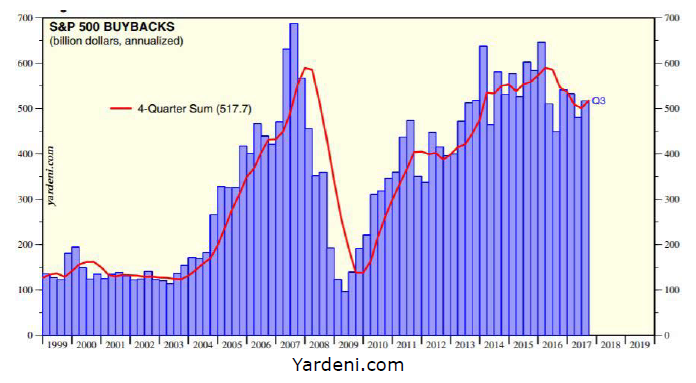
Rick Mills at Ahead of the Herd emailed a guest post Blue chip companies on track for $800 billion buyback record in 2018.
Donald Trump’s tax cuts are already paying dividends… well, actually the companies that are benefiting from the Tax Cuts and Jobs Act passed by the Trump Administration in December are not only returning cash to shareholders in the form of dividends, but are presiding over what could be the largest share buyback program in history.
The legislation slashed the corporate tax rate from 35% to 21% and the top individual tax rate shrunk to 37%. It also cut income tax rates, doubled the standard deduction and eliminated personal exemptions. All told, the Trump tax cuts are the eighth largest since 1918, and represent just over 1% of GDP – in other words, how much federal revenue the government will forego as a percentage of the economy.
Suddenly US companies have found themselves flush with cash, and they need to find a way to spend it. The options are typically to plough funds back into the company via capital expenditures like new buildings, products or equipment. Or, distribute the money back to shareholders in the form of dividends, or through share buybacks which don’t obviously go directly to shareholders, but reduce the number of outstanding shares, thereby making the share float less diluted.
S&P 500 firms are reportedly on track to give $1 trillion in either dividends or share buybacks to shareholders this year, based on the lower corporate tax rate, incentives to repatriate overseas cash and strong earnings. Goldman Sachs estimates share buybacks will jump to $650 billion while JP Morgan predicts they could run as high as $800 billion. Either estimate would far exceed the $530 billion in share buybacks recorded in 2017.

Goldman also sees dividends expanding to $515 billion. According to the Financial Times, companies have announced a record $187 billion in share buybacks so far this year; Trim Tabs Research reported $113.4 billion in February alone, a three-year high.
New Tool in the C-Suite Shed
Share buybacks are a relatively new phenomenon. For most of the 20th century they were illegal because they were considered to be a form of stock market manipulation. But that all changed in 1982 when the SEC legalized them. Since then buybacks have been a popular tool for management to stuff cash back into the company, indirectly, by reducing the share float. Purchasing company stock generally inflates the share price and boosts earnings per share – a key metric on which CEO bonuses are calculated.
After the SEC changed the rules to allow buybacks, hundreds of companies starting using them, especially when it was shown in a 1985 Fortune article that shareholders in buyback companies earned better returns than the S&P 500 index – 22.6% versus 14.1% Bloomberg points out in a primer on buybacks and dividends. In 1997 buybacks surpassed dividends as the main way companies redistribute funds to investors.
The Good and the Bad
The question is, are share buybacks good or bad for shareholders? The answer is, in your authors opinion cut and dried, the one positive does not outweigh the many negatives.
On the positive side of the ledger, reducing a company’s outstanding shares makes each dollar of earnings more valuable on a per share basis, which is good for investors.
Another thought to be plus for shareholders: corporate executives seemingly know how much their company is worth so if they are buying back shares, it’s a signal that the stock is undervalued – otherwise, why would they buy high?
Bloomberg states that buybacks can contribute to bull markets, noting that in some years, shares bought in buybacks outnumbered shares purchased by mutual funds by 6 to 1.
Really though, the most insightful thing to say about share buybacks is that they’re good for management, not necessarily shareholders. Buybacks make it easier for executives to hit targets by reducing the number of shares.
Management receives compensation – usually in the form of stock options – that is tied to the company’s stock price. The higher the stock price the more they make cashing out their options.
When a stock buyback occurs the short term implications on the stock price are positive. If a company’s stock is suffering from low financial ratios ie earnings per share (EPS) and price earnings ratio (PE), buying back stock can give the company a temporary boost because the ratios are based on the number of outstanding shares. Earnings don’t change but the EPS looks better because the firm has reduced the number of shares outstanding, so management meets goals for profit growth and earn bigger bonuses.
There are plenty of negatives to share buybacks, with the most obvious being that buying back shares means that executives are foregoing the opportunity to put that extra cash back into the business instead, which could potentially grow the company long term. Recent studies have linked increased spending on buybacks to decreased corporate investment – such as expansion plans, more hiring or raises. Buybacks have been used as a punching bag for Democrats in particular who argue that buybacks enrich companies and wealthy shareholders at the expense of workers.
Researchers Robert Ayres and Michael Olenick describe the stock buyback boom in the U.S. economy as “Corporate suicide.”

“We find that excessive buybacks in the past decades are a significant cause of secular stagnation, inasmuch as they effectively reduce corporate R&D while contributing, instead, to an asset bubble that creates no value.”
Timing the buyback is important. Companies have been criticized for buying shares too high, actually leaving shareholders worse off. Investors will also fail to benefit after a stock buyback program has been undertaken if companies do not reduce their share count because they have issued new stock to replace employee stock options.
Stock buybacks are almost always initiated in good times – when stock prices are high. Stock buybacks do not happen in bad times when stock prices are low. Purchasing stock at inflated prices, paying a dollar for 50 cents worth of stock, is not an effective use of cash; some companies borrow money to pay for their stock buyback programs.
According to Bloomberg, the all-time high in buyback activity was in the lead-up to the financial crisis of 2008, certainly the worst time in recent memory to be buying stocks.
Dividends are your Friend
By now we can see the pros and cons of buybacks (mostly cons, unless you’re in management), but what about dividends? Here too there are negatives and positives, but on the whole, dividends offer much better value for shareholders, in my opinion.
On the downside, dividends may work against the stock price of a company by reducing the book value of the stock. Also, managers do not immediately benefit from dividends as their options do not qualify for dividend payments.
On the Plus Side
- Dividends are the only returns on investment that shareholders achieve during bear markets.
- Dividends are valuable indicators of whether or not a stock is undervalued or overvalued and dividends put a floor under a stock.
- Dividends are flexible. They give investors options by allowing them to time, and direct, income flow to where they think the best investment opportunities are at any given moment.
- Dividends are a predictable and reliable source of income in retirement.
- Research has found that paying dividends increases earnings growth.
- Companies that regularly pay dividends have imposed fiscal discipline on their managers. There’s no empire building, instead focus must be on improving the bottom line without sacrificing return on equity.
- Stock buyback programs can be cancelled and most investors would not notice, while dividend payments are highly visible to shareholders and cutting or eliminating a payment creates warning signals something is amiss.
Conclusion
Knowing what we now know, in regards to current stock buyback programs, is it any wonder that managers prefer stock buybacks as opposed to special one-time dividends, starting or increasing existing dividends?
Each company’s share buyback program will have to be individually judged by their shareholders as to its worth – but perhaps existing shareholders and potential investors had better take a hard look at just what is happening.
Remember to check option grants and insider selling while doing your due diligence and making your mind up regarding stock buybacks versus dividends or reinvestment. The bottom line is that share buybacks usually do nothing to create long term shareholder value and are never a match for a steady, and sustainable, dividend.
There are many studies, easily accessible online, that have shown that the companies with the most consistent, and quickly rising dividends have greatly outperformed the overall market.
For those in search of appreciating retirement income streams, or income in bear markets and times of uncertainty, dividend-paying stocks – companies returning “excess” cash to shareholders in the most beneficial manner – should be on every investor’s radar screen.
Richard (Rick) Mills
You can follow Rick Mills at aheadoftheherd.com, on Twitter at @AOTH_RMills.
Mish Comments
Buybacks soar at every peak. Companies hoard cash at every bottom.
If companies did the opposite they would be acting in shareholder’s interest.
Instead, most copmpanies act to preserve the value of their stock options and bonuses.
Worse yet are companies going into debt to buy back shares.
Except for a dozen genuine cash cows, most of the alleged “cash” on corporate balance sheets is really debt.
Along similar lines is the way GE ran itself into the ground by manipulating earnings. For discussion, please see Amazon vs. GE: Where’s the Value? Paranoia, Walmart, the Cloud, Drugs.
Reader Sechel comments “Companies are using the tax cut to raise dividends and issue stock buybacks, not make capital investments. Where is my look of surprise?“
Yes, precisely. The same thing has happened after every repatriation holiday.
Mike “Mish” Shedlock






























Realist, I agree that for routine payments, dividends are the more reasonable way to go, precisely because they create a predictable stream of income, which is of value to shareholders. When a company simply wants to transfer a large amount of cash to shareholders as a one-time event, buybacks make far more sense than issuing say, a one-time $3/share dividend because, for most shareholders, they will owe less taxes.
As a practical matter, companies tend to have money they want to issue to shareholders when times are good, which will also tend to be times when stock prices are high. Thus, buybacks would obviously be more apt to occur “at precisely the wrong time”, but as I pointed out, that is irrelevant, so long as you sell the number of shares to stay with the same interest. Note that if you sell shares so as to stay with the same proportional share of the company, the reverse is true for you, you will be selling at “precisely the right time”.
You do raise a valid point that for the smaller investor, fees for selling small lots of stock would likely be larger than their tax savings for getting capital gains instead of regular income. Thus, for small investors, dividends would be preferred. Corporate holders, I believe, can exclude dividend income, but not capital gains, so they would also prefer dividends. While dividends and buybacks are mathematically identical ways for corporations to transfer money to shareholders, the tax consequences are not identical.
As far as whether the tax cut will lead to an investment boom, Mish has a separate post about that, so I’ll leave that discussion to be had on the other thread. I would agree with you that any company transferring their tax savings to shareholders, whether by a dividend, or by share buybacks, is not planning major increases in investment.
and I wonder why shareholders allow such high levels of bonuses and options allotments. The greed of the executives over rules commen sense nurturing of the company with a longer term view. Is it because most shareholders are etf’s now? The engaged, activist investor is a thing of the past?
Yes, the short term metrics and related executive compensation rule operation of things, r
I would add that it doesn’t matter how ridiculous the price is (in either direction) – so long as a shareholder sells a portion of the shares equivalent to the buyback, it remains mathematically exactly the same as a dividend in cash, and if they don’t, it remains exactly the same as receiving a dividend with reinvestment. As a shareholder, the only question in deciding whether you prefer an outright dividend or a share buyback is the tax consequences. These were illegal for a long time, not because they were bad, but because they were considered to be a tax loophole. They turned a regular dividend into a capital gain (if you sold some shares), or into a non-taxable event (if you held all your shares, essentially re-investing your dividend).
There are some unusual fact situations where they are different, legally, if not mathematically. For example, if you are the income beneficiary of a trust, selling a proportion of your shares would increase the principal, whereas a dividend would count as income.
Realist, I’m curious. How can you be for dividends, and against buybacks, since they are the same thing, except for the tax consequences? If a shareholder sells a proportion of their shares equivalent to the number of shares re-purchased, they have cash in their hands, and the same proportional interest in the company, exactly the same as if they had received a dividend. If they elect not to sell shares, they have no cash, and a higher proportional share of the company, exactly the same as if they had received a dividend, and automatically re-invested it. Mathematically there is no difference at all.
Continuing, at the end of the first post should come: and shareholders have the option of opting out of receiving cash, and can instead opt to own a larger portion of the company, and owe no taxes whatsoever.
This was supposed to precede the above: If a company buys back 1% of their shares, and each shareholder sells 1% of their shares, each shareholder has cash, and owns the same percentage of the company as before. Therefore,
Mathematically, buybacks are simply an alternative form of giving money to the shareholders, except that the shareholder is taxed at capital gains rates instead of at ordinary income rate, and shareholders can opt
R&D is a hard sell in most boardrooms and C suites and the long term damage done often doesn’t become apparent for many years. Witness the current sad state of GE. I railed at their slick financial reporting for years, hitting targets via plugs from reserve accounts, etc., often to the penny, while competitiveness eroded. Buybacks would stop overnight if the SEC issued a FASB bulletin disallowing any executive compensation scheme based on change in shares outstanding. Disgusting.
Please let the market tank while Trump is in office as I expect he will have little sympathy for the banks.
Share buybacks are far more tax efficient for investors than dividends, which are double taxed. I don’t believe corporations should be able to deduct interest on loans at the same time they are buying back shares. They are deducting interest from their taxes while the share price increases tax deferred and the the shareholder get preferential, long term capital gains treatment when they sell. The tax laws incentivize fictionalization over capital investment.
Which companies are the genuine cash cows? Does any such company even exist?
I meant to point that out too. Will add. Thanks